engine overheat NISSAN VERSA NOTE 2020 Owner´s Manual
[x] Cancel search | Manufacturer: NISSAN, Model Year: 2020, Model line: VERSA NOTE, Model: NISSAN VERSA NOTE 2020Pages: 492, PDF Size: 6.12 MB
Page 466 of 492
Octane rating tips
Using unleaded gasoline with an octane
rating lower than recommended can
cause persistent, heavy “spark knock.”
(“Spark knock” is a metallic rapping
noise.) If severe, this can lead to engine
damage. If you detect a persistent heavy
spark knock even when using gasoline
of the stated octane rating, or if you hear
steady spark knock while holding a
steady speed on level roads, it is recom-
mended that you have a NISSAN dealer
correct the condition. Failure to correct
the condition is misuse of the vehicle, for
which NISSAN is not responsible.
Incorrect ignition timing may result in
spark knock, af ter-run and/or overheating,
which may cause excessive fuel consump-
tion or engine damage. If any of the above
symptoms are encountered, have your ve-
hicle checked. It is recommended that you
visit a NISSAN dealer for servicing.
However, now and then you may notice
light spark knock for a short time while
accelerating or driving up hills. This is not
a cause for concern, because you get the
greatest fuel benefit when there is light
spark knock for a short time under heavy
engine load.
ENGINE OIL AND OIL FILTER
RECOMMENDATIONS
Selecting the correct oil
It is essential to choose the correct grade,
quality and viscosity engine oil to ensure
satisfactory engine life and performance.
For additional information, refer to “Recom-
mended fluids/lubricants and capacities”
in this section. NISSAN recommends the
use of an energy conserving oil in order to
improve fuel economy.
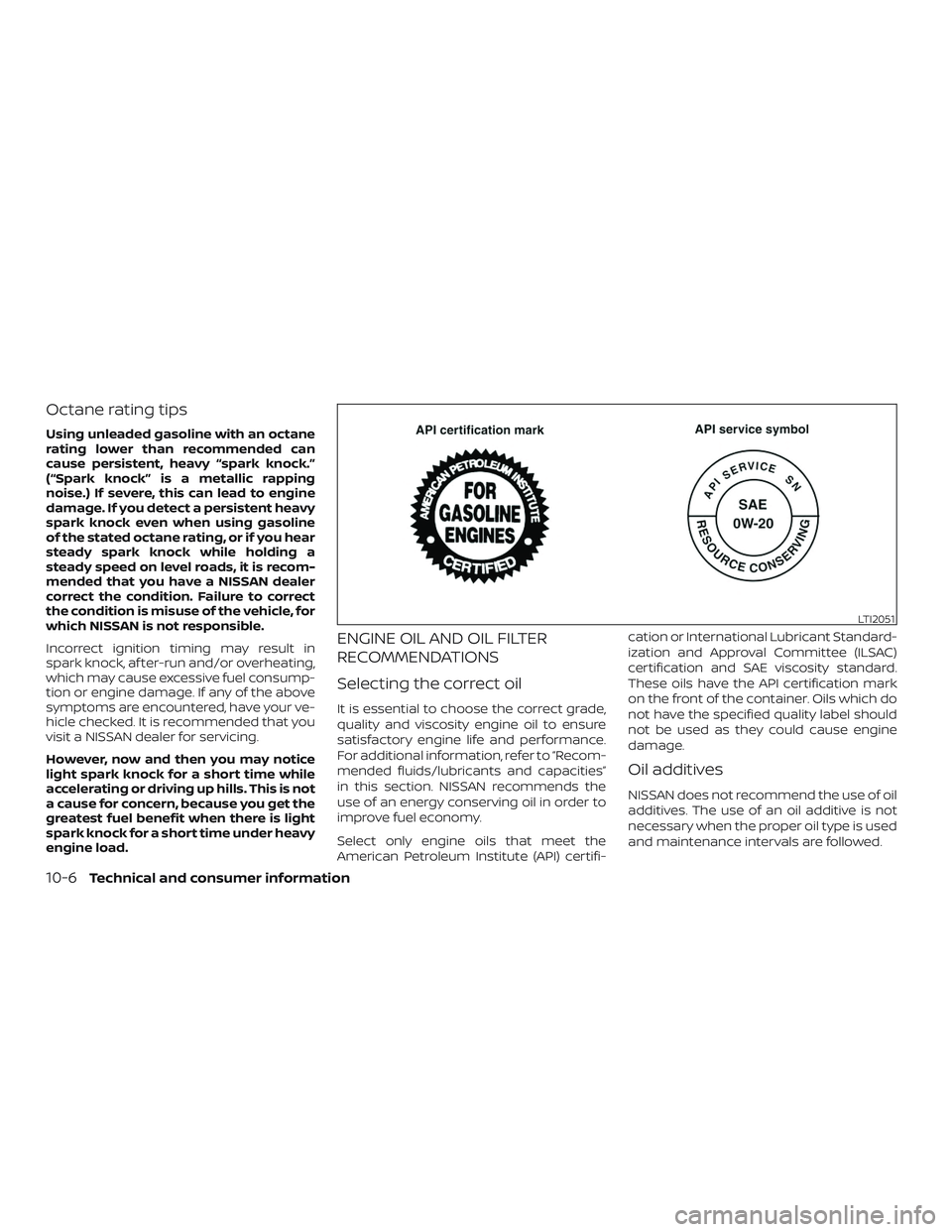
Select only engine oils that meet the
American Petroleum Institute (API) certifi-cation or International Lubricant Standard-
ization and Approval Committee (ILSAC)
certification and SAE viscosity standard.
These oils have the API certification mark
on the front of the container. Oils which do
not have the specified quality label should
not be used as they could cause engine
damage.
Oil additives
NISSAN does not recommend the use of oil
additives. The use of an oil additive is not
necessary when the proper oil type is used
and maintenance intervals are followed.
LTI2051
10-6Technical and consumer information
Page 485 of 492
NISSAN Intelligent Key® battery discharge
indicator.....................5-15
NISSAN Vehicle Immobilizer
System...............2-39,5-12,5-16O
Octane rating (See fuel octane rating) . .10-6
Odometer ....................2-6
Oil Capacities and recommended
fuel/lubricants...............10-2
Changing engine oil ............8-6
Changing engine oil filter .........8-6
Checking engine oil level .........8-6
Engine oil ...................8-6
Engine oil and oil filter
recommendation .............10-6
Engine oil viscosity .............10-7
Outsidemirrors.................3-31
Overheat Ifyourvehicleoverheats.........6-11
Owner's manual order form ........10-20
Owner's manual/service manual order
information..................10-20
P
Parking Parking brake operation .........5-25
Parking/parkingonhills.........5 -114
Parkingbrake .................5-25
Personal lights .................2-63
Phone, Bluetooth® hands-free system . .4-53 Power
Power door locks ..............3-6
Poweroutlet................2-55
Powerrearwindows ...........2-61
Power steering system .........5-115
Powerwindows..............2-59
Rearpowerwindows...........2-61
Poweroutlet..................2-55
Powersteering................5 -115
Precautions Maintenance precautions .........8-2
Precautions on booster
seats............1-21, 1-28, 1-34, 1-39
Precautions on child
restraints.........1-21, 1-28, 1-34, 1-39
Precautions on seat belt usage .....1-10
Precautions on supplemental restraint
system ....................1-43
Precautions when starting and
driving.....................5-4
Programmable features ............4-6
Push starting ..................6-11
R
Radio Car phone or CB radio ..........4-53
FM/AMradio................4-34
Steering wheel audio control
switch....................4-48
Readiness for inspection maintenance
(I/M) test ....................10-19
Rear Automatic Braking (RAB) .......5-78
RearCrossTrafficAlert(RCTA) .......5-43
Rear Door Alert ..........2-38,2-39,2-54 Rearpowerwindows.............2-61
Rearseat.....................1-4
Rear sonar system OFF switch
.......2-53
Rear Sonar System (RSS) ..........5-121
Rearviewmirror................3-30
RearViewMonitor................4-9
Rear window and outside mirror
defrosterswitch.............2-42,4-27
Rearwindowdefrosterswitch....2-42,4-19
Recommended Fluids ............10-2
Recorders EventData.................10-20
Refrigerant recommendation ........10-7
Registering a vehicle in another
country .....................10-10
Remote Engine Start ..........3-20,5-18
Reporting safety defects (US only) . . . .10-18
S
Safety Child safety rear door lock ........3-7
Childseatbelts......1-21, 1-28, 1-34, 1-39
Reporting safety defects (US only) . .10-18
Seat adjustment Front manual seat adjustment ......1-3
R e
ar seat adjustment ...........1-4
Seatback pockets ...............2-57
Seat belt Childsafety.................1-19
Infants and small children ........1-20
InjuredPerson............... .1-14
Largerchildren.............. .1-20
Precautionsonseatbeltusage.....1-10
Pregnant women ..............1-14
11-5