tow NISSAN VERSA NOTE 2020 Owner´s Manual
[x] Cancel search | Manufacturer: NISSAN, Model Year: 2020, Model line: VERSA NOTE, Model: NISSAN VERSA NOTE 2020Pages: 492, PDF Size: 6.12 MB
Page 461 of 492
10 Technical and consumer information
Recommended fluids/lubricants and
capacities...................................... 10-2
Fuel recommendation ....................... 10-4
Engine oil and oil filter
recommendations .......................... 10-6
Air conditioner system refrigerant and
oil recommendations ....................... 10-7
Specifications .................................. 10-8
Engine ...................................... 10-8
Wheels and tires ............................. 10-9
Dimensions and weights ....................10-9
When traveling or registering in another
country ........................................ 10-10
Vehicle identification .......................... 10-10
Vehicle Identification Number (VIN)
plate ....................................... 10-10
Vehicle identification number
(chassis number) ........................... 10-10
Engine serial number ........................ 10-11
F.M.V.S.S./C.M.V.S.S. certification label .........10-11 Emission control information label
..........10-11
Tire and Loading Information label .........10-12
Air conditioner specification label ...........10-12
Installing front license plate ....................10-12
Vehicle loading information ...................10-13
Terms ...................................... 10-13
Vehicle load capacity ....................... 10-14
Loading tips ................................ 10-15
Measurement of weights ...................10-16
Towing a trailer ................................ 10-16
Flat towing ................................. 10-16
Uniform tire quality grading ....................10-17
Emission control system warranty .............10-18
Reporting safety defects ......................10-18
Readiness for Inspection/Maintenance (I/M)
test ............................................ 10-19
Event Data Recorders (EDR) ....................10-20
Owner’s Manual/Service Manual order
information ................................... 10-20
Page 464 of 492
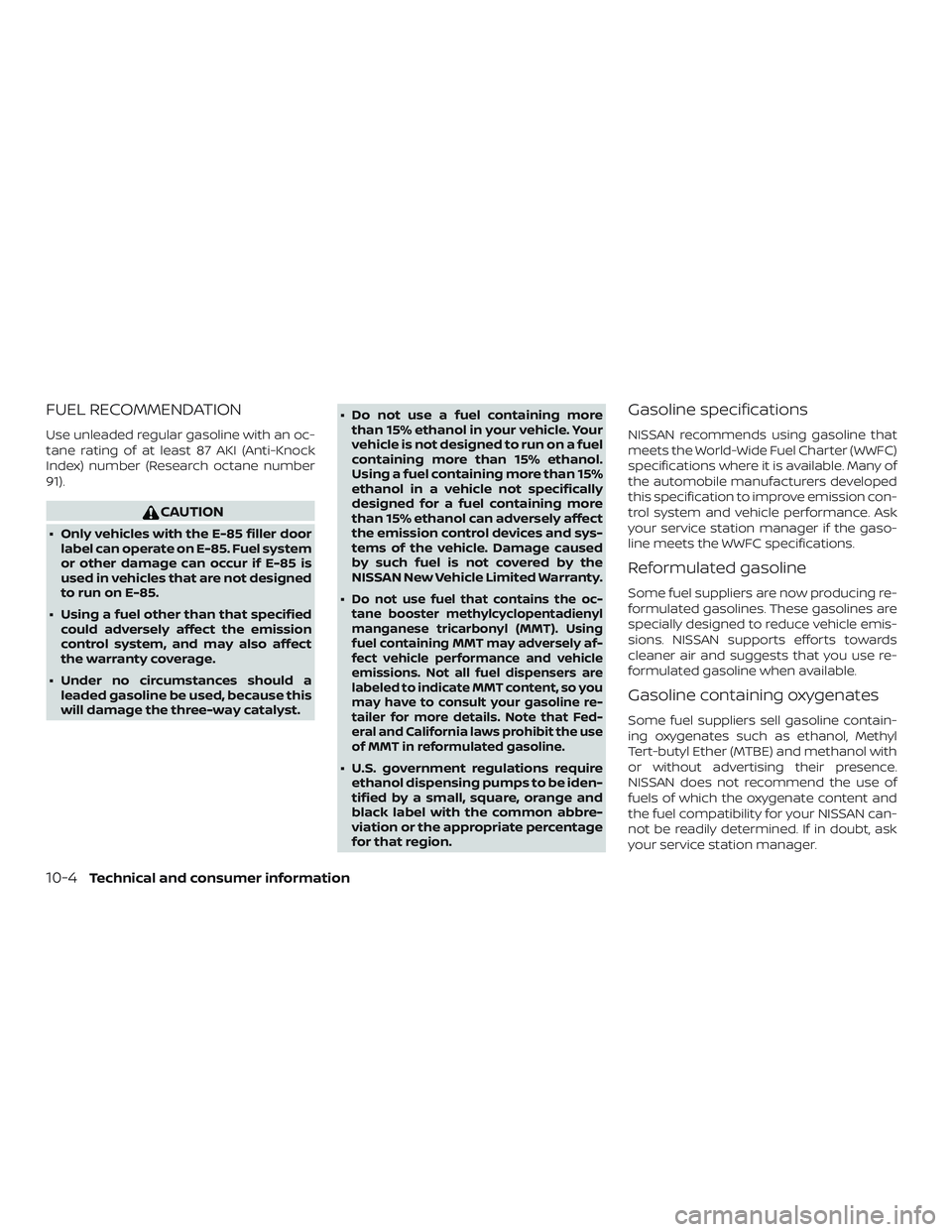
FUEL RECOMMENDATION
Use unleaded regular gasoline with an oc-
tane rating of at least 87 AKI (Anti-Knock
Index) number (Research octane number
91).
CAUTION
∙ Only vehicles with the E-85 filler doorlabel can operate on E-85. Fuel system
or other damage can occur if E-85 is
used in vehicles that are not designed
to run on E-85.
∙ Using a fuel other than that specified could adversely affect the emission
control system, and may also affect
the warranty coverage.
∙ Under no circumstances should a leaded gasoline be used, because this
will damage the three-way catalyst. ∙ Do not use a fuel containing more
than 15% ethanol in your vehicle. Your
vehicle is not designed to run on a fuel
containing more than 15% ethanol.
Using a fuel containing more than 15%
ethanol in a vehicle not specifically
designed for a fuel containing more
than 15% ethanol can adversely affect
the emission control devices and sys-
tems of the vehicle. Damage caused
by such fuel is not covered by the
NISSAN New Vehicle Limited Warranty.
∙
Do not use fuel that contains the oc-
tane booster methylcyclopentadienyl
manganese tricarbonyl (MMT). Using
fuel containing MMT may adversely af-
fect vehicle performance and vehicle
emissions. Not all fuel dispensers are
labeled to indicate MMT content, so you
may have to consult your gasoline re-
tailer for more details. Note that Fed-
eral and California laws prohibit the use
of MMT in reformulated gasoline.
∙ U.S. government regulations require ethanol dispensing pumps to be iden-
tified by a small, square, orange and
black label with the common abbre-
viation or the appropriate percentage
for that region.
Gasoline specifications
NISSAN recommends using gasoline that
meets the World-Wide Fuel Charter (WWFC)
specifications where it is available. Many of
the automobile manufacturers developed
this specification to improve emission con-
trol system and vehicle performance. Ask
your service station manager if the gaso-
line meets the WWFC specifications.
Reformulated gasoline
Some fuel suppliers are now producing re-
formulated gasolines. These gasolines are
specially designed to reduce vehicle emis-
sions. NISSAN supports efforts towards
cleaner air and suggests that you use re-
formulated gasoline when available.
Gasoline containing oxygenates
Some fuel suppliers sell gasoline contain-
ing oxygenates such as ethanol, Methyl
Tert-butyl Ether (MTBE) and methanol with
or without advertising their presence.
NISSAN does not recommend the use of
fuels of which the oxygenate content and
the fuel compatibility for your NISSAN can-
not be readily determined. If in doubt, ask
your service station manager.
10-4Technical and consumer information
Page 473 of 492
WARNING
∙ It is extremely dangerous to ride in a cargo area inside a ve-
hicle. In a collision, people riding
in these areas are more likely to
be seriously injured or killed.
∙ Do not allow people to ride in any area of your vehicle that is
not equipped with seats and
seat belts.
∙ Be sure everyone in your vehicle is in a seat and using a seat belt
properly.
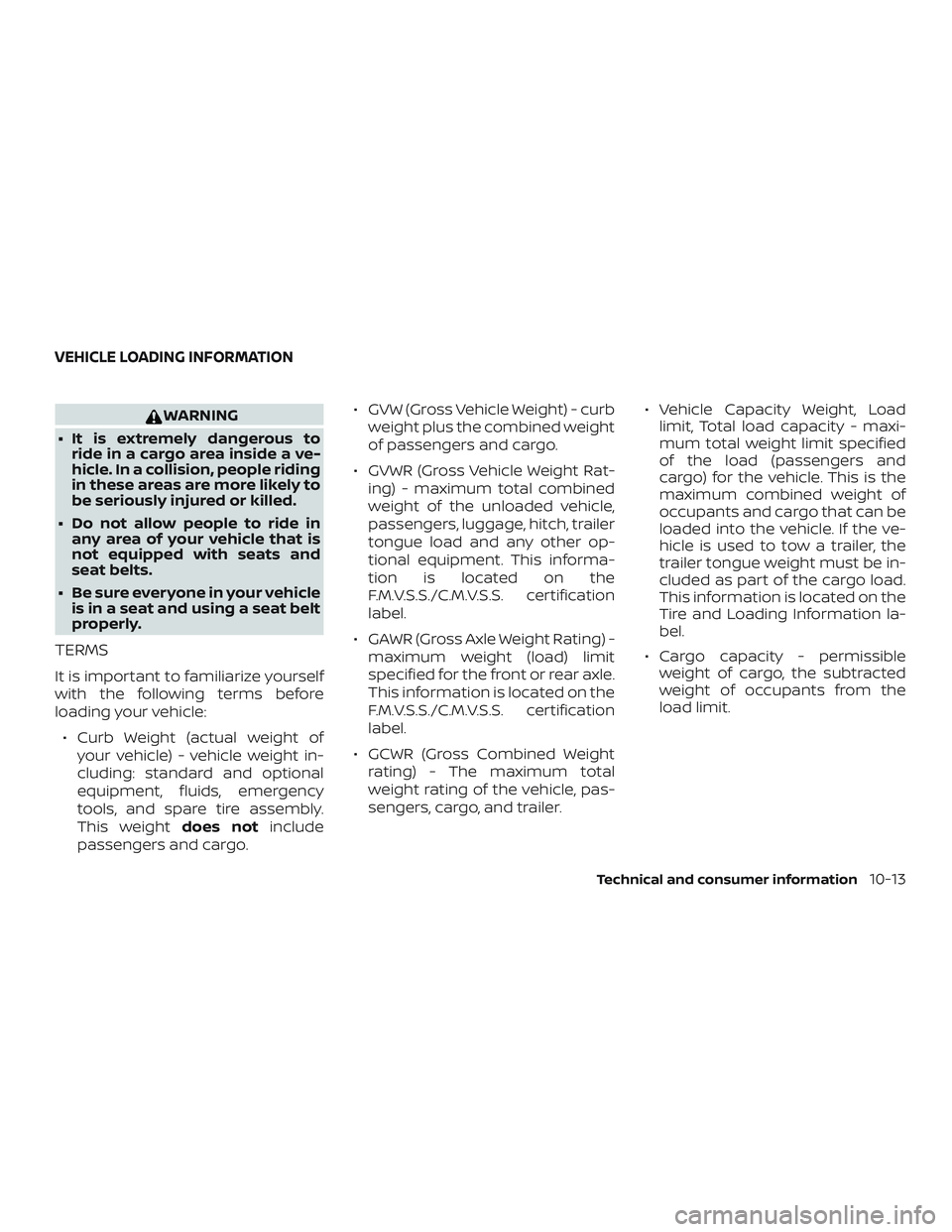
TERMS
It is important to familiarize yourself
with the following terms before
loading your vehicle:
∙ Curb Weight (actual weight of your vehicle) - vehicle weight in-
cluding: standard and optional
equipment, fluids, emergency
tools, and spare tire assembly.
This weight does notinclude
passengers and cargo. ∙ GVW (Gross Vehicle Weight) - curb
weight plus the combined weight
of passengers and cargo.
∙ GVWR (Gross Vehicle Weight Rat- ing) - maximum total combined
weight of the unloaded vehicle,
passengers, luggage, hitch, trailer
tongue load and any other op-
tional equipment. This informa-
tion is located on the
F.M.V.S.S./C.M.V.S.S. certification
label.
∙ GAWR (Gross Axle Weight Rating) - maximum weight (load) limit
specified for the front or rear axle.
This information is located on the
F.M.V.S.S./C.M.V.S.S. certification
label.
∙ GCWR (Gross Combined Weight rating) - The maximum total
weight rating of the vehicle, pas-
sengers, cargo, and trailer. ∙ Vehicle Capacity Weight, Load
limit, Total load capacity - maxi-
mum total weight limit specified
of the load (passengers and
cargo) for the vehicle. This is the
maximum combined weight of
occupants and cargo that can be
loaded into the vehicle. If the ve-
hicle is used to tow a trailer, the
trailer tongue weight must be in-
cluded as part of the cargo load.
This information is located on the
Tire and Loading Information la-
bel.
∙ Cargo capacity - permissible weight of cargo, the subtracted
weight of occupants from the
load limit.
VEHICLE LOADING INFORMATION
Technical and consumer information10-13
Page 476 of 492
∙ Overloading not only canshorten the life of your vehicle
and the tire, but can also cause
unsafe vehicle handling and
longer braking distances. This
may cause a premature tire fail-
ure which could result in a seri-
ous accident and personal in-
jury. Failures caused by
overloading are not covered by
the vehicle’s warranty.
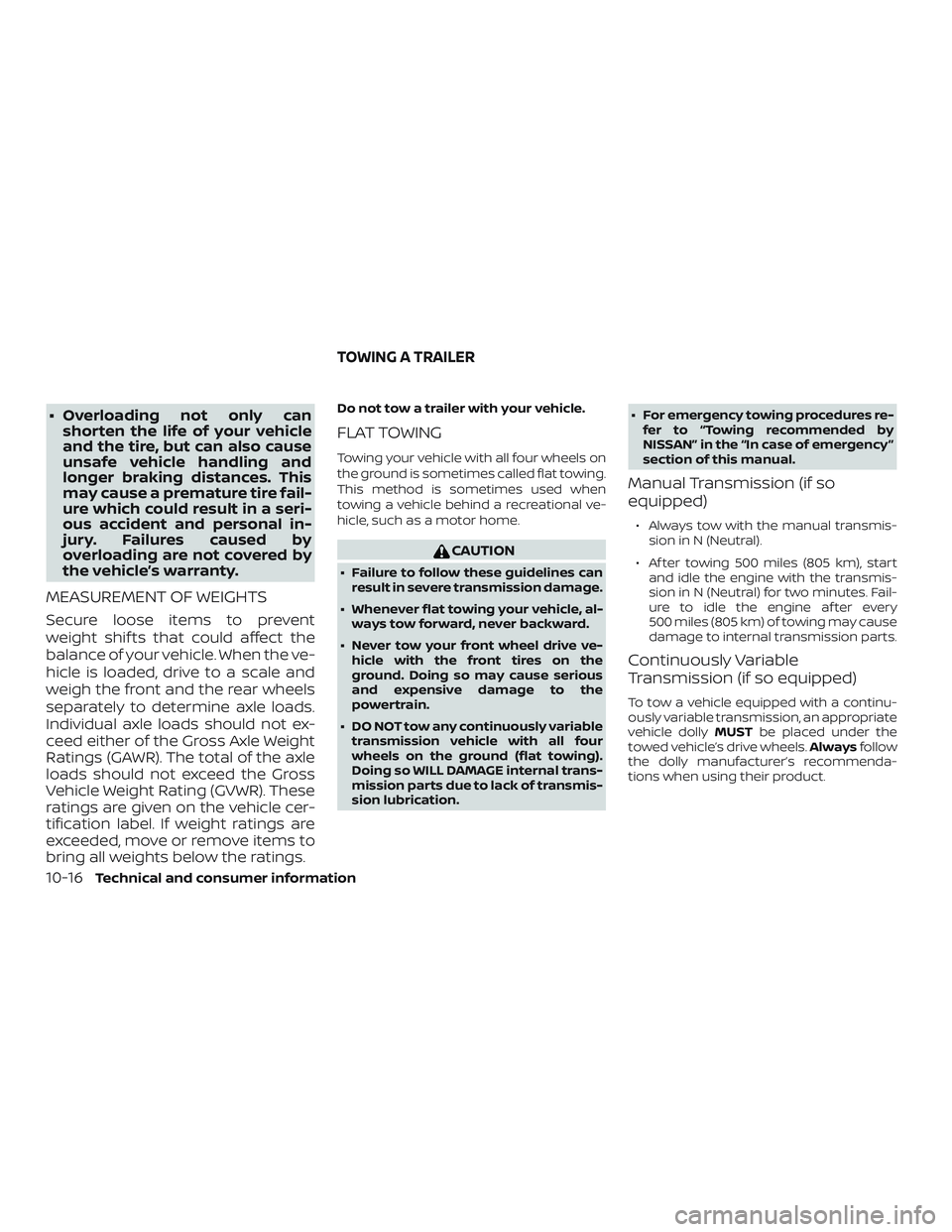
MEASUREMENT OF WEIGHTS
Secure loose items to prevent
weight shif ts that could affect the
balance of your vehicle. When the ve-
hicle is loaded, drive to a scale and
weigh the front and the rear wheels
separately to determine axle loads.
Individual axle loads should not ex-
ceed either of the Gross Axle Weight
Ratings (GAWR). The total of the axle
loads should not exceed the Gross
Vehicle Weight Rating (GVWR). These
ratings are given on the vehicle cer-
tification label. If weight ratings are
exceeded, move or remove items to
bring all weights below the ratings.
Do not tow a trailer with your vehicle.
FLAT TOWING
Towing your vehicle with all four wheels on
the ground is sometimes called flat towing.
This method is sometimes used when
towing a vehicle behind a recreational ve-
hicle, such as a motor home.
CAUTION
∙ Failure to follow these guidelines can
result in severe transmission damage.
∙ Whenever flat towing your vehicle, al- ways tow forward, never backward.
∙ Never tow your front wheel drive ve- hicle with the front tires on the
ground. Doing so may cause serious
and expensive damage to the
powertrain.
∙ DO NOT tow any continuously variable transmission vehicle with all four
wheels on the ground (flat towing).
Doing so WILL DAMAGE internal trans-
mission parts due to lack of transmis-
sion lubrication. ∙ For emergency towing procedures re-
fer to “Towing recommended by
NISSAN” in the “In case of emergency ”
section of this manual.
Manual Transmission (if so
equipped)
∙ Always tow with the manual transmis- sion in N (Neutral).
∙ Af ter towing 500 miles (805 km), start and idle the engine with the transmis-
sion in N (Neutral) for two minutes. Fail-
ure to idle the engine af ter every
500 miles (805 km) of towing may cause
damage to internal transmission parts.
Continuously Variable
Transmission (if so equipped)
To tow a vehicle equipped with a continu-
ously variable transmission, an appropriate
vehicle dolly MUSTbe placed under the
towed vehicle’s drive wheels. Alwaysfollow
the dolly manufacturer’s recommenda-
tions when using their product.
TOWING A TRAILER
10-16Technical and consumer information
Page 486 of 492
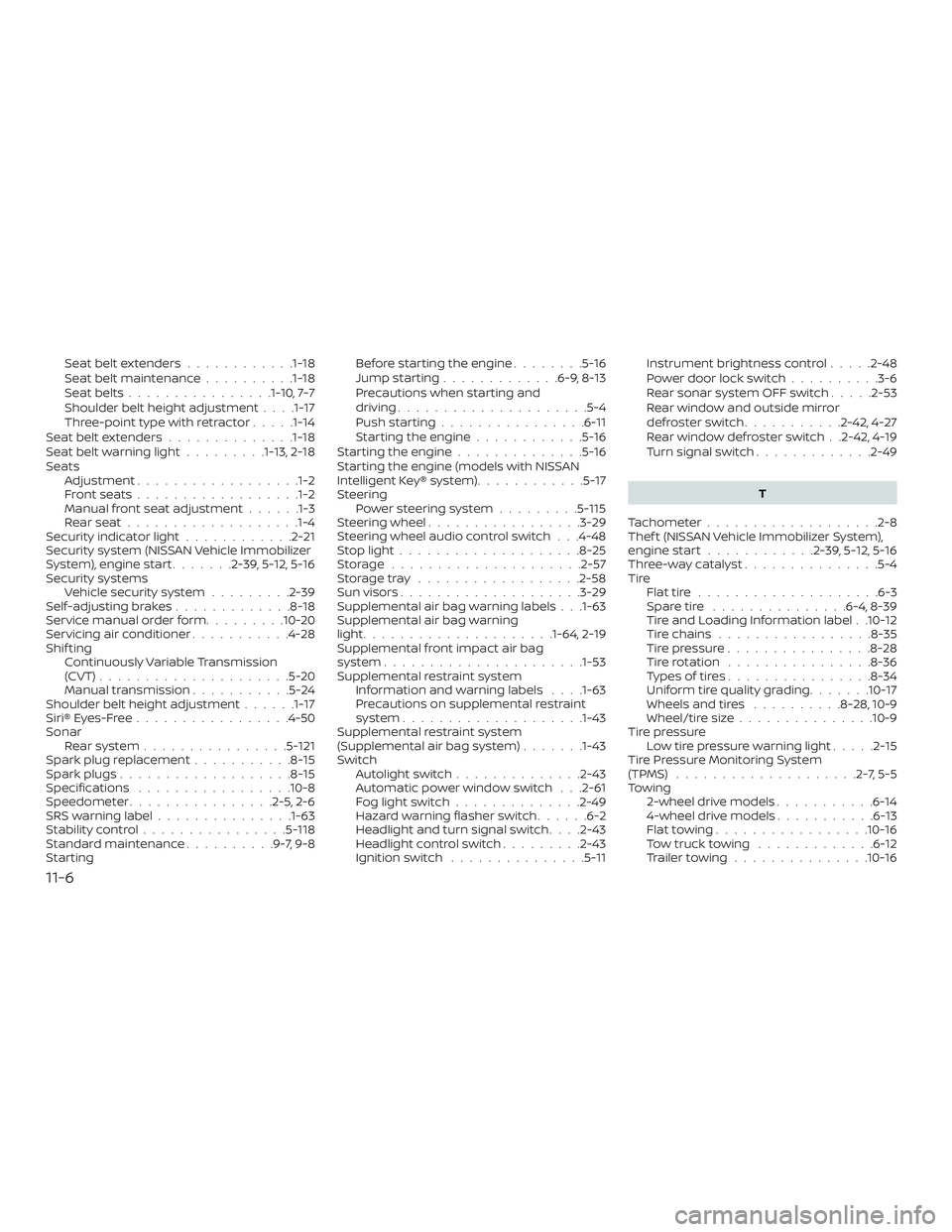
Seat belt extenders............1-18
Seat belt maintenance ..........1-18
Seatbelts................1-10, 7-7
Shoulder belt height adjustment . . . .1-17
Three-pointtypewithretractor.....1-14
Seat belt extenders ..............1-18
Seatbeltwarninglight.........1-13, 2-18
Seats Adjustment ..................1-2
Frontseats..................1-2
Manual front seat adjustment ......1-3
Rearseat...................1-4
Security indicator light ............2-21
Security system (NISSAN Vehicle Immobilizer
System), engine start .......2-39,5-12,5-16
Security systems Vehicle security system .........2-39
Self-adjustingbrakes.............8-18
Service manual order form .........10-20
Servicing air conditioner ...........4-28
Shif ting Continuously Variable Transmission
(CVT) .....................5-20
Manual transmission ...........5-24
Shoulder belt height adjustment ......1-17
Siri® Eyes-Free .................4-50
Sonar Rear system ................5-121
Spark plug replacement ...........8-15
Spark plugs ...................8-15
Specifications .................10-8
Speedometer ................2-5,2-6
SRS warning label ...............1-63
Stability control ................5 -118
Standard maintenance ..........9-7,9-8
Starting Before starting the engine
........5-16
Jumpstarting.............6-9,8-13
Precautions when starting and
driving.....................5-4
Push starting ................6-11
Starting the engine ............5-16
Starting the engine ..............5-16
Starting the engine (models with NISSAN
Intelligent Key® system) ............5-17
Steering Powersteeringsystem.........5 -115
Steering wheel .................3-29
Steering wheel audio control switch . . .4-48
Stoplight....................8-25
Storage .....................2-57
Storagetray ..................2-58
Sunvisors....................3-29
Supplemental air bag warning labels . . .1-63
Supplemental air bag warning
light.....................1-64, 2-19
Supplemental front impact air bag
system ..................... .1-53
Supplemental restraint system Information and warning labels . . . .1-63
Precautions on supplemental restraint
system ....................1-43
Supplemental restraint system
(Supplemental air bag system) .......1-43
Switch Autolightswitch..............2-43
Automatic power window switch . . .2-61
Fo
glightswitch..............2-49
Hazard warning flasher switch ......6-2
Headlight and turn signal switch ....2-43
Headlightcontrolswitch.........2-43
Ignition switch ...............5-11 Instrument brightness control
.....2-48
Power door lock switch ..........3-6
Rear sonar system OFF switch .....2-53
Rear window and outside mirror
defrosterswitch...........2-42,4-27
Rear window defroster switch . .2-42, 4-19
Turn signal switch .............2-49
T
Tachometer ...................2-8
Thef t (NISSAN Vehicle Immobilizer System),
engine start ............2-39,5-12,5-16
Three-waycatalyst...............5-4
Tire Flattire....................6-3
Spare tire ...............6-4,8-39
Tire and Loading Information label . .10-12
Tire chains .................8-35
Tire pressure ................8-28
Tirerotation ................8-36
Types of tires ................8-34
Uniform tire quality grading .......10-17
Wheels and tires ..........8-28,10-9
Wheel/tire size ...............10-9
Tire pressure Low tire pressure warning light .....2-15
Tire Pressure Monitoring System
(TPMS) ....................2-7, 5-5
Towing 2-wheel drive models ...........6-14
4-wheel drive models ...........6-13
Flattowing.................10-16
Towtrucktowing .............6-12
Trailertowing...............10-16
11-6
Page 487 of 492
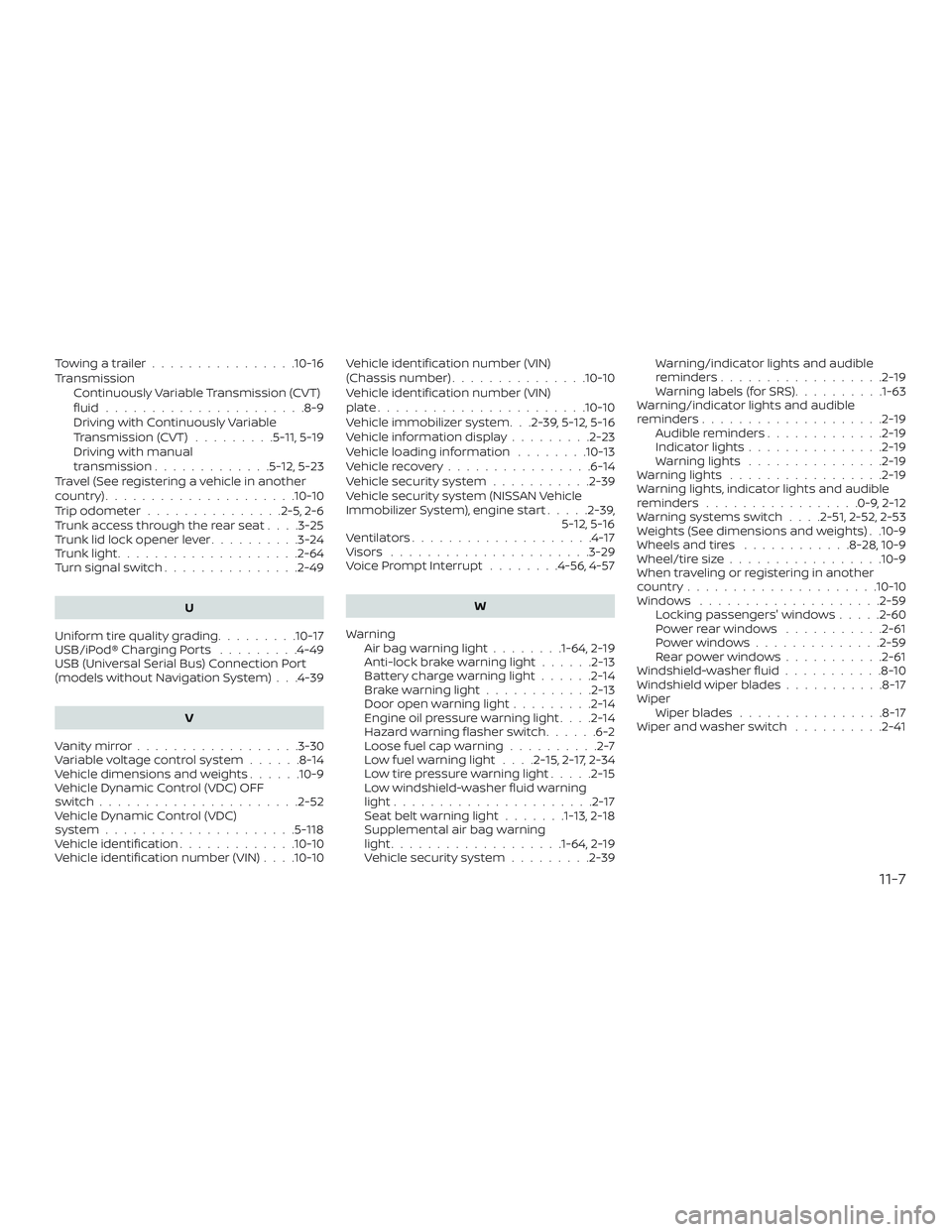
Towingatrailer................10-16
TransmissionContinuously Variable Transmission (CVT)
fluid......................8-9
Driving with Continuously Variable
Transmission (CVT) .........5-11, 5-19
Driving with manual
transmission .............5-12,5-23
Travel (See registering a vehicle in another
country) .....................10-10
Trip odometer ...............2-5,2-6
Trunk access through the rear seat ....3-25
Trunk lid lock opener lever ..........3-24
Trunklight....................2-64
Turn signal switch ...............2-49
U
Uniform tire quality grading .........10-17
USB/iPod® Charging Ports .........4-49
USB (Universal Serial Bus) Connection Port
(models without Navigation System) . . .4-39
V
Vanitymirror..................3-30
Variable voltage control system ......8-14
Vehicle dimensions and weights ......10-9
Vehicle Dynamic Control (VDC) OFF
switch......................2-52
Vehicle Dynamic Control (VDC)
system .....................5 -118
Vehicle identification .............10-10
Vehicle identification number (VIN) . . . .10-10Vehicle identification number (VIN)
(Chassis number)
...............10-10
Vehicle identification number (VIN)
plate.......................10-10
Vehicle immobilizer system. . .2-39, 5-12, 5-16
Vehicleinformationdisplay.........2-23
Vehicle loading information ........10-13
Vehiclerecovery................6-14
Vehicle security system ...........2-39
Vehicle security system (NISSAN Vehicle
Immobilizer System), engine start .....2-39,
5-12, 5-16
Ventilators ....................4-17
Visors ......................3-29
Voice Prompt Interrupt ........4-56,4-57
W
Warning Airbagwarninglight........1-64, 2-19
Anti-lock brake warning light ......2-13
Battery charge warning light ......2-14
Brakewarninglight............2-13
Door open warning light .........2-14
Engine oil pressure warning light ....2-14
Hazard warning flasher switch ......6-2
Loose fuel cap warning ..........2-7
Lowfuelwarninglight....2-15,2-17,2-34
Lowtirepressurewarninglight.....2-15
Low windshield-washer fluid warning
light......................2-17
Seatbeltwarninglight.......1-13, 2-18
Supplemental air bag warning
light...................1-64, 2-19
Vehicle security system .........2-39Warning/indicator lights and audible
reminders
..................2-19
Warning labels (for SRS) ..........1-63
Warning/indicator lights and audible
reminders ....................2-19
Audible reminders .............2-19
Indicatorlights...............2-19
Warninglights ...............2-19
Warninglights .................2-19
Warning lights, indicator lights and audible
reminders .................0-9,2-12
Warningsystemsswitch....2-51,2-52,2-53
Weights (See dimensions and weights) . .10-9
Wheels and tires ............8-28,10-9
Wheel/tire size .................10-9
When traveling or registering in another
country .....................10-10
Windows ....................2-59 Locking passengers' windows .....2-60
Powerrearwindows ...........2-61
Powerwindows............. .2-59
Rearpowerwindows.......... .2-61
Windshield -washer
fluid ...........8-10
Windshield wiper blades ...........8-17
Wiper Wiper blades ................8-17
Wiper and washer switch ..........2-41
11-7