belt NISSAN XTERRA 2002 WD22 / 1.G Owners Manual
[x] Cancel search | Manufacturer: NISSAN, Model Year: 2002, Model line: XTERRA, Model: NISSAN XTERRA 2002 WD22 / 1.GPages: 263, PDF Size: 2.22 MB
Page 1 of 263
Welcome to the growing family of new NISSAN
owners. This vehicle has been delivered to you
with confidence. It was produced using the
latest techniques and strict quality control.
This manual was prepared to help you under-
stand the operation and maintenance of your
vehicle so that you may enjoy many miles
(kilometers) of driving pleasure. Please read
through this manual before operating your
vehicle.
In the U.S., a separate Warranty Informa-
tion Booklet or in Canada, a Warranty and
Roadside Assistance Information Book-
let explains details about the warranties
covering your vehicle. The ªNISSAN Ser-
vice and Maintenance Guideº explains
details about maintaining and servicing
your vehicle. Additionally, a separate
Customer Care/Lemon Law Booklet (U.S.
only) will explain how to resolve any
concerns you may have with your ve-
hicle, as well as clarify your rights under
your state's lemon law.
Your NISSAN dealership knows your vehicle
best. When you require any service or have
any questions, they will be glad to assist you
with the extensive resources available to them.
READ FIRST - THEN DRIVE
SAFELY
Before driving your vehicle please read this
owner's manual carefully. This will ensurefamiliarity with controls and maintenance
requirements, assisting you in the safe op-
eration of your vehicle.
WARNING
IMPORTANT SAFETY INFORMATION
REMINDERS FOR SAFETY!
Follow these important driving rules to
help ensure a safe and complete trip for
you and your passengers!
²NEVER drive under the influence of
alcohol or drugs.
²ALWAYS observe posted speed lim-
its and never drive too fast for con-
ditions.
²ALWAYS use your seat belts and
appropriate child restraint systems.
Pre-teen children should be seated
in the rear seat.
²ALWAYS provide information about
the proper use of vehicle safety fea-
tures to all occupants of the vehicle.
²ALWAYS review this owner's manual
for important safety information.For descriptions specified for four-wheel
drive models, a
mark is placed at
the beginning of the applicable
sections/items.
As with other vehicles with features for
off-road use, failure to operate four-
wheel drive models correctly may result
in loss of control or an accident. Be sure
to read ``Driving safety precautions'' in
the ``Starting and driving'' section of this
manual.
ON-PAVEMENT AND OFF-ROAD DRIV-
ING
This vehicle will handle and maneuver
differently from an ordinary passenger
car because it has a higher center of
gravity for off-road use. As with other
vehicles with features of this type, fail-
ure to operate this vehicle correctly
may result in loss of control or an
accident.
Be sure to read ªOn-pavement and off-
road driving precautionsº, and ``Avoid-
ing collision and rollover'', and ªDriv-
ing safety precautionsº, in the
ªStarting and drivingº section of this
manual.
The inside pages of this manual contain
a minimum of 50% recycled fibers,
including 10% post-consumer fibers.
Foreword
ZX
Page 4 of 263

Welcome To The World Of NISSAN
Your new NISSAN is the result of our dedication
to produce the finest in safe, reliable and eco-
nomical transportation. Your vehicle is the prod-
uct of a successful worldwide company that
manufactures cars and trucks in over 17 coun-
tries and distributes them in 170 nations.
NISSAN vehicles are designed and manufac-
tured by Nissan Motor Co., Ltd. which was
founded in Tokyo, Japan in 1933, and NISSAN
affiliates world wide, collectively growing to be-
come the fifth largest automaker in the world. In
addition to cars and trucks, NISSAN also makes
forklift trucks, marine engines, boats and other
diversified products.
NISSAN has made a substantial and growing
investment in North America. NISSAN's commit-
ment is nearly $4 billion dollars in capital invest-
ments in facilities across the continent. Some of
the facilities include the Nissan Manufacturingfacility in Smyrna, Tennessee, vehicle styling
design at Nissan Design America, Inc. in San
Diego, California, and engineering at Nissan
Technical Center North America in Farmington
Hills, Michigan. Additionally, NISSAN employs
nearly 18,000 people throughout the United
States, Canada, and Mexico. An additional
71,000 people work for the 1,500 NISSAN and
INFINITI dealers across North America.
NISSAN is also a substantial contributor to the
Canadian economy. Nissan Canada Inc., its sup-
pliers and over 140 dealers employ approxi-
mately 4,500 people. These include company
employees and the staffs of NISSAN dealers all
across Canada. In addition, many Canadians
work for companies that supply NISSAN and
NISSAN dealers with materials and services
ranging from operation of port facilities and trans-portation services to the supply of lubricants,
parts and accessories.
NISSAN pioneered the use of electronics and
computers in automobiles, and has led the indus-
try in improving both performance and fuel effi-
ciency through new engine designs and the use
of synthetic materials to reduce vehicle weight.
The company has also developed ways to build
quality into its vehicles at each stage of the
production process, both through extensive use
of automation and Ð most importantly Ð
through an awareness thatpeopleare the cen-
tral element in quality control.
From the time the parts arrived from our suppli-
ers until you took delivery of your new NISSAN,
dozens of checks were made to ensure that only
the best job was being done in producing and
delivering your vehicle. NISSAN also takes great
care to ensure that when you take your NISSAN
to your dealer for maintenance, the service tech-
nician will perform his work according to the
quality standards that have been established by
the factory.
Safety has also been built into your NISSAN. As
you know, seat belts are an integral part of the
safety systems that will help protect you and your
passengers in the event of a sudden stop or an
accident. We urge you to use the seat belts every
time you drive the vehicle.
The NISSAN story of growth and achievement
reflects our major goal: to provide you, our
customer, with a vehicle that is built with quality
and craftsmanship Ð a product that we can be
proud to build and you can be proud to own.WFW0002
ZX
Page 8 of 263

1 Seats, restraints and supplemental air
bag systems
Seats ......................................................................1-2
Front manual seat adjustment...........................1-2
Rear seat adjustment (type a)...........................1-3
Rear seat adjustment (type b)...........................1-5
Head restraint adjustment .................................1-7
Supplemental restraint system ...............................1-7
Precautions on supplemental restraint
system ...............................................................1-7
Supplemental air bag warning labels ..............1-14
Supplemental air bag warning light .................1-14
Seat belts .............................................................1-16
Precautions on seat belt usage ......................1-16
Child safety ......................................................1-17
Pregnant women .............................................1-18
Injured persons ................................................1-18Three-point type seat belt with retractor .........1-19
Two-point type seat belt without
retractor (center of rear seat) ..........................1-21
Seat belt extenders .........................................1-23
Seat belt maintenance ....................................1-24
Child restraints .....................................................1-24
Precautions on child restraints ........................1-24
Installation on rear seat center position ..........1-26
Installation on rear seat outboard
positions ..........................................................1-29
Latch (lower anchors and tether for children)
system ..................................................................1-33
Top tether strap child restraint.........................1-35
Installation on front passenger seat ................1-36
ZX
Page 9 of 263
WARNING
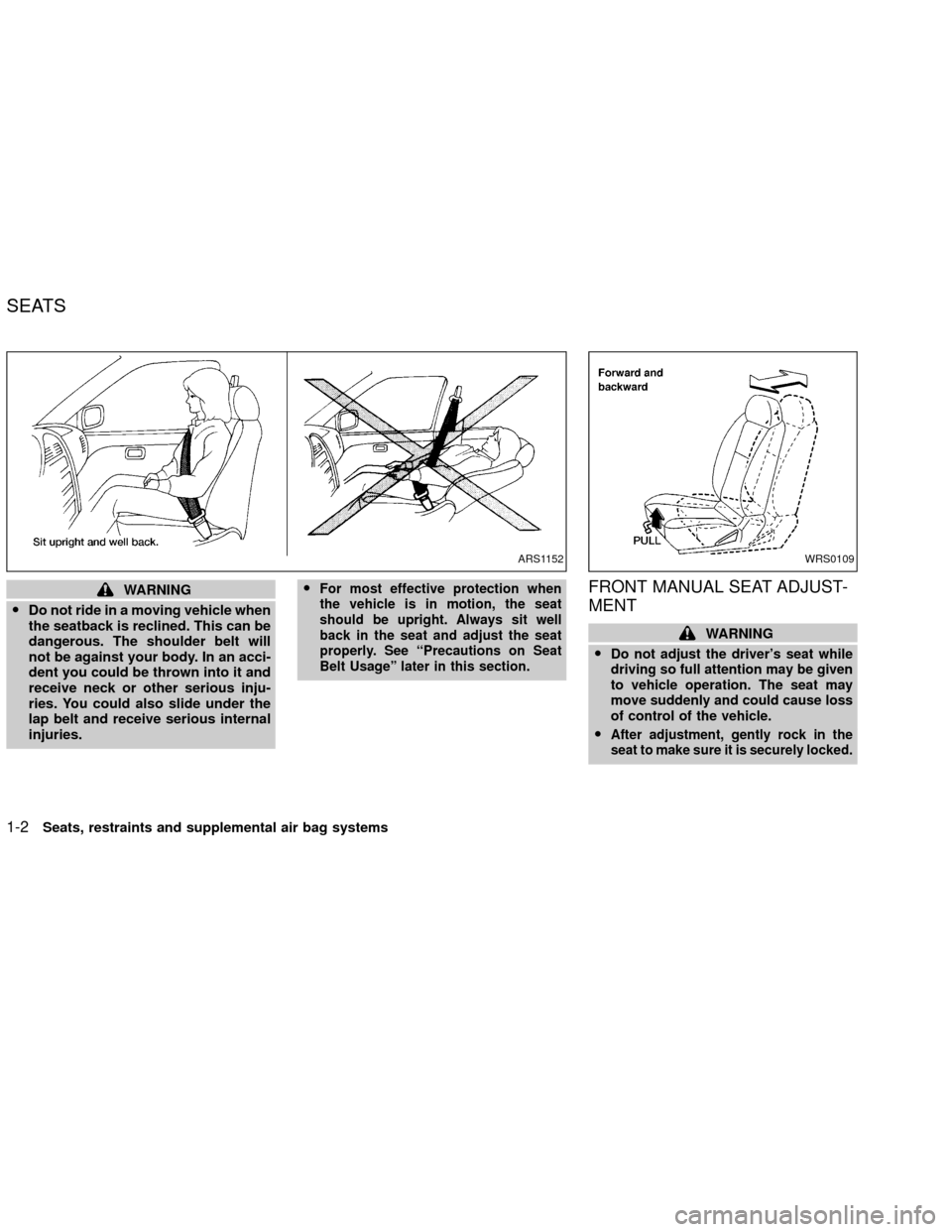
ODo not ride in a moving vehicle when
the seatback is reclined. This can be
dangerous. The shoulder belt will
not be against your body. In an acci-
dent you could be thrown into it and
receive neck or other serious inju-
ries. You could also slide under the
lap belt and receive serious internal
injuries.OFor most effective protection when
the vehicle is in motion, the seat
should be upright. Always sit well
back in the seat and adjust the seat
properly. See ``Precautions on Seat
Belt Usage'' later in this section.FRONT MANUAL SEAT ADJUST-
MENT
WARNING
O
Do not adjust the driver's seat while
driving so full attention may be given
to vehicle operation. The seat may
move suddenly and could cause loss
of control of the vehicle.
OAfter adjustment, gently rock in the
seat to make sure it is securely locked.
ARS1152WRS0109
SEATS
1-2Seats, restraints and supplemental air bag systems
ZX
Page 11 of 263
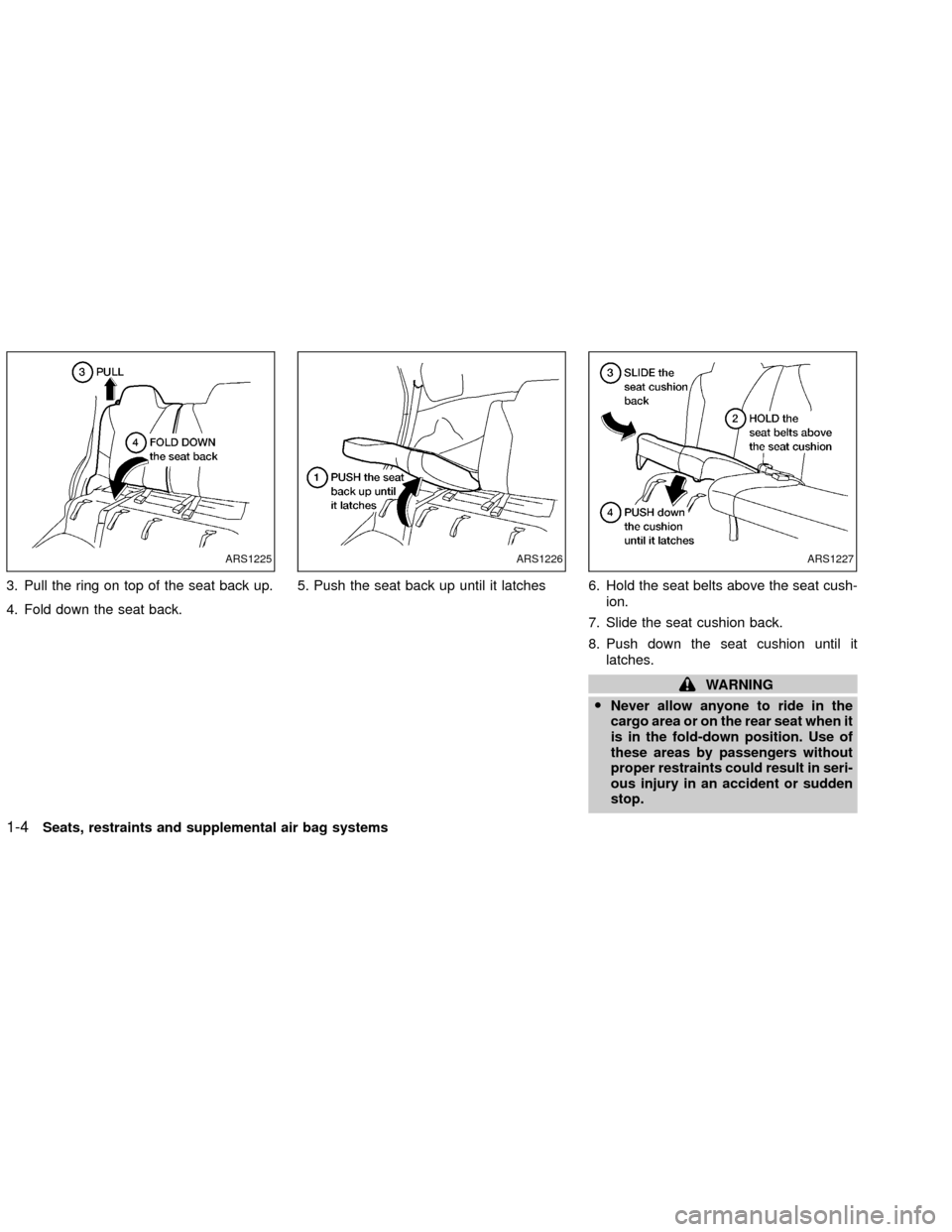
3. Pull the ring on top of the seat back up.
4. Fold down the seat back.5. Push the seat back up until it latches 6. Hold the seat belts above the seat cush-
ion.
7. Slide the seat cushion back.
8. Push down the seat cushion until it
latches.
WARNING
ONever allow anyone to ride in the
cargo area or on the rear seat when it
is in the fold-down position. Use of
these areas by passengers without
proper restraints could result in seri-
ous injury in an accident or sudden
stop.
ARS1225ARS1226ARS1227
1-4Seats, restraints and supplemental air bag systems
ZX
Page 12 of 263
OIt is extremely dangerous to ride in a
cargo area inside of a vehicle. In a
collision, people riding in these ar-
eas are more likely to be seriously
injured or killed.
ODo not allow people to ride in any
area of your vehicle that is not
equipped with seats and seat belts.
Be sure everyone in your vehicle is
in a seat and using a seat belt prop-
erly. Never ride in the rear seat un-
less the seat bottom cushions are in
place and latched.
OProperly secure all cargo to help
prevent it from sliding or shifting. Do
not place cargo higher than the seat-
backs. In a sudden stop or collision,
unsecured cargo could cause per-
sonal injury.
OWhen returning the seatbacks to the
upright position, be certain they are
completely secured in the latched
position. If they are not completely
secured in the latched position, pas-
sengers may be injured in an acci-
dent or sudden stop.
REAR SEAT ADJUSTMENT
(TYPE B)
Folding
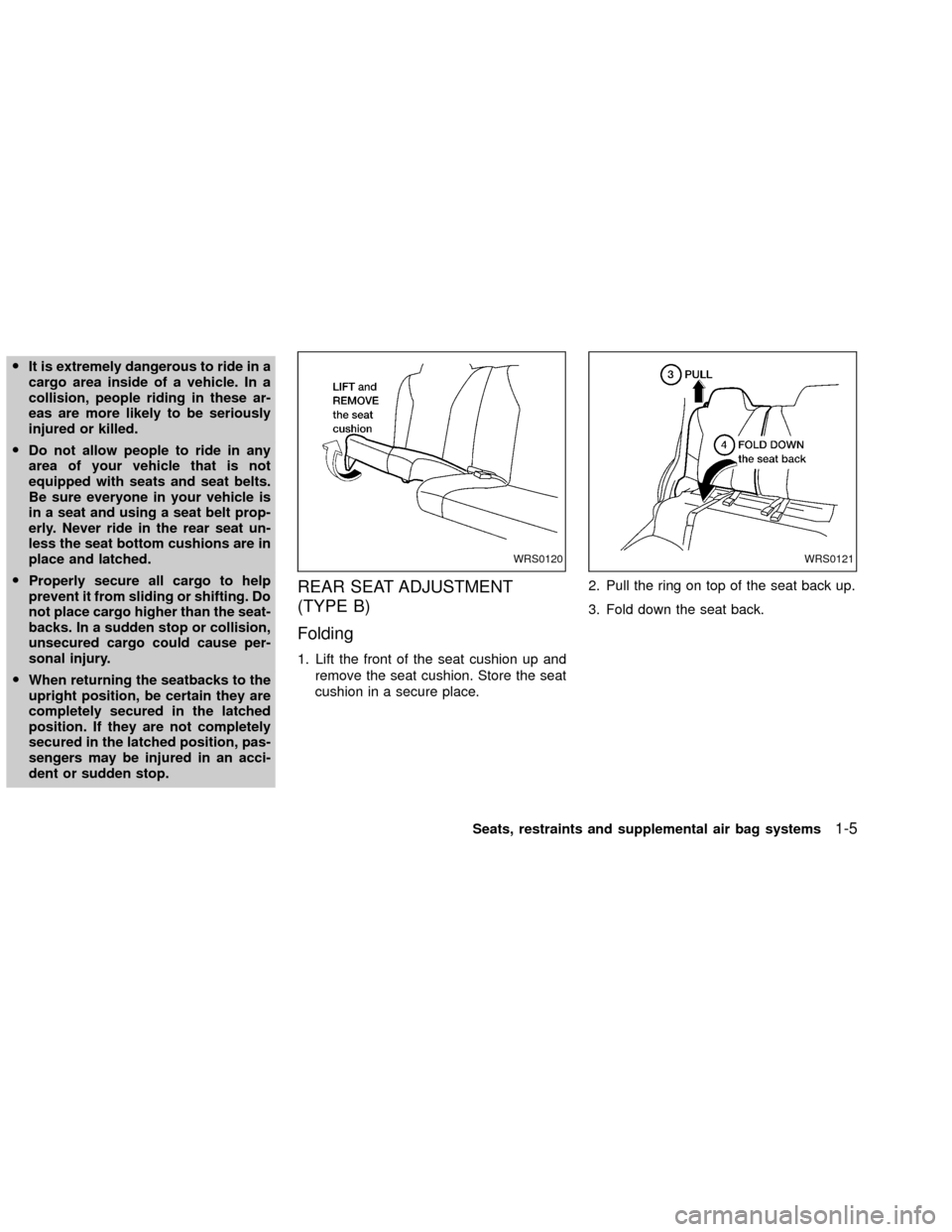
1. Lift the front of the seat cushion up and
remove the seat cushion. Store the seat
cushion in a secure place.2. Pull the ring on top of the seat back up.
3. Fold down the seat back.
WRS0120WRS0121
Seats, restraints and supplemental air bag systems1-5
ZX
Page 13 of 263
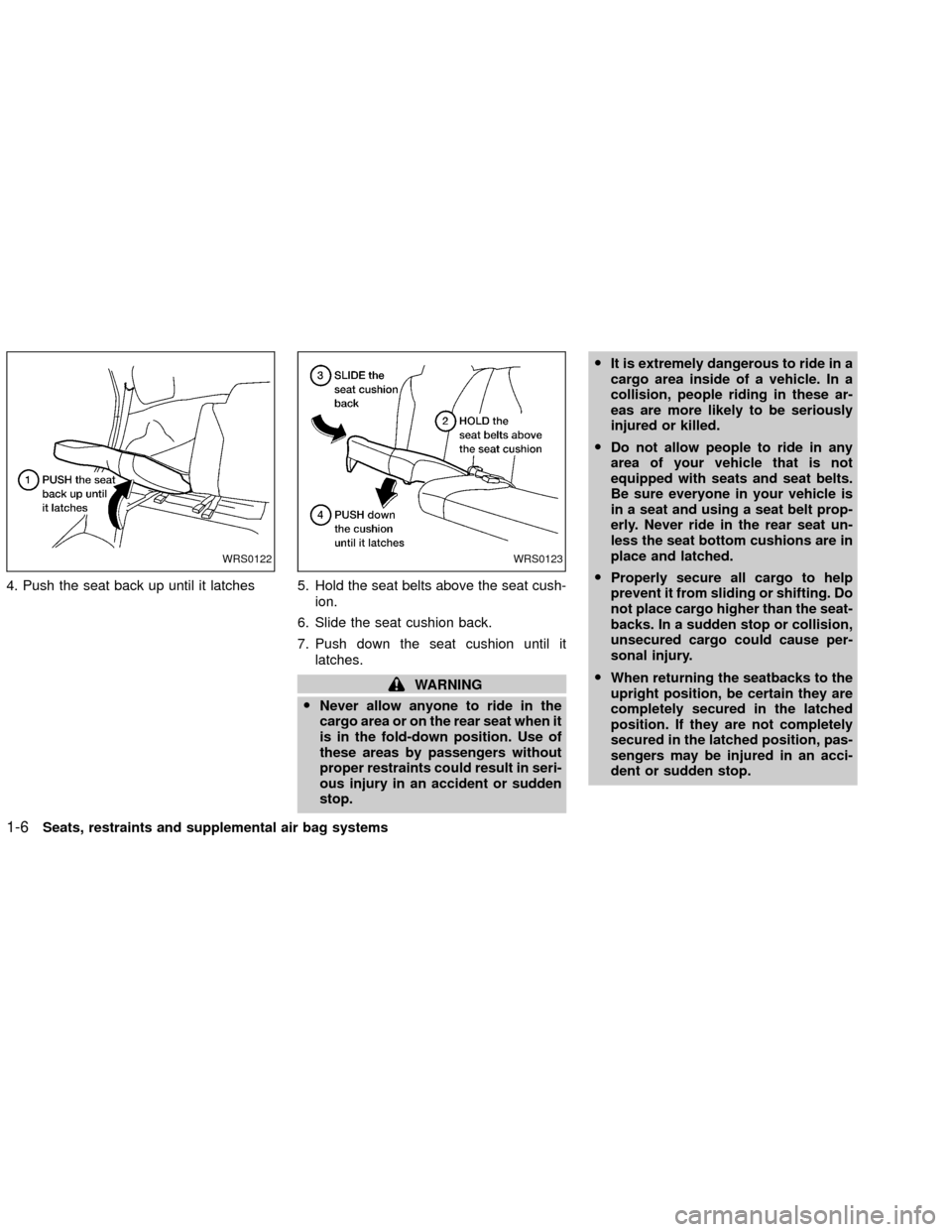
4. Push the seat back up until it latches 5. Hold the seat belts above the seat cush-
ion.
6. Slide the seat cushion back.
7. Push down the seat cushion until it
latches.
WARNING
ONever allow anyone to ride in the
cargo area or on the rear seat when it
is in the fold-down position. Use of
these areas by passengers without
proper restraints could result in seri-
ous injury in an accident or sudden
stop.OIt is extremely dangerous to ride in a
cargo area inside of a vehicle. In a
collision, people riding in these ar-
eas are more likely to be seriously
injured or killed.
ODo not allow people to ride in any
area of your vehicle that is not
equipped with seats and seat belts.
Be sure everyone in your vehicle is
in a seat and using a seat belt prop-
erly. Never ride in the rear seat un-
less the seat bottom cushions are in
place and latched.
OProperly secure all cargo to help
prevent it from sliding or shifting. Do
not place cargo higher than the seat-
backs. In a sudden stop or collision,
unsecured cargo could cause per-
sonal injury.
OWhen returning the seatbacks to the
upright position, be certain they are
completely secured in the latched
position. If they are not completely
secured in the latched position, pas-
sengers may be injured in an acci-
dent or sudden stop.
WRS0122WRS0123
1-6Seats, restraints and supplemental air bag systems
ZX
Page 14 of 263
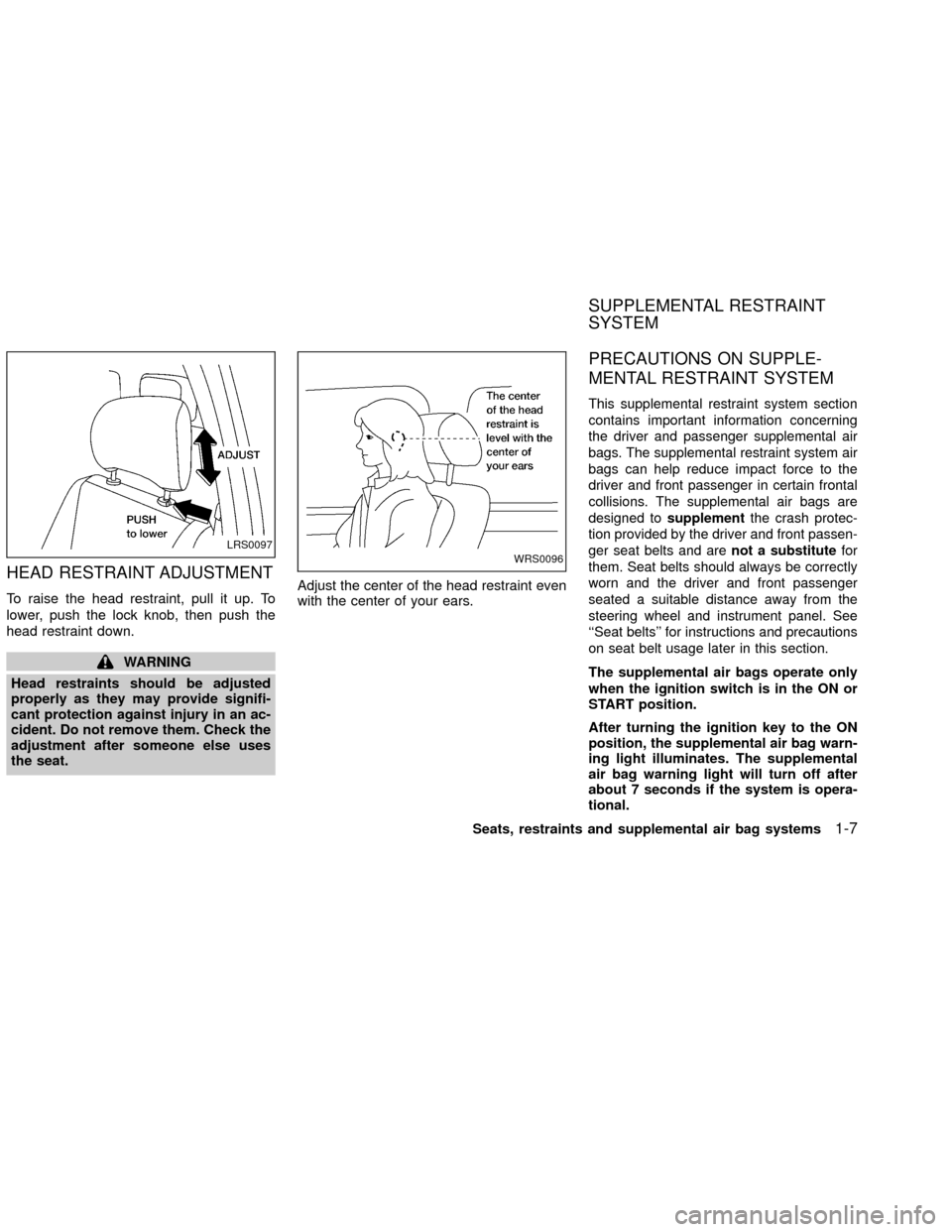
HEAD RESTRAINT ADJUSTMENT
To raise the head restraint, pull it up. To
lower, push the lock knob, then push the
head restraint down.
WARNING
Head restraints should be adjusted
properly as they may provide signifi-
cant protection against injury in an ac-
cident. Do not remove them. Check the
adjustment after someone else uses
the seat.Adjust the center of the head restraint even
with the center of your ears.
PRECAUTIONS ON SUPPLE-
MENTAL RESTRAINT SYSTEM
This supplemental restraint system section
contains important information concerning
the driver and passenger supplemental air
bags. The supplemental restraint system air
bags can help reduce impact force to the
driver and front passenger in certain frontal
collisions. The supplemental air bags are
designed tosupplementthe crash protec-
tion provided by the driver and front passen-
ger seat belts and arenot a substitutefor
them. Seat belts should always be correctly
worn and the driver and front passenger
seated a suitable distance away from the
steering wheel and instrument panel. See
``Seat belts'' for instructions and precautions
on seat belt usage later in this section.
The supplemental air bags operate only
when the ignition switch is in the ON or
START position.
After turning the ignition key to the ON
position, the supplemental air bag warn-
ing light illuminates. The supplemental
air bag warning light will turn off after
about 7 seconds if the system is opera-
tional.
LRS0097WRS0096
SUPPLEMENTAL RESTRAINT
SYSTEM
Seats, restraints and supplemental air bag systems1-7
ZX
Page 15 of 263
WARNING
OThe supplemental air bags ordinarily
will not inflate in the event of a side
impact, rear impact, roll over, or
lower severity frontal collision. Al-
ways wear your seat belts to help
reduce the risk or severity of injury
in various kinds of accidents.
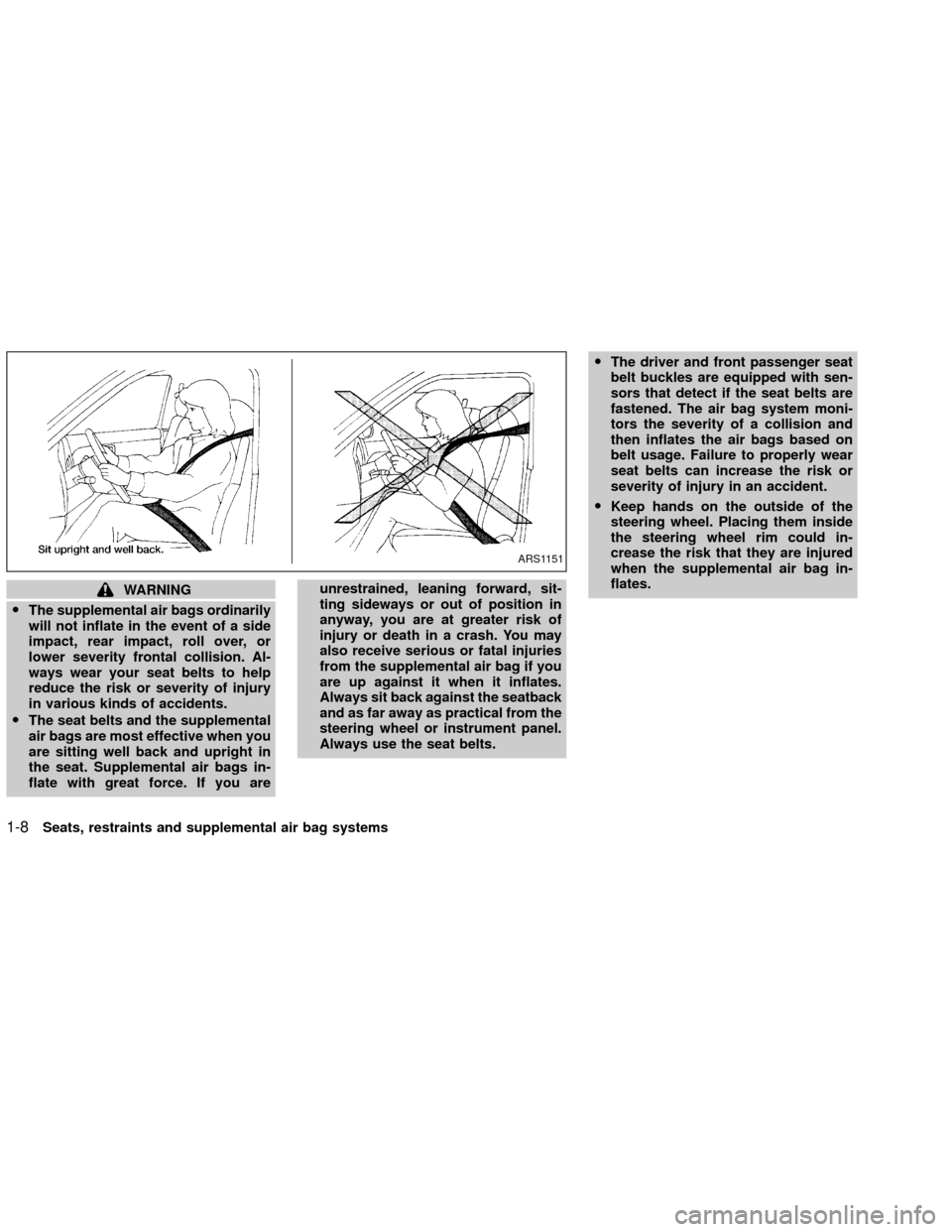
OThe seat belts and the supplemental
air bags are most effective when you
are sitting well back and upright in
the seat. Supplemental air bags in-
flate with great force. If you areunrestrained, leaning forward, sit-
ting sideways or out of position in
anyway, you are at greater risk of
injury or death in a crash. You may
also receive serious or fatal injuries
from the supplemental air bag if you
are up against it when it inflates.
Always sit back against the seatback
and as far away as practical from the
steering wheel or instrument panel.
Always use the seat belts.OThe driver and front passenger seat
belt buckles are equipped with sen-
sors that detect if the seat belts are
fastened. The air bag system moni-
tors the severity of a collision and
then inflates the air bags based on
belt usage. Failure to properly wear
seat belts can increase the risk or
severity of injury in an accident.
OKeep hands on the outside of the
steering wheel. Placing them inside
the steering wheel rim could in-
crease the risk that they are injured
when the supplemental air bag in-
flates.
ARS1151
1-8Seats, restraints and supplemental air bag systems
ZX
Page 18 of 263

Supplemental air bag system
The driver supplemental air bag is located in
the center of the steering wheel. The pas-
senger supplemental air bag is located in
the top right section of the instrument panel.
These systems are designed to meet optional
certification requirements under U.S. regula-
tions. They are also permitted in Canada. The
optional certification allows air bags to be
designed to inflate somewhat less forcefully
than previously.However, all of the informa-tion, cautions and warnings in this manual
still apply and must be followed.
The supplemental air bag system is de-
signed to inflate in higher severity frontal
collisions, although it may inflate if the
forces in another type of collision are similar
to those of a higher severity frontal impact. It
may not inflate in certain frontal collisions.
Vehicle damage (or lack of it) is not always
an indication of proper supplemental air bag
system operation.
The supplemental air bag system has dual
stage inflators for both the driver and pas-
senger air bags. The system monitors infor-
mation from the crash zone sensor, the
diagnosis sensor unit and seat belt buckle
sensors that detect if the seat belts are
fastened. Inflator operation is based on the
severity of a collision and whether the seat
belts are being used.
When the supplemental air bag inflates, a
fairly loud noise may be heard, followed by
the release of smoke. This smoke is not
harmful and does not indicate a fire. Care
should be taken not to intentionally inhale it,
as it may cause irritation and choking.
Those with a history of a breathing condition
should get fresh air promptly.
WRS0119
Seats, restraints and supplemental air bag systems1-11
ZX