flat tire NISSAN XTERRA 2010 Owner´s Manual
[x] Cancel search | Manufacturer: NISSAN, Model Year: 2010, Model line: XTERRA, Model: NISSAN XTERRA 2010Pages: 337, PDF Size: 3.69 MB
Page 310 of 337
5. Determine the combined weight ofluggage and cargo being loaded on
the vehicle. That weight may not
safely exceed the available cargo and
luggage load capacity calculated in
Step 4.
6. If your vehicle will be towing a trailer, load from your trailer will be trans-
ferred to your vehicle. Consult this
manual to determine how this re-
duces the available cargo and lug-
gage load capacity of your vehicle.
Before driving a loaded vehicle, confirm
that you do not exceed the Gross Vehicle
Weight Rating (GVWR) or the Gross Axle
Weight Rating (GAWR) for your vehicle.
See “Measurement of Weights” later in
this section.
Also check tires for proper inflation pres-
sures. See the Tire and Loading Informa-
tion label.
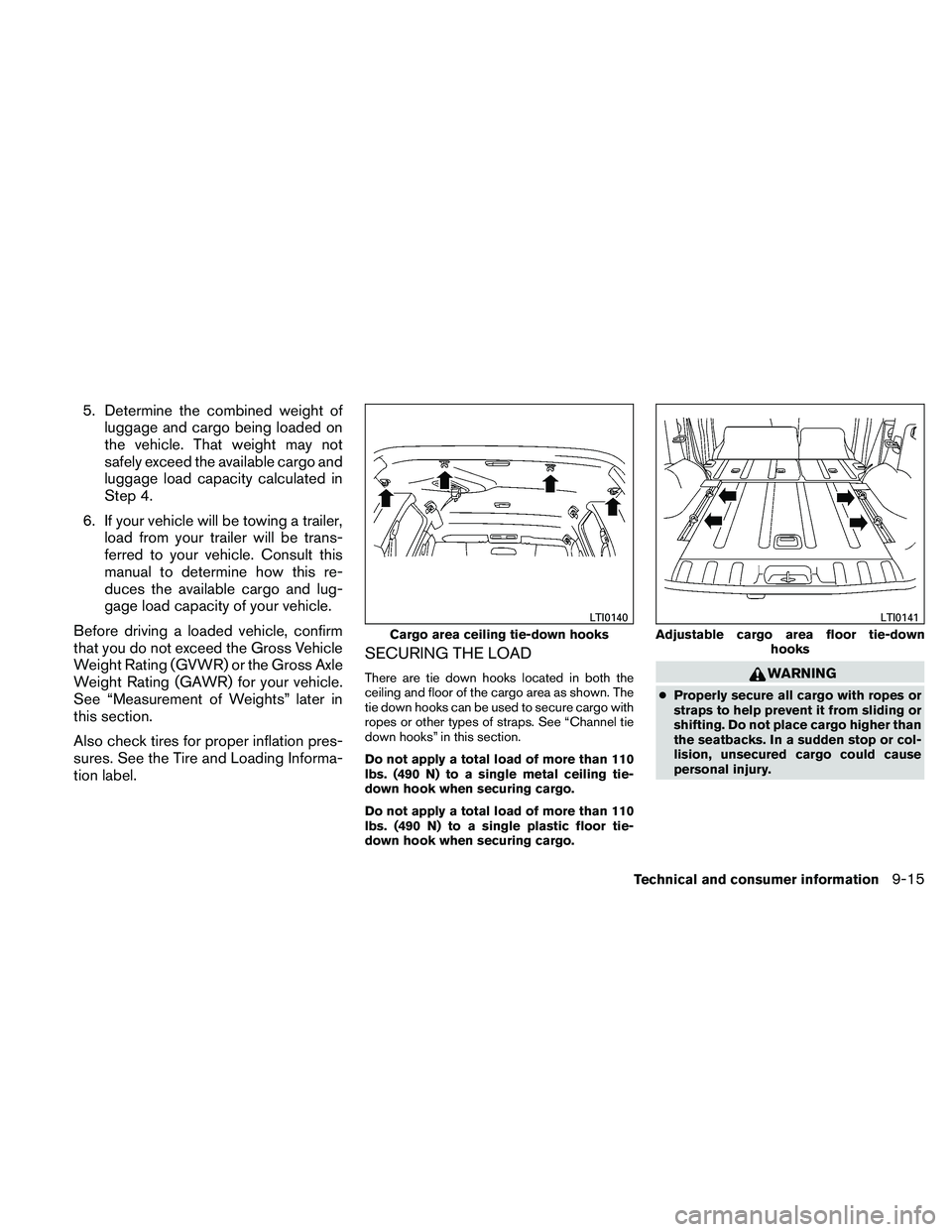
SECURING THE LOAD
There are tie down hooks located in both the
ceiling and floor of the cargo area as shown. The
tie down hooks can be used to secure cargo with
ropes or other types of straps. See “Channel tie
down hooks” in this section.
Do not apply a total load of more than 110
lbs. (490 N) to a single metal ceiling tie-
down hook when securing cargo.
Do not apply a total load of more than 110
lbs. (490 N) to a single plastic floor tie-
down hook when securing cargo.WARNING
● Properly secure all cargo with ropes or
straps to help prevent it from sliding or
shifting. Do not place cargo higher than
the seatbacks. In a sudden stop or col-
lision, unsecured cargo could cause
personal injury.
Cargo area ceiling tie-down hooks
LTI0140
Adjustable cargo area floor tie-down
hooks
LTI0141
Technical and consumer information9-15
Page 319 of 337
WARNING
Properly adjust the weight distributing
hitch so the rear of the bumper is no
higher than the measured reference
height when the trailer is attached. If the
rear bumper is higher than the measured
reference height when loaded, the vehicle
may handle unpredictably which could
cause a loss of vehicle control and cause
serious personal injury or property
damage.
Sway control device
Sudden maneuvers, wind gusts, and buffeting
caused by other vehicles can affect trailer han-
dling. Sway control devices may be used to help
control these affects. If you choose to use one,
contact a reputable trailer hitch supplier to make
sure the sway control device will work with the
vehicle, hitch, trailer and the trailer’s brake sys-
tem. Follow the instructions provided by the
manufacturer for installing and using the sway
control device.
Class I hitch
Class I trailer hitch equipment (receiver, ball
mount and hitch ball) can be used to tow trailers
of a maximum weight of 2,000 lb (909 kg) .
Class II hitch
Class II trailer hitch equipment (receiver, ball
mount and hitch ball) can be used to tow trailers
of a maximum weight of 3,500 lb (1,510 kg) .
Class III hitch
Class III trailer hitch equipment (receiver, ball
mount and hitch ball) can be used to tow trailers
of a maximum weight of 5,000 lb (2,272 kg) .
CAUTION
●Special hitches which include frame re-
inforcements are required for towing
above 2,000 lb (907 kg) . Suitable genu-
ine NISSAN hitches, ball mounts and
hitch balls for pickup trucks and sport
utility vehicles are available at a
NISSAN dealer.
● The hitch should not be attached to or
affect the operation of the impact-
absorbing bumper.
● Do not use axle-mounted hitches.
● Do not modify the vehicle exhaust sys-
tem, brake system, etc. to install a
trailer hitch. ●
To reduce the possibility of additional
damage if your vehicle is struck from
the rear, where practical, remove the
receiver when not in use.
● After the hitch is removed, seal the bolt
holes to prevent exhaust fumes, water
or dust from entering the passenger
compartment.
● Regularly check that all trailer hitch
mounting bolts are securely mounted.Tire pressures
● When towing a trailer, inflate the ve-
hicle tires to the recommended cold
tire pressure indicated on the Tire
and Loading Information label.
● Trailer tire condition, size, load rating
and proper inflation pressure should
be in accordance with the trailer and
tire manufacturer’s specifications.
9-24
Technical and consumer information
Page 324 of 337
DOT (Department of Transportation) Quality
Grades: All passenger car tires must conform to
federal safety requirements in addition to these
grades.
Quality grades can be found where applicable on
the tire sidewall between tread shoulder and
maximum section width. For example:
Treadwear 200 Traction AA Temperature A
Treadwear
The treadwear grade is a comparative rating
based on the wear rate of the tire when tested
under controlled conditions on a specified gov-
ernment test course. For example, a tire graded
150 would wear one and one-half (1 1/2) times
as well on the government course as a tire graded
100. The relative performance of tires depends
upon the actual conditions of their use, however,
and may depart significantly from the norm due to
variations in driving habits, service practices and
differences in road characteristics and climate.
Traction AA, A, B and C
The traction grades, from highest to lowest, are
AA, A, B, and C. Those grades represent the
tire’s ability to stop on wet pavement as mea-
sured under controlled conditions on specified
government test surfaces of asphalt and con-
crete. A tire marked C may have poor traction
performance.WARNING
The traction grade assigned to this tire is
based on straight-ahead braking traction
tests, and does not include acceleration,
cornering, hydroplaning, or peak traction
characteristics.
Temperature A, B and C
The temperature grades are A (the highest) , B,
and C, representing the tire’s resistance to the
generation of heat, and its ability to dissipate heat
when tested under controlled conditions on a
specified indoor laboratory test wheel. Sustained
high temperature can cause the material of the
tire to degenerate and reduce tire life, and exces-
sive temperature can lead to sudden tire failure.
The grade C corresponds to a level of perfor-
mance which all passenger car tires must meet
under the Federal Motor Safety Standard No.
109. Grades B and A represent higher levels of
performance on the laboratory test wheel than
the minimum required by law.
WARNING
The temperature grade for this tire is es-
tablished for a tire that is properly inflated
and not overloaded. Excessive speed,
under-inflation, or excessive loading, ei-
ther separately or in combination, can
cause heat build-up and possible tire
failure.
UNIFORM TIRE QUALITY GRADING
Technical and consumer information9-29
Page 331 of 337
C.M.V.S.S. certification label..........9-10
Cold weather driving ..............5-35
Compact disc (CD) player ...........4-27
Console box ...................2-36
Controls Audio controls (steering wheel) .......4-36
Heater and air conditioner controls . .4-2, 4-10
Coolant Capacities and recommended
fuel/lubricants .................9-2
Changing engine coolant ...........8-8
Checking engine coolant level ........8-7
Engine coolant temperature gauge .....2-6
Corrosion protection ...............7-5
Cruise control ..................5-18
Cup holders ...................2-38
Curtain side-impact and rollover air bag . . . .1-56
D
Daytime running light system (Canada only) . .2-27
Defroster switch Rear window and outside mirror defroster
switch .....................2-25
Dimensions and weights .............9-8
Dimmer switch for instrument panel ......2-28
Door locks .....................3-3
Door open warning light .............2-14
Drive belt .....................8-16
Driving Cold weather driving ............5-35
Driving with automatic transmission . . . .5-12
Driving with manual transmission ......5-16
Precautions when starting and driving . . . .5-2 E
Economy - fuel ..................5-20
Electronic locking rear differential (E-Lock)
system ......................5-27
Electronic locking rear differential (E-Lock)
system switch ..................2-32
Emission control information label .......9-10
Emission control system warranty .......9-30
Engine Before starting the engine ..........5-11
Block heater .................5-37
Capacities and recommended
fuel/lubricants .................9-2
Changing engine coolant ...........8-8
Changing engine oil.............
.8-9
Changing engine oil filter ..........8-10
Checking engine coolant level ........8-7
Checking engine oil level ...........8-8
Engine compartment check locations . . . .8-6
Engine coolant temperature gauge .....2-6
Engine cooling system ............8-7
Engine oil ...................8-8
Engine oil and oil filter recommendation . . .9-5
Engine oil pressure warning light ......2-14
Engine oil viscosity ..............9-5
Engine serial number ............9-10
Engine specifications .............9-7
Starting the engine .............5-11
Engine oil pressure gauge ............2-8
Event data recorders ..............9-31
Exhaust gas (Carbon monoxide) .........5-2 F
First aid kit .....................6-2
Flashers
(See hazard warning flasher switch) ......2-29
Flat tire .......................6-2
Floor mat positioning aid .............7-5
Fluid Brake fluid ..................8-12
Capacities and recommended
fuel/lubricants .................9-2
Clutch fluid ..................8-12
Engine coolant .................8-7
Engine oil ...................8-8
Power steering fluid .............8-11
Window washer fluid ............8-13
F.M.V.S.S. certification label ...........9-10
Fog light switch .................2-28
Front air bag system
(See supplemental restraint system) ......1-52
Front seats .....................1-2
Fuel Capacities and recommended
fuel/lubricants .................9-2
Fuel economy ................5-20
Fuel gauge .................. .2-7
Fuel
octane rating ...............9-4
Fuel recommendation .............9-3
Fuel-filler door and cap ...........3-10
Fuses .......................8-22
Fusible links ...................8-24
10-2
Page 335 of 337
Temperature gaugeEngine coolant temperature gauge .....2-6
Theft (NISSAN vehicle immobilizer system) ,
engine start .............2-23, 3-2, 5-11
Three-way catalyst ................5-2
Tilting steering wheel ..............3-12
Tire Flat tire .....................6-2
Spare tire ...................6-4
Tire and Loading Information label .....9-11
Tire chains ..................8-39
Tire placard ..................9-11
Tire pressure .................8-32
Tire rotation ..................8-39
Tires of 4-wheel drive ............8-41
Types of tires .................8-38
Uniform tire quality grading .........9-29
Wheels and tires ...............8-32
Wheel/tire size .................9-8
Tire pressure Low tire pressure warning light .......2-15
Tire Pressure Monitoring System (TPMS) . . . .5-3
Top tether strap child restraint .........1-31
Towing 2-wheel drive models ............6-12
4-wheel drive models ............6-13
Flat towing ..................9-28
Tow truck towing ...............6-11
Towing load/specification ..........9-22
Trailer towing .................9-19
Transmission Driving with automatic transmission . . . .5-12
Driving with manual transmission ......5-16
Travel (See registering your vehicle in another
country) ......................9-9
Trip computer ...................2-5 Trip odometer
...................2-4
Turn signal switch ................2-28
U
Uniform tire quality grading ...........9-29
V
Vanity mirror ...................3-13
V ariable voltage
control system.........8-16
Vehicle dimensions and weights .........9-8
Vehicle dynamic control (VDC) off switch . . .2-30
Vehicle dynamic control (VDC) system .....5-32
Vehicle identification ...............9-9
Vehicle identification number (VIN)
(Chassis number) .................9-9
Vehicle identification number (VIN) plate . . . .9-9
Vehicle loading information ...........9-12
Vehicle recovery ..............6-13, 6-14
Vehicle security system .............2-21
Vehicle security system (NISSAN vehicle immobi-
lizer system) , engine start ......2-23, 3-2, 5-11
Ventilators .....................4-2
Visors .......................3-12
Voltmeter ......................2-8
W
Warning 4WD warning light ..............2-15
Air bag warning light .........1-59, 2-17
Anti-lock brake warning light ........2-13Battery charge warning light
........2-14
Brake warning light .............2-14
Door open warning light ...........2-14
Engine oil pressure warning light ......2-14
Hazard warning flasher switch .......2-29
Low fuel warning light ............2-15
Low tire pressure warning light .......2-15
Low windshield-washer fluid warning
light ......................2-17
Passenger air bag and status light .....1-53
Seat belt warning light ............2-17
Vehicle security system ...........2-21
Warning labels (for SRS) ..........1-58
Warning/indicator lights and audible
reminders ...................2-12
Warning lights ..................2-12
Washer switch Rear window wiper and washer
switches ...................2-25
Windshield wiper and washer switch . . .2-24
Weights (See dimensions and weights) .....9-8
Wheels andtires ................
.8-32
Wheel/tire size ...................9-8
When traveling or registering your vehicle
in another country .................9-9
Window washer fluid ..............8-13
Windows Locking passengers’ windows .......2-46
Power rear windows .............2-46
Power windows ...............2-45
Rear power windows ............2-46
Windshield wiper and washer switch .....2-24
Wiper
Rear window wiper and washer switches. .2-25
Windshield wiper and washer switch . . .2-24
Wiper blades .................8-19
10-6