automatic transmission NISSAN XTERRA 2015 N50 / 2.G Owner's Guide
[x] Cancel search | Manufacturer: NISSAN, Model Year: 2015, Model line: XTERRA, Model: NISSAN XTERRA 2015 N50 / 2.GPages: 396, PDF Size: 3.51 MB
Page 314 of 396
When driving in areas using road salt or other
corrosive materials, check lubrication frequently.
Lights*Clean the headlights on a regular basis.
Make sure that the headlights, stop lights, tail
lights, turn signal lights, and other lights are all
operating properly and installed securely. Also
check headlight aim.
Road wheel nuts (lug nuts)* When checking
the tires, make sure no wheel nuts are missing,
and check for any loose wheel nuts. Tighten if
necessary.
Tire rotation* Tires should be rotated every
5,000 miles (8,000 km).
Tires* Check the pressure with a gauge often
and always prior to long distance trips. If neces-
sary, adjust the pressure in all tires, including the
spare, to the pressure specified. Check carefully
for damage, cuts or excessive wear.
Tire Pressure Monitoring System (TPMS)
transmitter components Replace the TPMS
transmitter grommet seal, valve core and cap
when the tires are replaced due to wear or age.
Wheel alignment and balance If the vehicle
should pull to either side while driving on a
straight and level road, or if you detect uneven or
abnormal tire wear, there may be a need for wheel alignment. If the steering wheel or seat vibrates at
normal highway speeds, wheel balancing may be
needed.
● For additional information regarding tires,
refer to “Important Tire Safety Information”
(US) or “Tire Safety Information” (Canada) in
the Warranty Information Booklet.
Windshield Clean the windshield on a regular
basis. Check the windshield at least every six
months for cracks or other damage. Have a dam-
aged windshield repaired by a qualified repair
facility.
Windshield wiper blades* Check for cracks or
wear if they do not wipe properly.
Inside the vehicle
The maintenance items listed here should be
checked on a regular basis, such as when per-
forming periodic maintenance, cleaning the ve-
hicle, etc.
Additional information on the following
items with an “*” is found in this section.
Accelerator pedal Check the pedal for smooth
operation and make sure the pedal does not bind
or require uneven effort. Keep the floor mat away
from the pedal.
Automatic transmission P (Park) position
mechanism On a fairly steep hill check that your vehicle is held securely with the shift lever in the P
(Park) position without applying any brakes.
Brake pedal
Check the pedal for smooth opera-
tion. If the brake pedal suddenly goes down fur-
ther than normal, the pedal feels spongy or the
vehicle seems to take longer to stop, see a
NISSAN dealer immediately. Keep the floor mat
away from the pedal.
Brakes Check that the brakes do not pull the
vehicle to one side when applied.
Parking brake Check the parking brake opera-
tion regularly. The vehicle should be securely held
on a fairly steep hill with only the parking brake
applied. If the parking brake needs adjustment,
see a NISSAN dealer.
Seats Check seat position controls such as seat
adjusters, seatback recliner, etc. to ensure they
operate smoothly and all latches lock securely in
every position. Check that the head
restraints/headrests move up and down
smoothly and the locks (if so equipped) hold
securely in all latched positions.
Seat belts Check that all parts of the seat belt
system (for example, buckles, anchors, adjusters
and retractors) operate properly and smoothly,
and are installed securely. Check the belt web-
bing for cuts, fraying, wear or damage.
Maintenance and do-it-yourself8-3
Page 317 of 396
CAUTION
●Do not work under the hood while the
engine is hot. Turn the engine off and
wait until it cools down.
● Avoid contact with used engine oil and
coolant. Improperly disposed engine
oil, engine coolant and/or other vehicle
fluids can damage the environment. Al-
ways conform to local regulations for
disposal of vehicle fluid.
● Never leave the engine or automatic
transmission related component har-
nesses disconnected while the ignition
switch is in the ON position.
● Never connect or disconnect the battery
or any transistorized component while
the ignition switch is in the ON position.
This “Maintenance and do-it-yourself” section
gives instructions regarding only those items
which are relatively easy for an owner to perform.
You should be aware that incomplete or improper
servicing may result in operating difficulties or
excessive emissions, and could affect warranty
coverage. If in doubt about any servicing,
have it done by a NISSAN dealer.
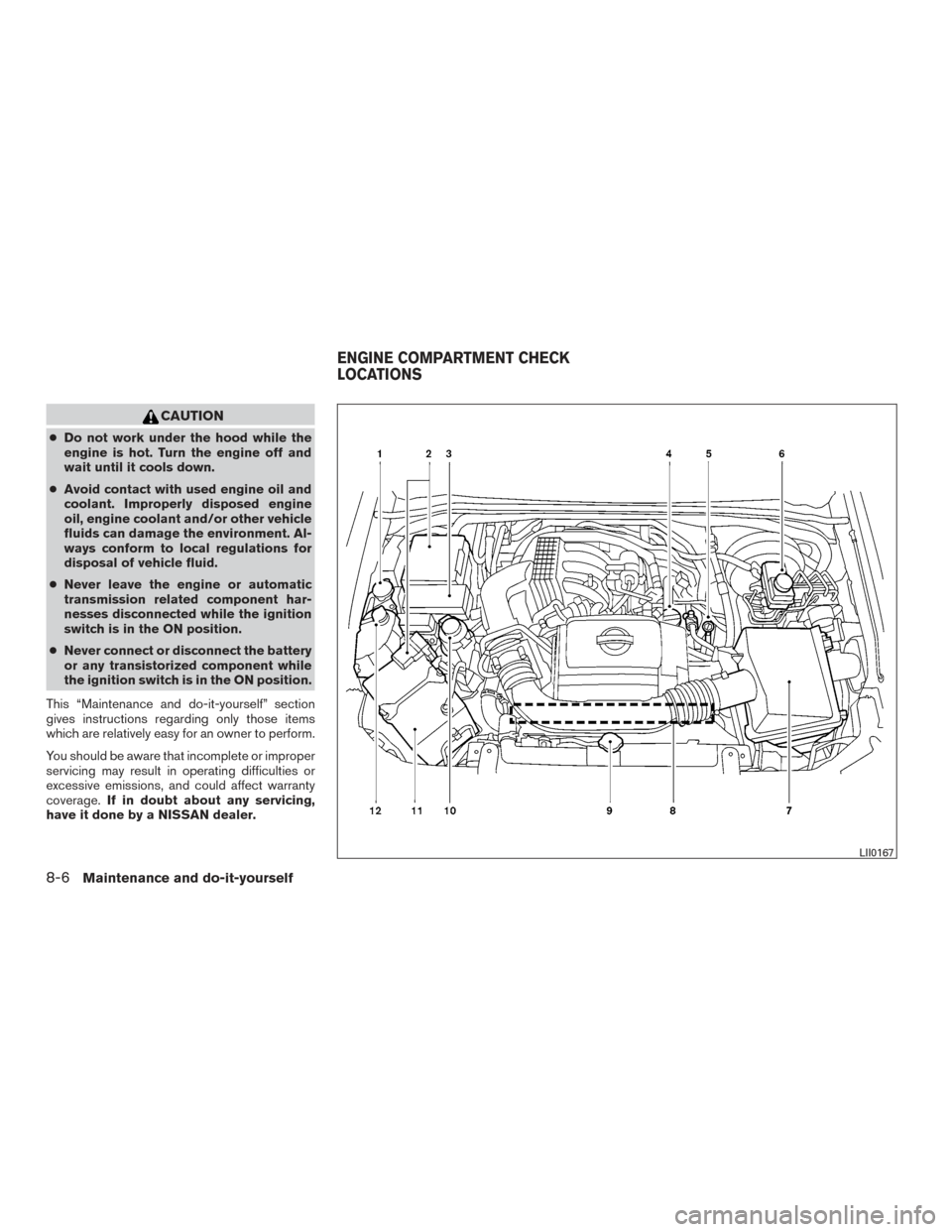
LII0167
ENGINE COMPARTMENT CHECK
LOCATIONS
8-6Maintenance and do-it-yourself
Page 323 of 396
When checking or replacement is required, we
recommend your NISSAN dealer for servicing.
CAUTION
●Use Genuine NISSAN Matic S ATF. If
Genuine NISSAN Matic S ATF is not
available, Genuine NISSAN Matic J ATF
may also be used.
● Using automatic transmission fluid
other than Genuine NISSAN Matic S
ATF or Matic J ATF will cause deteriora-
tion in driveability and automatic trans-
mission durability, and may damage the
automatic transmission, which is not
covered by the NISSAN new vehicle lim-
ited warranty.
The specified automatic transmission fluid is also
described on caution labels located in the engine
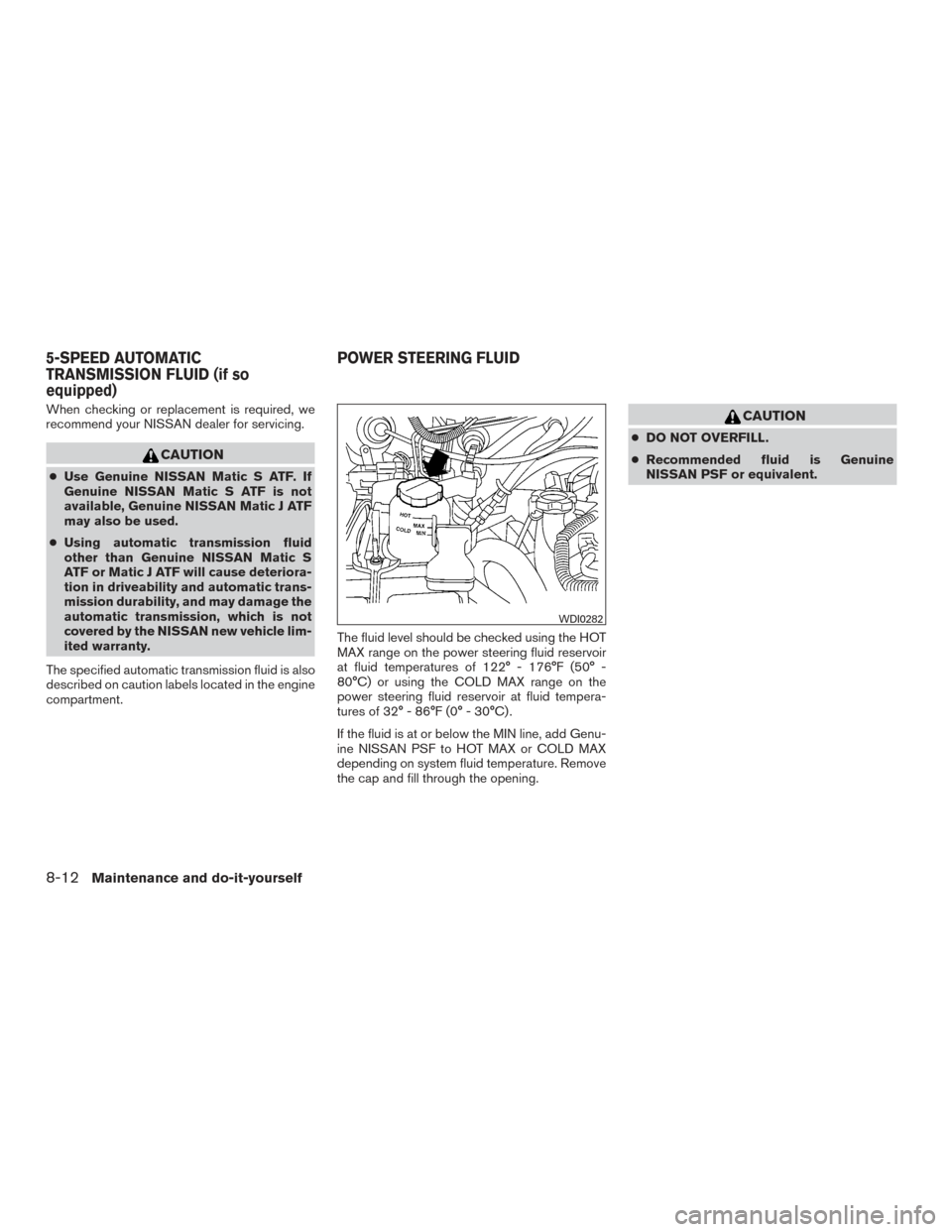
compartment. The fluid level should be checked using the HOT
MAX range on the power steering fluid reservoir
at fluid temperatures of 122° - 176°F (50° -
80°C) or using the COLD MAX range on the
power steering fluid reservoir at fluid tempera-
tures of 32° - 86°F (0° - 30°C) .
If the fluid is at or below the MIN line, add Genu-
ine NISSAN PSF to HOT MAX or COLD MAX
depending on system fluid temperature. Remove
the cap and fill through the opening.
CAUTION
●
DO NOT OVERFILL.
● Recommended fluid is Genuine
NISSAN PSF or equivalent.
WDI0282
5-SPEED AUTOMATIC
TRANSMISSION FLUID (if so
equipped) POWER STEERING FLUID
8-12Maintenance and do-it-yourself
Page 357 of 396
The following are approximate capacities. The actual refill capacities may be slightly different. When refilling, follow the procedure
described in the “Maintenance and do-it-yourself” section to determine the proper refill capacity.
Capacity (Approximate)Recommended Fluids and Lubricants
US measure Imp measure Liter
Fuel 21-1/8 Gal17-5/8 Gal 80 L • For additional information, refer to “Fuel recommendation” in this section.
Engine oil Drain and refill• For additional information, refer to “Engine oil” in the “Maintenance and
do-it-yourself” section of this manual.
VQ40DE With oil filter
change 5-3/8 qt
4-1/2 qt5.1 L• Genuine NISSAN engine oil or equivalent
• NISSAN recommends Genuine NISSAN Ester Oil available at a NISSAN
dealer
• Engine oil with API Certification Mark
• Viscosity SAE 5W-30
• For additional information, refer to “Engine oil and oil filter recommenda-
tions” in this section.
Without oil
filter change 5-1/8 qt
4-1/4 qt4.8 L
Cooling system With reservoir 2-3/4 gal 2-1/4 gal10.2 L • Pre-diluted Genuine NISSAN Long Life Antifreeze/Coolant (blue) or
equivalent
Manual transmission gear oil 4WD 4-3/8 qt3-5/8 qt4.2 L• Genuine NISSAN Manual Transmission Fluid (MTF) HQ Multi 75W-85
• API GL-4, Viscosity SAE 75W-85 may be used as a temporary replace-
ment for Genuine NISSAN Manual Transmission Fluid (MTF) HQ Multi
75W-85. However, NISSAN recommends the use of Genuine NISSAN
gear oil, available at NISSAN dealer.
Automatic transmission fluid Refill to the proper level according to the instructions in
the “Maintenance and do-it-yourself” section. • Genuine NISSAN Matic S ATF
• If Genuine NISSAN Matic S ATF is not available, Genuine NISSAN Matic J
ATF may also be used. Using automatic transmission fluid other than Genu-
ine NISSAN Matic S ATF or Genuine NISSAN Matic J ATF will cause dete-
rioration in driveability and automatic transmission durability, and may dam-
age the automatic transmission, which is not covered by the NISSAN new
vehicle limited warranty.
Power steering fluid (PSF) Refill to the proper level according to the instructions in
the “Maintenance and do-it-yourself” section. • Genuine NISSAN PSF or equivalent.
• DEXRON™ VI type ATF may also be used.
RECOMMENDED FLUIDS/
LUBRICANTS AND CAPACITIES
9-2Technical and consumer information
Page 381 of 396
Pre-towing tips
●Be certain your vehicle maintains a level
position when a loaded and/or unloaded
trailer is hitched. Do not drive the vehicle if it
has an abnormal nose-up or nose-down
condition; check for improper tongue load,
overload, worn suspension or other possible
causes of either condition.
● Always secure items in the trailer to prevent
load shift while driving.
●
Keep the cargo load as low as possible in the
trailer to keep the trailer center of gravity low.
● Load the trailer so approximately 60 percent
of the trailer load is in the front half and
40 percent is in the back half. Also make
sure the load is balanced side to side.
● Check your hitch, trailer tire pressure, ve-
hicle tire pressure, trailer light operation, and
trailer wheel lug nuts every time you attach a
trailer to the vehicle.
● Be certain your rearview mirrors conform to
all federal, state or local regulations. If not,
install any mirrors required for towing before
driving the vehicle.
● Determine the overall height of the vehicle
and trailer so the required clearance is
known.
Trailer towing tips
In order to gain skill and an understanding of the
vehicle’s behavior, you should practice turning,
stopping and backing up in an area which is free
from traffic. Steering stability and braking perfor-
mance will be somewhat different than under
normal driving conditions.
● Always secure items in the trailer to prevent
load shift while driving.
● Lock the trailer hitch coupler with a pin or
lock to prevent the coupler from inadver-
tently becoming unlatched.
● Avoid abrupt starts, acceleration or stops.
● Avoid sharp turns or lane changes.
● Always drive your vehicle at a moderate
speed.
● When backing up, hold the bottom of the
steering wheel with one hand. Move your
hand in the direction in which you want the
trailer to go. Make small corrections and
back up slowly. If possible, have someone
guide you when you are backing up.
Always block the wheels on both vehicle and
trailer when parking. Parking on a slope is not
recommended; however, if you must do so:
CAUTION
If you move the shift lever to the P (Park)
position before blocking the wheels and
applying the parking brake, transmission
damage could occur.
1. Apply and hold the brake pedal.
2. Have someone place blocks on the downhill side of the vehicle and trailer wheels.
3. After the wheel blocks are in place, slowly release the brake pedal until the blocks ab-
sorb the vehicle load.
4. Apply the parking brake.
5. Shift the transmission into P (Park) .
6. Make sure the
indicator light (if so
equipped) indicates the transfer case is in
4H, 4L, or 2H and that the ATP light is off. If
the
indicator light is flashing, or the
ATP light is ON, make sure the transmission
is in P (Park) (A/T) and turn the 4WD switch
to 2WD or 4H. Refer to, “Automatic trans-
mission park warning light” in the “Instru-
ments and controls” section and “Using four
wheel drive (4WD)” in the “Starting and
driving” section of this manual.
7. Turn off the engine.
9-26Technical and consumer information
Page 383 of 396
●Some states or provinces have specific
regulations and speed limits for vehicles that
are towing trailers. Obey the local speed
limits.
● Check your hitch, trailer wiring harness con-
nections, and trailer wheel lug nuts after
50 miles (80 km) of travel and at every break.
● When launching a boat, don’t allow the wa-
ter level to go over the exhaust tail pipe or
rear bumper.
● Make sure you disconnect the trailer lights
before backing the trailer into the water or
the trailer lights may burn out.
When towing a trailer, final drive gear oil
should be replaced and transmission
oil/fluid should be changed more fre-
quently. For additional information, refer to
“Maintenance and do-it-yourself” section
in this manual.
FLAT TOWING
Towing your vehicle with all four wheels on the
ground is sometimes called flat towing. This
method is sometimes used when towing a vehicle
behind a recreational vehicle, such as a motor
home.
CAUTION
● Failure to follow these guidelines can
result in severe transmission damage.
● Whenever flat towing your vehicle, al-
ways tow forward, never backward.
● DO NOT tow any automatic transmis-
sion vehicle with all four wheels on the
ground (flat towing) . Doing so WILL
DAMAGE internal transmission parts
due to lack of transmission lubrication.
● For emergency towing procedures refer
to “Towing recommended by NISSAN”
in the “In case of emergency” section of
this manual.
Manual Transmission (if so equipped)
● Always tow with the manual transmission in
Neutral.
● On 4-wheel drive vehicles, place the transfer
case in the 2H range. Failure to do so will
cause the powertrain to bind up. ●
After towing 500 miles (805 km) , start and
idle the engine with the transmission in Neu-
tral for two minutes. Failure to idle the engine
after every 500 miles (805 km) of towing
may cause damage to internal transmission
parts.
Automatic Transmission (if so
equipped)
To tow a vehicle equipped with an automatic
transmission, an appropriate vehicle dolly MUST
be placed under the towed vehicle’s drive
wheels. Always follow the dolly manufacturer’s
recommendations when using their product.
9-28Technical and consumer information
Page 388 of 396
10 Index
4WDwarninglight...............2-17A
Active brake limited slip (ABLS) system . . .5-34
Air bag (See supplemental restraint
system) .....................1-47
Air bag system Front (See supplemental front impact
air bag system) ...............1-54
Airbagwarninglabels.............1-61
Airbagwarninglight...........1-62,2-19
Air cleaner housing filter ............8-18
Air conditioner Air conditioner operation ..........4-18
Air conditioner service ...........4-23
Air conditioner specification label .....9-12
Air conditioner system refrigerant and
oil recommendations .............9-7
Heater and air conditioner controls ....4-15
Servicing air conditioner ..........4-23
Airflowcharts..................4-19
Alarm system
(See vehicle security system) .........2-24
Anchor point locations .............1-30
Antenna .....................4-57
Anti-lock brake warning light ..........2-15
Anti-lock Braking System (ABS) ........5-33
Audible reminders ...............2-23
Audio system ..................4-23
Bluetooth®audio..............4-54
Compact disc (CD) player . .4-33, 4-37, 4-44 FM-AM radio with compact disc (CD)
player ....................4-31
FM/AM/SAT radio with compact disc (CD)
player.................4-35,4-39
Audio System iPod® Player .............4-49,4-51
Audio system Radio ....................4-23
Steering wheel audio control switch . . .4-56
USB interface ............4-45,4-47
Autolight switch .................2-29
Automatic Automatic power window switch .....2-49
Automatic transmission position indicator
light .....................2-20
Driving with automatic transmission ....5-13
Automatic anti-glare inside mirror .......3-15
Automatic door locks ..............3-5
AUXjack.................4-34,4-45
B
Battery ......................8-14
Chargewarninglight............2-16
Before starting the engine ...........5-12
Belt (See drive belt) ..............8-17
Block heater Engine ....................5-39
Bluetooth®audio................4-54
Bluetooth® hands-free phone
system ...............4-59,4-74,4-84
Boosterseats..................1-44 Brake
Anti-lock Braking System (ABS) ......5-33
Brake fluid ..................8-13
Brakelight(Seestoplight).........8-31
Brake system ................5-32
Brakewarninglight.............2-16
Brakewearindicators........2-23,8-23
Parking brake operation ..........5-19
Self-adjusting brakes ............8-23
Brakes ......................8-23
Break-inschedule ...............5-21
Brightness/contrast button ...........4-9
Brightness control Instrument panel ..............2-31
Bulb check/instrument panel ..........2-15
Bulbreplacement................8-31
C
Capacities and recommended
fuel/lubricants ...................9-2
Cargolight ...................2-51
Cargonet....................2-44
Cargo (See vehicle loading information) . . .9-12
Car phone or CB radio .............4-58
CDcareandcleaning .............4-55
CD player (See audio system) . .4-33, 4-37, 4-44
Check tire press .................2-5
Child restraints .......1-24,1-25,1-26,1-28
Precautions
on child
restraints ........1-26,1-33,1-39,1-44
Top tether strap anchor point locations . .1-30
Page 389 of 396
Child restraint with top tether strap.......1-30
Child safety rear door lock ............3-5
Chimes, audible reminders ...........2-23
Cleaningexteriorandinterior...........7-2
Clock.......................4-32 (models without navigation system) ....4-32
Clockset.....................4-32
Clutch Clutch fluid ..................8-13
Clutch interlock (clutch start) switch ......2-36
C.M.V.S.S. certification label ..........9-11
Cold weather driving ...............5-38
Compact disc (CD) player ....4-33,4-37,4-44
Compass display .................2-10
Consolebox...................2-39
Control panel buttons ...............4-4
Brightness/contrast button ..........4-9
Enterbutton..................4-4
Setting button .................4-7
Controls Audiocontrols(steeringwheel).......4-56
Heater and air conditioner controls .....4-15
Coolant Capacities and recommended
fuel/lubricants .................9-2
Changing engine coolant ...........8-8
Checking engine coolant level ........8-8
Engine coolant temperature gauge .....2-6
Corrosionprotection ...............7-6
Cruisecontrol..................5-20
Cupholders...................2-41
Curtain side-impact and rollover air bag ....1-59D
Daytime running light system (Canada only) . .2-30
Defroster switch Rear window and outside mirror defroster
switch.....................2-28
Dimensionsandweights.............9-9
Dimmer switch for instrument panel ......2-31
Display controls (see control panel buttons) . .4-4
Door locks .....................3-3
Door open warning light .............2-17
Drive belt .....................8-17
Driving Cold weather driving .............5-38
Driving with automatic transmission ....5-13
Driving with manual transmission ......5-17
Precautions when starting and driving ....5-2
E
Economy - fuel ..................5-23
Electronic locking rear differential (E-Lock)
system ......................5-29
Electronic locking rear differential (E-Lock)
system switch ..................2-35
Emission control information label .......9-11
Emission control system warranty .......9-30
Engine Before starting the engine ..........5-12
Block heater .................5-39
Capacities and recommended
fuel/lubricants .................9-2
Changingenginecoolant...........8-8
Changingengineoil.............8-10 Changing engine oil filter
..........8-11
Checking engine coolant level ........8-8
Checking engine oil level ...........8-9
Engine compartment check locations ....8-6
Engine coolant temperature gauge .....2-6
Engine cooling system ............8-7
Engineoil ...................8-9
Engine oil and oil filter recommendation . . .9-6
Engine oil pressure warning light ......2-17
Engine oil viscosity ............. .9-6
Engine
serial number ............9-10
Engine specifications .............9-8
Starting the engine .............5-12
Engine oil pressure gauge ............2-8
Enter button ....................4-4
Event data recorders ..............9-32
Exhaust gas (Carbon monoxide) .........5-2
Extended storage switch ............8-26
F
First aid kit .....................6-3
Flashers (See hazard warning flasher switch) . .6-2
Flat tire .......................6-3
Floor mat positioning aid .............7-5
Fluid Brake fluid ..................8-13
Capacities and recommended
fuel/lubricants.................9-2
Clutch fluid ..................8-13
Enginecoolant.................8-7
Engineoil ...................8-9
Power steering fluid .............8-12
Windshield-washer fluid ...........8-14
F.M.V.S.S. certification label ...........9-11
10-2
Page 392 of 396
On-pavement and off-road driving
precautions ..................5-5
Precautions on child
restraints.........1-26,1-33,1-39,1-44
Precautionsonseatbeltusage.......1-13
Precautions on supplemental restraint
system ....................1-47
Precautions when starting and driving ....5-2
Pre-tensioner seat belt system .........1-60
Programmable features ..............4-7
Push starting ...................6-12
R
Radio Car phone or CB radio ...........4-58
FM-AM radio with compact disc (CD)
player .....................4-31
FM/AM/SAT radio with compact disc (CD)
player .................4-35,4-39
Steering wheel audio control switch ....4-56
Readiness for inspection maintenance (I/M)
test........................9-31
Rear center seat belt ..............1-19
Rear power windows ..............2-49
RearViewMonitor................4-10
Rear window and outside mirror defroster
switch.......................2-28
Rear window wiper and washer switches . . .2-27
Recorders Eventdata..................9-32
Refrigerant recommendation ...........9-7
Registering your vehicle in another country . .9-10
Remote keyless entry system ...........3-6
Reporting safety defects (US only) .......9-30Roof rack
.....................2-45
S
Safety Child safety rear door lock ..........3-5
Child seat belts .....1-26,1-33,1-39,1-44
Reporting safety defects (US only) .....9-30
Seat adjustment Frontmanualseatadjustment ........1-2
Seatback pockets ................2-40
Seat belt Child safety ..................1-24
Infantsandsmallchildren..........1-25
Injured Person ................1-16
Largerchildren................1-25
Precautions on seat belt usage .......1-13
Pregnant women ...............1-16
Pre-tensioner seat belt system .......1-60
Rear center seat belt ............1-19
Seatbeltextenders .............1-23
Seat belt maintenance ............1-23
Seatbelts...................1-13
Shoulder belt height adjustment ......1-22
Three-point type with retractor .......1-16
Seat belt warning light ..........1-16,2-19
Seats Adjustment...................1-2
Front seats ...................1-2
Heated seats .................2-33
Manual front seat adjustment .........1-2
Security indicator light ..............2-22
Security system (NISSAN vehicle immobilizer
system) , engine start ........2-25,3-2,5-11
Self-adjusting brakes ..............8-23 Service manual order form
...........9-32
Servicing air conditioner .............4-23
Setting button ...................4-7
Shifting Automatic transmission ...........5-14
Manual transmission .............5-18
Shiftlockrelease.................5-16
Shoulder belt height adjustment ........1-22
Side air bag system (See supplemental side air
bag, curtain and rollover air bag systems) . . .1-59
Sparkplugreplacement.............8-18
Speedometer ...................2-4
SRSwarninglabel................1-61
Starting Before starting the engine ..........5-12
Jump starting .................6-10
Precautions
when starting and driving ....5-2
Push starting .................6-12
Starting the engine .............5-12
Steering Power steering fluid .............8-12
Power steering system ...........5-32
Tilting steering wheel ............3-13
Steeringwheelaudiocontrolswitch......4-56
Stoplight.....................8-31
Storage......................2-38
Storagebin....................2-42
Storage tray ...................2-38
Sunglasses case .................2-39
Sun visors ....................3-13
Supplemental air bag warning labels ......1-61
Supplemental air bag warning light . . .1-62, 2-19
Supplemental front impact air bag system . . .1-54
Supplemental restraint system Information and warning labels .......1-61
10-5
Page 393 of 396
Precautions on supplemental restraint
system ....................1-47
Supplemental restraint system
(Supplemental air bag system) .........1-47
Switch Autolightswitch...............2-29
Automatic power window switch ......2-49
Clutch interlock (clutch start) switch ....2-36
Electronic locking rear differential (E-Lock)
systemswitch................2-35
Foglightswitch ...............2-31
Hazard warning flasher switch ........6-2
Headlight and turn signal switch ......2-28
Headlight control switch ..........2-28
Hill descent control switch .........2-34
Ignition switch .................5-9
Overdrive switch ...............5-17
Power door lock switch ............3-4
Rear window and outside mirror defroster
switch.....................2-28
Rear window wiper and washer
switches ...................2-27
Turnsignalswitch..............2-31
Vehicle dynamic control (VDC) off
switch.....................2-34
Windshield wiper and washer switch . . .2-26
T
Tachometer ....................2-6
Temperature gauge Engine coolant temperature gauge .....2-6
Theft (NISSAN vehicle immobilizer system) ,
engine start .............2-25,3-2,5-11
Three-way catalyst ................5-2 Tilting steering wheel
..............3-13
Tire Flat tire .....................6-3
Spare tire ...................6-5
Tire and Loading Information label .....9-11
Tirechains..................8-41
Tireplacard..................9-11
Tire pressure .................8-34
Tirerotation..................8-41
Tires of 4-wheel drive ............8-43
Types of tires .................8-40
Uniform tire quality grading .........9-29
Wheels and tires ...............8-34
Wheel/tire size .................9-9
Tire pressure Low tire pressure warning light .......2-18
Tire Pressure Monitoring System (TPMS) ....5-3
Top tether strap child restraint .........1-30
Towing 2-wheel drive models ............6-14
4-wheel drive models ............6-15
Flattowing..................9-28
Towing load/specification ..........9-22
Towtrucktowing...............6-13
Trailer towing .................9-19
Transmission Driving with automatic transmission ....5-13
Driving with manual transmission ......5-17
Travel (See registering your vehicle in another
country) ......................9-10
Trip computer ...................2-9
Trip odometer ...................2-4
Turn signal switch ................2-31 U
Uniform tire quality grading ...........9-29
USB interface Audio file operation ..........4-46,4-48
V
Vanity mirror ...................3-14
Variable voltage control system .........8-17
Vehicle dimensions and weights .........9-9
Vehicle dynamic control (VDC) off switch . . .2-34
Vehicle dynamic control (VDC) system .....5-35
V
ehicle identification ...............9-10
Vehicle identification number (VIN) plate ....9-10
Vehicle loading information ...........9-12
Vehicle recovery .................6-15
Vehicle security system .............2-24
Vehicle security system (NISSAN vehicle immobi-
lizer system) , engine start ......2-25,3-2,5-11
Ventilators ....................4-15
Visors.......................3-13
Voice Prompt Interrupt . . .4-63, 4-76, 4-77, 4-87
Voice recognition system ............4-91
Voltmeter ......................2-8
W
Warning 4WDwarninglight..............2-17
Air bag warning light .........1-62,2-19
Anti-lock brake warning light ........2-15
Battery charge warning light ........2-16
Brake warning light .............2-16
10-6