lights Oldsmobile Achieva 1995 Owner's Manuals
[x] Cancel search | Manufacturer: OLDSMOBILE, Model Year: 1995, Model line: Achieva, Model: Oldsmobile Achieva 1995Pages: 340, PDF Size: 16.99 MB
Page 7 of 340

Vehicle Symbols
These are some of the symbols you may find on your vehicle.
For example,
these symbols
are used on an
original battery:
POSSIBLE A
CAUTION
INJURY
PROTECT EYES BY
SHIELDING
CAUSTIC
ACID COULD BATTERY
CAUSE
BURNS
AVOID
SPARKS
OR
FLAMES
SPARK
OR ,\I/,
COULD FLAME
EXPLODE BATTERY
These symbols
are important
for you and
your passengers
whenever your
vehicle
is
driven:
DOOR LOCK
UNLOCK
FASTEN SEAT
BELTS
POWER
WINDOW
These symbols
have to do with
your lights:
SIGNALS e e
TURN
FOG LAMPS
$0
These symbols
are on some of
your controls:
WINDSHIELD
WIPER
WINDSHIELD DEFROSTER
WINDOW
DEFOGGER
VENTILATING FAN
These symbols are used on
warning and
indicator lights:
COOLANT F-
TEMP --
ENGINE
CHARGING
I-1
BATTERY SYSTEM
BRAKE
(a)
FUEL
ENGINE OIL
PRESSURE
Wd
TEMP OIL 9b
ANTI-LOCK (@)
BRAKE
Here are some
other symbols
you may see:
FUSE -%-
RELEASE
RADIO
VOLUME
CONDITIONING
A'R 43
RELEASE TRUNK e
LIGHTER n
HORN )tr
SPEAKER
b
V
Page 69 of 340
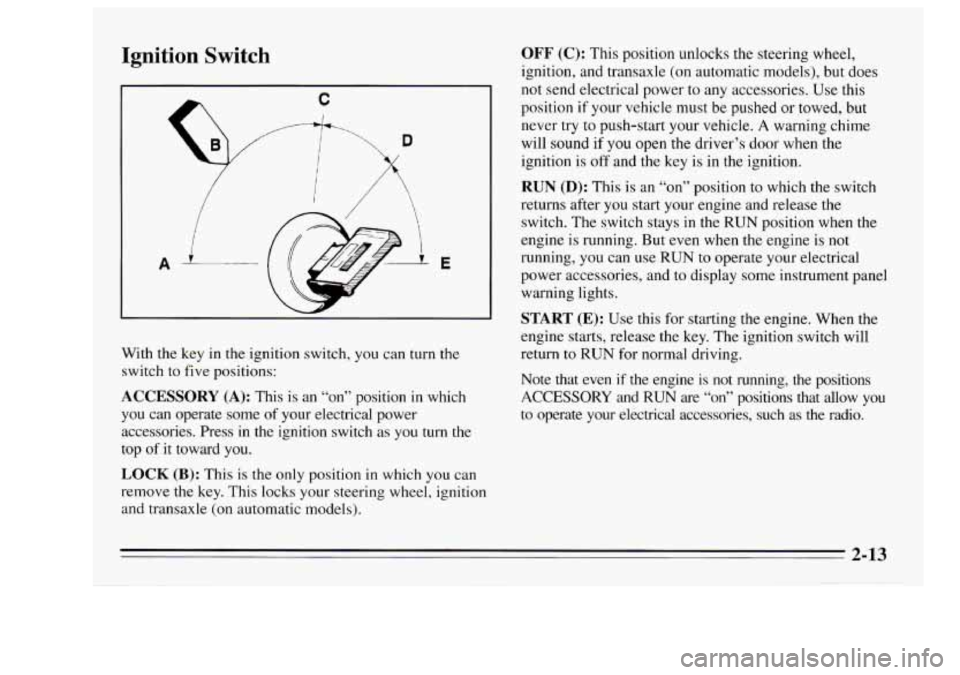
Ignition Switch
A E
With the key in the ignition switch, you can turn the
switch to five positions:
ACCESSORY (A): This is an “on” position in which
you can operate some
of your electrical power
accessories. Press in the ignition switch as you
turn the
top
of it toward you.
LOCK (B): This is the only position in which you can
remove the key. This locks your steering wheel, ignition
and transaxle (on automatic models).
OFF (C): This position unlocks the steering wheel,
ignition, and transaxle (on automatic models), but does
not send electrical power to any accessories. Use this
position
if your vehicle must be pushed or towed, but
never try to push-start your vehicle.
A warning chime
will sound if
you open the driver’s door when the
ignition is
off and the key is in the ignition.
RUN (D): This is an “on” position to which the switch
returns after you start your engine and release the
switch. The switch stays
in the RUN position when the
engine is running. But even when the engine
is not
running, you can use
RUN to operate your electrical
power accessories, and to display some instrument panel
warning lights.
START (E): Use this for starting the engine. When the
engine starts, release the key.
The ignition switch will
return to
RUN for normal driving.
Note that even
if the engine is not running, the positions
ACCESSORY and RUN are “on” positions that allow you
to operate your electrical accessories, such as the radio.
2-13
Page 91 of 340
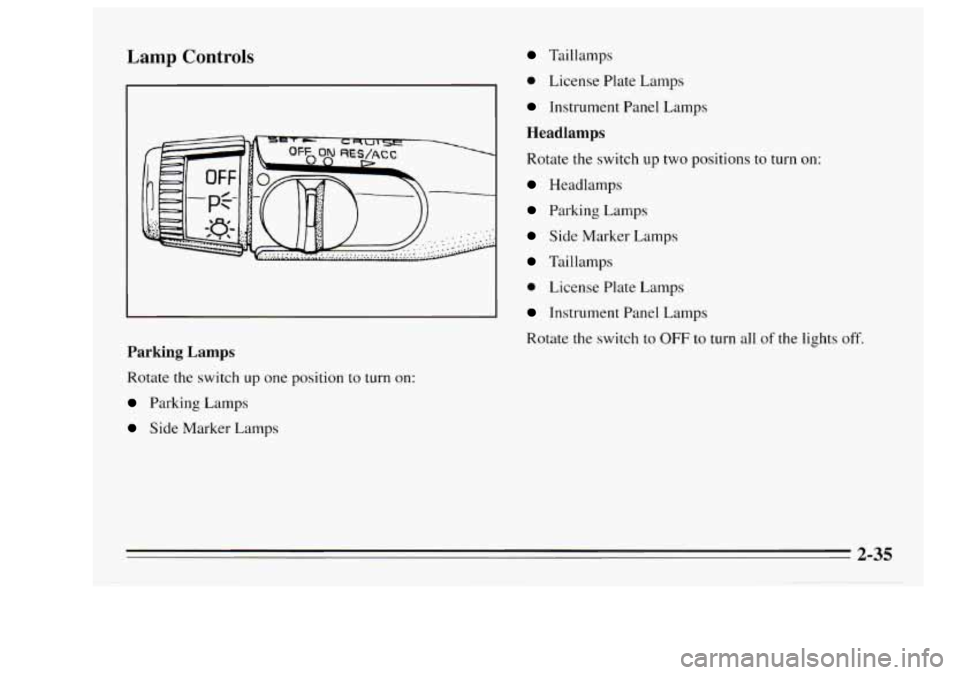
Lamp Controls
Parking Lamps
Rotate the switch up one position to turn on:
Parking Lamps
Side Marker Lamps
Tai 1 I amps
0 License Plate Lamps
Instrument Panel Lamps
Headlamps
Rotate the switch up two positions to turn on:
Headlamps
Parking Lamps
Side Marker Lamps
Taillamps
0 License Plate Lamps
Instrument Panel Lamps
Rotate the switch to
OFF to turn all of the lights off.
2-35
Page 99 of 340
To Get Out of Cruise Control
There are two ways to turn off the cruise control:
Step lightly on the brake pedal or push the clutch
pedal, if you have
a manual transaxle; OR
Move the cruise switch to OFF.
To Erase Cruise Speed Memory
When you turn off the cruise control or the ignition,
your cruise control set speed memory is erased.
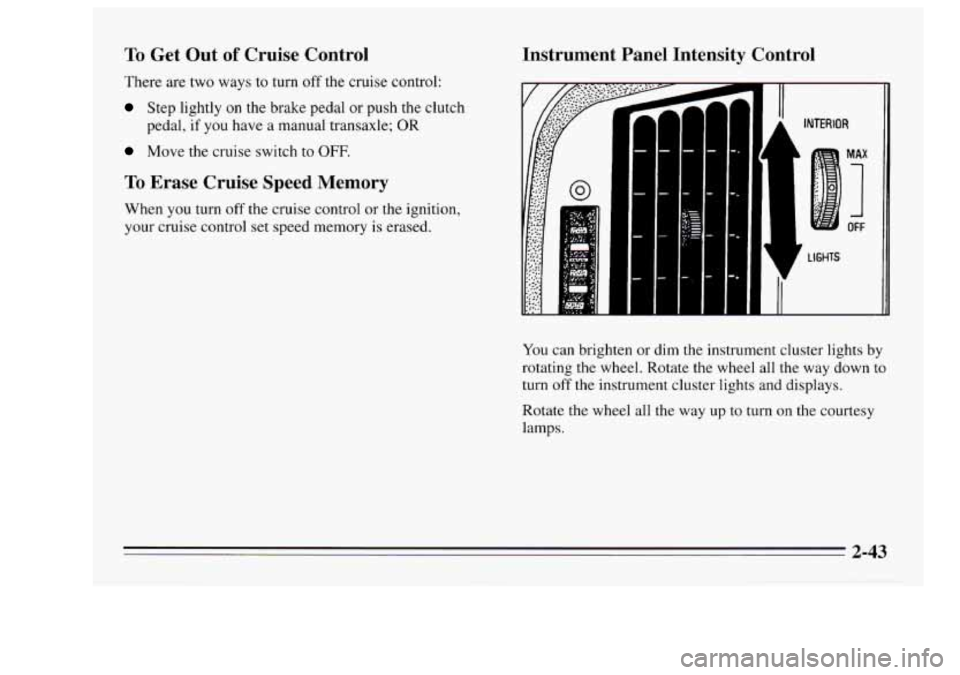
Instrument Panel Intensity Control
I A lNTER’OR 7
A LIGHTS
You can brighten or dim the instrument cluster lights by
rotating the wheel. Rotate the wheel all the way down to
turn
off the instrument cluster lights and displays.
Rotate
the wheel all the way up to turn on the courtesy
lamps.
2-43
Page 100 of 340
Fog Lamps (Option) Daytime Running Lamps (Canada Only)
7 %.
OFF
LIGHTS
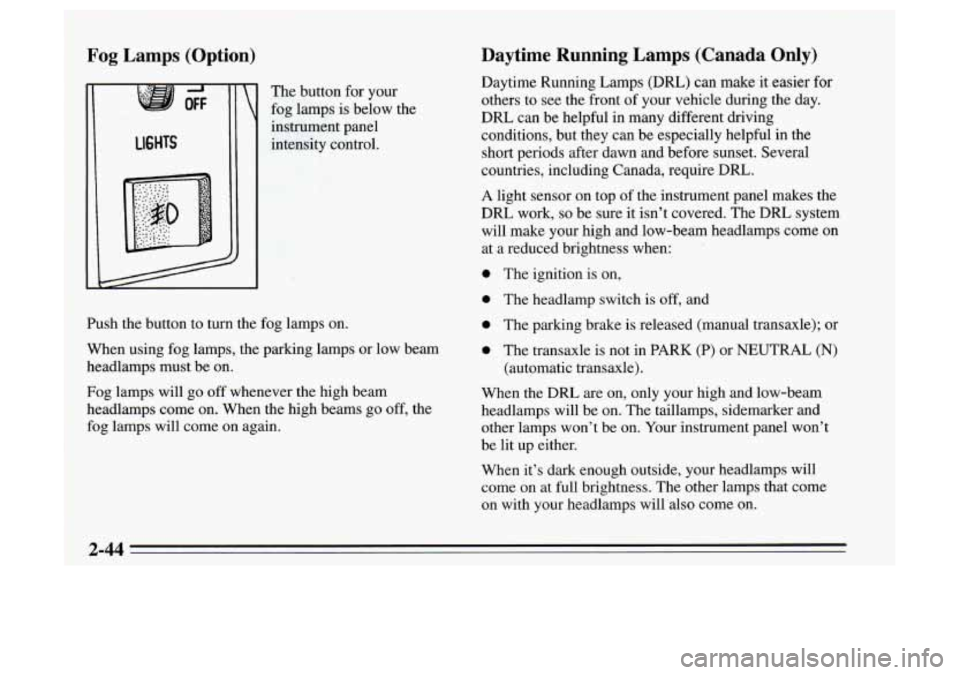
The
button for your
fog lamps is below the
instrument panel
intensity control. Daytime Running
Lamps (DRL) can make it easier for
others to see the front of your vehicle during the day.
DRL can be helpful in many different driving
conditions, but they can
be especially helpful in the
short periods after dawn and before sunset. Several
countries, including Canada, require DRL.
A light sensor on top of the instrument panel makes the
DRL work,
so be sure it isn’t covered. The DRL system
will make your high and low-beam headlamps come on
at a reduced brightness when:
0 The ignition is on,
Push the button to turn the fog lamps on.
When using fog lamps, the parking lamps or low beam
headlamps must be on.
Fog lamps will go off whenever the high beam
headlamps come on. When the high beams go
off, the
fog lamps will come on again.
0 The headlamp switch is off, and
0 The parking brake is released (manual transaxle); or
0 The transaxle is not in PARK (P) or NEUTRAL (N)
(automatic transaxle).
When the DRL are on, only your high and low-beam
headlamps will be on. The taillamps, sidemarker and
other lamps won’t be on. Your instrument panel won’t
be lit up either.
When it’s dark enough outside, your headlamps will
come on at
full brightness. The other lamps that come
on with your headlamps will also come on.
Page 103 of 340
Also, if your vehicle is left with the ignition turned off
for over 24 days, battery power to your clock, audio
system and Remote
Lock Control (if you have this
option) will be turned
off to reduce battery drain. When
the ignition is turned on again, battery power will
be
resupplied. However, under these conditions, it will be
necessary to reset the clock and audio system settings.
Inside Manual Daymight Rearview Mirror
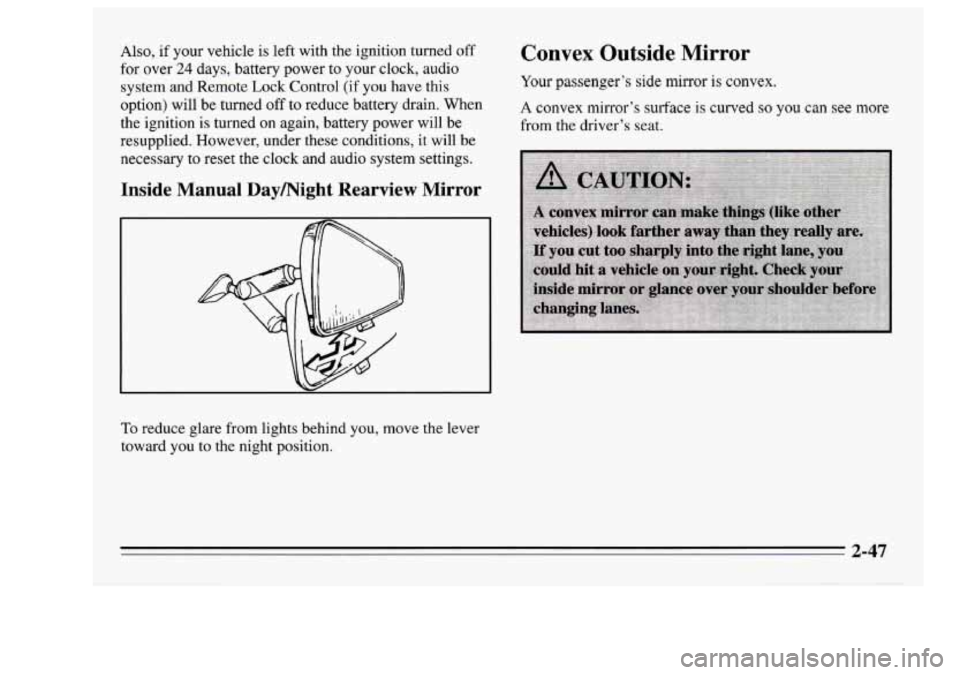
To reduce glare from lights behind you, move the lever
toward you to the night position.
Convex Outside Mirror
Your passenger’s side mirror is convex.
A convex mirror’s surface is curved so you can see more
from the driver’s seat.
2-47
Page 112 of 340
Instrument Panel Clusters
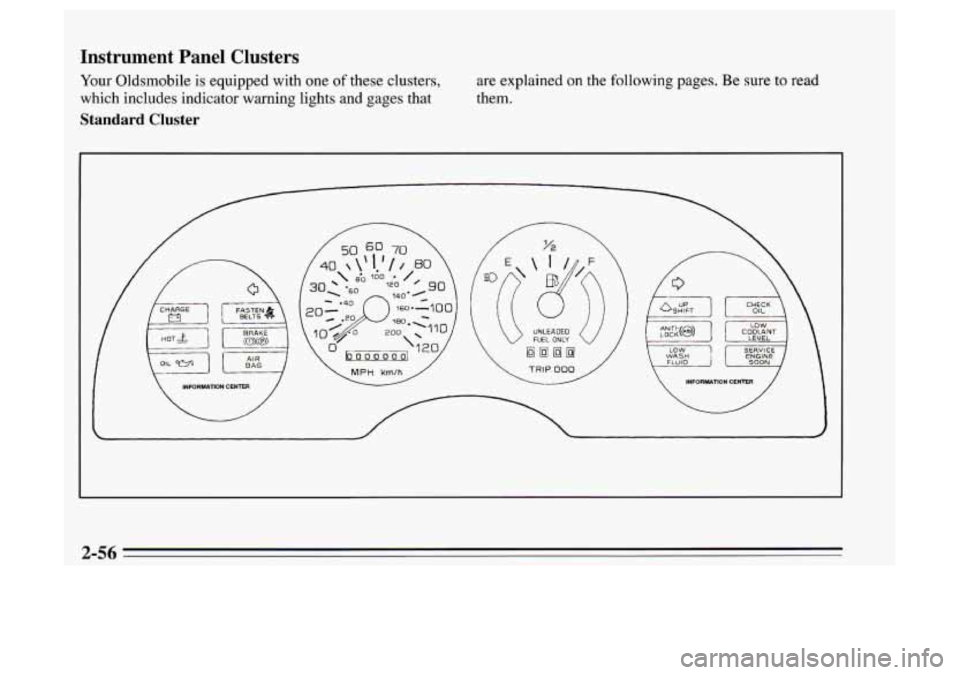
Your Oldsmobile is equipped with one of these clusters,
which includes indicator warning lights and gages that
Standard Cluster
are explained on the following pages. Be sure to read
them.
FASTEN& BELTS
HOT &
OIL y9 A1 R BAG
INFORMATION CENTER INFORWTION
CENTER
1
2-56
Page 115 of 340
Warning Lights, Gages and
Indicators
Warning lights and gages can signal that something is
wrong before it becomes serious enough to cause an
expensive repair or replacement. Paying attention to
your warning lights and gages could also save you or
others from injury.
Warning lights come on when there may be or is a
problem with one of your vehicle’s functions.
As you
will see
in the details on the next few pages, some
warning lights come on briefly when you start the engine just to let you know they’re working. If you are
familiar with this section, you should not be alarmed when this happens.
Gages can indicate when there may be or is a problem
with one of your vehicle’s functions. Often gages and
warning lights work together to let you know when
there’s a problem with your vehicle.
When one of the warning lights comes on and stays on
when you are driving, or when one of the gages shows
there may be a problem, check the section that tells you
what to do about it. Please follow this manual’s advice.
Waiting to do repairs can be costly
-- and even
dangerous.
So please get to know your warning lights
and gages. They’re a big help.
Safety Belt Warning Light
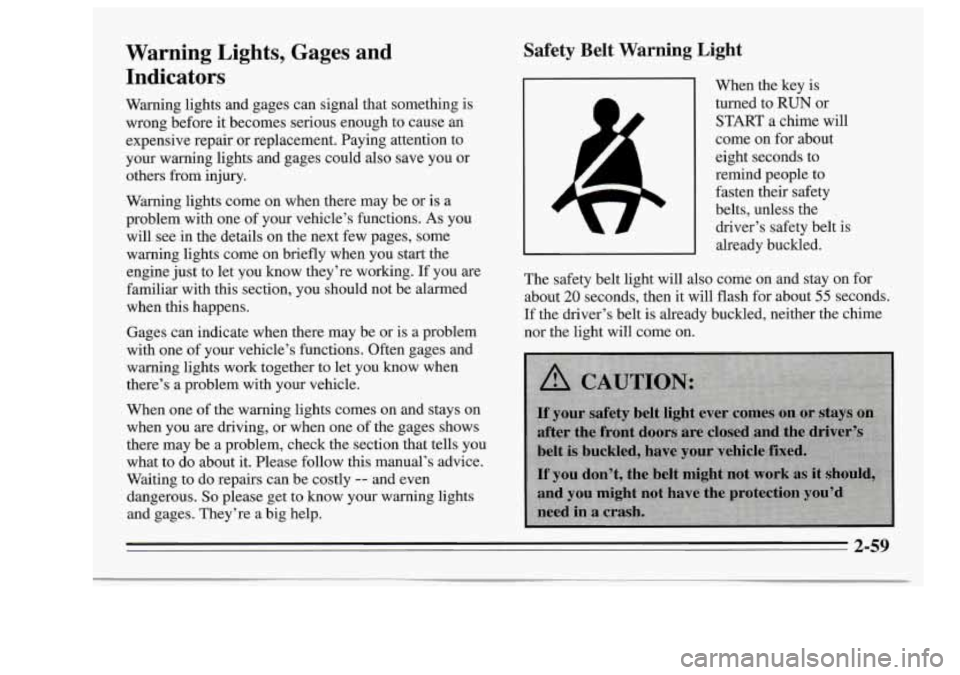
When the key is
turned to
RUN or
START a chime will
come on for about
eight seconds to
remind people to fasten their safety
belts, unless the
driver’s safety belt
is
already buckled.
The safety belt light will also come on and stay on for
about
20 seconds, then it will flash for about 55 seconds.
If the driver’s belt is already buckled, neither the chime
nor the light will come on.
2-59
Page 158 of 340
You can be temporarily blinded by approaching lights. It
can take
a second or two, or even several seconds, for
your eyes to readjust to the dark. When
you are faced
with severe glare (as from a driver who doesn’t lower
the high beams, or
a vehicle with misaimed headlamps),
slow down a little. Avoid staring directly into the
approaching lights.
Keep your windshield and all
the glass on your vehicle
clean
-- inside and out, Glare at night is made much
worse by dirt
on the glass. Even the inside of the glass
can build up a film caused by dust. Dirty glass makes
lights dazzle and flash more than clean glass would,
making the pupils of your eyes contract repeatedly.
Remember that your headlamps light up far less
of a
roadway when you are in a turn or curve. Keep your
eyes moving; that way,
it’s easier to pick out dimly
lighted objects. Just as your headlamps should be
checked regularly for proper aim,
so should your eyes
be examined regularly. Some drivers suffer from night
blindness
-- the inability to see in dim light -- and aren’t
even aware of it.
Driving in the Rain
4-14
~--
Page 221 of 340
Underhood Light
Your parking lights or headlights must be on for the
underhood light
to function when you open the hood.
Engine Oil
If the CHECK OIL light on the instrument panel comes
on, it means you need to check your engine oil level
right away. For more information, see
”CHECK OIL
LIGHT” in the Index. You should check your engine oil
level regularly; this is an added reminder.
It’s a good idea
to check your engine oil every time you
get fuel.
In order to get an accurate reading, the oil must
be warm and the vehicle must be
on level ground.
Turn
off the engine and give the oil a few minutes to
drain back into the oil pan. If you don’t, the oil dipstick
might not show the actual level.
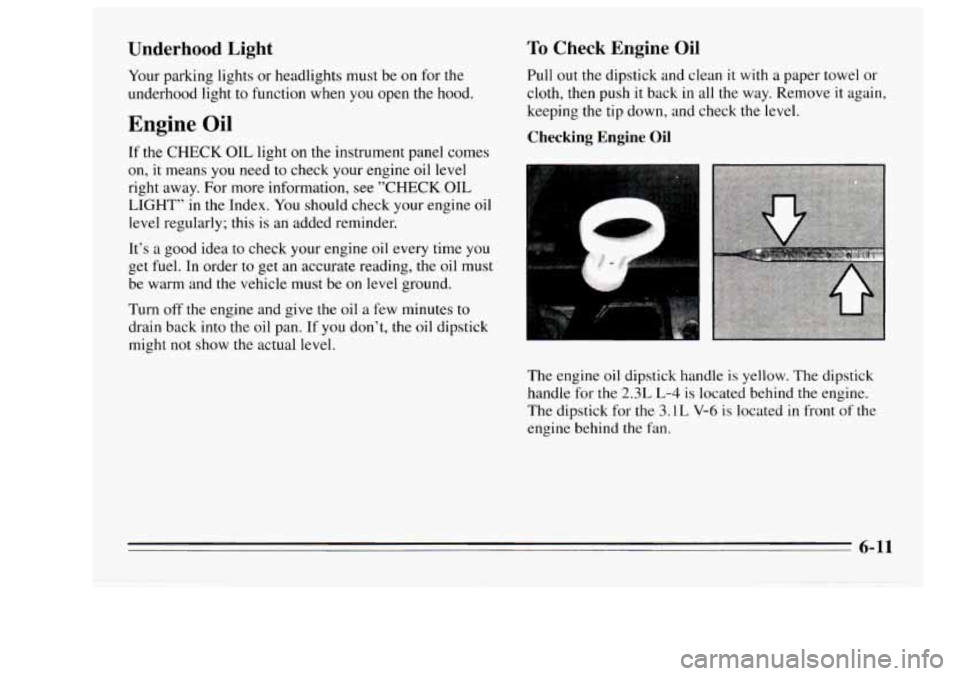
To Check Engine Oil
Pull out the dipstick and clean it with a paper towel or
cloth, then push it back in all the way. Remove it again,
keeping the tip down, and check the level.
Checking Engine Oil
The engine oil dipstick handle is yellow. The dipstick
handle for the
2.3L L-4 is located behind the engine.
The dipstick for the 3.1L
V-6 is located in front of the
engine behind the fan.
6-11