cooling Oldsmobile Achieva 1997 s User Guide
[x] Cancel search | Manufacturer: OLDSMOBILE, Model Year: 1997, Model line: Achieva, Model: Oldsmobile Achieva 1997Pages: 372, PDF Size: 18.52 MB
Page 255 of 372
NOTICE:
When adding coolant, it is important that you use
only
DEX-COOL@ (silicate-free) coolant.
If coolant is other than DEX-COOL@ is added to
the system, premature engine, heater core or
radiator corrosion may result. In addition, the
engine coolant will require change sooner
-- at
30,000 miles (50 000 km) or 24 months,
whichever occurs first. Damage caused by the use
of coolant other than DEX-COOL’ is not
covered by our new vehicle warranty.
What to Use
Use a mixture of one-half clean water (preferably
distilled) and one-half
DEX-COOL@ coolant which
won’t damage aluminum parts.
If you use this mixture,
you don’t need
to add anything else.
Adding only plain water to your cooling system can be dangerous. Plain water, or some other
liquid like alcohol, can boil before the proper
coolant mix will. Your vehicle’s coolant warning
system is set for the proper coolant mix. With
plain water or the wrong mix, your engine could
get too hot but you wouldn’t get the overheat
warning. Your engine could catch fire and you or
others could be burned. Use
a 50/50 mix of clean
water and DEX-COOL%oolant.
Page 256 of 372
NOTICE:
If you use an improper coolant mix, your engine
could overheat and be badly damaged. The
repair cost wouldn't be covered
by your
warranty.
Too much water in the mix can freeze
and crack the engine, radiator, heater core and
other parts.
If you have to add coolant more than four times a yea,
have your retailer check your cooling system.
I NOTICE:
If you use the proper coolant, you don't have to
add extra inhibitors or additives which claim to
improve the system. These can be harmful.
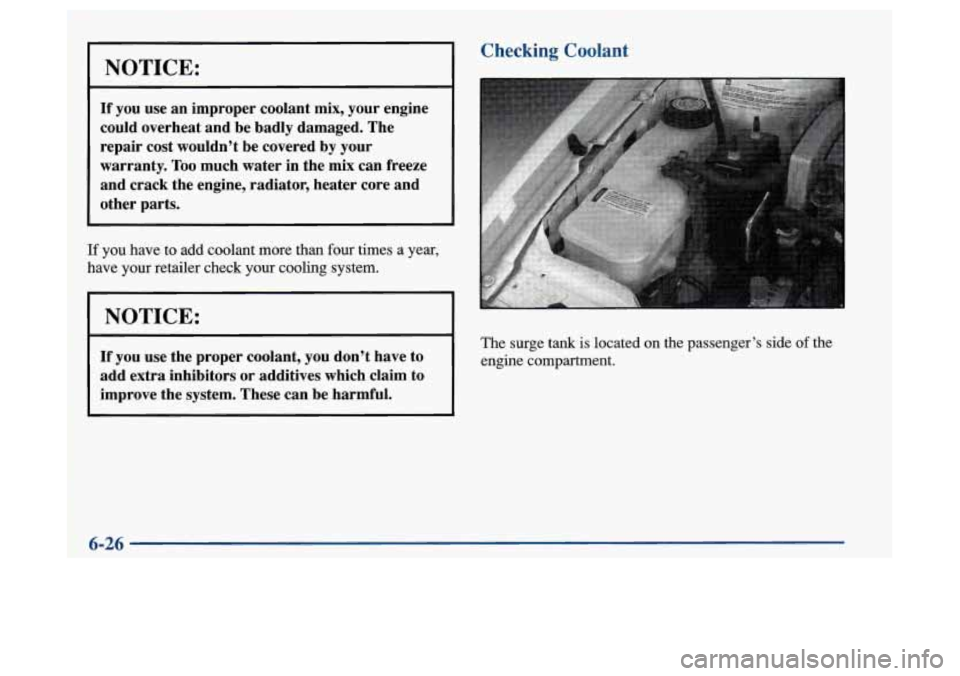
Checking Coolant
The surge tank is located on the passenger's side of the
engine compartment.
6-26
Page 276 of 372
Wheel Replacement
Replace any wheel that is bent, cracked, or badly rusted
or corroded. If wheel nuts keep coming loose, the wheel,
wheel bolts and wheel nuts should
be replaced. If the
wheel leaks air, replace it (except some aluminum
wheels, which can sometimes be repaired). See your
Oldsmobile retailer if any of these conditions exist.
Your retailer will know the kind of wheel you need.
Each new wheel should have the same load-carrying
capacity, diameter, width, offset and be mounted the
same way as the one it replaces.
If you need
to replace any of your wheels, wheel bolts
or wheel nuts, replace them only with new
GM original
equipment parts. This way, you will be sure to have the
right wheel, wheel bolts and wheel nuts for your
Oldsmobile model.
c
a CAUTION:
Using the wrong replacement wheels, wheel
bolts or wheel nuts on your vehicle can be
dangerous. It could affect the braking and
handling of your vehicle, make your tires lose
air
and make you lose control. You could have a
collision in which you or others could be injured.
Always use the correct wheel, wheel bolts and
wheel nuts for replacement.
I NOTICE:
~~
The wrong wheel can also cause problems with
bearing life, brake cooling, speedometer or
odometer calibration, headlamp aim, bumper
height, vehicle ground clearance and tire or tire
chain clearance to the body and chassis.
See “Changing a Flat Tire” in the Index for
more information.
6-46
Page 291 of 372
Fuse
IGN MOD
HVAC BLO MOT
PCM BATT
CLG FAN
HDLP
STOP
LPS PWR
ACC
RR DEFG
ABS
IGN SW
Usage
Ignition System
Heater/ Air Conditioner-High
Blower, Generator-Voltage
Sense
Powertrain Computer
Engine Cooling Fan
Lighting Circuits
Power Accessory,
Stoplamp Circuits,
Rear Window Defogger
Anti-Lock Brakes,
Variable
Effort Steering
Ignition Switched Circuits
Replacement Bulbs
Outside Lamps Bulb
Headlamp .............................. 9004
Back-up ............................... 2057
High Level Stop
.......................... 912
Tail/Stop/Turn
.......................... 3057
Inside Lamps Bulb
Dome .................................. 562
6-61
- . -
Page 292 of 372
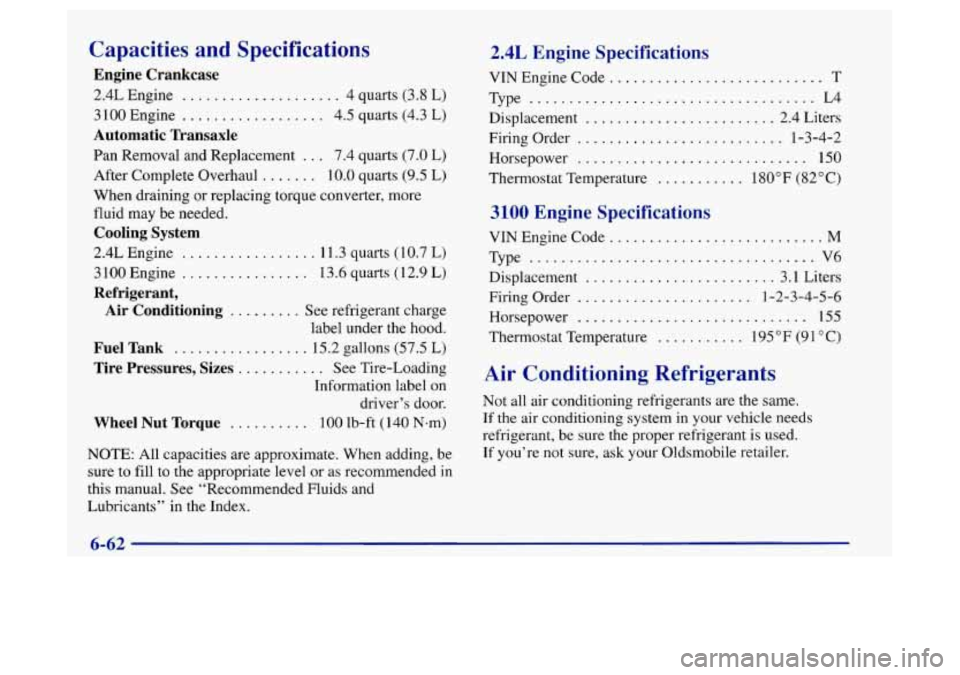
Capacities and Specifications
Engine Crankcase
2.4L Engine .................... 4 quarts (3.8 L)
3 100 Engine
.................. 4.5 quarts (4.3 L)
Automatic Transaxle
Pan Removal and Replacement ... 7.4 quarts (7.0 L)
After Complete Overhaul ....... 10.0 quarts (9.5 L)
When draining or replacing torque converter, more
fluid may be needed.
Cooling System
2.4LEngine ................. 11.3 quarts (10.7 L)
3100Engine
................ 13.6 quarts (12.9 L)
Refrigerant,
Air Conditioning
......... See refrigerant charge
label under the hood.
Fuel Tank ................. 15.2 gallons (57.5 L)
Tire Pressures, Sizes
........... See Tire-Loading
Information label on
driver’s door.
Wheel Nut Torque .......... 100 lb-ft (140 N-m)
NOTE: All capacities are approximate. When adding, be
sure to fill to the appropriate level or as recommended in
this manual. See “Recommended Fluids and
Lubricants” in the Index.
2.4L Engine Specifications
VINEngineCode ........................... T
Type .................................... L4
Displacement
........................ 2.4 Liters
Firing Order
.......................... 1-3-4-2
Thermostat Temperature
........... 180 OF (82 O C)
Horsepower ............................. 150
3100 Engine Specifications
VIN Engine Code ........................... M
Type .................................... V6
Displacement ........................ 3.1 Liters
Firing Order
...................... 1-2-3-4-5-6
Horsepower ............................. 155
Thermostat Temperature
........... 195°F (9 1 “C)
Air Conditioning Refrigerants
Not all air conditioning refrigerants are the same.
If the air conditioning system in your vehicle needs
refrigerant, be sure the proper refrigerant is used.
If you’re not sure, ask your Oldsmobile retailer.
6-62
Page 299 of 372
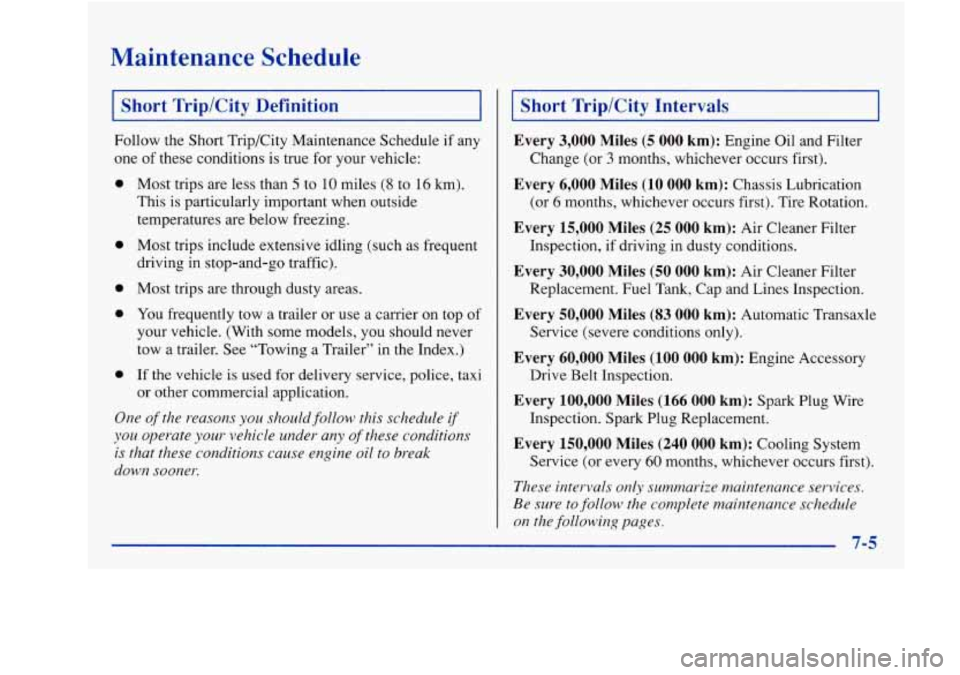
Maintenance Schedule
[ Short Trip/City Definition
Follow the Short Trip/City Maintenance Schedule if any
one
of these conditions is true for your vehicle:
0
0
0
0
0
Most trips are less than 5 to 10 miles (8 to 16 km).
This is particularly important when outside
temperatures are below freezing.
Most trips include extensive idling (such as frequent
driving in stop-and-go traffic).
Most trips
are through dusty areas.
You frequently tow a trailer or use a carrier on top of
your vehicle. (With some models, you should never
tow a trailer. See “Towing a Trailer” in the Index.)
If the vehicle is used for delivery service, police, taxi
or other commercial application.
One of the reasons you should follow this sch.edule if
you operate your vehicle under any
of these conditions
is
that these conditions cause engine oil to break
down sooner.
I i
I Short Trip/City Intervals
Every 3,000 Miles (5 000 km): Engine Oil and Filter
Every 6,000 Miles (10 000 km): Chassis Lubrication
Every 15,000 Miles (25 000 km): Air Cleaner Filter
Every 30,000 Miles (50 000 km): Air Cleaner Filter
Change
(or
3 months, whichever occurs first).
(or
6 months, whichever occurs first). Tire Rotation.
Inspection,
if driving in dusty conditions.
Replacement. Fuel Tank, Cap and Lines Inspection.
Every 50,000 Miles (83 000 km): Automatic Transaxle
Service (severe conditions only).
Every 60,000 Miles (100 000 km): Engine Accessory
Every 100,000 Miles (166 000 km): Spark Plug Wire
Every 150,000 Miles (240 000 km): Cooling System
These intervals only summarize maintenance services.
Be sure to
follow the complete maintenance schedule
on tlze,following pages.
Drive Belt Inspection.
Inspection. Spark Plug Replacement. Service (or every
60 months, whichever occurs first).
Page 300 of 372
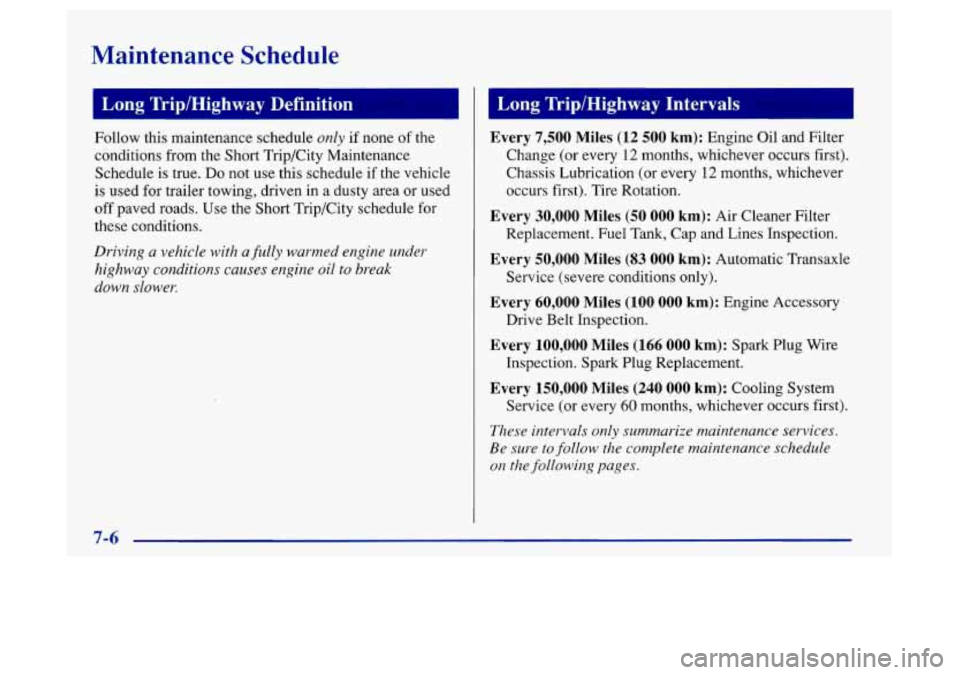
Maintenance Schedule
~~~~~~
I Long TriplHighway Definition
Follow this maintenance schedule only if none of the
conditions from the Short Trip/City Maintenance
Schedule is true.
Do not use this schedule if the vehicle
is used for trailer towing, driven in a dusty area or used
off paved roads. Use the
Short Trip/City schedule for
these conditions.
Driving a vehicle with a fully warmed engine under
highway conditions causes engine oil
to break
down slower.
I Long TrzH
Every 7,500 Miles (12 500 km): Engine Oil and Filter
Change (or every
12 months, whichever occurs first).
Chassis Lubrication (or every
12 months, whichever
occurs first). Tire Rotation.
Every 30,000 Miles (50 000 km): Air Cleaner Filter
Replacement. Fuel Tank, Cap and Lines Inspection.
Every 50,000 Miles (83 000 km): Automatic Transaxle
Service (severe conditions only).
Every 60,000 Miles (100 000 km): Engine Accessory
Every 100,000 Miles (166 000 km): Spark Plug Wire
Every 150,000 Miles (240 000 km): Cooling System
These intervals only summarize maintenance services.
Be sure
to follow the complete maintenance schedule
on the.foIlowing pages.
Drive Belt Inspection.
Inspection. Spark Plug Replacement.
Service (or every
60 months, whichever occurs first).
7-6
Page 322 of 372
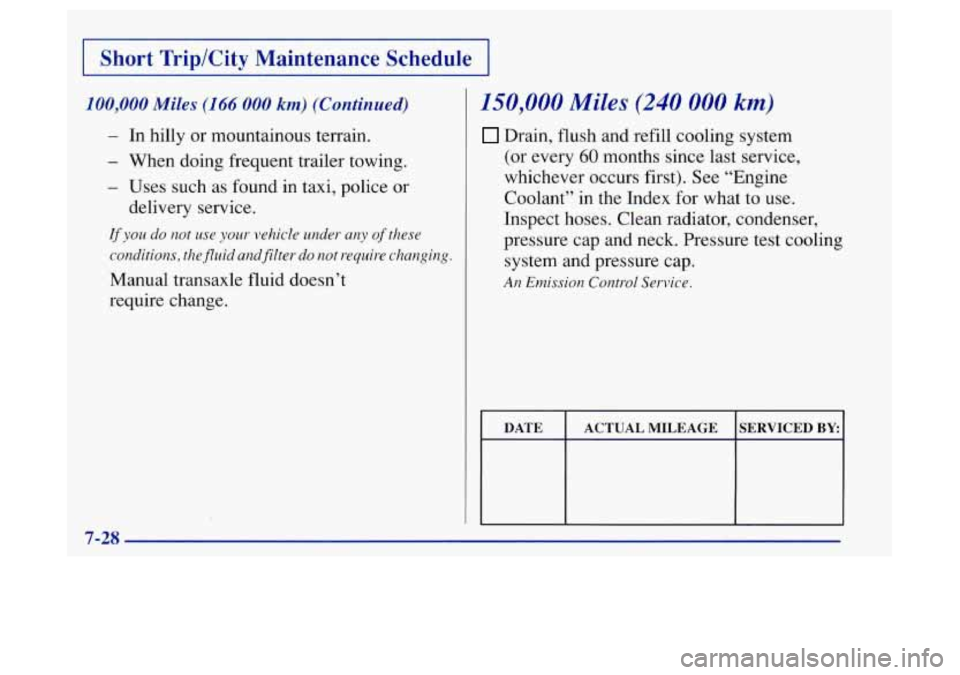
I Short Trip/City Maintenance Schedule I
100,000 Miles (I66 000 km) (Continued)
- In hilly or mountainous terrain.
- When doing frequent trailer towing.
- Uses such as found in taxi, police or
delivery service.
If you do not use your vehicle under any of these
conditions, thefluid andfilter
do not require changing.
Manual transaxle fluid doesn’t
require change.
150,000 Miles (240 000 km)
Drain, flush and refill cooling system
(or every
60 months since last service,
whichever occurs first). See “Engine
Coolant” in the Index for what to use.
Inspect hoses. Clean radiator, condenser,
pressure cap and neck. Pressure test cooling
system and pressure cap.
An Emission Control Service.
7-28
Page 334 of 372
LUII~ Trip/High LY Maintenance Schedule
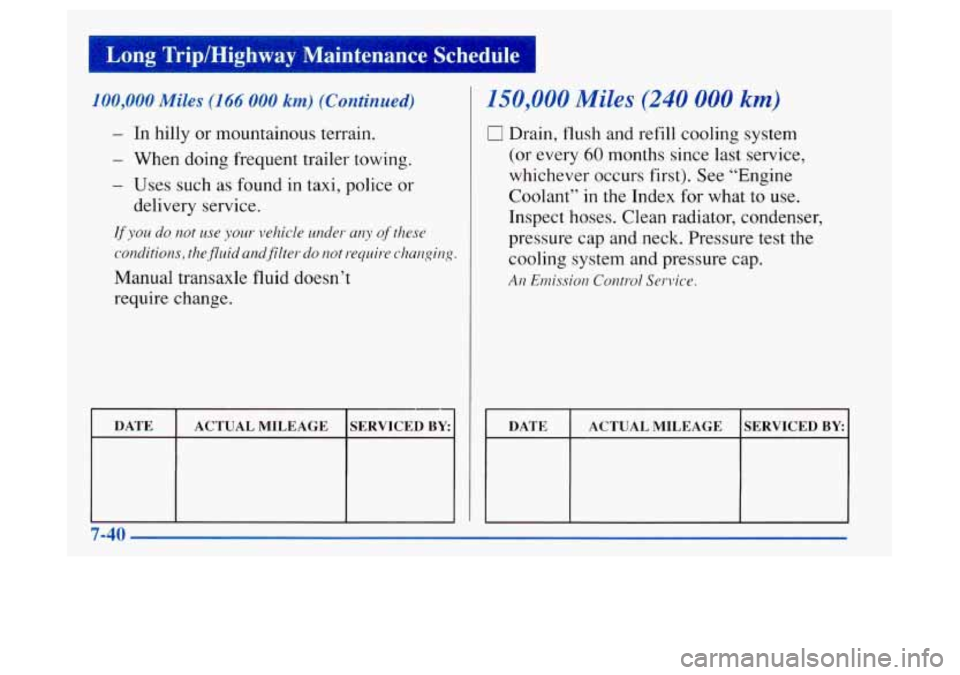
100,000 --Xes (1 66 000 km) (Continued)
- In hilly or mountainous terrain. wing.
- When doing frequent trailer to
- Uses such as found in taxi, pol
delivery service. ice or
If you do
not use your vehicle under any of these
conditions, the.fluid and.filtep. do not require changing.
Manual transaxle fluid doesn’t
require change.
I 1 I I
DATE
SERVICED BY ACTUAL MILEAGE
150,000 Miles (240 000 km)
0 Drain, flush and refill cooling system
(or every
60 months since last service,
whichever occurs first). See “Engine
Coolant” in the Index for what to use.
Inspect hoses. Clean radiator, condenser,
pressure cap and neck. Pressure test the
cooling system and pressure cap.
An En.zissiol.2 Control Service.
DATE
SERVICED BY ACTUAL MILEAGE
7-40
Page 361 of 372
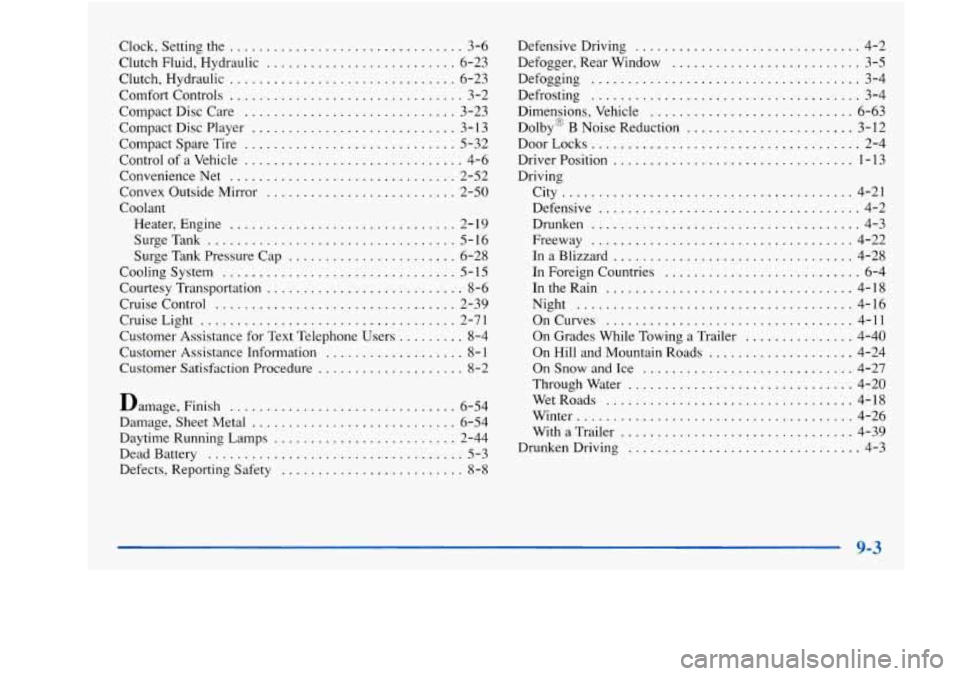
Clock. Setting the ................................ 3-6
Clutch Fluid. Hydraulic
.......................... 6-23
Compact Disc Care
............................. 3-23
Compact Disc Player
............................ 3-13
Compact Spare Tire
............................. 5-32
Clutch. Hydraulic
............................... 6-23
Comfort Controls
................................ 3-2
Control
of a Vehicle .............................. 4-6
Convenience Net
............................... 2-52
Convex Outside Mirror
.......................... 2-50
Coolant Heater. Engine
............................... 2- 19
SurgeTank
.................................. 5-16
Surge Tank Pressure Cap
....................... 6-28
Cooling System ................................ 5- 15
Courtesy Transportation
........................... 8-6
Cruise Control
................................. 2-39
CruiseLight
................................... 2-71
Customer Assistance for Text Telephone Users ......... 8-4
Customer Assistance Information
................... 8- 1
Customer Satisfaction Procedure .................... 8-2
Damage. Finish
............................... 6-54
Damage. Sheet Metal
............................ 6-54
Daytime Running Lamps
......................... 2-44
Defects. Reporting Safety
......................... 8-8
DeadBattery ................................... 5-3
Defensive Driving ............................... 4-2
Defogger. Rear Window
.......................... 3-5
Defogging
..................................... 3-4
Defrosting
..................................... 3-4
Dimensions. Vehicle
............................ 6-63
Dolby@
€3 Noise Reduction ....................... 3-12
DoorLocks
..................................... 2-4
Driver Position
................................. 1-13
Driving City
........................................ 4-21
Defensive
.................................... 4-2
Drunken
..................................... 4-3
Freeway .................................... 4-22
In a Blizzard
................................. 4-28
In Foreign Countries
........................... 6-4
In the Rain
.................................. 4-18
Night
...................................... 4-16
On Curves
.................................. 4-11
On Grades While Towing a Trailer
............... 4-40
On Hill and Mountain Roads
.................... 4-24
OnSnowandIce
............................. 4-27
WetRoads
.................................. 4-18
Winter
...................................... 4-26
With a Trailer
................................ 4-39
Drunken Driving
................................ 4-3
Through
Water
............................... 4-20