power steering OLDSMOBILE ALERO 1999 Owners Manual
[x] Cancel search | Manufacturer: OLDSMOBILE, Model Year: 1999, Model line: ALERO, Model: OLDSMOBILE ALERO 1999Pages: 328, PDF Size: 2.62 MB
Page 92 of 328
yellowblue
2-32
Auto-Down Switch
The driver's window switch has an auto
-down feature.
This switch is labeled AUTO. Push the top of the switch
partway, and the driver's window will open a small
amount. If the switch is pushed all the way, the window
will go all the way down.
To stop the window while it is lowering, push the switch
forward. To raise the window, push and hold the
switch forward.
Lock
-Out Switch
On four
-door models, the driver's power window
controls also include a lock
-out switch. When the
lockout switch is moved to the left (with the white stripe
showing), the driver and passengers will be able to use
their window switches. Move the lockout switch to the
right to stop the passengers from using their window
switches. The driver can still control all the windows
with the lock on.
Horn
You can sound the horn by pressing the horn symbol on
your steering wheel.
Tilt Wheel
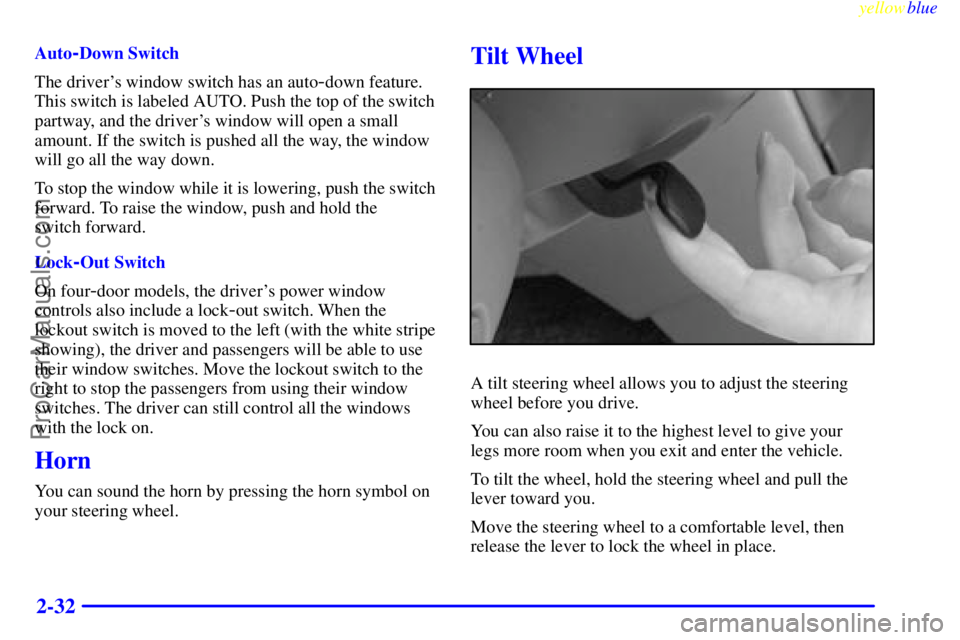
A tilt steering wheel allows you to adjust the steering
wheel before you drive.
You can also raise it to the highest level to give your
legs more room when you exit and enter the vehicle.
To tilt the wheel, hold the steering wheel and pull the
lever toward you.
Move the steering wheel to a comfortable level, then
release the lever to lock the wheel in place.
ProCarManuals.com
Page 163 of 328

yellowblue
4-11 Braking in Emergencies
With anti-lock, you can steer and brake at the same
time. In many emergencies, steering can help you more
than even the very best braking.
Steering
Power Steering
If you lose power steering assist because the engine
stops or the system is not functioning, you can steer but
it will take much more effort.
Variable Effort Steering (If Equipped)
This steering system provides lighter steering effort for
parking and at low vehicle speeds. Steering effort will
increase at higher speeds for improved road feel.
Steering Tips
Driving on Curves
It's important to take curves at a reasonable speed.
A lot of the ªdriver lost controlº accidents mentioned on
the news happen on curves. Here's why:Experienced driver or beginner, each of us is subject to
the same laws of physics when driving on curves. The
traction of the tires against the road surface makes it
possible for the vehicle to change its path when you turn
the front wheels. If there's no traction, inertia will keep
the vehicle going in the same direction. If you've ever
tried to steer a vehicle on wet ice, you'll understand this.
The traction you can get in a curve depends on the
condition of your tires and the road surface, the angle
at which the curve is banked, and your speed.
While you're in a curve, speed is the one factor you
can control.
Suppose you're steering through a sharp curve.
Then you suddenly accelerate. Both control
systems
-- steering and acceleration -- have to
do their work where the tires meet the road. Adding the
sudden acceleration can demand too much of those
places. You can lose control. Refer to ªEnhanced
Traction Systemº in the Index.
What should you do if this ever happens? Ease up on the
accelerator pedal, steer the vehicle the way you want it
to go, and slow down.
Speed limit signs near curves warn that you should
adjust your speed. Of course, the posted speeds are
based on good weather and road conditions. Under less
favorable conditions you'll want to go slower.
ProCarManuals.com
Page 225 of 328
6-
yellowblue
6-1
Section 6 Service and Appearance Care
Here you will find information about the care of your vehicle. This section begins with service and fuel information,
and then it shows how to check important fluid and lubricant levels. There is also technical information about your
vehicle, and a part devoted to its appearance care.
6
-2 Service
6
-3 Fuel
6
-5 Fuels in Foreign Countries
6
-5 Filling Your Tank
6
-7 Filling a Portable Fuel Container
6
-7 Checking Things Under the Hood
6
-11 Engine Oil
6
-16 Engine Air Cleaner/Filter
6
-17 Automatic Transaxle Fluid
6
-18 Thermostat
6
-18 Engine Coolant
6
-22 Power Steering Fluid
6
-23 Windshield Washer Fluid
6
-24 Brakes
6
-27 Battery6
-28 Bulb Replacement
6
-34 Windshield Wiper Blade Replacement
6
-34 Tires
6
-44 Appearance Care
6
-44 Cleaning the Inside of Your Vehicle
6
-46 Care of Safety Belts
6
-48 Cleaning the Outside of Your Vehicle
6
-50 Finish Damage
6
-51 GM Vehicle Care/Appearance Materials
6
-52 Vehicle Identification Number (VIN)
6
-53 Electrical System
6
-58 Replacement Bulbs
6
-59 Capacities and Specifications
6
-59 Air Conditioning Refrigerants
6
-60 Normal Maintenance Replacement Parts
ProCarManuals.com
Page 233 of 328
yellowblue
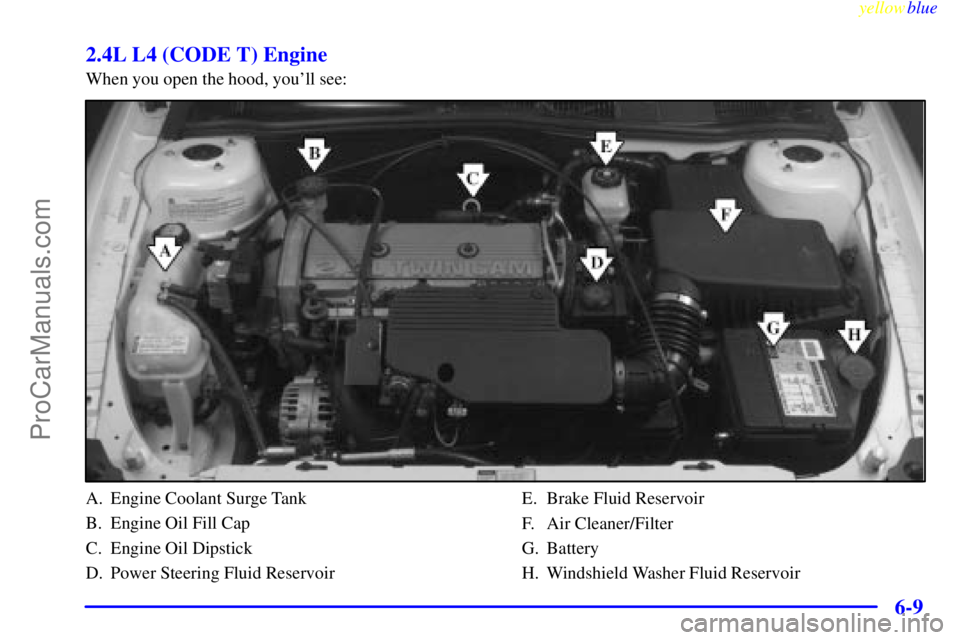
6-9 2.4L L4 (CODE T) Engine
When you open the hood, you'll see:
A. Engine Coolant Surge Tank
B. Engine Oil Fill Cap
C. Engine Oil Dipstick
D. Power Steering Fluid ReservoirE. Brake Fluid Reservoir
F. Air Cleaner/Filter
G. Battery
H. Windshield Washer Fluid Reservoir
ProCarManuals.com
Page 234 of 328
yellowblue
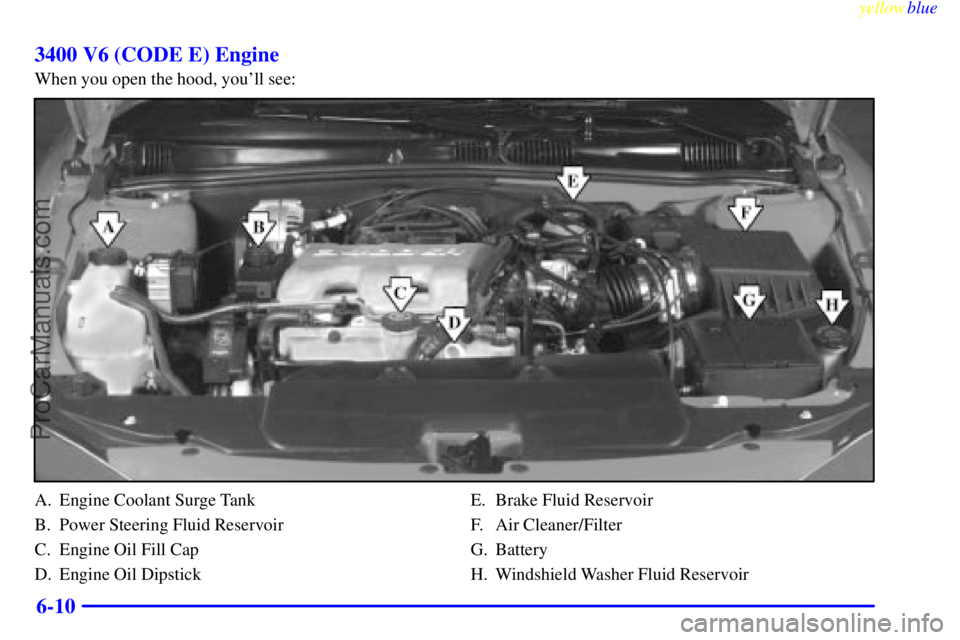
6-10 3400 V6 (CODE E) Engine
When you open the hood, you'll see:
A. Engine Coolant Surge Tank
B. Power Steering Fluid Reservoir
C. Engine Oil Fill Cap
D. Engine Oil DipstickE. Brake Fluid Reservoir
F. Air Cleaner/Filter
G. Battery
H. Windshield Washer Fluid Reservoir
ProCarManuals.com
Page 246 of 328
yellowblue
6-22
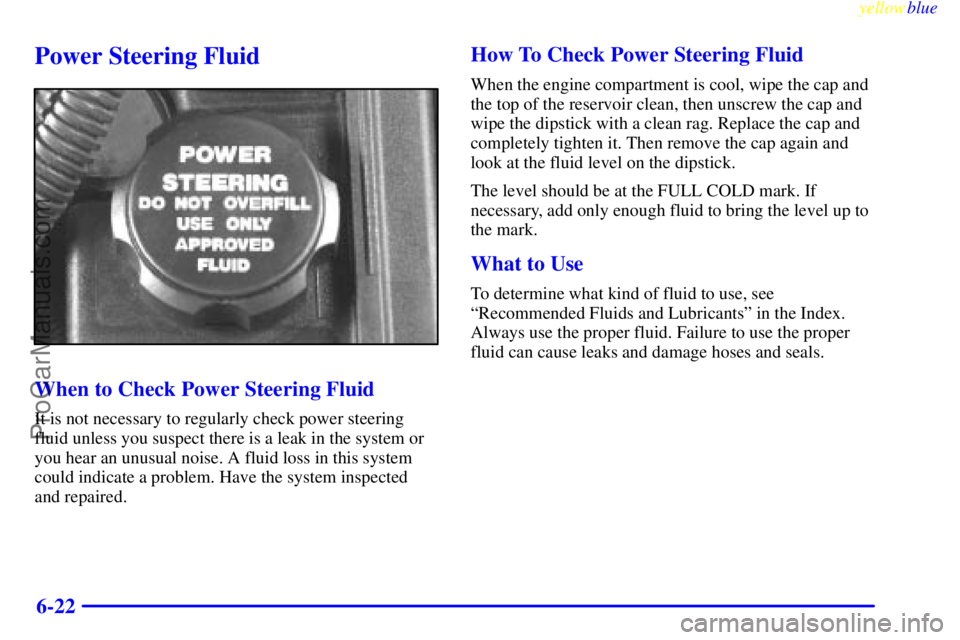
Power Steering Fluid
When to Check Power Steering Fluid
It is not necessary to regularly check power steering
fluid unless you suspect there is a leak in the system or
you hear an unusual noise. A fluid loss in this system
could indicate a problem. Have the system inspected
and repaired.
How To Check Power Steering Fluid
When the engine compartment is cool, wipe the cap and
the top of the reservoir clean, then unscrew the cap and
wipe the dipstick with a clean rag. Replace the cap and
completely tighten it. Then remove the cap again and
look at the fluid level on the dipstick.
The level should be at the FULL COLD mark. If
necessary, add only enough fluid to bring the level up to
the mark.
What to Use
To determine what kind of fluid to use, see
ªRecommended Fluids and Lubricantsº in the Index.
Always use the proper fluid. Failure to use the proper
fluid can cause leaks and damage hoses and seals.
ProCarManuals.com
Page 278 of 328

yellowblue
6-54
Driver's Side
Fuse Usage
RADIO SW Steering Wheel Radio Switches
RADIO ACC Radio
WIPER Windshield Wiper Motor,
Washer Pump
TRUNK
REL/RFA/RADIO
AMPTrunk Release Relay/Motor,
RKE, Audio AmplifierFuse Usage
TURN LPS Turn Signal Lamps
PWR MIRROR Power Mirrors
AIR BAG Air Bags
BFC BATT Body Computer (BFC)
PCM ACC PCM
DR LOCK Door Lock Motors
IPC/BFC ACC Cluster, Body Computer (BFC)
STOP LPS Stop Lamps
HAZARD LPS Hazard Lamps
IPC/HVAC BATT HVAC Head, Cluster,
Data Link Connector
Circuit Breaker Usage
PWR SEAT Power Seats
ProCarManuals.com
Page 279 of 328

yellowblue
6-55
Passenger's Side
Fuse Usage
INST LPS Interior Lamp Dimming
CRUISE SW
LPSSteering Wheel Cruise Control
Switch Lamps
CRUISE SW Steering Wheel Cruise Control
SwitchesFuse Usage
HVAC
BLOWERHVAC Blower Motor
CRUISE Cruise Control
FOG LPS Fog Lamps
INT LPS Interior Courtesy Lamps
RADIO BATT Radio
SUNROOF Power Sunroof
Circuit Breaker Usage
PWR WNDW Power Windows
ProCarManuals.com
Page 281 of 328

yellowblue
6-57
Fuse Usage
Maxi
-Fuses
3) Left
-Hand Electrical Center-Stop
Lamps, Hazard Lamps, Body
Function Control Module, Cluster,
Climate Control System
4) Right
-Hand Electrical Center-Fog
Lamps, Radio, Body Function
Control Module, Interior Lamps
5) Ignition Switch
6) Not Used
7) Anti
-Lock Brakes
8) Cooling Fan #1
Mini
-Relays
9) Rear Defog
10) Not Used
11) Anti
-Lock Brakes
12) Cooling Fan #1
13) HVAC Blower (Climate Control)
14) Cooling Fan #2
15) Cooling Fan #2Fuse Usage
Micro
-Relays
16) Air Conditioning Compressor
17) Not Used
18) Fuel Pump
19) Automatic Light Control
20) Automatic Light Control
21) Horn
22) Daytime Running Lamps
Mini
-Fuses
23
- 32) Spare Fuse Holder
33) Rear Defog
34) Accessory Power Outlets,
Cigarette Lighter
35) Anti
-Lock Brakes
36) Anti
-Lock Brakes, Variable Effort
Steering
37) Air Conditioning Compressor,
Body Function Control Module
38) Automatic Transaxle
39) Powertrain Control Module
40) Anti
-Lock Brakes
ProCarManuals.com
Page 301 of 328

yellowblue
7-17
Part C: Periodic Maintenance
Inspections
Listed in this part are inspections and services which
should be performed at least twice a year (for instance,
each spring and fall). You should let your dealer's
service department or other qualified service center
do these jobs. Make sure any necessary repairs are
completed at once.
Proper procedures to perform these services may be
found in a service manual. See ªService and Owner
Publicationsº in the Index.
Steering, Suspension and Front Drive Axle
Boot and Seal Inspection
Inspect the front and rear suspension and steering
system for damaged, loose or missing parts, signs of
wear or lack of lubrication. Inspect the power steering
lines and hoses for proper hook
-up, binding, leaks,
cracks, chafing, etc. Clean and then inspect the drive
axle boot seals for damage, tears or leakage. Replace
seals if necessary.
Exhaust System Inspection
Inspect the complete exhaust system. Inspect the body
near the exhaust system. Look for broken, damaged,
missing or out
-of-position parts as well as open seams,holes, loose connections or other conditions which could
cause a heat build
-up in the floor pan or could let
exhaust fumes into the vehicle. See ªEngine Exhaustº in
the Index.
Engine Cooling System Inspection
Inspect the hoses and have them replaced if they are
cracked, swollen or deteriorated. Inspect all pipes, fittings
and clamps; replace as needed. Clean the outside of the
radiator and air conditioning condenser. To help ensure
proper operation, a pressure test of the cooling system and
pressure cap is recommended at least once a year.
Throttle System Inspection
Inspect the throttle system for interference or binding,
and for damaged or missing parts. Replace parts as
needed. Replace any components that have high effort
or excessive wear. Do not lubricate accelerator and
cruise control cables.
Brake System Inspection
Inspect the complete system. Inspect brake lines and
hoses for proper hook
-up, binding, leaks, cracks,
chafing, etc. Inspect disc brake pads for wear and rotors
for surface condition. Inspect other brake parts,
including calipers, parking brake, etc. You may need to
have your brakes inspected more often if your driving
habits or conditions result in frequent braking.
ProCarManuals.com