weight Oldsmobile Alero 2003 s User Guide
[x] Cancel search | Manufacturer: OLDSMOBILE, Model Year: 2003, Model line: Alero, Model: Oldsmobile Alero 2003Pages: 354, PDF Size: 16.74 MB
Page 211 of 354
Weight of the Trailer Tongue
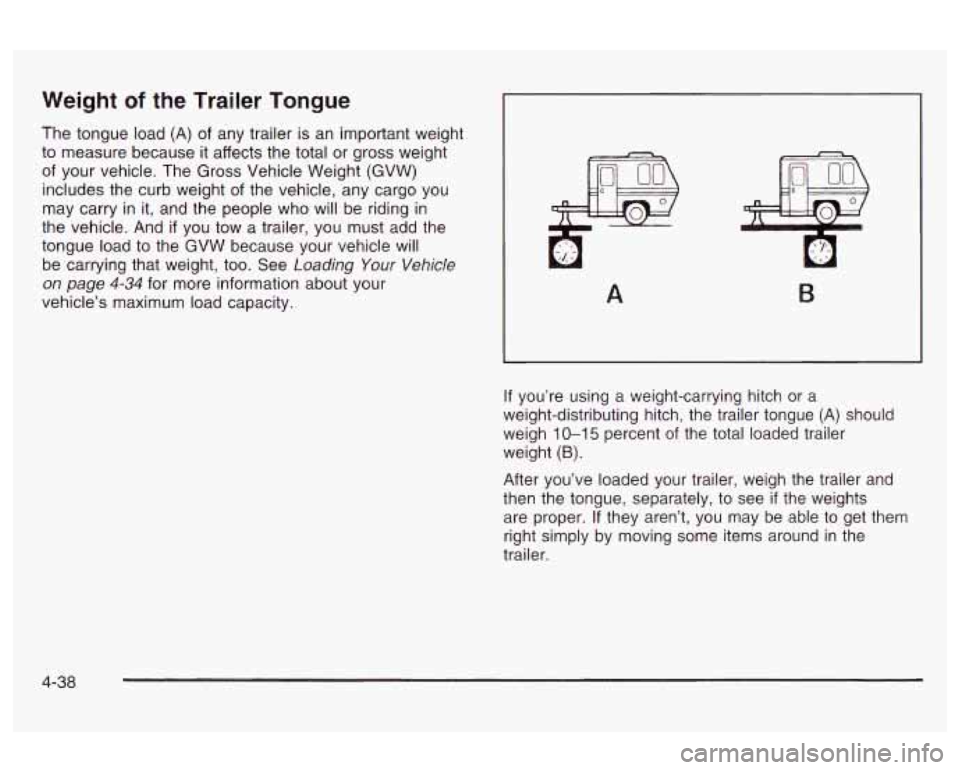
The tongue load (A) of any trailer is an important weight
to measure because it affects the total or gross weight
of your vehicle. The Gross Vehicle Weight (GVW)
includes the curb weight of the vehicle, any cargo you
may carry
in it, and the people who will be riding in
the vehicle. And
if you tow a trailer, you must add the
tongue load to the GVW because your vehicle will
be carrying that weight, too. See
Loading Your Vehicle
on page
4-34 for more information about your
vehicle’s maximum load capacity. A B
If you’re using a weight-carrying hitch or a
weight-distributing hitch, the trailer tongue
(A) should
weigh
10-1 5 percent of the total loaded trailer
weight
(B).
After you’ve loaded your trailer, weigh the trailer and
then the tongue, separately, to see
if the weights
are proper. If they aren’t, you may be able to get them
right simply by moving some items around in the
trailer.
4-38
Page 212 of 354
Total Weight on Your Vehicle’s Tires
Be sure your vehicle’s tires are inflated to the upper limit
for cold tires. You’ll find these numbers on the Tire
Loading Information label at the rear edge of the driver’s
door or see
Loading Your Vehicle on page 4-34. Then
be sure you don’t go over the
GVW limit for your vehicle,
including the weight of the trailer tongue.
Hitches
It’s important to have the correct hitch equipment.
Crosswinds, large trucks going by and rough roads are
a few reasons why you’ll need the right hitch. Here
are some rules to follow:
The rear bumper on your vehicle is not intended for
hitches. Do not attach rental hitches or other
bumper-type hitches to it. Use only a
frame-mounted hitch that does not attach to the
bumper.
Will yo11 have to make any holes in the body nf
your vehicle when you install a trailer hitch? If
you do, then be sure to seal the holes later when
you remove the hitch. If you don’t seal them, deadly
carbon monoxide (CO) from your exhaust can get
into your vehicle. See
Engine Exhaust on
page
2-30. Dirt ana water can, too.
Safety Chains
You should always attach chains between your vehicle
and your trailer. Cross the safety chains under the
tongue of the trailer
so that the tongue will not drop to
the road
if it becomes separated from the hitch.
Instructions about safety chains may be provided by the
hitch manufacturer or by the trailer manufacturer.
Follow the manufacturer’s recommendation for attaching
safety chains and do not attach them to the bumper.
Always leave just enough slack
so you can turn
with your rig. And, never allow safety chains to drag on
the ground.
Trailer Brakes
Does your trailer have its own brakes?
Be sure to read and
follow the instructions for the trailer
brakes
so you’ll be able to install, adjust and maintain
them properly. And because you may have anti-lock
brakes, do not try to tap into your vehicle’s brake
system.
If you do, both systems won’t work well,
e!- 2! 2!!.
4-39
Page 213 of 354
Driving with a Trailer
Towing a trailer requires a certain amount of experience.
Before setting out for the open road, you’ll want to get
to know your rig. Acquaint yourself with the feel of
handling and braking with the added weight of the trailer.
And always keep in mind that the vehicle you are
driving is now a good deal longer and not nearly as
responsive as your vehicle is by itself.
Before you start, check the trailer hitch and platform
(and attachments), safety chains, electrical connector,
lamps, tires and mirror adjustment.
If the trailer has
electric brakes, start your vehicle and trailer moving and
then apply the trailer brake controller by hand to be
sure the brakes are working. This lets you check your
electrical connection at the same time.
During your trip, check occasionally to be sure that the
load is secure, and that the lamps and any trailer
brakes are still working.
Following Distance
Stay at least twice as far behind the vehicle ahead as
you would when driving your vehicle without a trailer.
This can help you avoid situations that require
heavy braking and sudden turns.
Passing
You’ll need more passing distance up ahead when
you’re towing a trailer. And, because you’re a good deal
longer, you’ll need to go much farther beyond the
passed vehicle before you can return to your lane.
Backing Up
Hold the bottom of the steering wheel with one hand.
Then, to move the trailer to the left, just move that hand
to the left. To move the trailer to the right, move your
hand to the right. Always back up slowly and,
if possible,
have someone guide you.
Making Turns
Notice: Making very sharp turns while trailering
could cause the trailer to come in contact with the
vehicle. Your vehicle could be damaged. Avoid
making very sharp turns while trailering.
When you’re turning with a trailer, make wider turns
than normal.
Do this so your trailer won’t strike
soft shoulders, curbs, road signs, trees or other objects.
Avoid jerky or sudden maneuvers. Signal well in
advance.
4-40
Page 346 of 354
Tires (cont.) Wheel Alignment and Tire Balance
................. 5-58
Wheel Replacement
..................................... 5-59
When It
Is Time for New Tires ...................... 5-56
To Use the Engine Coolant Heater
.................... 2-21
Top of the Instrument Panel
............................. 5-74
Top Strap
...................................................... 1-41
Top Strap Anchor Location
............................... 1-42
Torque Lock
................................................... 2-28
Total Weight on Your Vehicle’s Tires
.................. 4-39
Towing Recreational Vehicle
..................................... 4-31
Towing a Trailer
.......................................... 4-36
Your Vehicle
............................................... 4-31
Traction Enhmced Traction Systerr; Active Light
........... 3-30
Enhanced Traction System Warning Light
........ 3-29
Enhanced
Traction System (ETS)
.................... 4-9
Trailer Brakes
................................................. 4-39
Transaxle Fluid, Automatic
........................................... 5-22
Fluid, Manual
.............................................. 5-22 T - - .. I - n- -.--a: - .- A . .I -.-- -L:- I I dl 13dAlt: Upel dllUl I, fiUlUl1 ldllb 6-66 A nA .........................
Transaxle Operation, Manual ............................ 2-25
Transmission Up-Shift Light
.............................................. 3-28
Transmission, Transaxle, Transfer Case Unit
Repair Manual
........................................ 7-10
Transportation Options
...................................... 7-7
Trap-Resistant Trunk Kit
................................... 2-1 3 Trip Odometer
.......... ........................... 3-25
Trunk
............................................................ 2-11
Turn and Lane-Change Signals
.......................... 3-8
Turn Signal/Multifunction Lever
........................... 3-7
Turn Signals When Towing a Trailer
.................. 4-41
Trunk Lamp
................................................... 3-16
Underbody Flushing Service
............................. 6-12
Understanding Radio Reception
........................ 3-65
Uniform Tire Quality Grading
............................ 5-57
United States
................................................... 7-4
Up-Shift Light
................................................. 3-28
Used Replacement Wheels
.............................. 5-60
using Cleaner on Fabric
.................................. 5-73
v
Vehicle
Control
........................... ..................... 4-5
Damage Warnings
........................................... iv
Loading
...................................................... 4-34
Service Soon Light
...................................... 3-36
Parking
Your
............................................... 2-29
Symbols
......................................................... iv
Vehicle Identification
Number (VIN)
............................................. 5-80
Service Parts Identification Label
................... 5-80
Vehicle Storage
.............................................. 5-41
13
Page 347 of 354
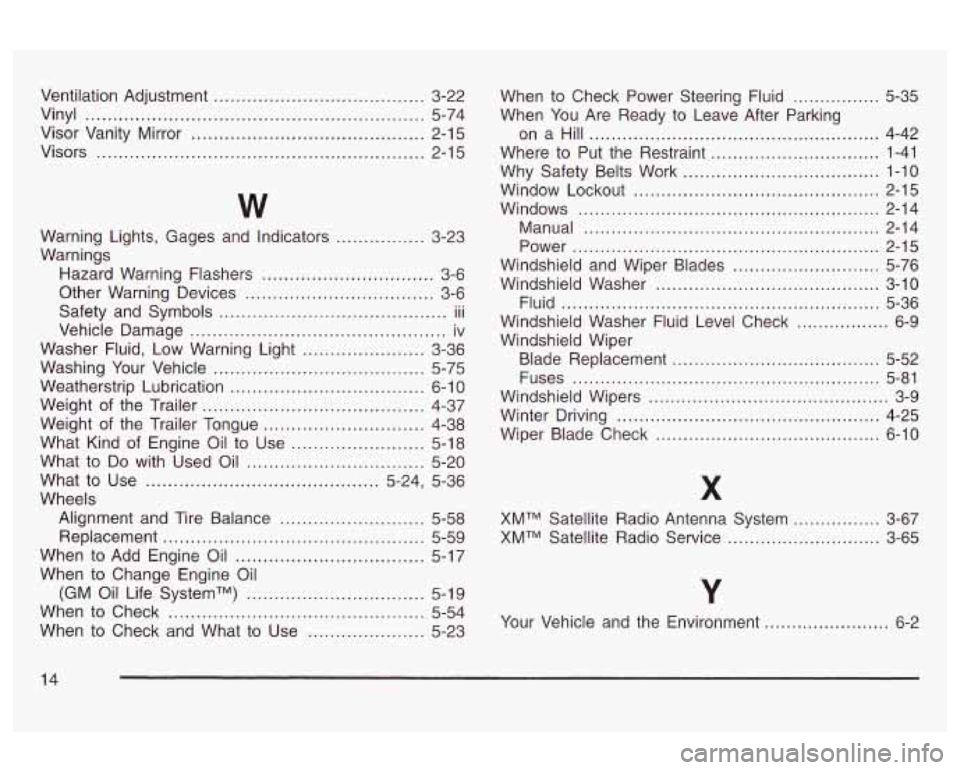
Ventilation Adjustment ...................................... 3-22
Vinyl
............................................................. 5-74
Visor Vanity Mirror
.......................................... 2-15
Visors
........................................................... 2-1 5
Warning Lights. Gages and indicators ................ 3-23
Warnings
Hazard Warning Flashers
............................... 3-6
Other Warning Devices
.................................. 3-6
Safety and Symbols
......................................... iii
Vehicle Damage .............................................. iv
Washer Fluid, Low Warning Light
...................... 3-36
Washing Your Vehicle
...................................... 5-75
Weatherstrip Lubrication
................................... 6-1 0
Weight of the Trailer ........................................ 4-37
Weight
of the Trailer Tongue ............................. 4-38
What Kind
of Engine Oil to Use ........................ 5-18
What to Do with Used Oil
................................ 5-20
What to Use
.......................................... 5-24, 5-36
Wheels Alignment and Tire Balance
.......................... 5-58
Replacement
............................................... 5-59
When to Add Engine Oil
.................................. 5-17
When to Change Engine Oil
(GM Oil Life SystemTM)
................................ 5-19
When to Check
.............................................. 5-54
When to Check and What to Use
..................... 5-23 When
to Check Power Steering Fluid
................ 5-35
When You Are Ready to Leave After Parking
on a Hill
..................................................... 4-42
Where to Put the Restraint
........... ............ 1-41
Window Lockout
............................................. 2-15
Windows
....................................................... 2-14
Manual
...................................................... 2-14
Power
........................................................ 2-15
Windshield and Wiper Blades
....................... 5-76
Windshield Washer
..................................... 3-10
Fluid
.......................................................... 5-36
Windshield Washer Fluid Level Check
................. 6-9
Windshield Wiper
Blade Replacement
...................................... 5-52
Fuses
........................................................ 5-81
Windshield Wipers
............................................ 3-9
Winter Driving
......... ................................ 4-25
Wiper Blade Check
..... ........ ........ 6-10
Why Safety Belts Work
.................................... 1-10
X
XMTM Satellite
Radio Antenna System ................ 3-67
XMTM Satellite Radio Service
............................ 3-65
Your Vehicle and the Environment
....................... 6-2
14