engine oil Oldsmobile Aurora 1997 s Owner's Guide
[x] Cancel search | Manufacturer: OLDSMOBILE, Model Year: 1997, Model line: Aurora, Model: Oldsmobile Aurora 1997Pages: 404, PDF Size: 20.75 MB
Page 267 of 404
What to Do with Used Oil
Did you know that used engine oil contains certain
elements that may be unhealthy for your skin and could
even cause cancer? Don’t let used oil stay on your
skin
for very long. Clean your skin and nails with soap and
water, or a good hand cleaner. Wash or properly throw
away clothing or rags containing used engine oil. (See
the manufacturer’s warnings about the use and disposal
of oil products.)
Used oil can be a real threat to the environment. If you
change your own oil, be sure to drain all free-flowing oil
from the filter before disposal. Don’t ever dispose of oil
by putting it in the trash, pouring it on the ground, into
sewers, or into streams or bodies of water. Instead,
recycle it by taking it to a place that collects used
oil. If
you have a problem properly disposing of your used oil,
ask your retailer, a service station or a local recycling
center for help.
Air Cleaner
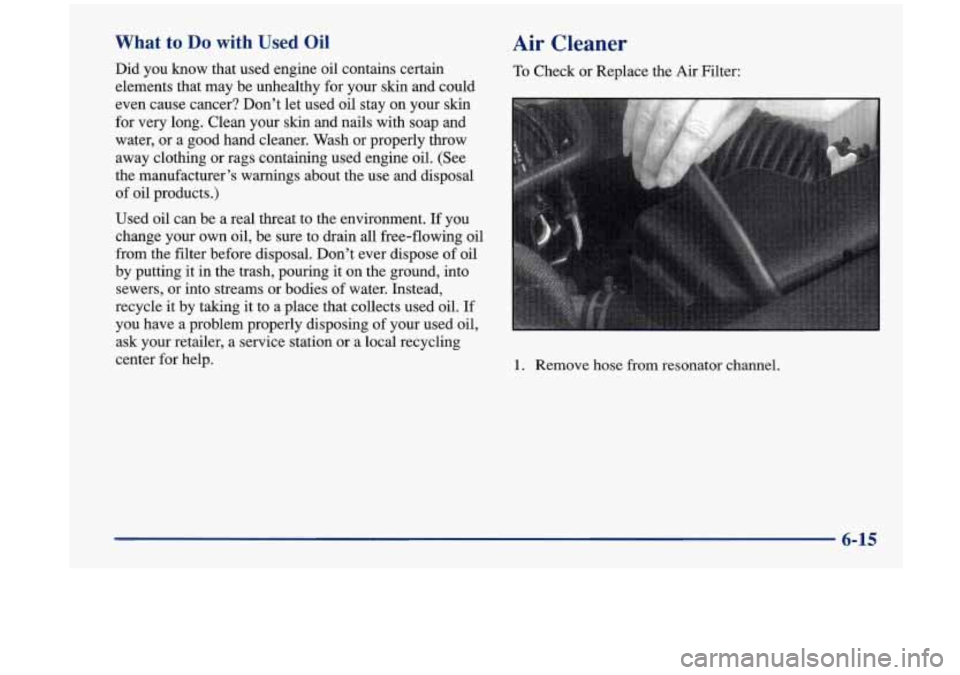
To Check or Replace the Air Filter:
1. Remove hose from resonator channel.
6-15
Page 270 of 404
Operating the engine with the air cleaner off can
cause you or others to be burned. The air cleaner
not only cleans the air, it stops flame if the engine
backfires.
If it isn’t there, and the engine
backfires, you could be burned. Don’t drive with
it off, and be careful working on the engine with
the air cleaner
off.
NOTICE:
If the air cleaner is off, a backfire can cause a
damaging engine fire. And, dirt can easily get
into your engine, which will damage it. Always
have the air cleaner in place when you’re driving.
Automatic Transaxle Fluid
When to Check and Change
A good time to check your automatic transaxle fluid
level is when the engine oil is changed.
Change both the fluid and filter every
50,000 miles
(83 000 km) if the vehicle is mainly driven under one or
more of these conditions:
0 In heavy city traffic where the outside temperature
regularly reaches
90 OF (32 O C) or higher.
In hilly or mountainous terrain.
0 When doing frequent trailer towing.
0 Uses such as found in taxi, police or delivery service.
If you do not use your vehicle under any of these
conditions, the fluid and filter do not require changing.
See “Scheduled Maintenance Services” in the Index.
6-18
Page 273 of 404
How to Add Fluid
Refer to the Maintenance Schedule to determine what
kind of transaxle fluid to use. See “Recommended
Fluids and Lubricants” in the Index.
If the fluid level
is low, add only enough of the proper
fluid
to bring the level into the cross-hatched area on
the dipstick.
1. Pull out the dipstick.
2. Using a long-neck funnel, add enough fluid at the
dipstick hole to bring it to
the proper level.
3. After adding fluid, recheck the fluid level as
described under “How to Check.”
4. When the correct fluid level is obtained, push the
dipstick back
in all the way.
Engine Coolant
The cooling s stem in your vehicle is filled with
DEX-COOL engine coolant. This coolant
is designed
to remain
in your vehicle for 5 years or 150,000 miles
(240 000 km), whichever occurs first, if you add only
DEX-COOL@ extended life coolant.
Lx
It doesn’t take much fluid, generally less than one pint The following explains
Your cooling system and how to
(0.5 L). Don’t overjill. add coolant when it is low. If you have a problem with
engine overheating, see “Engine Overheating” in
the Index.
NOTICE: A 50/50 mixture of water and DEX-COOL’
coolant will:
We recommend you use only fluid labeled
DEXRON’III, because fluid with that label is
made especially for your automatic transaxle.
Damage caused by fluid other than
DEXRON@III
is not covered by your new vehicle warranty.
Give freezing protection down to -34°F (-37°C).
Give boiling protection up to 265°F (129°C).
Protect against rust and corrosion.
Help keep the proper engine temperature,
Let the warning lights and gages work as
they should.
Page 274 of 404
What to Use I
NOTICE:
When adding coolant, it is important that you use
only
DEX-COOL@ (silicate-free) coolant.
If coolant other than DEX-COOL@ is added to
the system, premature engine, heater core or
radiator corrosion may result.
In addition, the
engine coolant will require change sooner
-- at
30,000 miles (50 000 km) or 24 months,
whichever occurs
first. Damage caused by the use
of coolant other than DEX-COOL@ is not
covered by your new vehicle warranty.
Use a mixture of one-half clean water (preferably
distilled) and one-half
DEX-COOL@ coolant which
won’t damage aluminum
parts. If you use this mixture,
you don’t need to add anything else. A special procedure
is required for adding sealer; see the Aurora Service
Manual.
(To order a service manual, see “Service
Publications’’ in the Index.)
r =
Adding only plain water to your cooling system
can be dangerous. Plain water, or some other
liquid like alcohol, can boil before the proper
coolant
mix will. Your vehicle’s coolant warning
system
is set for the proper coolant mix. With
plain water or the wrong
mix, your engine could
get too hot but you wouldn’t get the overheat
warning. Your engine could catch fire and
you or
others could be burned. Use
a 50/50 mix of clean
water and DEX-COOL@ coolant.
6-22
Page 282 of 404
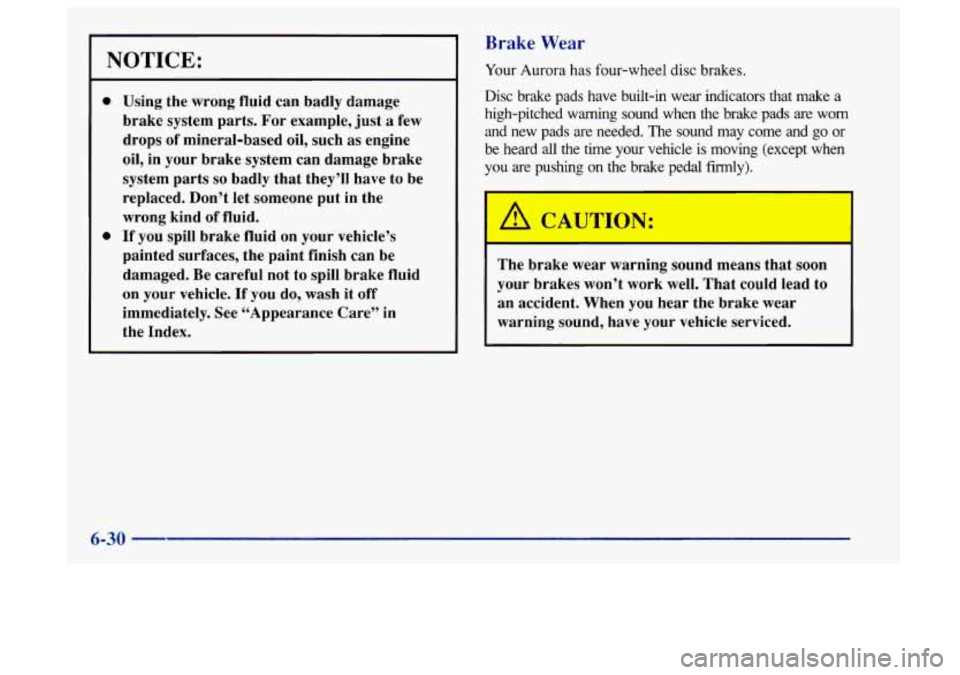
NOTICE:
Using the wrong fluid can badly damage
brake system parts. For example, just
a few
drops
of mineral-based oil, such as engine
oil, in your brake system can damage brake
system parts
so badly that they’ll have to be
replaced. Don’t let someone put in the
wrong kind of fluid.
If you spill brake fluid on your vehicle’s
painted surfaces, the paint finish can be
damaged. Be careful not to spill brake fluid
on your vehicle.
If you do, wash it off
immediately. See “Appearance Care” in
the Index.
Brake Wear
Your Aurora has four-wheel disc brakes.
Disc brake pads have built-in wear indicators that make a
high-pitched warning sound when
the brake pads are worn
and new pads are needed. The sound may come and go or
be heard all the time your vehicle is moving (except when
you are pushing on the brake pedal fiily).
The brake wear warning sound means that soon
your brakes won’t work well. That could lead to
an accident. When you hear the brake wear
warning sound, have your vehicle serviced.
Page 325 of 404
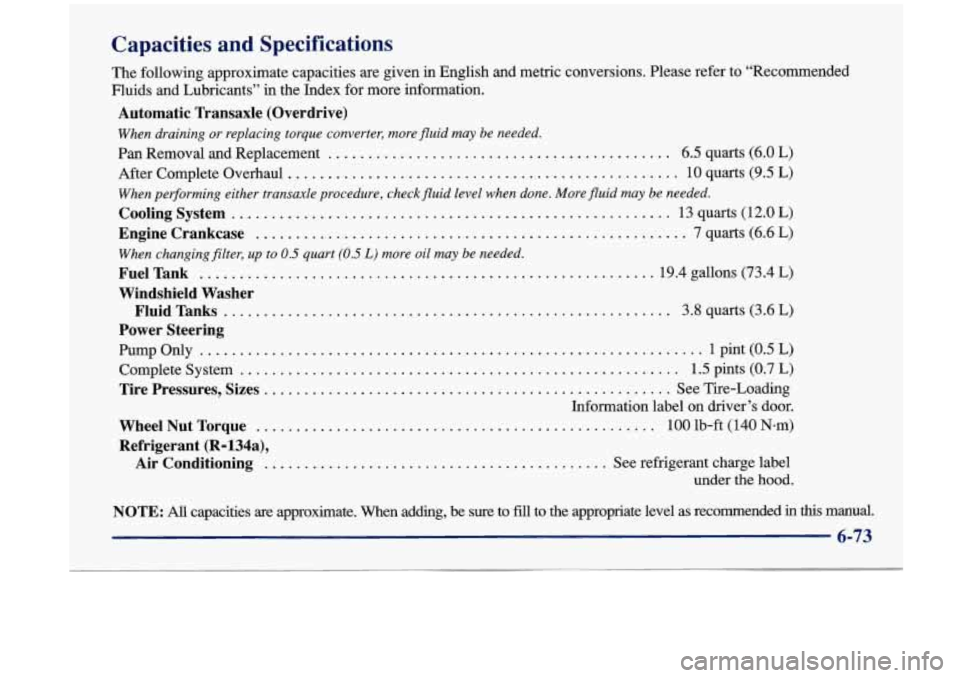
Capacities and Specifications
The following approximate capacities are given in English and metric conversions. rlease refer to “Recommended
Fluids
and Lubricants” in the Index for more information.
Automatic Transaxle (Overdrive)
When draining or replacing torque converter, more fluid may be needed.
Pan Removal and Replacement ........................................... 6.5 quarts (6.0 L)
After Complete Overhaul ................................................. 10 quarts (9.5 L)
When pe~orming either transaxle procedure, check fluid level when done. More fluid may be needed.
Cooling System ....................................................... 13 quarts (12.0 L)
Engine Crankcase ...................................................... 7 quarts (6.6 L)
When changing filter, up to 0.5 quart (0.5 L) more oil may be needed.
Fuel Tank ......................................................... 19.4 gallons (73.4 L)
Windshield Washer
Fluid Tanks
...................................................... 3.8 quarts (3.6 L)
Power Steering
Pump Only ............................................................... 1 pint (0.5 L)
Complete System ....................................................... 1.5 pints (0.7 L)
Tire Pressures, Sizes ................................................... See Tire-Loading
Information label on driver’s door.
Wheel Nut Torque .................................................. 100 lb-ft (140 N-m)
Refrigerant (R-l34a),
Air Conditioning
........................................... See refrigerant charge label
under the hood.
NOTE: All capacities are approximate. When adding, be sure to fd to the appropriate level as recommended in this manual.
6-73
Page 326 of 404
Air Conditioning Refrigerants
Not all air conditioning refrigerants are the same. If the
air conditioning system
in your vehicle needs
refrigerant, be sure the proper refrigerant is used. If
you’re not sure, ask your Aurora retailer.
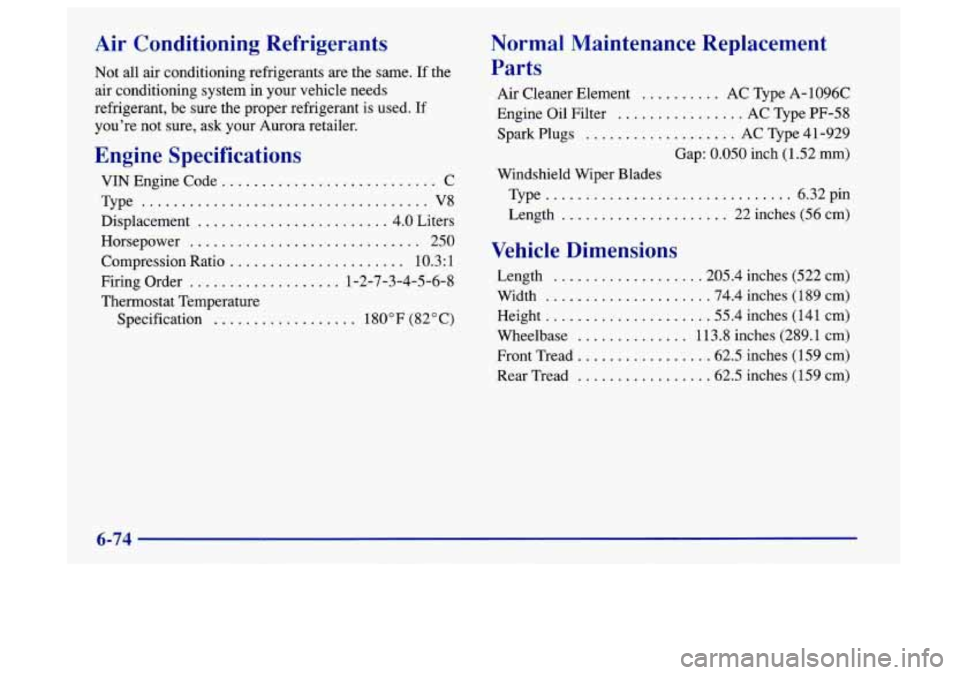
Engine Specifications
VIN Engine Code ........................... C
Type
.................................... V8
Displacement ........................ 4.0 Liters
Horsepower
............................. 250
Firing Order
................... 1-2-7-3-4-5-6-8
Thermostat Temperature
Specification
.................. 180°F (82°C)
Compression Ratio
...................... 10.3:
1
Normal Maintenance Replacement
Parts
Air Cleaner Element .......... AC Type A- 1096C
Engine Oil Filter
................ AC Type PF-58
Spark Plugs
................... AC Type 41-929
Gap:
0.050 inch (1.52 mm)
Windshield Wiper Blades
Type
............................... 6.32pin
Length
..................... 22 inches (56 cm)
Vehicle Dimensions
Length .................. .205.4 inches (522 cm)
Width
.................... ,74.4 inches (189 cm)
Height
.................... .55.4 inches (141 cm)
Wheelbase
.............. 11 3.8 inches (289.1 cm)
Front Tread
................ .62.5 inches (159 cm)
Rear Tread
................ .62.5 inches (159 cm)
6-74
Page 330 of 404
IMPORTANT:
KEEP ENGINE OIL
AT THE PROPER
LEVEL AND CHANGE AS
RECOMMENDED
Have you purchased the GM Protection Plan? The Plan
supplements
your new vehicle warranties. See your
Warranty and Owner Assistance booklet, 01- your Aurora
retailer
for details.
Introduction
Your Vehicle and the Environment
Proper vehicle maintenance not only helps to keep your
vehicle in good working condition, but also helps the
environment. All recommended maintenance procedures
are important. Improper vehicle maintenance can even
affect the quality
of the air we breathe. Improper fluid
levels
or the wrong tire inflation can increase the level
of emissions from your vehicle.
To help protect our
environment, and to keep your vehicle in good
condition, please maintain your vehicle properly.
7-2
Page 333 of 404
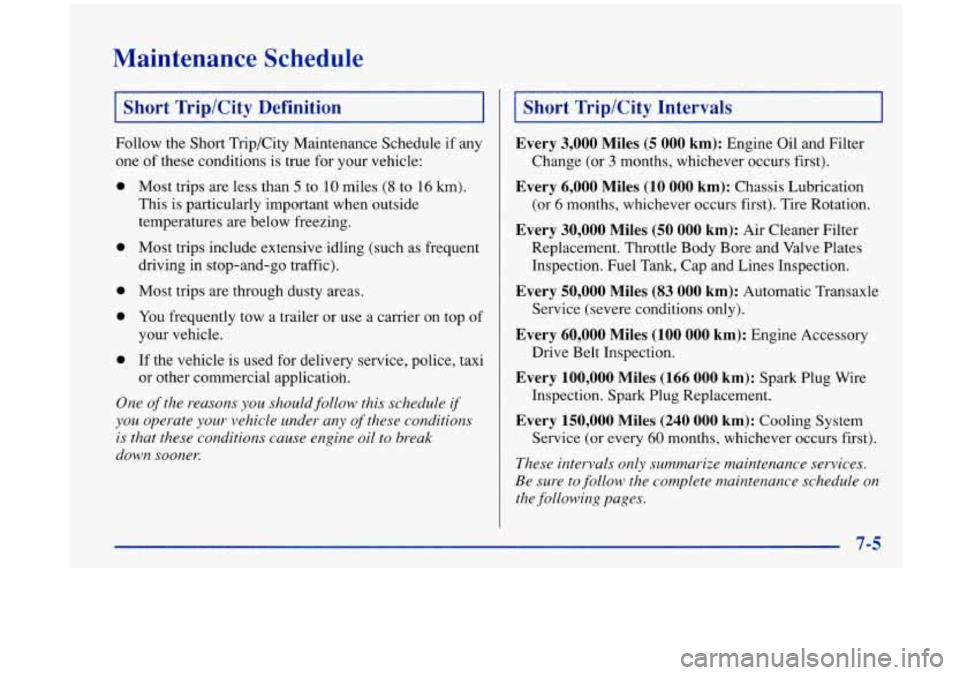
Maintenance Schedule
I Short Trip/City Definition I
Follow the Short Trip/City Maintenance Schedule if any
one of these conditions is true for your vehicle:
0
0
0
0
0
Most trips are less than 5 to 10 miles (8 to 16 km).
This is particularly important when outside
temperatures are below freezing.
Most trips include extensive idling (such
as frequent
driving in stop-and-go traffic).
Most trips are through dusty areas.
You frequently tow a trailer or use a carrier on top of
your vehicle.
If the vehicle is used for delivery service, police, taxi
or other commercial application.
One of the reasons you should follow this schedule if
you operate your vehicle under any of these conditions
is that these conditions cause engine oil to break
down sooner.
Short Trip/City Intervals
Every 3,000 Miles (5 000 km): Engine Oil and Filter
Change (or
3 months, whichever occurs first).
(or
6 months, whichever occurs first). Tire Rotation.
Every 6,000 Miles (10 000 km): Chassis Lubrication
Every 30,000 Miles (50 000 km): Air Cleaner Filter
Replacement. Throttle Body Bore and Valve Plates
Inspection. Fuel Tank, Cap and Lines Inspection.
Service (severe conditions only).
Every 50,000 Miles (83 000 km): Automatic Transaxle
Every 60,000 Miles (100 000 km): Engine Accessory
Every 100,000 Miles (166 000 km): Spark Plug Wire
Every 150,000 Miles (240 000 km): Cooling System
Drive Belt
Inspection.
Inspection. Spark Plug Replacement.
Service (or every
60 months, whichever occurs first).
These intervals only summarize maintenance services.
Be sure
to follow the complete maintenance schedule on
the following pages.
Page 334 of 404
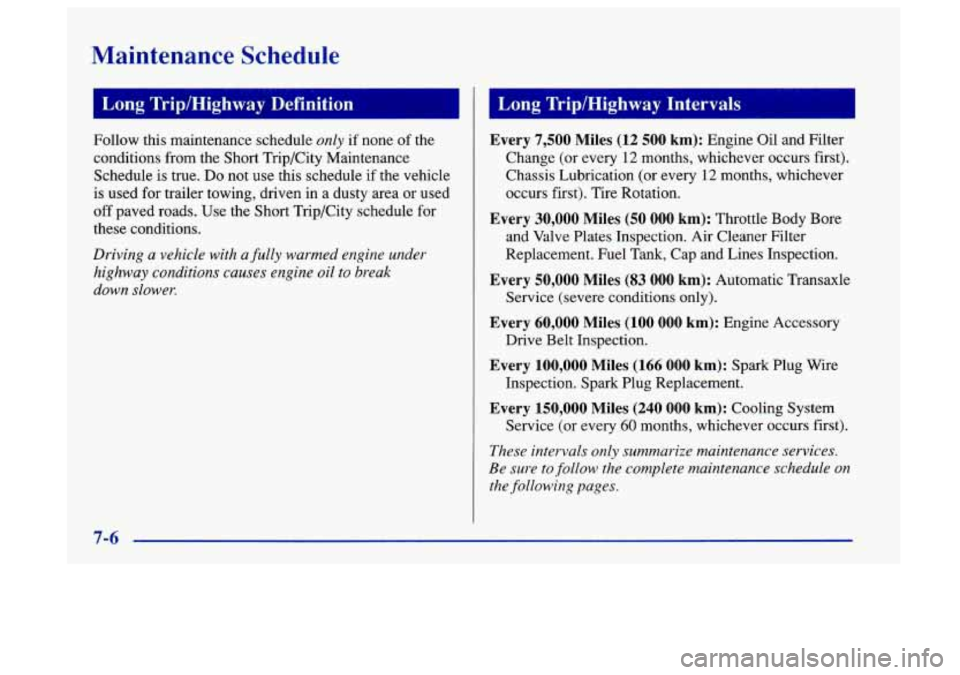
Maintenance Schedule
I Long Trip/Highway Definition I
Follow this maintenance schedule only if none of the
conditions from the Short Trip/City Maintenance
Schedule is true.
Do not use this schedule if the vehicle
is used
for trailer towing, driven in a dusty area or used
off paved roads. Use the Short Trip/City schedule for
these conditions.
Driving a vehicle with a fully warmed engine under
highway conditions causes engine oil to break
down slower.
Long Trip/Highway Intervals
1
Every 7,500 Miles (12 500 km): Engine Oil and Filter
Change (or every
12 months, whichever occurs first).
Chassis Lubrication (or every
12 months, whichever
occurs first). Tire Rotation.
Every 30,000 Miles (50 000 km): Throttle Body Bore
and Valve Plates Inspection. Air Cleaner Filter
Replacement. Fuel Tank, Cap and Lines Inspection.
Every 50,000 Miles (83 000 km): Automatic Transaxle
Every 60,000 Miles (100 000 km): Engine Accessory
Service (severe conditions
only).
Drive Belt Inspection.
Every 100,000 Miles (166 000 km): Spark Plug Wire
Every 150,000 Miles (240 000 km): Cooling System
Inspection. Spark Plug Replacement.
Service
(or every 60 months, whichever occurs first).
These intervals only summarize maintenance services.
Be sure
to follow the complete maintenance schedule on
the following pages.