brake Oldsmobile Aurora 1998 s Service Manual
[x] Cancel search | Manufacturer: OLDSMOBILE, Model Year: 1998, Model line: Aurora, Model: Oldsmobile Aurora 1998Pages: 380, PDF Size: 19.75 MB
Page 253 of 380
@ Section 6 Service and Appearance Care
Here you will find information about the care of your vehicle. This section begins with service and fuel information,
and then it shows
how to check important fluid and lubricant levels. There is also technical information about your
vehicle, and a part devoted to its appearance care.
6-2 6-3
6- 8
6- 8
6-11
6- 15
6-18
6-2 1
6-26
6-28
6-3
1
6-33
6-36
6-43
6-5 1 Service
Fuel
Filling a Portable Fuel Container
Checking Things Under the Hood
Engine Oil
Air Cleaner Automatic Transaxle Fluid
Engine Coolant
Windshield Washer Fluid
Brakes
Battery Bulb Replacement
Headlamp Aiming
Tires Appearance Care 6-5
1
6-55
6-57
6-57
6-58
6-59
6-60
6-64 6-70
6-70
6-7 1
6-7
1
6-7 1
6-72 Cleaning the
Inside of Your Vehicle
Cleaning the Outside
of Your Vehicle
Underbody Maintenance Chemical Paint Spotting
Appearance Care Materials Chart
Vehicle Identification Number (VIN)
Electrical System
Removing the Rear Seat Cushion
Replacement Bulbs Capacities and Specifications
Air Conditioning Refrigerants
Engine Specifications
Normal Maintenance Replacement Parts Vehicle Dimensions
6-1
Page 261 of 380
I A CAUTION:
Things that burn can get on hot engine parts and
start a fire. These include liquids like gasoline,
oil, coolant, brake fluid, windshield washer and
other fluids, and plastic or rubber. You or others
could be burned. Be careful not to drop or spill
things that will burn onto a hot engine.
The following sections tell you how to check fluids,
lubricants and important parts underhood.
Hood Release
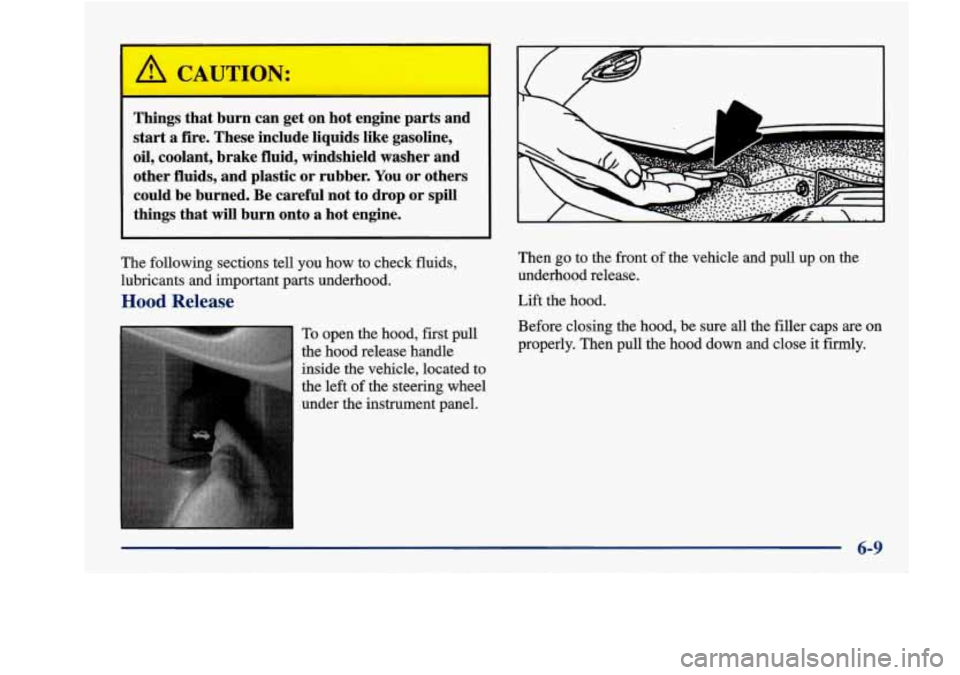
To open the hood, first pull
the hood release handle
inside the vehicle, located to
the left of the steering wheel
under the instrument panel. Then
go to the front
of the vehicle and pull up on the
underhood release.
Lift the hood.
Before closing the hood, be sure
all the filler caps are on
properly. Then pull the hood down and close it fiiy.
6-9
Page 262 of 380
4.0L Engine
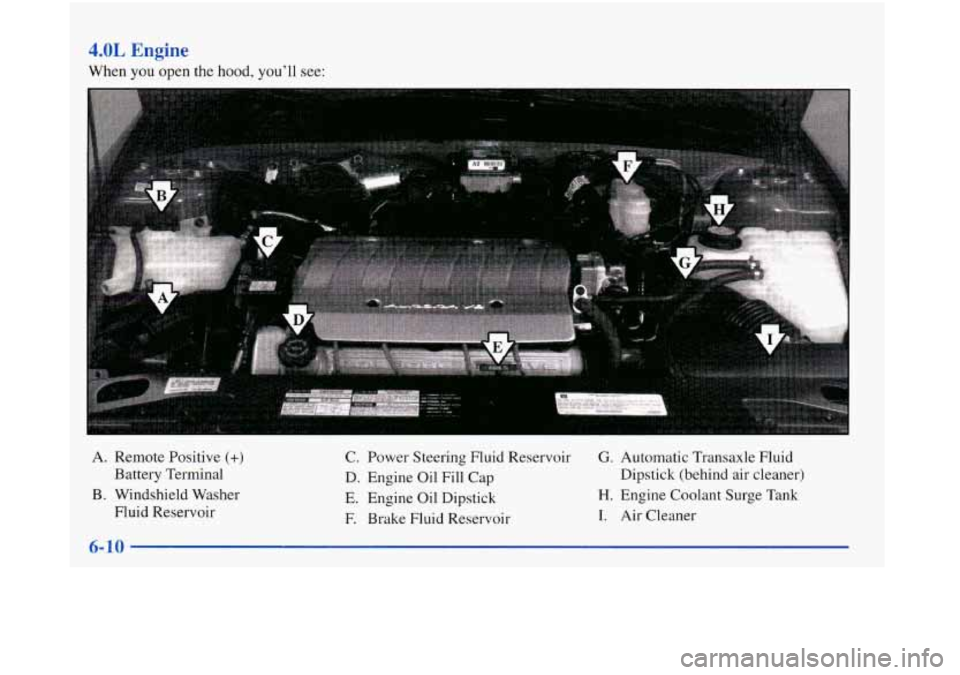
When you open the hood, you'll see:
A. Remote Positive (+)
Battery Terminal
B. Windshield Washer
fluid Reservoir
C. Power Steering Fluid Reservoir G. Automatic Transaxle Fluid
D. Engine Oil Fill Cap Dipstick
(behind air cleaner)
E. Engine Oil Dipstick H. Engine Coolant Surge Tank
E Brake Fluid Reservoir I. Air Cleaner
Page 271 of 380

Wait at least 30 minutes before checking the transaxle
fluid level if you have been driving:
0 When outside temperatures are above 90°F (32°C).
0 At high speed for quite a while.
0 In heavy traffic -- especially in hot weather.
0 While pulling a trailer.
To get the right reading, the fluid should be at
normal operating temperature, which is
1 80°F to
200°F (82°C to 93°C).
Get the vehicle warmed up by driving about 15 miles
(24
km) when outside temperatures are above 50°F
(10°C). If it's colder than 50°F (lO"C), you may
have to drive longer.
Checking the Fluid Level
0 Park your vehicle on a level place. Keep the
engine running.
0 With the parking brake applied, place the shift lever
in PARK
(P).
0 With your foot on the brake pedal, move the shift
lever through each gear range, pausing for about
three seconds in each range. Then, position the shift
lever in
PARK (P).
Let the engine run at idle for three to five minutes.
Then, without shutting
off the engine, follow these steps:
1. Pull out the dipstick and
wipe it with a clean rag
or paper towel.
2. Push it back in all the way, wait three seconds and
then pull
it back out again.
6-19
Page 280 of 380

Brakes
Brake Fluid
Your brake master cylinder reservoir is here. It is filled
with
DOT-3 brake fluid.
There are only two reasons why the brake fluid level
in the
reservoir might go down. The first is that the brake fluid
goes down to
an acceptable level during normal brake
lining wear. When new linings are put in, the fluid level
goes back up. The other reason is that fluid is leaking out
of the brake system. If it is, you should have your brake
system fixed, since a leak means that sooner or later your
brakes won’t work well, or won’t work at all.
So, it isn’t a good idea to “top off’ your brake fluid.
Adding brake fluid won’t correct a leak. If you add fluid
when your linings are worn, then you’ll have
too much
fluid when you get new brake linings. You should add
(or remove) brake fluid, as necessary, only when work is
done on the brake hydraulic system.
When your brake fluid falls to a low level, your brake
warning light will come on.
A chime will sound if you
try to drive with
this warning light on. See “Brake
System Warning Light” in the Index.
If you have too much brake fluid, it can spill on
the engine. The fluid
will burn if the engine is
hot enough. You or others could be burned,
and your vehicle could be damaged. Add brake
fluid only when work is done on the brake
hydraulic system.
6-28
Page 281 of 380

What to Add
When you do need brake fluid, use only DOT-3
brake fluid
-- such as Delco Supreme 11 @ (GM Part
No. 12377967). Use new brake fluid from a sealed
container
only.
Always clean the brake fluid reservoir cap and the area
around the cap before removing it. This will help keep
dirt from entering the reservoir.
CAUTION: I
With the wrong kind of fluid in your braKe
system, your brakes may not work well, or they
may not even work
at all. This could cause a
crash. Always use the proper brake fluid.
NOTICE:
0
0 Using the wrong fluid can badly damage
brake system parts. For example,
just a few
drops
of mineral-based oil, such as engine
oil, in your brake system can damage brake
system parts
so badly that they’ll have to be
replaced. Don’t let someone put in the
wrong kind of fluid.
If you spill brake fluid on your vehicle’s
painted surfaces, the paint finish can be damaged. Be careful not to spill brake fluid
on your vehicle. If you do, wash it
off
immediately. See “Appearance Care” in
the Index.
6-29
Page 282 of 380
Brake Wear
Your vehicle has four-wheel disc brakes.
Disc brake pads have built-in wear indicators that
make a high-pitched warning sound when the brake
pads are worn and new pads
are needed. The sound
may come and go or be heard all the time your vehicle
is moving (except when you are pushing on the brake
pedal firmly).
A CAUTION:
The brake wear warning sound means that soon
your brakes won’t work well. That could lead
to
an accident. When you hear the brake wear
warning sound, have your vehicle serviced.
I NOTICE:
Continuing to drive with worn-out brake pads
could result in costly brake repair.
Some driving conditions or climates may cause a brake
squeal when the brakes
are first applied or lightly
applied.
This does not mean something is wrong with
your brakes.
Properly torqued wheel nuts
are necessary to help
prevent brake pulsation. When tires are rotated, inspect
brake pads for wear and evenly torque wheel nuts in
the proper sequence
to GM specifications.
Brake linings should always be replaced as complete
axle sets.
See “Brake System Inspection” in Section
7 of
this manual under Part
C “Periodic Maintenance
Inspections.”
Brake Pedal Travel
See your retailer if the brake pedal does not return to
normal height, or if there is a rapid increase in pedal
travel. This could be a sign of brake trouble.
Brake Adjustment
Every time you apply the brakes, with or without the
vehicle moving, your brakes adjust for wear.
6-30
Page 283 of 380
Replacing Brake System Parts
The braking system on a modern vehicle is complex.
Its many parts have to be of top quality and work well
together
if the vehicle is to have really good braking.
Your vehicle was designed and tested with top-quality
GM brake parts. When you replace parts of your bralung
system
-- for example, when your brake linings wear
down and you have
to have new ones put in -- be sure
you get new approved
GM replacement parts. If you
don’t, your brakes may no longer work properly. For
example, if someone puts in brake linings that are wrong
for your vehicle, the balance between your front and
rear brakes can change
-- for the worse. The braking
performance you’ve come to expect can change in many
other ways
if someone puts in the wrong replacement
brake parts.
Battery
Every new Aurora has an ACDelco Freedom@ battery.
You never have to add water to one of these. When it’s
time for a new battery, we recommend an ACDelco
Freedom battery. Get one that has the replacement
number shown on the original battery’s label. The
battery is located under the rear seat cushion.
To access
the battery, see “Removing the Rear Seat
Cushion” in the Index.
You don’t need to access the
battery to jump start your vehicle. See “Jump Starting”
in the Index.
A CAUTION:
A battery that isn’t properly vented can let
sulfuric acid fumes into the area under the rear
seat cushion. These fumes can damage your rear
seat safety belt systems. You may not be able to
see this damage, and the safety belts might not
provide the protection needed in a crash.
If a
replacement battery is ever needed, it must
be vented in the same manner as the original
battery.
Always make sure that the vent hose is
properly reattached before reinstalling the
seat cushion.
Page 302 of 380
NOTICE:
The wrong wheel can also cause problems with
bearing life, brake cooling, speedometer or
odometer calibration, headlamp aim, bumper
height, vehicle ground clearance and tire or tire
chain clearance to the body and chassis.
See “Changing a Flat Tire” in the Index for more
information.
Used Replacement Wheels
Putting
a used wheel on your vehicle is
dangerous. You can’t know how it’s been used or
how far it’s been driven. It could fail suddenly
and cause an accident. If you have to replace
a
wheel, use a new GM original equipment wheel.
Tire Chains
NOTICE:
Use tire chains only where legal and only when
you must. Use only
SAE Class “S” type chains
that are the proper size for your tires. Install
them on the front tires and tighten them as
tightly as possible with the ends securely
fastened. Drive slowly and follow the chain
manufacturer’s instructions. If you can hear the
chains contacting your vehicle, stop and retighten
them.
If the contact continues, slow down until it
stops. Driving too fast or spinning the wheels
with chains on will damage your vehicle.
6-50
Page 315 of 380
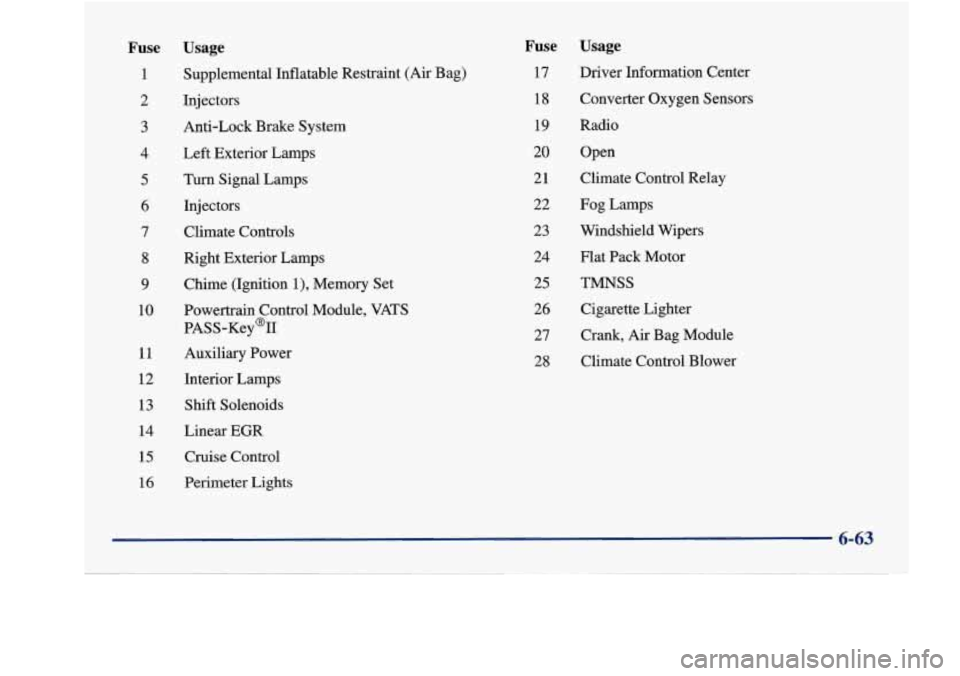
Fuse Usage
1 Supplemental Inflatable Restraint (Air Bag)
2
3
4
5
6
7
Injectors
Anti-Lock Brake System
Left Exterior Lamps Turn Signal Lamps
Injectors Climate Controls
8 Right Exterior Lamps
9 Chime (Ignition l), Memory Set
10 Powertrain Control Module, VATS
PASS-Key@II
11 Auxiliary Power
12
13
14
15
16
Interior Lamps Shift Solenoids
Linear
EGR
Cruise Control
Perimeter Lights
Fuse
17 18
19
20
21 22
23
24
25
26 27
28
Usage
Driver Information Center
Converter Oxygen Sensors
Radio Open
Climate Control Relay
Fog Lamps
Windshield Wipers
Flat Pack Motor
TMNSS
Cigarette Lighter
Crank,
Air Bag Module
Climate Control Blower
6-63