parking brake Oldsmobile Aurora 1998 Owner's Manuals
[x] Cancel search | Manufacturer: OLDSMOBILE, Model Year: 1998, Model line: Aurora, Model: Oldsmobile Aurora 1998Pages: 380, PDF Size: 19.75 MB
Page 67 of 380
Section 2 Features and Controls
Here you can learn about the many standard and optional features on your vehicle, and information on starting,
shifting
and braking. Also explained are the instrument panel and the warning systems that tell you if everything is
working properly
-- and what to do if you have a problem.
2-2
2-4
2-9
2- 14
2-15
2- 16
2-1s
2- 19
2-20
2-21
2-23
2-27
2-28
2-30
2-3
1
Keys
Door Locks
Remote Lock Control TrUIlk
Theft
Universal Theft-Deterrent
PASS-Key(%
New Vehicle “Break-In”
Ignition Positions Starting Your Engine
Engine Coolant Heater (Option)
Parking Brake
Shifting Into PARK (P)
Shifting Out of PARK (P)
Parking Over Things That Burn 2-3 1
2-3
3
2-34
2-34
2-42
2-45
2-48
2-52
2-55
2-55 2-55
2-56
2-60
2-64
2-75 Engine Exhaust
Windows
Tilt Wheel
Turn SignaVMultifunction Lever
Exterior Lamps Interior Lamps
Mirrors
Storage Compartments
Cellular Telephone (Option)
Accessory Power Outlet
Sunroof (Option)
Universal Transmitter
Instrument Panel
Warning Lights, Gages and Indicators
Driver Information Center
2-1
Page 90 of 380
Automatic Transaxle Operation
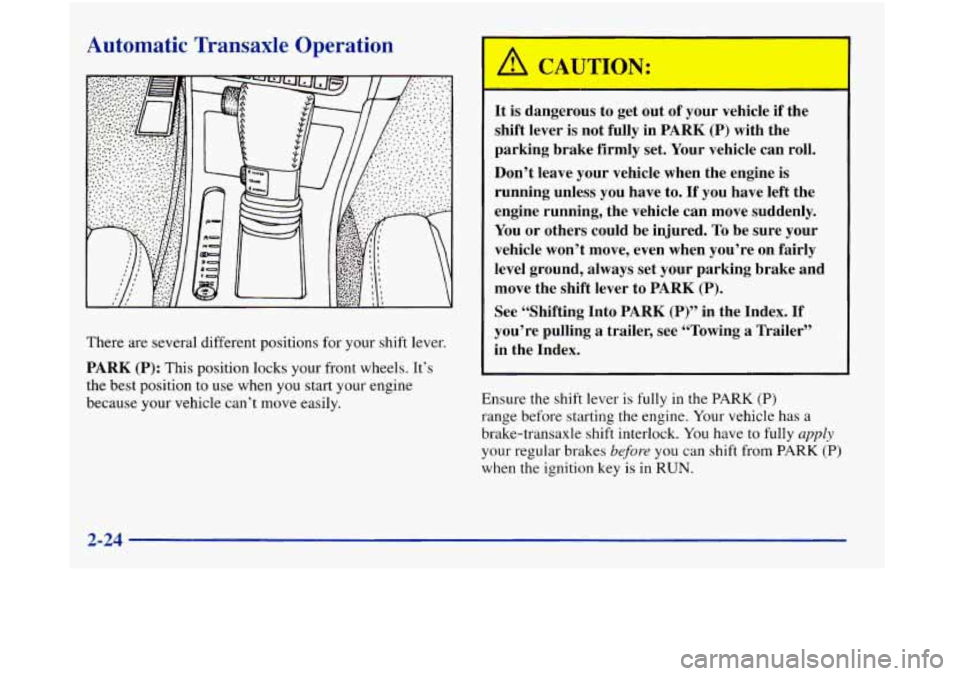
There are several different positions for your shift lever.
PARK (P): This position locks your front wheels. It’s
the best position
to use when you start your engine
because your vehicle can’t move easily. It
is dangerous to get
out of your vehicle if the
shift lever is not fully in
PARK (P) with the
parking brake firmly set. Your vehicle can roll.
Don’t leave your vehicle when the engine is
running unless you have
to. If you have left the
engine running, the vehicle can move suddenly.
You
or others could be injured. To be sure your
vehicle won’t move, even when you’re on fairly
level ground,
always set your parking brake and
move the shift lever to
PARK (P).
See “Shifting Into PARK (P)” in the Index. If
you’re pulling a trailer, see “Towing a Trailer’’
in the Index.
Ensure the shift lever
is fully in the PARK (P)
range before starting the engine. Your vehicle has a
brake-transaxle shift interlock. You have to fully
apply
your regular brakes bcfore you can shift from PARK (P)
when the ignition key is in RUN.
2-24
Page 93 of 380
Selectable Shift
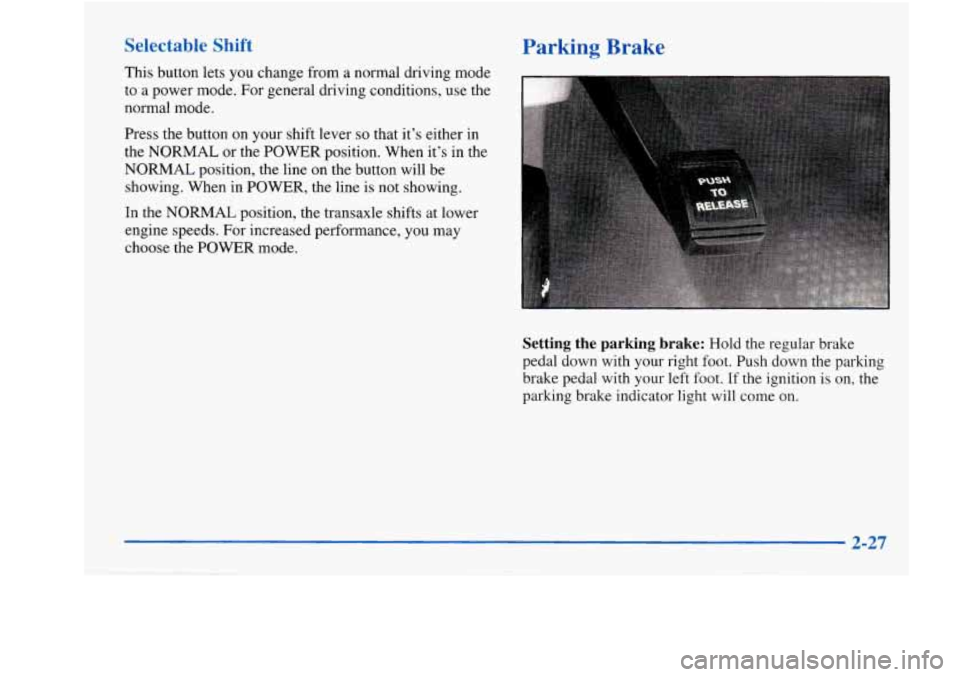
This button lets you change from a normal driving mode
to a power mode. For general driving conditions, use the
normal mode.
Parking Brake
Press the button on your shift lever so that it’s either in
the NORMAL or the
POWER position. When it’s in the
NORMAL position, the line on the button will be
showing. When in POWER, the line is not showing.
In the NORMAL position, the transaxle shifts at lower
engine speeds. For increased performance, you may
choose the POWER mode.
Setting the parking brake: Hold the regular brake
pedal down with your right foot. Push down the parking
brake pedal with your left foot.
If the ignition is on, the
parking brake indicator light will come on.
Page 94 of 380
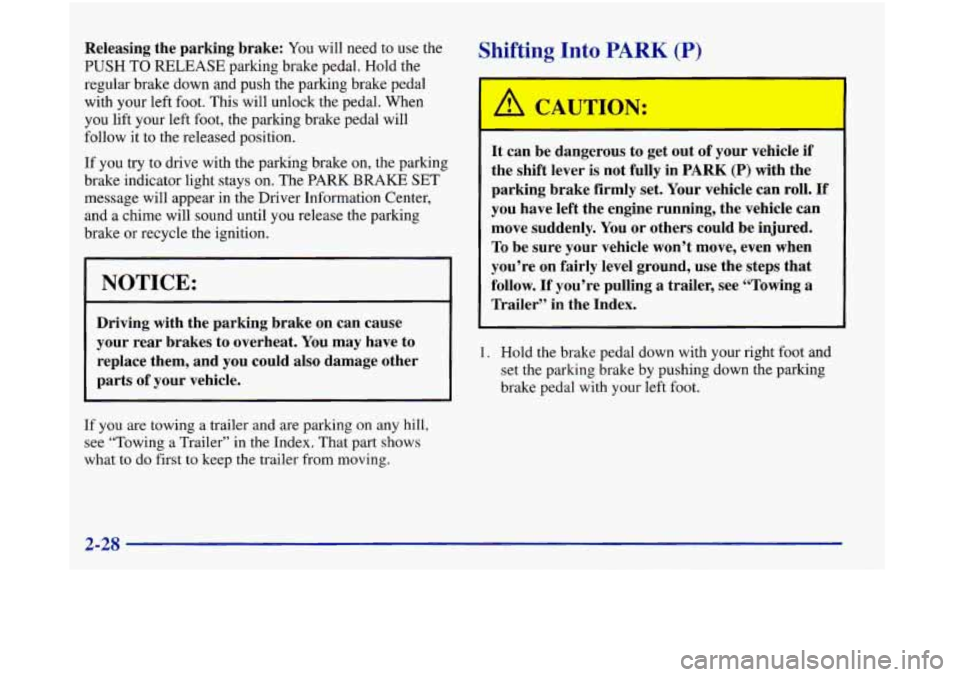
Releasing the parking brake: You will need to use the
PUSH TO RELEASE parking brake pedal. Hold the
regular brake down and push the parking brake pedal
with your left foot. This will unlock the pedal. When
you lift your left foot, the parking brake pedal will
follow
it to the released position.
If you try to drive with the parking brake on, the parking
brake indicator light stays
on. The PARK BRAKE SET
message will appear in the Driver Information Center,
and
a chime will sound until you release the parking
brake or recycle the ignition.
NOTICE:
Shifting Into PARK (P)
Driving with the parking brake on can cause
your rear brakes to overheat. You may have to
replace them, and you could also damage other
parts of your vehicle.
1
If you are towing a trailer and are parking on any hill,
see “Towing a Trailer” in the Index. That part
shows
what to do first to keep the trailer from moving.
It can be dangerous to get out of your vehicle if
the shift lever is not fully in PARK (P) with the
parking brake firmly set.
Your vehicle can roll. If
you have left the engine running, the vehicle can
move suddenly. You or others could be injured.
To be sure your vehicle won’t move, even when
you’re on fairly level ground, use the steps that
follow. If you’re pulling a trailer, see “Towing a
Trailer” in the Index.
1. Hold the brake pedal down with your right foot and
set the parking brake by pushing down the parking
brake pedal with your left foot.
2-28
Page 95 of 380

2. Move the shift lever into PARK (P) as follows:
Hold in the button on the lever.
Push the lever all the way down toward the front
of your vehicle.
3. Turn the ignition key to LOCK.
4. Remove the key and take it with you. If you can
leave your vehicle with the ignition key in your
hand, your vehicle is in
PARK (P).
Leaving Your Vehicle With the
Engine Running
It can be dangerous to leave your vehicle with the
engine running. Your vehicle could move
suddenly if the shift lever is not fully in
PARK (P)
with the parking brake firmly set. And, if you
leave the vehicle with the engine running, it could overheat and even catch fire. You or others could
be injured. Don’t leave your vehicle with the
engine running unless you have to.
If you have to leave your vehicle with the engine
running, be sure your vehicle is
in PARK (P) and your
parking brake is firmly set before you leave
it. After
you’ve moved the shift lever into PARK (P), hold the
regular brake pedal down. Then,
see if you can move the
shift lever away from PARK (P) without first pushing
the button.
If you can, it means the shift lever wasn’t fully locked
into PARK (P).
Page 96 of 380
Torque Lock
If you are parking on a hill and you don’t shift your
transaxle into PARK
(P) properly, the weight of the
vehicle may put too much force on the parking pawl in
the transaxle. You may find it difficult to pull the shift
lever out of PARK (P). This is called “torque lock.”
To
prevent torque lock, set the parking brake and then shift
into PARK (P) properly before you leave the driver’s
seat.
To find out how, see “Shifting Into PARK (P)” in
the Index.
When you are ready to drive, move the shift lever out
of PARK
(P) before you release the parking brake.
If torque lock does occur, you may need to have another
vehicle push yours a little uphill to take some of the
pressure from the parking pawl in the transaxle,
so you
can pull the shift lever out
of PARK (P).
Shifting Out of PARK (P)
Your vehicle has a brake-transaxle shift interlock. You
have to fully
apply your regular brake before you can
shift from PARK (P) when the ignition
is in RUN. See
“Shifting the Automatic Transaxle” in the Index.
If you cannot shift out of PARK
(P), ease pressure on
the shift lever
-- push the shift lever all the way into
PARK
(P) as you maintain brake application. Then
move the shift lever into the gear you wish. Press the
shift lever button before moving the shift lever.
If you ever hold the brake pedal down but still can’t
shift out
of PARK (P), try this:
1. Turn the ignition key to OFF. Open and close the
driver’s door
to turn off the retained accessory
power feature.
2. Apply and hold the brake until the end of Step 4.
3. Shift to NEUTRAL (N).
4. Start the vehicle and then shift to the drive gear
you want.
5. Take your vehicle to an authorized service center
as soon as you can.
Page 99 of 380
Running Your Engine While
You’re
P-_- I-ed
It’s better not to park with the engine running. But if you
ever have to, here are
some things to know.
A
/L CA 7ON:
Idling the engine with the climate control
system
off could allow dangerous exhaust into
your vehicle (see the earlier Caution under
“Engine Exhaust”).
Also, idling in
a closed-in place can let deadly
carbon monoxide
(CO) into your vehicle even
if the fan switch is at the highest setting. One
place this can happen is
a garage. Exhaust -- with
CO -- can come in easily. NEVER park in a
garage with the engine running.
Another closed-in place can be a blizzard. (See
“Blizzard” in the Index.)
-
It can be dangerous to get out of your vehicle if
the shift lever is not fully in PARK (P) with the
parking brake firmly set. Your vehicle can roll.
Don’t leave your vehicle when the engine is
running unless you have to.
If you’ve left the
engine running, the vehicle can move suddenly.
You or others could be injured.
To be sure your
vehicle won’t move, even when you’re on fairly
level ground, always set your parking brake and
move the shift lever to PARK
(P).
Follow the proper steps to be sure your vehicle won’t
move. See “Shifting Into
PARK (P)” in the Index.
If you are parking on a hill and if you’re pulling a
trailer, also see “Towing a Trailer’’ in the Index.
Page 133 of 380
If the light and chime come on while you are driving,
pull off the road and stop carefully. You may notice that
the pedal is harder to push. Or, the pedal may go closer
to the floor. It may take longer to stop. If the light is still
on, have the vehicle towed for service. (See “Towing
Your Vehicle” in the Index.)
Your brake system may not be working properly
if the brake warning light
is on. Driving with the
i brake warning light on can lead to an accident.
If the light is still on after you’ve pulled off the
road and stopped carefully, have the vehicle
towed for service.
Parking Brake Indicator Light
When the ignition is on,
PARK
this light will come on when
you set your parking brake.
The light will stay
on if
your parking brake doesn’t
release fully.
If you try to drive off with the parking brake set,
a chime will also come on until you release the
parking brake.
This light should also come on when you turn the
ignition key to
START. If it doesn’t come on then, have
it fixed
so it will be ready to remind you if the parking
brake hasn’t released fully.
Page 188 of 380
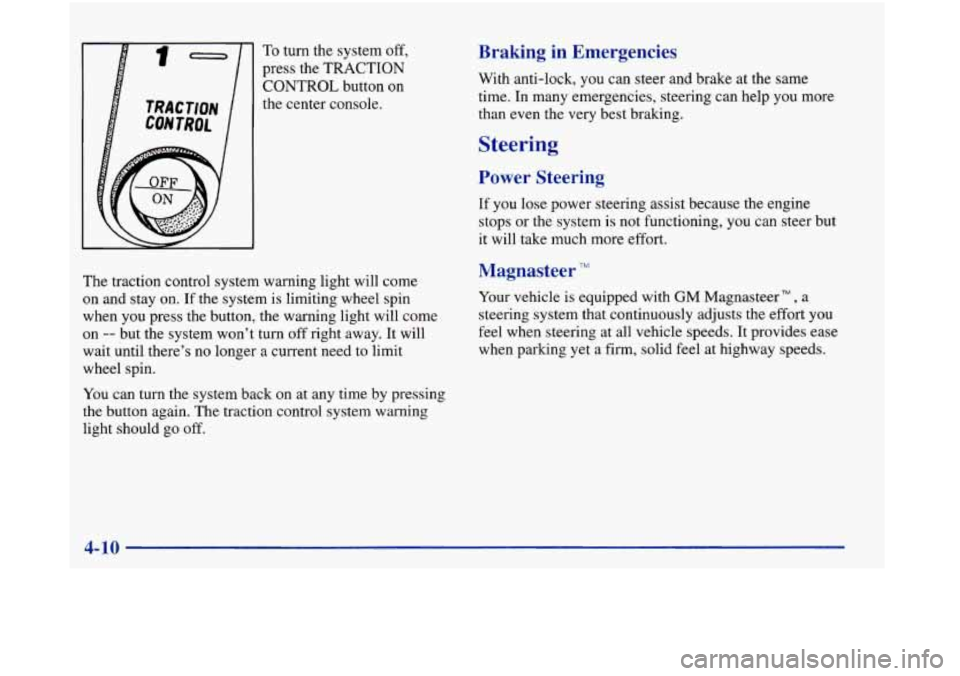
To turn the system off,
press the TRACTION
CONTROL button on
the center console.
Braking in Emergencies
With anti-lock, you can steer and brake at the same
time. In many emergencies, steering can help you more
than even the very best braking.
Steering
Power Steering
If you lose power steering assist because the engine
stops or the system is not functioning, you can steer but
it will take much more effort.
The traction control system warning light will come
on and stay on.
If the system is limiting wheel spin
when you press the button, the warning light will come
on
-- but the system won't turn off right away. It will
wait until there's no longer a current need to limit
wheel spin.
You can turn the system back on at any time by pressing
the button again. The traction control system warning
light should go off.
Magnasteer TM
Your vehicle is equipped with GM Magnasteer" , a
steering system that continuously adjusts the effort you
feel when steering at all vehicle speeds. It provides ease
when parking yet a firm, solid feel at highway speeds.
Page 214 of 380
Making Turns
I NOTICE: 1
Making very sharp turns while trailering could
cause the trailer to come in contact with the
vehicle. Your vehicle could be damaged. Avoid
making very sharp turns while trailering.
When you’re turning with a trailer, make wider
turns than normal.
Do this so your trailer won’t
strike soft shoulders, curbs, road signs, trees or other
objects. Avoid jerky or sudden maneuvers. Signal
well in advance.
Tbrn Signals When Towing a Trailer
The green arrows on your instrument panel will flash
whenever you signal a turn or lane change. Properly
hooked up, the trailer lamps will also flash, telling other
drivers you’re about to turn, change lanes or stop.
When towing a trailer, the green arrows on your
instrument panel will flash for turns even if the bulbs on
the trailer are burned out. Thus, you may think drivers behind
you are seeing your signal when they
are not. It’s
important to check occasionally to be sure the trailer
bulbs are still working.
Your vehicle may have bulb warning messages. When
you plug a trailer lighting system into your vehicle’s
lighting system, its bulb warning messages may not let
you know if one
of your lamps goes out. So, when you
have a trailer lighting system plugged in, be sure to
check your vehicle and trailer lamps from time to time
to be sure they’re all working. Once you disconnect the
trailer lamps, the bulb warning messages again can tell
you if one of your vehicle lamps is out.
Driving On Grades
Reduce speed and shift to a lower gear before you start
down a long or steep downgrade.
If you don’t shift
down, you might have to use your brakes
so much that
they would get hot and no longer work well.
Parking on Hills
You really should not park your vehicle, with a trailer
attached, on a hill. If something goes wrong, your rig
could start
to move. People can be injured, and both
your vehicle and the trailer can be damaged.
4-36