brakes OLDSMOBILE AURORA 2003 Owner's Manual
[x] Cancel search | Manufacturer: OLDSMOBILE, Model Year: 2003, Model line: AURORA, Model: OLDSMOBILE AURORA 2003Pages: 387, PDF Size: 18.05 MB
Page 272 of 387

Brakes
Brake Fluid
1
A DOT3
b
your brake system fixed, since a leak means that
sooner or later your brakes won’t work well, or won’t
work at all.
So, it isn’t a good idea to “top
off’ your brake fluid.
Adding brake fluid won’t correct a leak.
If you add fluid
when your linings are worn, then you’ll have too
much fluid when you get new brake linings.
You should
add (or remove) brake fluid, as necessary, only when
work is don
- In the brake hydraulic sys’- -n
Your master cylinder reservoir is on the driver’s side of
the engine compartment. It is filled with DOT-3 brake
fluid. See
Engine Compartment Overview on page 5-14
There are only two reasons why the brake fluid level
in the reservoir might go down. The first is that the brake
fluid goes down to an acceptable level during normal
brake lining wear. When new linings are put
in, the fluid
level goes back up. The other reason is that fluid is
leaking out of the brake system.
If it is, you should have
If you have too much brake fluid, it can spill on
the engine. The fluid will burn if the engine
is
hot enough. You or others could be burned,
and your vehicle could be damaged. Add brake
fluid only when work is done on the brake
hydraulic system.
When your brake fluid falls to a low level, your brake
warning light will come on.
A chime will sound if you try
to drive with this warning light on. See
Brake System
Warning Light on
page 3-35.
5-39
ProCarManuals.com
Page 273 of 387

What to Add Notice:
When you do need brake fluid, use only DOT-3 brake
fluid. Refer
to Part D: Recommended Fluids and
Lubricants on page
6-75. Use new brake fluid from a
sealed container only.
Always clean the brake fluid reservoir cap and the area
around the cap before removing it. This will help
keep dirt from enteri-- the reservoir.
With the wrong kind of fluid in your brake
system, your brakes may not work well, or
they may not even work at all. This could
cause a crash. Always use the proper brake
fluid.
Using the wrong fluid can badly damage brake
system parts. For example, just a few drops of
mineral-based oil, such as engine oil, in your
brake system can damage brake system
parts
so badly that they’ll have to be replaced.
Don’t let someone put in the wrong kind of fluid.
9 If you spill brake fluid on your vehicle’s painted
surfaces, the paint finish can
be damaged. Be
careful not to spill brake fluid on your vehicle.
If
you do, wash it off immediately. See
“Appearance Care” in the Index.
5-40
ProCarManuals.com
Page 274 of 387

Brake Wear
Your vehicle has four-wheel disc brakes.
Disc brake pads have built-in wear indicators that make
a high-pitched warning sound when the brake pads
are worn and new pads are needed. The sound
may come and go or be heard all the time your vehicle
is moving (except when you are pushing on the
brake pedal firmly).
The brake wear warning sound means that
soon your brakes won’t work well. That could
lead to an accident. When you hear the brake
wear warning sound, have your vehicle
serviced.
Notices Continuing to drive with worn-out brake
pads could result in costly brake repair.
Some driving conditions or climates may cause a brake
squeal when the brakes are first applied or lightly
applied. This does not mean something is wrong with
your brakes.
Properly torqued wheel nuts are necessary to help
prevent brake pulsation. When tires are rotated, inspect
brake pads for wear and evenly tighten wheel nuts in
the proper sequence to
GM torque specifications.
Brake linings should always be replaced as complete
axle sets.
See
Brake System Inspection on page 6- 14.
Brake Pedal Travel
See your dealer if the brake pedal does not return to
normal height, or
if there is a rapid increase in
pedal travel. This could be a sign of brake trouble.
Brake Adjustment
Every time you apply the brakes, with or without the
vehicle moving, your brakes adjust for wear.
5-4 1
ProCarManuals.com
Page 275 of 387

Replacing Brake System Parts
The braking system on a vehicle is complex. Its many
parts have to be of top quality and work well together
if
the vehicle is to have really good braking. Your
vehicle was designed and tested with top-quality GM
brake parts. When you replace parts of your braking
system
- for example, when your brake linings
wear down and you need new ones put in
- be sure
you get new approved GM replacement parts. If
you don’t, your brakes may no longer work properly. For
example,
if someone puts in brake linings that are
wrong for your vehicle, the balance between your front
and rear brakes can change
- for the worse. The
braking performance you’ve come to expect can change
in many other ways
if someone puts in the wrong
replacement brake parts.
Battery
Your new vehicle comes with a maintenance free
ACDelco@ battery. When it’s time for a new battery, get
one that has the replacement number shown on the
original battery’s label. We recommend an ACDelco
battery.
Warning: Battery posts, terminals and related
accessories contain lead and lead compounds,
chemicals known to the State of California to cause
cancer and reproductive harm. Wash hands after
handling. The
battery is located under the rear seat cushion. To
access the battery, see
Removing the Rear Seat
Cushion on page 5-95. You don’t need to access the
battery to jump start your vehicle. See
Jump Starting on
page 5-44.
- - ~ttery -.~t isn’t properly vented can let
sulfuric acid fumes into the area under the rear
seat cushion. These fumes can damage your
rear seat safety belt systems. You may not be
able to see this damage, and the safety belts
might not provide the protection needed in a
crash. If a replacement battery is ever needed,
it must be vented in the same manner as the
original battery. Always make sure that the
vent hose
is properly reattached before
reinstalling the seat cushion.
5-42
ProCarManuals.com
Page 303 of 387

Tire Chains
If your vehicle has P235/55R17 size tires, don’t
use tire chains, there’s not enough clearance.
Tire chains used on a vehicle without the proper amount of clearance can cause damage
to the brakes, suspension or other vehicle
parts. The area damaged by the tire chains
could cause you to lose control of your vehicle
and you or others may be injured
in a crash.
Use another type of traction device only if its
manufacturer recommends
it for use on your
vehicle and tire size combination and road
conditions. Follow that manufacturer’s
instructions. To help avoid damage to your
vehicle, drive slowly, readjust or remove the device if it’s contacting your vehicle, and don’t
spin your wheels.
If you do find traction devices that will fit,
install them on the front tires.
Notice: If your vehicle has a tire size other than
P235/55R17 size tires, use tire chains only where
legal and only when you must. Use only
SAE Class
”S” type chains that are the proper size for your
tires. Install them
on the front tires and tighten them
as tightly as possible with the ends securely
fastened. Drive
slowly and follow the chain
manufacturer’s instructions.
If you can hear the
chains contacting your vehicle, stop and retighten
them. If the contact continues, slow down until
it stops. Driving too fast or spinning the wheels with
chains on will damage your vehicle.
If a Tire Goes Flat
It’s unusual for a tire to “blow out” while you’re driving,
especially
if you maintain your tires properly. If air
goes out of a tire, it’s much more likely to leak out
slowly. But
if you should ever have a “blowout”, here are
a few tips about what to expect and what to do:
If a front tire fails, the flat tire will create a drag that
pulls the vehicle toward that side. Take your foot
off the
accelerator pedal and grip the steering wheel firmly.
Steer to maintain lane position, and then gently brake to
a stop well out of the traffic lane.
5-70
ProCarManuals.com
Page 340 of 387
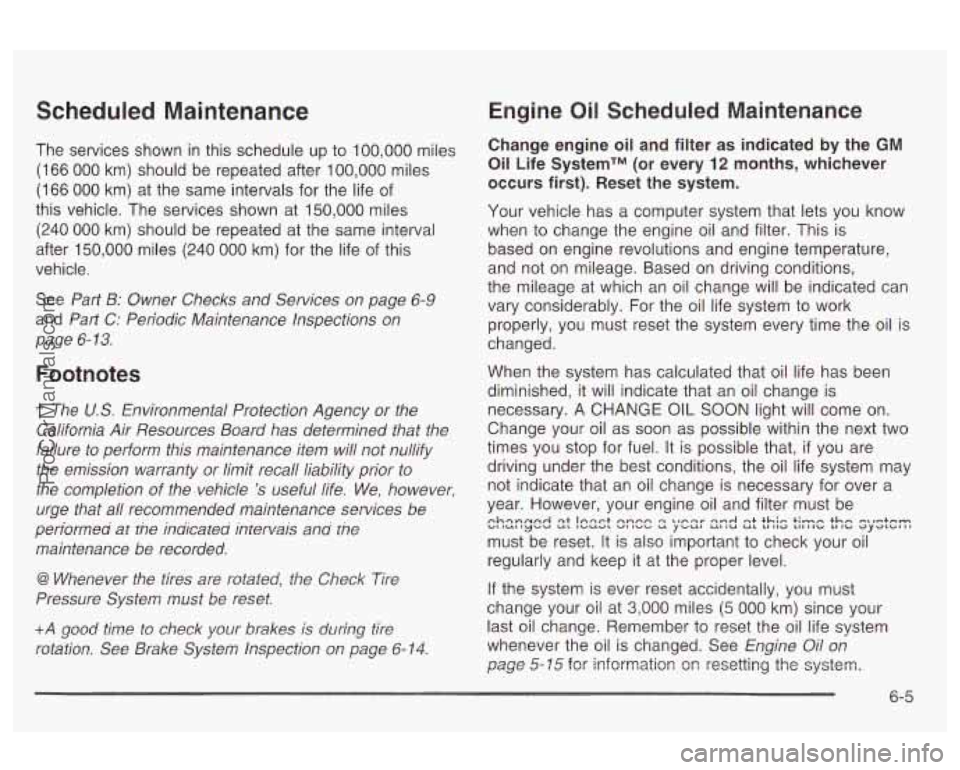
Scheduled Maintenance
The services shown in this schedule up to 100,000 miles
(166 000 km) should be repeated after
100,000 miles
(166
000 km) at the same intervals for the life of
this vehicle. The services shown at 150,000 miles
(240 000 km) should be repeated at the same interval
after 150,000 miles
(240 000 km) for the life of this
vehicle.
See
Part 5: Owner Checks and Services on page 6-9
and Part C: Periodic Maintenance Inspections on
page
6- 13.
Footnotes
t The U.S. Environmental Protection Agency or the
California Air Resources Board has determined that the
failure to perform this maintenance item will not nullify
the emission warranty or limit recall liability prior to
the completion of the vehicle
's useful life. We, however,
urge that all recommended maintenance services be
periormea at tne inuicateti intervais anti tne
maintenance be recorded.
@ Whenever the tires are rotated, the Check Tire
Pressure System must be reset.
+A good ti.me to check your brakes is duri.ng tire
rotation. See Brake System Inspection on page 6-14.
Engine Oil Scheduled Maintenance
Change engine oil and filter as indicated by the GM
Oil Life SystemTM (or every 12 months, whichever
occurs first). Reset the system.
Your vehicle has a computer system that lets you know
when to change the engine oil and filter. This is
based on engine revolutions and engine temperature,
and not on mileage. Based on driving conditions,
the mileage at which an oil change will be indicated can
vary considerably. For the oil life system to work
properly, you must reset the system every time the oil is
changed.
When the system has calculated that oil life has been
diminished, it will indicate that an oil change is
necessary. A CHANGE
OIL SOON light will come on.
Change your oil as
soon as possible within the next two
times you stop for fuel.
It is possible that, if you are
driving under the best conditions, the oil life system may
not indicate that an oil change is necessary for over a
year. However, your engine oil and filter must be
must be reset. It is
also important to check your oil
regularly and keep it at the proper level.
If the system is ever reset accidentally, you must
change your oil at
3,000 miles (5 000 km) since your
last oil change. Remember to reset the
oil life system
whenever the oil is changed. See
Engine Oil on
page
5-15 for information on resetting the system.
nh-nnnr-4 qt Inrrrt nnnn q
nqv Qnrl rrt thio t;-m th- rrnrrrtmm WI IUI uyuu UL IUUUL VI lWcI u yuul UI IU UL LI Ilr) tIIIIc, LI Ic, G)yr)LOIl1
6-5
ProCarManuals.com
Page 349 of 387

Engine Cooling System Inspection
Inspect the hoses and have them replaced if they
are cracked, swollen or deteriorated. Inspect all pipes,
fittings and clamps; replace as needed. Clean the
outside of the radiator and air conditioning condenser.
To help ensure proper operation, a pressure test of
the cooling system and pressure cap is recommended
at least once a year.
Throttle System Inspection
Inspect the throttle system for interference or binding,
and for damaged or missing parts. Replace parts
as needed. Replace any components that have high
effort or excessive wear.
Do not lubricate accelerator
and cruise control cables.
Brake System Inspection
Inspect the complete system. Inspect brake lines and
hoses for proper hook-up, binding, leaks, cracks,
chafing, etc. Inspect disc brake pads for wear and rotors
for surface condition. Inspect other brake parts,
including calipers, parking brake, etc. You may need to
have your brakes inspected more often
if your driving
habits or conditions result in frequent braking.
6-1 4
ProCarManuals.com
Page 362 of 387

If NHTSA receives similar complaints, it may open an
investigation, and
if it finds that a safety defect exists in
a group of vehicles, it may order a recall and remedy
campaign. However, NHTSA cannot become involved in
individual problems between you, your dealer or
General Motors.
To contact NHTSA, you may either call the Auto Safety
Hotline toll-free at 1-800-424-9393 (or 366-0123 in
the Washington, D.C. area) or write to:
NHTSA,
U.S. Department of Transportation
Washington, D.C. 20590
You can also obtain other information about motor
vehicle safety from the hotline.
Reporting Safety Defects to the
Canadian Government
If you live in Canada, and you believe that your vehicle
has a safety defect, you should immediately notify
Transport Canada, in addition to notifying General
Motors of Canada Limited. You may write to:
Transport Canada 330 Sparks Street
Tower C
Ottawa, Ontario KIA ON5
Reporting Safety Defects to General
Motors
In addition to notifying NHTSA (or Transport Canada) in
a situation like this, we certainly hope you’ll notify us.
Please call us at 1-800-442-6537, or write:
Oldsmobile Customer Assistance Center
P.O. Box 33171
Detroit, MI 48232-51 71
In Canada, please call us at 1-800-263-3777 (English)
or 1-800-263-7854 (French). Or, write:
General Motors of Canada Limited
Customer Communication Centre 163-005
1908 Colonel Sam Drive
Oshawa, Ontario L1H 8P7
Service Publications Ordering
Information
Service Manuals
Service Manuals have the diagnosis and repair
information on engines, transmission, axle, suspension
brakes, electrical, steering, body, etc.
RETAIL
SELL PRICE: $120.00
7-9
ProCarManuals.com
Page 365 of 387

Automatic Climate Control System ..................... 3-23
Automatic Door Locks
..................................... 3-54
Automatic Headlamp System
............................ 3-1 6
Automatic Level Control
................................... 4-36
Automatic Operation
........................................ 3-23
Automatic Transaxle Fluid
.......................................................... 5-22
Operation
................................................... 2-26
Automatic Transaxle Check
.............................. 6-1 0
Automatic Transaxle Shift Lock Control System
Check
........................................................ 6-1 1
Backing
Up .................................................... 4-41
Battery
.......................................................... 5-42
Battery Load Management
............................... 3-21
Battery Replacement
......................................... 2-9
Battery Warning Light
...................................... 3-35
Before Leaving on a Long Trip
......................... 4-23
Body Lubrication Service
.................................. 6-10
Brake
Parking
...................................................... 2-29
System Inspection
....................................... 6-1 4
System Warning Light
.................................. 3-35 Brake
Fluid
.................................................... 5-39
Brake Wear
................................................... 5-41
Brakes
.......................................................... 5-39
Braking
........................................................... 4-6
Braking in Emergencies
..................................... 4-8
Break.ln. New Vehicle
..................................... 2-23
Bulb Replacement
........................................... 5-54
Front Turn Signal and Parking Lamps
............. 5-57
Halogen Bulbs
............................................ 5-54
Headlamp Aiming
........................................ 5-50
Headlamps ................................................. 5-55
Replacement Bulbs ...................................... 5-58
Taillamps, Turn Signal, Stoplamps and Back-up Lamps
........................................ 5-58
Buying New Tires
........................................... 5-66
C
California Fuel .......................................... 5-6
Canada
........................................................... 7-4
Canadian Owners
................................................ ii
Canadian Roadside Assistance
........................... 7-6
Capacities and Specifications
.......................... 5-1 00
Carbon Monoxide ................... 4.26. 4.36. 2.14. 2-33
ProCarManuals.com
Page 377 of 387

T
Tachometer ............................. ........ 3-33
Taillamps Turn Signal, Stoplamps and Back-up Lamps
.... 5-58
TCS Active Light
............................................. 3-38
TCS Warning Light
.......................................... 3-37
Testing the Alarm
............................................ 2-20
Theater Dimming
............................................ 3-1 9
Theft-Deterrent Systems
.................... .... 2-19
PASS-Key@
Ill Operation ... .... .... 2-21
Throttle System Inspection
............................... 6-14
Theft-Deterrent,
Radio
.................. .... 3-73
PASS-Key@
Ill .......................... .... 2-21
Universal Theft-Deterrent
.............................. 2-1 9
Tilt Wheel ........................................................ 3-5
Tire Inflation Check
........................................... 6-9
Tires
..................................................... 5-60, 5-86
Buying New Tires
........................................ 5-66
Chains
....................................................... 5-70
Changing a Flat Tire
.................................... 5-71
Check Tire Pressure System
......................... 5-62
If a Tire Goes Flat ....................................... 5-70
Inflation
-- Tire Pressure ............................... 5-60
Inspection and Rotation ................................ 5-63
Uniform Tire Quality Grading
......................... 5-67
Compact Spare Tire
..................................... 5-81 Tires (cont.)
Wheel Alignment and Tire Balance
..... ..... 5-68
Wheel Replacement
......................... ..... 5-68
When It
Is Time for New Tires .................. 5-65
To Use the Engine Coolant Heater
................ 2-25
Top of the Instrument Panel
............................. 5-83
Top Strap
...................................................... 1-38
Top Strap Anchor Location
............................... 1-39
Torque Lock
................................................... 2-31
Total Weight on Your Vehicle’s Tires
.................. 4-39
Towing Recreational Vehicle
..... ..... 4-33
Towing a Trailer
...................... ..... 4-36
Your Vehicle
.............................. ......... 4-33
Control System Active Light
...................... 3-38
Control System (TCS)
.................................... 4-8
Control System Warning Light
....................... 3-37
Trailer Brakes
................................................. 4-40
Trailer Wiring Harness
..................................... 4-40
Transaxle Fluid, Automatic
...................... ............. 5-22
Transaxle Operation, Automatic
......................... 2-26
Transmission, Transaxle, Transfer Case Unit Repair Manual
............................................ 7-10
Transportation Options
........ ................... 7-7
Traction
14
ProCarManuals.com