service OLDSMOBILE BRAVADA 1994 User Guide
[x] Cancel search | Manufacturer: OLDSMOBILE, Model Year: 1994, Model line: BRAVADA, Model: OLDSMOBILE BRAVADA 1994Pages: 248, PDF Size: 14.54 MB
Page 94 of 248

Features & Controk
88
Engine Coolant Temperature Gage
pcmoNIc CLUSTER)
This gage has bars that show the engine
coolant temperature.
A box around the temperature symbol
will flash when your engine
is too hot.
It means that your engine coolant has
overheated. If you have been operating
your vehicle under normal driving
conditions, you should pull
off the road,
stop your vehicle and turn
off the
engine as soon as possible.
HOT COOLANT
CAN BURN YOU
BADLY!
In ProbZems on the Road, this manual
shows what to do. See the
Index under
Engine Overheating.
~
Brake System Warning Light
Your Oldsmobile’s hydraulic brake
system is divided into two parts.
If one
part isn’t working, the other part can
still work and stop you. For good
braking, though, you need both parts
working well.
If the warning light comes on, there
could be a brake problem. Have your
brake system inspected right away.
This light should come on as you start
the vehicle. If it doesn’t come on then,
have it fixed
so it will be ready to warn
you
if there’s a problem.
If the light comes on while you are
driving, pull off the road and stop
carefully.
You may notice that the pedal
is harder to push. Or, the pedal may go closer
to the floor. It may take longer to
stop.
If the light is still on, have the
vehicle towed for service. (See
Towing
Your Truck in the Index.)
The brake system warning light will also
come on when you set your parking
brake, and it will stay on
if your parking
brake doesn’t release fully. If it stays
on
after your parking brake is fully released,
it means you have a brake problem.
ProCarManuals.com
Page 95 of 248

Anti-Lock Brake System Warning Light
With anti-lock, this light will go on
when you start your engine and may
stay on for several seconds. That’s
normal. If the light doesn’t come on,
have it fixed
so it will be ready to warn
you if there is
a problem.
If the light stays
on, or comes on when
you’re
driving, your Oldsmobile needs
service.
If the regular brake system
warning light isn’t
on, you still have
brakes, but you don’t have anti-lock
brakes. If the regular brake system
warning light is
also on, you don’t have
anti-lock brakes and there’s a problem
with your regular brakes. See
Brake
System Warning Light earlier in this part
Malfunction Indicator Lamp
(Service Engine Soon Light)
A computer monitors operation of your
fuel, ignition and emission control
systems. This light should come on
when the ignition
is on, but the engine
is not running, as a check to show you
it is working. If it does not come on at
all, have it fixed right away. If it stays
on, or it comes on while you are driving,
the computer is indicating that you
have a problem. You should take your
vehicle in for service soon.
NOTICE:
If you keep driving your vehicle
with this light on, after a while the
emission controls won’t work as
well, your fuel economy won’t be
as good and your engine may not
run as smoothly. This could lead
to costly repairs not covered by
your warranty.
L 1
89
ProCarManuals.com
Page 108 of 248

Comfort Controls &Audio Systems
102
Care of Your Cassette Tape
Player
A tape player that is not cleaned
regularly is subject to reduced sound
quality, ruining the cassette, or
damaging the mechanism. Tape
cassettes that are not properly stored in
their plastic cases away from
contaminants, direct sunlight, and
extreme heat may not operate properly
and could cause premature failure of
the tape player.
Your tape player should be cleaned
monthly or with every
15 hours of use,
as regular maintenance. If you notice a
reduction in sound quality,
try a good
cassette to see if the tape or the tape
1
player is at fault. If the second cassette
results in no improvement in sound
quality, try cleaning the tape player.
Proper tape player cleaning should be
done with a
wiping action nonabrasive
cleaner cassette.
To properly clean your
tape player,
you should follow the
directions on the cleaning cassette.
Cassettes are subject to wear and the
sound quality may degrade over time.
Always verify that the cassette tape is in
good condition before obtaining service
on your tape player.
Care of Your Compact Discs
Handle discs carefully. Store them in
their original cases or other protective
cases and away from direct sunlight and
dust. If the surface of a disc is soiled,
dampen a clean, soft cloth in a mild,
neutral detergent solution and clean it,
wiping from the center to the edge.
Be sure never to touch the signal
surface when handling discs. Pick up
discs by grasping the outer edges or the
edge of the hole and the outer edge.
ProCarManuals.com
Page 116 of 248

Your Driving and the Road
110
SERVICE
ENGINE
SOON ANT’- LOCK I
Anti-Lock Brakes (ABS)
Your vehicle has an advanced electronic
braking system that can help you keep
it under control. When you start your
vehicle and begin to drive away, you
may hear a momentary motor or
clicking noise. This is the ABS system
testing itself. Here’s how anti-lock works.
Let’s say
the road is wet. You’re driving safely.
Suddenly an animal jumps out in front
You slam on the brakes. Here’s what
happens with
ABS.
A computer senses that the wheels are
slowing down. If one of the wheels is
about to stop rolling, the computer will
separately work the brakes at each front
wheel and at the rear wheels. The anti-
lock system can change the brake
pressure faster than any driver could.
The computer is programmed to make
the most of available tire and road
conditions. You can steer around the
obstacle while braking hard.
of
you.
As you brake, your computer keeps
receiving updates on wheel speed and
controls braking pressure accordingly.
Remember: Anti-lock doesn’t change
the time you need to get your foot up to
the brake pedal.
If you get too close to
the vehicle
in front of you, you won’t
have time to apply your brakes if that
vehicle suddenly slows or stops. Always
leave enough room up ahead to stop,
even though you have anti-lock brakes.
To Use Four-wheel Anti-Lock
Don’t pump the brakes. Just hold the
brake pedal down and let anti-lock
work for you. You may feel the brakes
vibrate, or you may notice some noise,
but this is normal.
ProCarManuals.com
Page 121 of 248

Driving Guidelines
This multipurpose passknger vehicle is
defined as a utility vehicle in Consumer
Information Regulations issued by the
National Highway Traffic Safety
Administration (NHTSA) of the United
States Department of Transportation.
Utility vehicles have higher ground
clearance and a narrower track to make
them capable of performing in a wide
variety of off-road applications. Specific
design characteristics give them a
higher center of gravity than ordinary
cars. An advantage of the higher ground
clearance is a better view of the road
allowing you to anticipate problems.
They are not designed for cornering at
the same speeds as conventional
2-
wheel drive vehicles any more than low-
slung sports cars are designed to
perform satisfactorily under off-road
conditions.
If at all possible, avoid sharp
turns or abrupt maneuvers. As with
other vehicles of this type, failure to
operate this vehicle correctly may result
in loss of control or vehicle rollover.
3perating Your Bravada Off
Paved Roads
Many of the same design features that
help make Bravada responsive on paved
roads during poor weather conditions
-
features like the locking rear axle and all-
wheel drive - help make it much better
suited for off-road use than a
conventional passenger
car. Its higher
ground clearance also helps Bravada step
over some off-road obstacles. But
Bravada doesn’t have features like special
underbody shielding and a transfer case
low gear range, things that are usually
thought necessary for extended or severe
off-road service.
This guide is for
operating your Bravada off paved roads.
Also, see Anti-Lock Brakes in the Index.
Off-road driving can be great fun. But it
does have some definite hazards. The
greatest of these is the terrain itself.
“Off-roading” means you’ve left the
great North American road system
behind. Traffic lanes aren’t marked.
Curves aren’t banked. There are no
road signs. Surfaces can be slippery,
rough, uphill or downhill. In short,
you’ve gone right back to nature.
Off-road driving involves some new
skills. And that’s why it’s very
important that
you read this guide.
You’ll find many driving tips and
suggestions. These will help malte your
off-road driving safer and more
enjoyable.
Before You Go Ofi-Roading
There are some things to do before you
go out. For example, be sure to have all
necessary maintenance and service
work done. Be sure you read all the
information about your all-wheel drive
vehicle in this manual.
Is there enough
fuel? Is the spare tire fully inflated? Are
the fluid levels up where they should
be? What are the local laws that apply
to off-roading where you’ll be driving?
115
ProCarManuals.com
Page 129 of 248

Driving In Water
Light rain causes no special off-road
driving problems. But heavy rain can
mean flash flooding, and flood waters
demand extreme caution.
Find
out how deep the water is before
you drive through it. If it’s deep enough
to cover your wheel hubs, axles, or
exhaust pipe, don’t
try it - you
probably won’t get through.
Also, water
that deep can damage your axle and
other vehicle parts.
If the water isn’t too deep, then drive
through it slowly. At fast speeds, water
splashes on your ignition system and
your vehicle can stall. Stalling can also
occur
if you get your tailpipe under
water.
And, as long as your tailpipe is
under water, you’ll never be able to
start your engine. When you go through
water, remember that when your brakes
get wet, it may take you longer to stop.
After OtY-Road Driving
Remove any brush or debris that has
collected on the underbody, chassis or
under the hood. These accumulations
can be a fire hazard.
After operation
in mud or sand, have
the brake linings cleaned and checked.
These substances can cause glazing and
uneven braking. Check the body
structure, steering, suspension, wheels,
tires, and exhaust system for damage.
Also, check the fuel lines and cooling
system for any leakage.
Your vehicle
will require more frequent
service due to off-road use. Refer to the
Maintenance Schedule for additional
information.
L
123
ProCarManuals.com
Page 134 of 248
Your Driving und the Road
128
The exit ramp can be curved, sometimes
quite sharply.
The exit speed is usually posted.
Reduce your speed according to your
speedometer, not to your sense of
motion. After driving for any distance at
higher speeds, you may tend to think you
are going slower than you actually are.
I Before Leaving on a Long
Tip
Make sure you’re ready. Try to be well
rested. If
you must start when you’re
not fresh
- such as after a day’s work
- don’t plan to make too many miles
that first part of the journey. Wear
comfortable clothing and shoes you can
easily drive in.
Is your vehicle ready for a long trip? If
you keep it serviced and maintained, it’s
ready to go.
If it needs service, have it
done before starting out.
Of course,
you’ll find experienced and able service
experts in Oldsmobile dealerships all
across North America. They’ll be ready
and willing to help if you need it.
Here are some things you can check
before a trip:
Windshield Washer Fluid Is the
reservoir full? Are all windows clean
inside and outside?
shape?
you checked all levels?
Wiper Blades: Are they in good
Fuel, Engine Oil, Other Fluids: Have
Lights: Are they all working? Are the
lenses clean?
Tires: They are vitally important to a
safe, trouble-free trip. Is the tread
good enough for long-distance
driving? Are the tires all inflated to
the recommended pressure?
Weather Forecasts: What’s the
weather outlook along your route?
Should you delay your trip a short
time to avoid a major storm system?
Maps: Do you have up-to-date maps?
Highway Hypnosis
Is there actually such a condition as
“highway hypnosis”? Or is it just plain
falling asleep at the wheel? Call it
highway hypnosis, lack
of awareness, or
whatever.
There is something about an easy
stretch of road with the same scenery, along
with the hum of the tires on the
road, the drone of the engine, and the
rush of the wind against the vehicle that
can make you sleepy. Don’t let it
happen
to you! If it does, your vehicle
can leave the road in
less than a
second, and you could crash and be
injured.
What can you do about highway
hypnosis? First, be aware that it can
happen.
Then here are some tips:
Make sure your vehicle is well
ventilated, with a comfortably cool
interior.
Keep your eyes moving. Scan the road
ahead and to the sides. Check your
mirrors and your instruments
frequently.
If you get sleepy, pull off the road into
a rest, service, or parking area and
take a nap, get some exercise, or both.
For safety, treat drowsiness on the
highway as an emergency.
ProCarManuals.com
Page 142 of 248

Your Driving and the Road
Turn Signals When Towing a
Trailer
When you tow a trailer, your vehicle has
to have a different turn signal flasher
and extra wiring. The green arrows on
your instrument panel will flash
whenever you signal a turn or lane
change. Properly hooked up, the trailer
lights will also flash, telling other
drivers you’re about to turn, change
lanes or stop.
When towing a trailer, the green arrows
on your instrument panel will flash for
turns even if the bulbs on the trailer are
burned out. Thus, you may think
drivers behind you are seeing your
signal when they are not, It’s important
to check occasionally to be sure the
trailer bulbs are still working.
Driving On Grades
Reduce speed and shift to a lower gear
before you start down a long or steep
downgrade. If you don’t shift
down, you
might have to use your brakes
so much
that they would get hot and no longer
work well. On
a long uphill grade, shift down and
reduce your speed
to around 45 mph
(70 km/h) to reduce the possibility of
engine and transmission overheating.
If you are towing a trailer that weighs
more than
3,000 pounds (1 350 kg), it’s
best to drive in
D instead of Overdrive
(or, as you need to, a lower gear). This
will minimize heat build-up and extend
the life of your transmission.
Parking on Hills
You really should not park your vehicle,
with a trailer attached, on a hill.
If
something goes wrong, your rig could
start to move. People can be injured,
and both your vehicle and the trailer
can be damaged.
But if you ever have to park your rig on
a hill, here’s how to do it:
1. Apply your regular brakes, but don’t
shift into
P (Park) yet.
2. Have someone place chocks under
the trailer wheels.
3. When the wheel chocks are in place,
release the regular brakes until the
chocks absorb the load.
4. Reapply the regular brakes. Then
apply your parking brake and then
shift to
P (Park).
5. Release the regular brakes.
When You Are Ready to Leave
After Parking on
a Hill
1. Apply your regular brakes and hold
the pedal down while you:
Start your engine;
Shift into a gear; and
Release the parking brake.
2. Let up on the brake pedal.
3. Drive slowly until the trailer is clear
4. Stop and have someone pick up and
of
the chocks.
store the chocks.
Maintenance When Trailer Towing
Your vehicle will need service more
often when you’re pulling a trailer. See
the Maintenance Schedule for more on
this. Things that are especially
important in trailer operation are
automatic transmission fluid (don’t
overfill), engine oil, axle lubricant, belt,
cooling system, and brake adjustment.
Each of these is covered in this manual,
ProCarManuals.com
Page 143 of 248
and the Index will help you find them
quickly. If you’re trailering, it’s a good
idea to review these sections before
you
start your trip.
Check periodically to see that all hitch
nuts and bolts are tight.
See the next section,
Trailer Wiring
Harness.
Trailer Wiring Harness (OPTION)
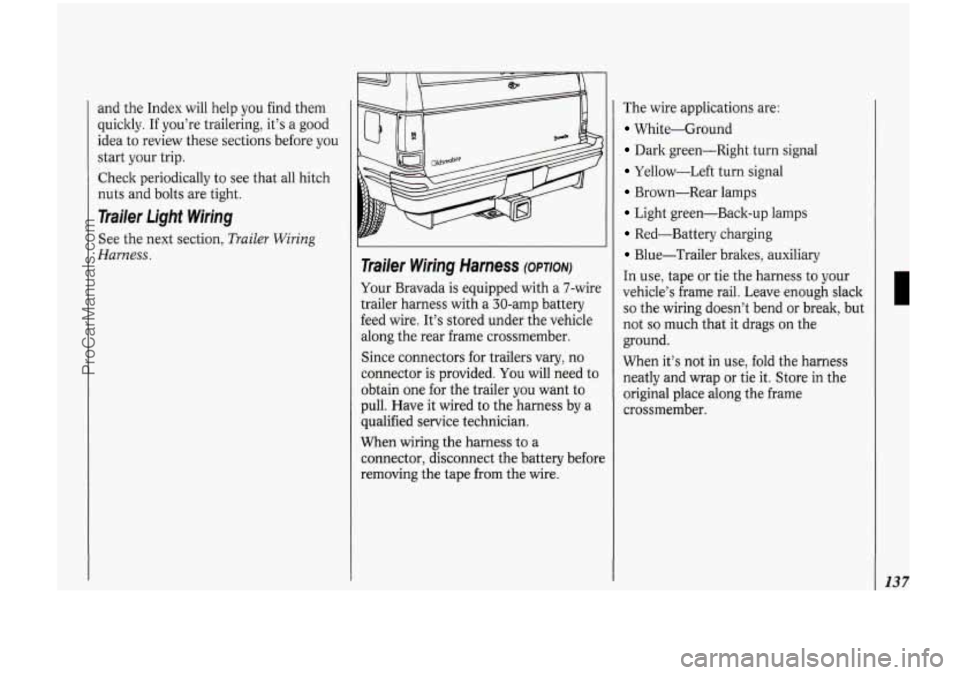
Your Bravada is equipped with a 7-wire
trailer harness with a 30-amp battery
feed wire. It’s stored under the vehicle
along the rear frame crossmember.
Since connectors for trailers vary, no
connector is provided.
You will need to
obtain one for the trailer
you want to
pull. Have it wired to the harness by a
qualified service technician.
When wiring the harness to a
connector, disconnect the battery before
removing the tape from the wire. The
wire applications are:
White-Ground
Dark green-Right turn signal
Yellow-Left turn signal
Brown-Rear lamps
Light green-Back-up lamps
Red-Battery charging
Blue-Trailer brakes, auxiliary
In use, tape or tie the harness to your
vehicle’s frame rail. Leave enough slack
so the wiring doesn’t bend or break, but
not
so much that it drags on the
ground.
When it’s not in use, fold the harness
neatly and wrap or tie it. Store in the
original place along the frame
crossmember.
137
ProCarManuals.com
Page 149 of 248

7. Don’t let the other end touch metal.
Connect it to the positive
(+)
terminal of the good battery. Use a
remote positive
(+) terminal if the
vehicle has one.
8. Now connect the black negative (-)
cable to the good battery’s negative
(-) terminal. Don’t let the other end
touch anything until the next step.
The other end of the negative cable
doesn’t go to the dead battery. It goes
to a heavy unpainted metal part on
the engine
of the vehicle with the
dead battery.
9. Attach the cable at least 18 inches
(45 cm) away from the dead battery,
but not near engine parts that move.
The electrical connection is just as
good there, but the chance of sparks
getting back to the battery is much
less.
IO. Now start the vehicle with the good
battery and run the engine for a
while.
11. Try to start the vehicle with the
dead battery. If it won’t start after a
few tries, it probably needs service.
I U I
12. Remove the cables in reverse order
to prevent electrical shorting. Take
care that they don’t touch each
other
or any other metal.
143
ProCarManuals.com