cooling OLDSMOBILE BRAVADA 1994 Owners Manual
[x] Cancel search | Manufacturer: OLDSMOBILE, Model Year: 1994, Model line: BRAVADA, Model: OLDSMOBILE BRAVADA 1994Pages: 248, PDF Size: 14.54 MB
Page 98 of 248

Comfort Cont'rok &Audio Systems
LO HI
Climate Control System
Your vehicle's heater and air
conditioner work best
if you keep your
windows closed. Your vehicle also has
flow-through ventilation, described later
in this section, to bring outside air into
your vehicle.
3f Fan Lever: The lever at the top has
four positions. Move it toward
HI to
increase the air flow. To decrease the
air flow, move it toward
LO.
Temperature Lever: Slide the lever on
the left to control the temperature of the
air flow into the vehicle. Move the lever
up for warmer air, down for cooler air.
Function Lever: Slide the lever on the
right to select the function desired. The
air conditioner compressor will operate
in all settings except
VENT and HTR
(Heater) when the outside temperature
is above freezing. When the air
conditioner compressor cycles
on, you
may sometimes notice slight changes in
your vehicle's engine performance and
power. This is normal, because the
system is designed to keep the desired
cooling level and help fuel economy. There are
three air conditioning
settings:
MAX A/C, NORM A/C, and
BI-LEV A/C. On very hot days, your
vehicle will cool down more quickly and
economically in any of these settings
if
you open the windows long enough to
let hot inside air escape. For all settings,
adjust the temperature control lever and
fan speed as desired.
MAX A/C: Select this setting to get
maximum cooling or quick cool-down
on very hot days. This setting
recirculates much of the air inside your
vehicle. It should not be used for long
periods
of time because the air may
become too cold and dry.
Also slide the temperature control lever
down to the coolest setting and adjust
the fan speed as desired.
NORM A/C: Use this setting for
normal cooling on hot days. This setting
cools outside air and directs it through
the instrument panel outlets.
BI-LEV A/C: Use on cool but sunny
days. This setting brings in outside air,
but directs it two ways-through the
instrument panel outlets and the heater
ProCarManuals.com
Page 129 of 248

Driving In Water
Light rain causes no special off-road
driving problems. But heavy rain can
mean flash flooding, and flood waters
demand extreme caution.
Find
out how deep the water is before
you drive through it. If it’s deep enough
to cover your wheel hubs, axles, or
exhaust pipe, don’t
try it - you
probably won’t get through.
Also, water
that deep can damage your axle and
other vehicle parts.
If the water isn’t too deep, then drive
through it slowly. At fast speeds, water
splashes on your ignition system and
your vehicle can stall. Stalling can also
occur
if you get your tailpipe under
water.
And, as long as your tailpipe is
under water, you’ll never be able to
start your engine. When you go through
water, remember that when your brakes
get wet, it may take you longer to stop.
After OtY-Road Driving
Remove any brush or debris that has
collected on the underbody, chassis or
under the hood. These accumulations
can be a fire hazard.
After operation
in mud or sand, have
the brake linings cleaned and checked.
These substances can cause glazing and
uneven braking. Check the body
structure, steering, suspension, wheels,
tires, and exhaust system for damage.
Also, check the fuel lines and cooling
system for any leakage.
Your vehicle
will require more frequent
service due to off-road use. Refer to the
Maintenance Schedule for additional
information.
L
123
ProCarManuals.com
Page 135 of 248

Hill and Mountain Roads
Driving on steep hills or mountains is
different from driving
in flat or rolling
terrain.
If you drive regularly in steep country,
or
if you’re planning to visit there, here
are some tips that can make your trips
safer and more enjoyable. (See
Off-
Road Driving in the Index for
information about driving off-road.)
Keep your vehicle in good shape.
Check
all fluid levels and also the
brakes, tires, cooling system and
transmission. These parts can work
hard on mountain roads.
how how to go down hills. The most
important thing to how is this: let
your engine do some
of the slowing down.
Shift to
a lower gear when you
go
down a steep or long hill.
Know how to go uphill. You may
want to shift
down to a lower gear.
The lower gears help cool your engine
and transmission, and you can climb
the hill better.
Stay in your own lane when driving on
two-lane roads in hills or mountains.
Don’t swing wide or cut across the
center of the road. Drive at speeds that
let you stay in your
own lane.
As you go over the top of a hill, be
alert. There could be something in
your lane, like a stalled car or an
accident.
You may see highway signs on
mountains that warn of special
problems. Examples are long grades,
passing or no-passing zones, a falling
rocks area, or winding roads. Be alert
to these and tale appropriate action.
129
ProCarManuals.com
Page 142 of 248

Your Driving and the Road
Turn Signals When Towing a
Trailer
When you tow a trailer, your vehicle has
to have a different turn signal flasher
and extra wiring. The green arrows on
your instrument panel will flash
whenever you signal a turn or lane
change. Properly hooked up, the trailer
lights will also flash, telling other
drivers you’re about to turn, change
lanes or stop.
When towing a trailer, the green arrows
on your instrument panel will flash for
turns even if the bulbs on the trailer are
burned out. Thus, you may think
drivers behind you are seeing your
signal when they are not, It’s important
to check occasionally to be sure the
trailer bulbs are still working.
Driving On Grades
Reduce speed and shift to a lower gear
before you start down a long or steep
downgrade. If you don’t shift
down, you
might have to use your brakes
so much
that they would get hot and no longer
work well. On
a long uphill grade, shift down and
reduce your speed
to around 45 mph
(70 km/h) to reduce the possibility of
engine and transmission overheating.
If you are towing a trailer that weighs
more than
3,000 pounds (1 350 kg), it’s
best to drive in
D instead of Overdrive
(or, as you need to, a lower gear). This
will minimize heat build-up and extend
the life of your transmission.
Parking on Hills
You really should not park your vehicle,
with a trailer attached, on a hill.
If
something goes wrong, your rig could
start to move. People can be injured,
and both your vehicle and the trailer
can be damaged.
But if you ever have to park your rig on
a hill, here’s how to do it:
1. Apply your regular brakes, but don’t
shift into
P (Park) yet.
2. Have someone place chocks under
the trailer wheels.
3. When the wheel chocks are in place,
release the regular brakes until the
chocks absorb the load.
4. Reapply the regular brakes. Then
apply your parking brake and then
shift to
P (Park).
5. Release the regular brakes.
When You Are Ready to Leave
After Parking on
a Hill
1. Apply your regular brakes and hold
the pedal down while you:
Start your engine;
Shift into a gear; and
Release the parking brake.
2. Let up on the brake pedal.
3. Drive slowly until the trailer is clear
4. Stop and have someone pick up and
of
the chocks.
store the chocks.
Maintenance When Trailer Towing
Your vehicle will need service more
often when you’re pulling a trailer. See
the Maintenance Schedule for more on
this. Things that are especially
important in trailer operation are
automatic transmission fluid (don’t
overfill), engine oil, axle lubricant, belt,
cooling system, and brake adjustment.
Each of these is covered in this manual,
ProCarManuals.com
Page 152 of 248

Problems on the Road
146
NOTICE:
If your engine catches fire because
you keep driving with no coolant,
your vehicle can be badly damaged.
The costly repairs would not be
covered by your warranty.
If No Steam Is Coming From Your
Engine
If you get the overheat warning but see
or hear no steam, the problem may not
be too serious. Sometimes the engine
can get a little too hot when you:
Climb a long hill on a hot day.
Stop after high speed driving.
Idle for long periods in traffic.
Tow a trailer.
If you get the overheat warning with no
sign of steam, try this for a minute or
so:
1. Turn off your air conditioner.
2. Turn on your heater to full hot at the
highest fan speed and open the
window as necessary.
3. If you’re in a traffic jam, shift to
N (Neutral). If
you no longer have the overheat
warning, you can drive. Just to be safe,
drive slower for about ten minutes.
If
the warning doesn’t come back on, you
can drive normally.
If the warning continues, pull over,
stop, and park your vehicle right away.
If there’s still no sign of steam, push the
accelerator until the engine speed is
about twice as fast as normal idle speed.
Bring the engine speed back to normal
idle speed after two or three minutes.
Now see
if the warning stops. But then,
if you still have the warning, TURN
OFF THE ENGINE AND GET
EVERYONE OUT
OF THE VEHICLE
until it cools down.
You may decide not to lift the hood but
to get service help right away.
Cooling System
When you decide it’s safe to lift the
hood, here’s what you’ll see:
(A) Coolant recovery tank
(B) Radiator pressure cap
If the coolant inside the coolant
recovery tank is boiling, don’t do
anything else until it cools down.
ProCarManuals.com
Page 153 of 248

I
The coolant level should be at or above
the
FULL HOT mark. If it isn’t, you
may have a leak in the radiator hoses,
heater hoses, radiator, water pump or
somewhere else in the cooling system.
NOTICE:
Engine damage from running your
engine without coolant isn’t
covered by your warranty.
If there seems to be no leak, start the
engine again. See if the fan speed
increases when idle speed is doubled by
pushing the accelerator pedal down. If
it doesn’t, your vehicle needs service.
Turn off the engine.
How to Add Coolant to the
Coolant Recovery Tank
If you haven’t found a problem yet, but
the coolant level isn’t at or above the
FULL HOT mark, add a 50/50 mixture
of
clean water (preferably distilled) and
a proper antifreeze at the coolant
recovery tank. (See
Engine Coolant in
the
Index for more information about
the proper coolant mix.)
I NOTICE: I
In cold weather, water can freeze
and crack the engine, radiator,
heater core and other parts. Use the
recommended coolant.
147
ProCarManuals.com
Page 154 of 248
Problems on the Rod
148
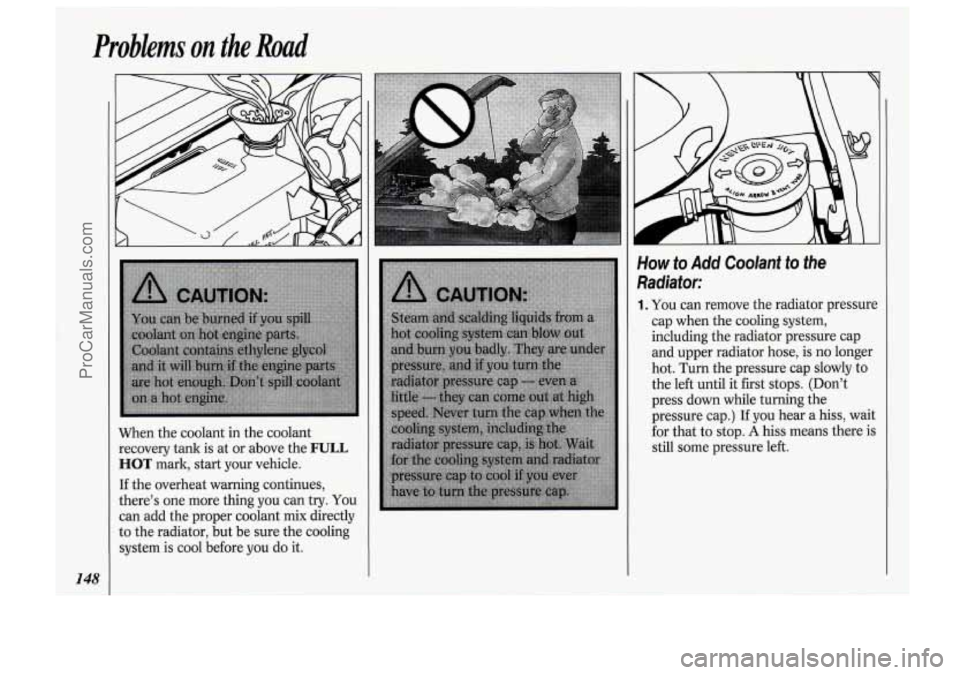
When the coolant in the coolant
recovery tank is at or above the
FULL
HOT mark, start your vehicle.
If the overheat warning continues,
there’s one more thing you can try.
You
can add the proper coolant mix directly
to the radiator, but be sure the cooling
system is cool before you do it.
How to Add Coolant to the
Radiator:
1. You can remove the radiator pressur(
cap when the cooling system,
including the radiator pressure cap
and upper radiator hose, is no longer
hot. Turn the pressure cap slowly to
the left until it first stops. (Don’t
press down while turning the
pressure cap.) If you hear a hiss, wail
for that to stop.
A hiss means there i:
still some pressure left.
ProCarManuals.com
Page 157 of 248

Engine Fan Noise
This vehicle has a clutched engine
cooling fan. When the clutch is engaged,
the fan spins faster to provide more air
to cool the engine. In most everyday
driving conditions the clutch is not
engaged. This improves fuel economy
and reduces fan noise. Under heavy
vehicle loading, trailer towing and/or
high outside temperatures, the fan speed
increases when the clutch engages.
So
you may hear an increase in fan noise.
This is normal and should not be
mistaken as the transmission slipping or
making extra shifts. It is merely the
cooling system functioning properly.
The fan will slow down when additional
cooling is not required and the clutch
disengages. You may also hear this fan
noise when you start the engine. It will
go away
as the fan clutch disengages.
I Ifa Tire Goes Flat
It’s unusual for a tire to “blow out”
while you’re driving, especially if you
maintain your tires properly. If air goes
out of a tire, it’s much more likely to
leak out slowly. But if you should ever
have a “blowout,” here are a few tips
about what to expect and what to do:
If a front tire fails, the flat tire
will
create a drag that pulls the vehicle
toward that side. Take your foot
off the
accelerator pedal and grip the steering
wheel firmly. Steer to maintain lane
position, then gently brake to a stop
well out of the traffic lane.
A rear blowout, particularly on a curve,
acts much like a skid and may require
the same correction you’d use in a skid.
In any rear blowout, remove your foot
from the accelerator pedal. Get the
vehicle under control by steering the
way you want the vehicle to go. It may
be very bumpy and noisy, but you can
still steer. Gently brake to a stop, well
off the road if possible.
If a tire goes
flat, the next section shows
how to use your jacking equipment to
change a flat tire safely.
I Changing a Flat Tire
If a tire goes flat, avoid further tire and
wheel damage by driving slowly to a
level place. Turn
on your hazard
warning flashers.
151
ProCarManuals.com
Page 180 of 248

Service & Appearance Care
I
1 74
After adding fluid, recheck the fluid
level as described under
How to
Check.
obtained, push the dipstick back in all
the way.
When the correct fluid level is
I Rear Axle
When to Check and Change
Lubricant
Refer to the Maintenance Schedule to
determine how often to check the
lubricant and when to change it. See
Scheduled Maintenance Services in
the
Index.
How to Check Lubricant
If the level is below the bottom of the
filler plug hole, you’ll need to add some
lubricant. Add enough lubricant to
raise the level to the bottom of the filler
plug hole.
What to Use
Refer to the Maintenance Schedule to
determine what kind of lubricant to use.
See
Recommended Fluids E. Lubricants
in the Index.
I All-Wheel Drive
Transfer Case
When to Check Lubricant
Refer to the Maintenance Schedule to
determine how often to check the
lubricant. See
Periodic Maintenance
Inspections
in the Index.
How to Check Lubricant
If the level is below the bottom of the
filler plug hole, you’ll need to add some
lubricant. Add enough lubricant to
raise the level to the bottom of the filler
plug hole.
What to Use
Refer to the Maintenance Schedule to
determine what kind of lubricant to use.
See
Recommended Fluids G Lubricants
in the Index.
Front Axle
When to Check and Change
Lubricant
Refer to the Maintenance Schedule to
determine how often to check the
lubricant and when to change it. See
Scheduled Maintenance Services in the
Index.
How to Check Lubricant
If the level is below the bottom of the
filler plug hole, you’ll need to add some
lubricant. Add enough lubricant to raise
the level to the bottom of the filler plug
hole.
What to Use
Refer to the Maintenance Schedule to
determine what kind of lubricant to use.
See
Recommended Fluids G Lubricants
in the Index.
I Engine Coolant
The following explains your cooling
system and how to add coolant when it
is low. If you have a problem with
engine overheating, see
Engine
Overheating
in the Index.
The proper coolant for your Oldsmobile
will:
Give freezing protection down to
Give boiling protection up to 258°F
Protect against rust and corrosion.
Help keep the proper engine
-34°F (-37°C).
(125°C).
temperature.
I
ProCarManuals.com
Page 181 of 248

Let the warning lights and gages work
What to Use
Use a mixture of one-half clean water
(preferably distilled) and one-half
antifreeze that meets
“GM Specification
6038-M,” which won’t damage
aluminum parts. If you use this mixture,
you don’t need
to add anything else.
as
they should.
NOTICE:
If you use an improper coolant mix,
your engine could overheat and be
badly damaged. The repair cost
wouldn’t be covered by your
warranty. Too much water in the
mix can freeze and crack the
engine, radiator, heater core and
other parts.
Some conditions, such as air trapped in
the cooling system, can affect the
coolant level in the radiator. Check the
coolant level when the engine is cold
and follow the steps under
Adding
Coolant for the proper way to add
coolant.
If you have to add coolant more than
four times a year, have your dealer
check your cooling system.
NOTICE:
If you use the proper coolant, you
don’t have to add extra inhibitors
or additives which claim to improve
the system. These can be harmful.
~~
Adding Coolant
To Check Coolant
When your engine is cold, the coolant
level should be at
ADD, or a little
higher. When your engine is warm, the
level should be up to
FULL HOT, or a
little higher.
L
175
ProCarManuals.com