spare tire OLDSMOBILE BRAVADA 1994 Owners Manual
[x] Cancel search | Manufacturer: OLDSMOBILE, Model Year: 1994, Model line: BRAVADA, Model: OLDSMOBILE BRAVADA 1994Pages: 248, PDF Size: 14.54 MB
Page 49 of 248

Power Tailgate Window Release
From inside the vehicle, press the REAR
WINDOW button, located to the left of
the radio, to unlock the tailgate window.
Your shift lever must be in
P (Park) or
N (Neutral).
Tailgate-Mounted Spare Tire
Carrier
(OPTION)
You must move the carrier arm out of
the way to open the tailgate window.
r
43
ProCarManuals.com
Page 121 of 248

Driving Guidelines
This multipurpose passknger vehicle is
defined as a utility vehicle in Consumer
Information Regulations issued by the
National Highway Traffic Safety
Administration (NHTSA) of the United
States Department of Transportation.
Utility vehicles have higher ground
clearance and a narrower track to make
them capable of performing in a wide
variety of off-road applications. Specific
design characteristics give them a
higher center of gravity than ordinary
cars. An advantage of the higher ground
clearance is a better view of the road
allowing you to anticipate problems.
They are not designed for cornering at
the same speeds as conventional
2-
wheel drive vehicles any more than low-
slung sports cars are designed to
perform satisfactorily under off-road
conditions.
If at all possible, avoid sharp
turns or abrupt maneuvers. As with
other vehicles of this type, failure to
operate this vehicle correctly may result
in loss of control or vehicle rollover.
3perating Your Bravada Off
Paved Roads
Many of the same design features that
help make Bravada responsive on paved
roads during poor weather conditions
-
features like the locking rear axle and all-
wheel drive - help make it much better
suited for off-road use than a
conventional passenger
car. Its higher
ground clearance also helps Bravada step
over some off-road obstacles. But
Bravada doesn’t have features like special
underbody shielding and a transfer case
low gear range, things that are usually
thought necessary for extended or severe
off-road service.
This guide is for
operating your Bravada off paved roads.
Also, see Anti-Lock Brakes in the Index.
Off-road driving can be great fun. But it
does have some definite hazards. The
greatest of these is the terrain itself.
“Off-roading” means you’ve left the
great North American road system
behind. Traffic lanes aren’t marked.
Curves aren’t banked. There are no
road signs. Surfaces can be slippery,
rough, uphill or downhill. In short,
you’ve gone right back to nature.
Off-road driving involves some new
skills. And that’s why it’s very
important that
you read this guide.
You’ll find many driving tips and
suggestions. These will help malte your
off-road driving safer and more
enjoyable.
Before You Go Ofi-Roading
There are some things to do before you
go out. For example, be sure to have all
necessary maintenance and service
work done. Be sure you read all the
information about your all-wheel drive
vehicle in this manual.
Is there enough
fuel? Is the spare tire fully inflated? Are
the fluid levels up where they should
be? What are the local laws that apply
to off-roading where you’ll be driving?
115
ProCarManuals.com
Page 140 of 248

Your Driving and the Road
134
Hitches
It’s important to have the correct hitch
equipment. Crosswinds, large trucks
going by, and rough roads are a few
reasons why you’ll need the right hitch.
Here are some rules to follow:
If you’ll be pulling a trailer that, when
loaded, will weigh more than
2,000
pounds (900 kg), be sure to use a
properly mounted, weight-distributing
hitch and sway control
of the proper
size. This equipment is very important
for proper vehicle loading and good
handling when you’re driving.
Will you have to make any holes in
the body of your vehicle when you
install a trailer hitch? If you do, then
be sure to seal the holes later when
you remove the hitch. If you don’t
seal them, deadly carbon monoxide
(CO) from your exhaust can get into
your vehicle (see
Carbon Monoxide in
the
Index). Dirt and water can, too.
. The bumpers on your vehicle are not
intended for hitches. Do not attach
rental hitches or other bumper-type
hitches to them. Use only a frame-
mounted hitch that does not attach to
the bumper. If
your vehicle has
a deadweight hitch
and a tailgate-mounted spare tire, and
your trailer has a winch or tongue jack,
you could have interference between
them.
Safety Chains
You should always attach chains
between your vehicle and your trailer. Cross the safety chains under the
tongue of the trailer
so that the tongue
will not drop to the road if it becomes
separated from the hitch. Instructions
about safety chains may be provided by
the hitch manufacturer or by the trailer
manufacturer. Follow the
manufacturer’s recommendation for
attaching safety chains. Always leave
just enough slack
so you can turn with
your rig. And, never allow safety chains
to drag on the ground.
Trailer Brakes
If your trailer weighs more than 1,000
pounds (450 kg) loaded, then it needs
its own brakes
- and they must be
adequate. Be sure to read and follow
the instructions for the trailer brakes
so
you’ll be able to install, adjust and
maintain them properly. Don’t
tap into your vehicle’s brake
system
if the trailer’s brake system will
use more than
0.02 cubic inch (0.3 cc)
of fluid from your vehicle’s master
cylinder. If it does, both braking
systems won’t work well. You could
even lose your brakes.
Will the trailer brake parts take 3,000
psi (20 650 kPa) of pressure? If not,
the trailer brake system must not be
used with your vehicle.
If everything checks out this far, then
make the brake fluid tap at the port
on the master cylinder that sends
fluid to the rear brakes. But don’t use
copper tubing for this. If
you do, it
will bend and finally break off. Use
steel brake tubing.
Driving with a Trailer
Towing a trailer requires a certain
amount of experience. Before setting
out for the open road, you’ll want to get
to know your rig. Acquaint yourself
with the feel of handling and braking
with the added weight of the trailer.
And always keep in mind that the
vehicle you are driving is now a good
ProCarManuals.com
Page 158 of 248
Problems on the Road
152
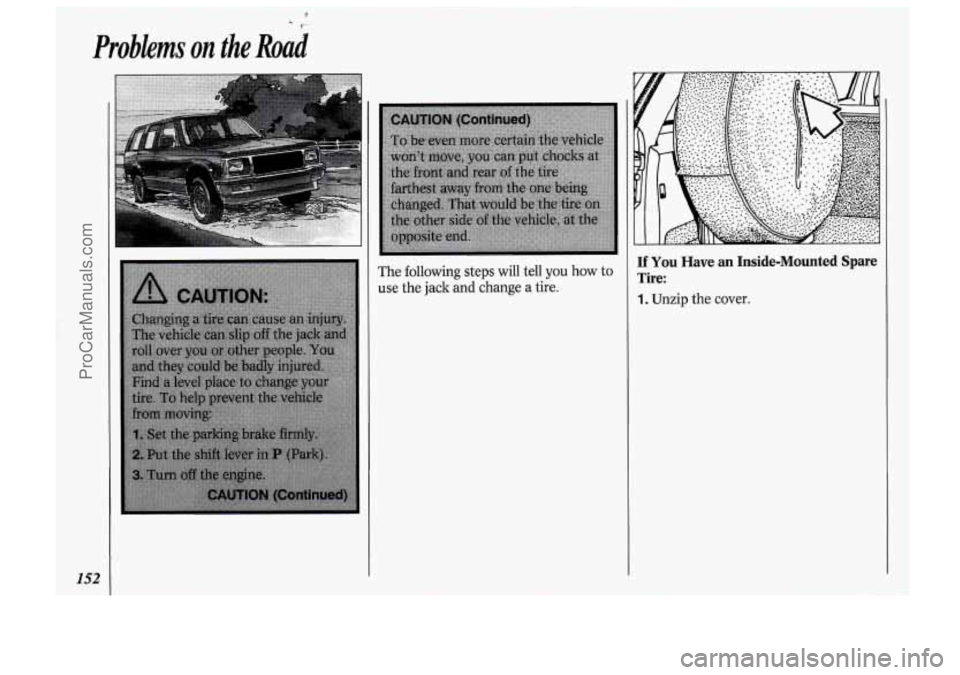
The following steps will tell you how to
use the jack and change a tire.
If You Have an Inside-Mounted Spare
Tire:
1. Unzip the cover.
ProCarManuals.com
Page 160 of 248
Problems on the Road
154
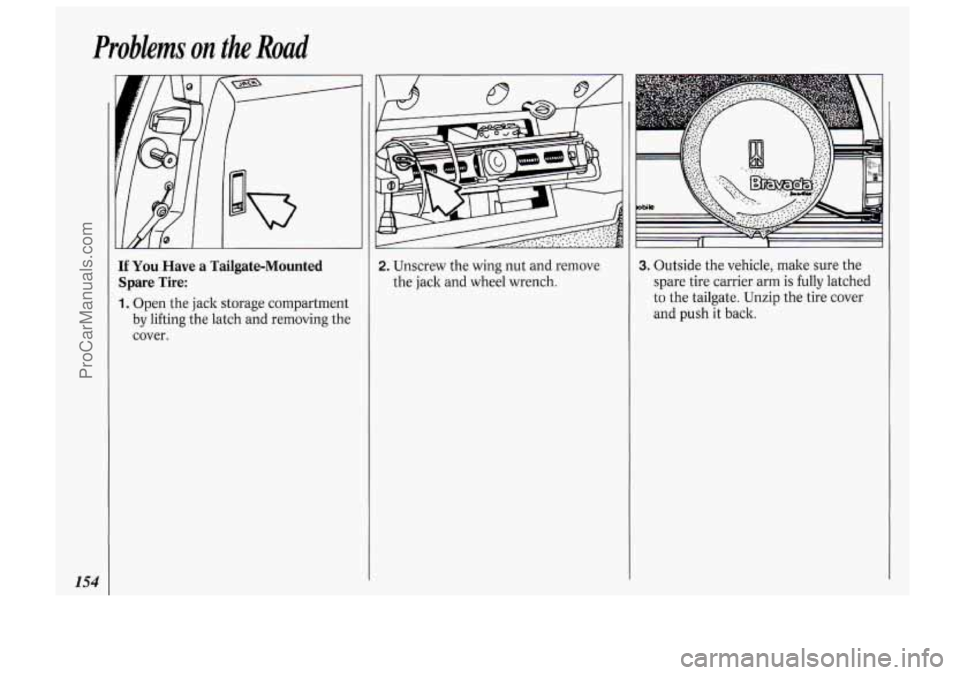
If You Have a Tailgate-Mounted
Spare Tire:
1. Open the jack storage compartment
by lifting the latch and removing the
cover.
2. Unscrew the wing nut and remove
the jack and wheel wrench.
I I I
3. Outside the vehicle, make sure the
spare tire carrier arm is fully latched
to the tailgate. Unzip the tire cover
and
push it back.
ProCarManuals.com
Page 161 of 248

4. Use the wheel wrench to remove the
wheel nuts that secure the tire to the
carrier. Then lift the tire
off the
mounting bracket.
For Both Mounting Systems:
5. Put the spare tire near the flat one.
6. Using the Torx@ head wrench
supplied with the vehicle and stored
in the glove
box, remove the wheel
nut cover.
7. Using the wheel wrench, loosen all tht
wheel nuts. Don’t remove them yet.
155
ProCarManuals.com
Page 162 of 248
Problems on the Road
156
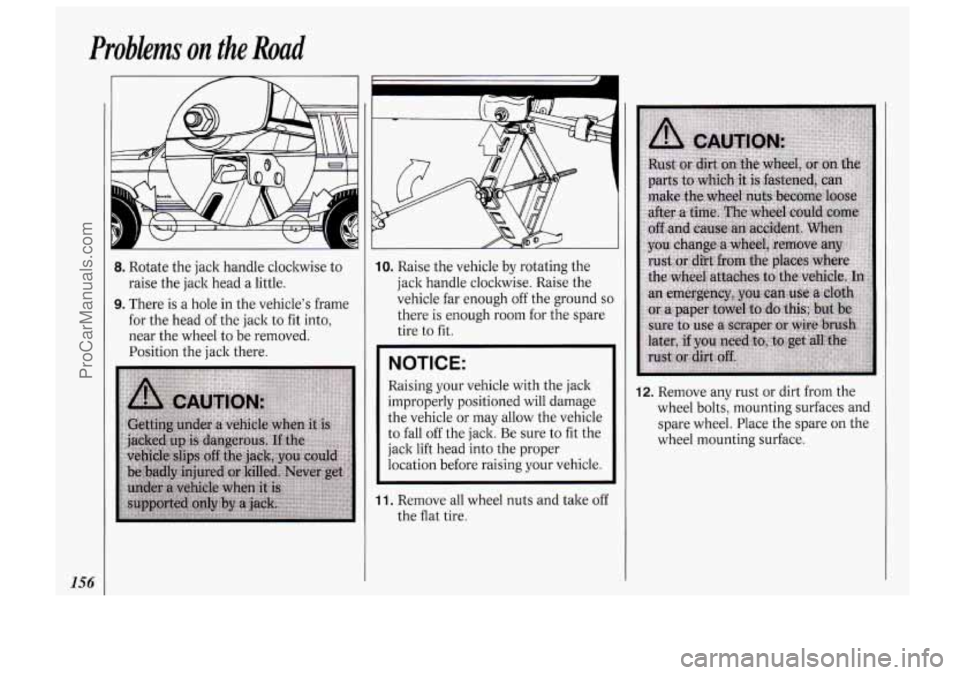
8. Rotate the jack handle cloclwise to
raise the jack head
a little.
9. There is a hole in the vehicle’s frame
for the head of the jack to fit into,
near the wheel to be removed.
Position the jack there.
10. Raise the vehicle by rotating the
jack handle cloclwise. Raise the
vehicle far enough off the ground
so
there is enough room for the spare
tire to fit.
NOTICE:
Raising your vehicle with the jack
improperly positioned will damage
the vehicle or may allow the vehicle
to fall off the jack. Be sure to fit the
jack
lift head into the proper
location before raising your vehicle.
11. Remove all wheel nuts and take off
the flat tire.
12. Remove any rust or dirt from the
wheel bolts, mounting surfaces and
spare wheel. Place the spare on the
wheel mounting surface.
ProCarManuals.com
Page 164 of 248

Problems on the Road
158
I
16. Replace the wheel nut cover on the
spare wheel. Be sure to insert the
pin on the wheel cover into the hole
in the wheel. Screw the cover in
place using the TorxB head wrench.
17. Lower the jack head completely by
rotating the jack handle
counterclockwise. If you have an
inside-mounted spare tire, return
the jack and wheel wrench to their
storage compartment and secure
them with the wing nut. Replace the
jack storage compartment cover.
18. Fasten the flat tire where the spare
was stored. If you have a tailgate-
mounted spare tire carrier, tighten
firmly. Push and pull to make sure it
is not loose.
As soon as possible,
tighten the nuts to 22-32 pound-feet
(30-40
Nom) torque.
I If You’re Stuck: In Sand,
Mud, Ice or Snow
19. If you have a tailgate-mounted spare
tire, return the jack and wheel
wrench to their storage
compartment and replace the jack
storage compartment cover. Insert
the cover tabs into the trim panel,
align the cover and fasten the latch. What
you
don’t want to do when your
vehicle is stuck is to spin your wheels.
The method known as “rocking” can
help you get out when you’re stuck, but
you must use caution.
ProCarManuals.com
Page 191 of 248

Accelerator Control System
Your Maintenance Schedule will tell
you how often the accelerator linkage
pivot points must be lubricated and
what type of lubricant to use.
Accelerator cables and cruise control
cables should not be lubricated. Any
cables that are worn or are hard to pull
should be replaced.
Hood Latches and Hood
Hinge
Your Maintenance Schedule will tell
you how to lubricate the hood latch and
hood hinge assembly.
Lock Cylinders
To be sure your locks operate properly,
they must be lubricated. Your
Maintenance Schedule will tell you how
often to lubricate them and what type of
lubricant to use.
You should not use penetrating oils
because they could wash out the factory
installed lubricant and cause the lock to
bind. De-icers which contain alcohol could
also wash away the lubricant,
so
be sure to lubricate the lock after using
a de-icer of this type.
Tailgate-Mounted Spare Tire
Carrier
The spare tire carrier must be lubricated
to keep it operating smoothly. Your
Maintenance Schedule
will tell you
what type of lubricant to use.
Tires
We don’t make tires. Your new vehicle
comes with high quality tires made by a
leading tire manufacturer. These tires
are warranted by the tire manufacturers
and their warranties are delivered with
every new Oldsmobile. If your spare tire
is a different brand than your road tires,
you will have a tire warranty folder from
each of these manufacturers.
185
ProCarManuals.com
Page 192 of 248

Service & Appearance Care
186
Inflation-Tire Pressure
The Certification/Tire label which is
on the rear edge
of the driver’s door
shows the correct inflation pressures
for your tires, when they’re cold.
“Cold” means your vehicle has been
sitting for at least three hours or driven
no more than
a mile. Also see
Capacities G Specifications in the
Index.
NOTICE:
Don’t let anyone tell you that
underinflation
or overinflation is all
right. It’s not. If your tires don’t
have enough air (underinflation)
you can get:
Too much flexing
Too much heat
Tire overloading
Bad wear
Bad handling
Bad fuel economy.
If your tires have too much air
(overinflation)
) you can get:
Unusual wear
Bad handling
Rough ride
Needless damage from road
hazards.
When to Check
Check your tires once a month or more.
Also, check the tire pressure
of the
spare tire.
How to Check
Use a good quality pocket-type gage to
check tire pressure. Simply looking at
the tires will not tell you the pressure,
especially if you have radial tires
-
which may look properly inflated even if
they’re underinflated.
If your tires have valve caps, be sure to
put them back on. They help prevent
leaks by keeping out dirt and moisture.
ProCarManuals.com