transmission fluid OLDSMOBILE BRAVADA 1994 Owners Manual
[x] Cancel search | Manufacturer: OLDSMOBILE, Model Year: 1994, Model line: BRAVADA, Model: OLDSMOBILE BRAVADA 1994Pages: 248, PDF Size: 14.54 MB
Page 135 of 248

Hill and Mountain Roads
Driving on steep hills or mountains is
different from driving
in flat or rolling
terrain.
If you drive regularly in steep country,
or
if you’re planning to visit there, here
are some tips that can make your trips
safer and more enjoyable. (See
Off-
Road Driving in the Index for
information about driving off-road.)
Keep your vehicle in good shape.
Check
all fluid levels and also the
brakes, tires, cooling system and
transmission. These parts can work
hard on mountain roads.
how how to go down hills. The most
important thing to how is this: let
your engine do some
of the slowing down.
Shift to
a lower gear when you
go
down a steep or long hill.
Know how to go uphill. You may
want to shift
down to a lower gear.
The lower gears help cool your engine
and transmission, and you can climb
the hill better.
Stay in your own lane when driving on
two-lane roads in hills or mountains.
Don’t swing wide or cut across the
center of the road. Drive at speeds that
let you stay in your
own lane.
As you go over the top of a hill, be
alert. There could be something in
your lane, like a stalled car or an
accident.
You may see highway signs on
mountains that warn of special
problems. Examples are long grades,
passing or no-passing zones, a falling
rocks area, or winding roads. Be alert
to these and tale appropriate action.
129
ProCarManuals.com
Page 142 of 248

Your Driving and the Road
Turn Signals When Towing a
Trailer
When you tow a trailer, your vehicle has
to have a different turn signal flasher
and extra wiring. The green arrows on
your instrument panel will flash
whenever you signal a turn or lane
change. Properly hooked up, the trailer
lights will also flash, telling other
drivers you’re about to turn, change
lanes or stop.
When towing a trailer, the green arrows
on your instrument panel will flash for
turns even if the bulbs on the trailer are
burned out. Thus, you may think
drivers behind you are seeing your
signal when they are not, It’s important
to check occasionally to be sure the
trailer bulbs are still working.
Driving On Grades
Reduce speed and shift to a lower gear
before you start down a long or steep
downgrade. If you don’t shift
down, you
might have to use your brakes
so much
that they would get hot and no longer
work well. On
a long uphill grade, shift down and
reduce your speed
to around 45 mph
(70 km/h) to reduce the possibility of
engine and transmission overheating.
If you are towing a trailer that weighs
more than
3,000 pounds (1 350 kg), it’s
best to drive in
D instead of Overdrive
(or, as you need to, a lower gear). This
will minimize heat build-up and extend
the life of your transmission.
Parking on Hills
You really should not park your vehicle,
with a trailer attached, on a hill.
If
something goes wrong, your rig could
start to move. People can be injured,
and both your vehicle and the trailer
can be damaged.
But if you ever have to park your rig on
a hill, here’s how to do it:
1. Apply your regular brakes, but don’t
shift into
P (Park) yet.
2. Have someone place chocks under
the trailer wheels.
3. When the wheel chocks are in place,
release the regular brakes until the
chocks absorb the load.
4. Reapply the regular brakes. Then
apply your parking brake and then
shift to
P (Park).
5. Release the regular brakes.
When You Are Ready to Leave
After Parking on
a Hill
1. Apply your regular brakes and hold
the pedal down while you:
Start your engine;
Shift into a gear; and
Release the parking brake.
2. Let up on the brake pedal.
3. Drive slowly until the trailer is clear
4. Stop and have someone pick up and
of
the chocks.
store the chocks.
Maintenance When Trailer Towing
Your vehicle will need service more
often when you’re pulling a trailer. See
the Maintenance Schedule for more on
this. Things that are especially
important in trailer operation are
automatic transmission fluid (don’t
overfill), engine oil, axle lubricant, belt,
cooling system, and brake adjustment.
Each of these is covered in this manual,
ProCarManuals.com
Page 167 of 248

Part 6
Sewice &Appearance Care
Service ........................................................................\
............................................. 162
Fuel
........................................................................\
.................................................. 163
Hood Release
........................................................................\
................................... 165
Engine Oil
........................................................................\
........................................ 168
Air Cleaner
........................................................................\
...................................... 171
Transmission Fluid ........................................................................\
.......................... 172
Axles/Transfer Case
........................................................................\
........................ 174
Engine Coolant
........................................................................\
................................ 174
Power Steering Fluid
........................................................................\
....................... 176
Windshield Washer Fluid ........................................................................\
................
177
Brakes ........................................................................\
.............................................. 178
Battery ........................................................................\
............................................. 180
Bulb Replacement
........................................................................\
........................... 181
Windshield Wiper Blade Replacement ................................................................... 182
..
Loading Your Vehicle ........................................................................\
..................... 183
Tires ........................................................................\
................................................. 185
Appearance Care ........................................................................\
............................. 190
Vehicle Identification Number (VIN)
.................................................................... 195
Add-on Electrical Equipment
........................................................................\
........ 196
Fuses
& Circuit Breakers ........................................................................\
................ 196
Capacities
& Specifications ........................................................................\
............ 199
Normal Maintenance Replacement Parts
............................................................... 200
Fluids & Lubricants ........................................................................\
........................ 201
Replacement Bulbs
........................................................................\
.......................... 202
.
161
ProCarManuals.com
Page 173 of 248

4.3L V6 Engine (CODE w)
When you open the hood, you’ll see:
1. Engine Coolant Recovery Tank
2. Automatic Transmission Dipstick
3. Engine Oil Fill Cap
4. Brake Fluid Reservoir
5. Windshield Washer Fluid Reservoir
6. Air Cleaner
7. Power Steering Fluid Reservoir
8. Engine Oil Dipstick
9. Radiator Pressure Cap
IO. Battery
a
167
ProCarManuals.com
Page 178 of 248

Service &Appearance Care
4. Remove the air cleaner filter from the
5. Install a new air cleaner filter and
housing.
reverse steps
1-3.
Automatic Transmission Fluid
When to Check and Change
4 good time to check your automatic
transmission fluid level is when the
:ngine oil is changed. Refer to the
Maintenance Schedule to determine
when to change your fluid. See
Scheduled Maintenance Services in
the
Index.
How to Check
Because this operation can be a little
difficult, you may choose to have this
done at an Oldsmobile dealership
Service Department.
If you do it yourself, be sure to follow
all the instructions here, or you could
get a false reading on the dipstick.
NOTICE:
Too much or too little fluid can
damage your transmission.
Too
much can mean that some of the
fluid could come out and fall on hot
engine parts or exhaust system,
starting a fire. Be sure to get an
accurate reading if you check your
transmission fluid.
Wait at least
30 minutes before
checking the transmission fluid level if
you have been driving:
When outside temperatures are abovc
At high speed for quite a while.
90°F (32°C).
In
heavy traffic - especially in hot
weather.
While pulling a trailer.
To get the right reading, the fluid
should be at normal operating
temperature, which is
180°F to 200°F
(82°C to 93°C).
To Check Transmission Fluid Hot:
Get the vehicle warmed up by driving
about
15 miles (24 km) when outside
temperatures are above
50°F (10°C). If
it's colder than
50°F ( 10°C), drive the
vehicle in
D (3rd Gear) until the engine
temperature gage moves and then
remains steady for ten minutes. Then
follow the hot check procedures.
To Check Transmission Fluid Cold:
A cold check is made after the vehicle
has been sitting for eight hours or more
with the engine off and is used only as a
reference. Let the engine run at idle for
five minutes if outside temperatures are
50°F (10°C) or more. If it's colder than
50°F (lO"C), you may have to idle the
engine longer. Should the fluid level be
low during a cold check, you
must
perform a hot check before adding fluid.
This will give you a more accurate
reading of the fluid level.
ProCarManuals.com
Page 179 of 248

To Check the Fluid Hot or Cold:
Park your vehicle on a level place.
With the parking brake applied, place
With your foot on the brake pedal,
the
shift lever in
P (Park).
move the shift lever through each gear
range, pausing for about three
seconds in each range. Then, position
the shift lever in
P (Park).
minutes or more.
Let the engine run at idle for three Then, Without Shutting off the
Engine, Follow These Steps:
1. Flip the handle up and then pull out
the dipstick and wipe it with a clean
rag or paper towel.
2. Push it back in all the way, wait three
seconds and then pull it back
out
again.
3. Check both sides of the dipstick, and
read the lower level. The fluid level
must be in the
COLD area for a cold
check or in the
HOT area or cross-
hatched area for a hot check.
4. If the fluid level is in the acceptable
range, push the dipstick back in all
the way; then flip the handle down to
lock the dipstick in place.
How to Add FIuid
Refer to the Maintenance Schedule to
determine what kind
of transmission
fluid to use. See
Recommended Fluids
G Lubricants in the index.
If the fluid level is low, add only enough
of the proper fluid to bring the level up
to the COLD area for a cold check or
the HOT area for a hot check. It doesn’t
take much fluid, generally less than a
pint
(OSL) . Don’t overfill. We
recommend you use only fluid labeled
DEXRONB-I11 or DEXRONB-IIE,
because fluids with that label are made
especially for your automatic
transmission. Damage caused by fluid
other than DEXRONB-I11 or
DEXRONB-IIE is not covered by your
new vehicle warranty.
I 73
ProCarManuals.com
Page 207 of 248
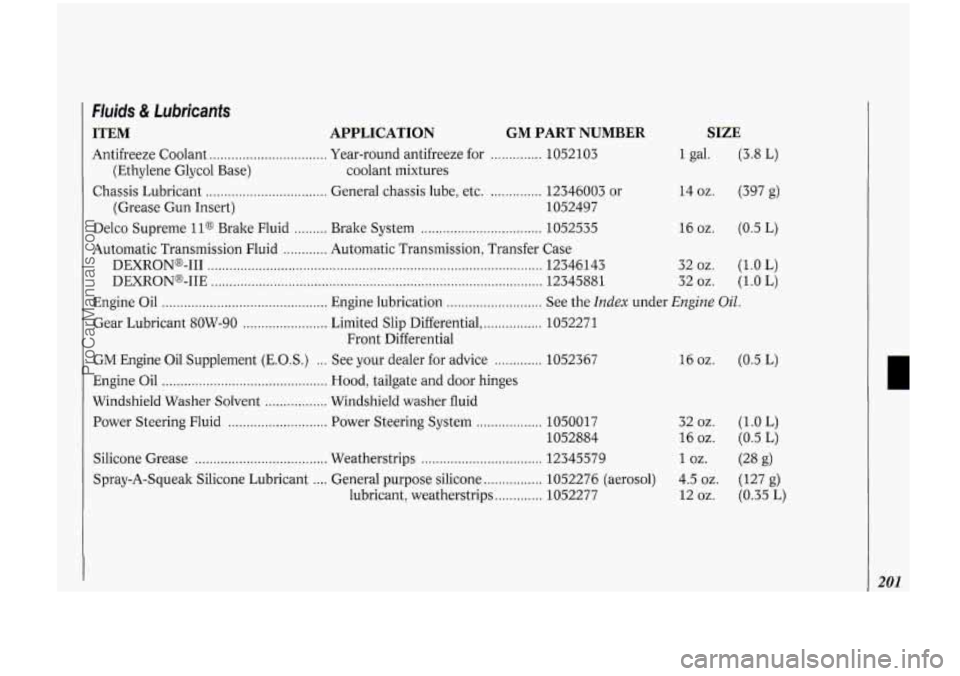
Fluids & Lubricants
I ITEM APPLICATION GM PART NUMBER SIZE
Antifreeze Coolant ................................ Year-round antifreeze for .............. 1052103 1 gal. (3.8 L)
(Ethylene Glycol Base) coolant mixtures
(Grease Gun Insert) 1052497
Chassis
Lubricant
................................. General chassis lube, etc. .............. 12346003 or 14 oz. (397 g)
Delco Supreme 110 Brake Fluid ......... Brake System ................................. 1052535 16 02. (0.5 L)
Automatic Transmission Fluid
............ Automatic Transmission, Transfer Case
DEXRON@-I11
........................................................................\
................... 12346143 32 02. (1.0 L)
DEXRONB-IIE ........................................................................\
.................. 12345881 32 02. (1.0 L)
Engine Oil ............................................. Engine lubrication .......................... See the Index under Engine OiZ.
Gear Lubricant 8OW-90 ....................... Limited Slip Differential , ................ 1052271
GM Engine Oil Supplement
(E.O.S.) ... See your dealer for advice ............. 1052367
Engine Oil
............................................. Hood, tailgate and door hinges
Windshield Washer Solvent
................. Windshield washer fluid
Power Steering Fluid
........................... Power Steering System .................. 1050017 32 oz. (1 .O L)
1052884 16 02. (0.5 L)
Front Differential
Silicone Grease
.................................... Weatherstrips ................................. 12345579 1 02. (28 g)
Spray-A-Squeak Silicone Lubricant
.... General purpose silicone ................ 1052276 (aerosol) 4.5 oz. (127 g)
lubricant, weatherstrips
............. 1052277 12 oz. (0.35 L)
16 oz. (0.5 L)
201
ProCarManuals.com
Page 212 of 248

Maintenance Schedule
206
Schedule I
Follow Schedule I if your vehicle is
MAINLY driven under one or more of
the following conditions:
When most trips are less than 4 miles
When most trips are less than 10
(6 lun) .
miles (16 lm) and outside
temperatures remain below freezing.
When most trips include extended
idling and/or frequent low-speed
operation, as in stop-and-go traffic.
When towing a trailer.
When operating in dusty areas or off-
Schedule I should also be followed if
the vehicle is used for delivery service,
police, taxi or other commercial
applications.
road frequently.
ITEM TO BE SERVICED
Nom See Explanation of Scheduled Maintenance
Services
following Schedules I and 11.
WHEN TO PERFORM
Miles (kilometers) or Months
(whichever occurs first).
2 1 Chassis Lubrication 1 Everv 3.000 Miles (5 000 kml or 12 Months. I
4 I Engine Accessory Drive Belt Inspection (erv 60.000 Miles (100 000 kml. I
6 I Transmission Service See Explanation
of Scheduled Maintenance
Services
following Schedules I and 11. I
8 I Spark Plug Wire 1nspection"t I Every 60,000 Miles (100 000 lm). I
10 I Fuel Tank, Cap & Lines Inspection*t I000 Miles (100 000 lun). I
12 I Fuel Filter Replacement*t I Everv 30.000 Miles (50 000 lun). I
16 I Transfer Case Fluid Change I See Explanation of Scheduled Maintenance
Services
followinrr Schedules I and 11. I
ProCarManuals.com
Page 216 of 248

210
Explanation of Scheduled
Maintenance Services
Below are explanations of the services
listed in Schedule I and Schedule 11.
The proper fluids and lubricants to use
are listed in Section
D. Make sure
whoever services your vehicle uses
these. All parts should be replaced and
all necessary repairs done before you or
anyone else drives the vehicle.
ITEM SERVICE
NO.
1. Engine Oil and Filter Change* -
Always use SH or SG Energy
Conserving I1 oils of proper viscosity.
The
“SH” or “SG” designation may be
shown alone or in combination with
others, such as “SH/CD,”
“SH, SG,
CD,” “SG/CD,” etc. To determine the
preferred viscosity for your vehicle’s engine (e.g., SAE 5W-30 or SAE 1OW-
30), see the Index under Engine Oil.
2. Chassis Lubrication - Lubricate the
transmission shift linkage, parking
brake cable guides, underbody contact points and linkage. Lubricate the front
suspension and steering linkage.
3. Tire and Wheel Rotation and
Inspection
- For proper wear and
maximum tire life, rotate your tires
following the instructions
in this
manual. See
Tires, Inspection G.
Rotation in the Index. Check the
tires for uneven wear or damage. If
you see irregular or premature wear,
check the wheel alignment. Check for
damaged wheels also.
Inspection - Inspect the drive belt
for cracks, fraying, wear and proper
tension. Replace as needed.
5. Cooling System Service‘: - Drain,
flush and refill the system with new
or approved recycled coolant
conforming to
GM Specification
6038-M. Keep coolant at the proper
mixture as specified. See
CooZant in
the
Index. This provides proper
freeze and boil protection, corrosion
inhibitor level and maintains proper
engine operating temperature.
Inspect hoses and replace if they are
cracked, swollen or deteriorated.
Tighten screw-type hose clamps. Clean the outside of the radiator and
air conditioning condenser. Wash the
pressure cap and neck.
4. Engine Accessory Drive Belt
To help ensure proper operation, we
recommend
a pressure test of both the
cooling system and the pressure cap.
6. Transmission Service - Change
both the fluid and filter every 15,000
miles
(25 000 lun) if the vehicle is
mainly driven under one or more of
these conditions:
In heavy city traffic where the
outside temperature regularly
reaches
90°F (32°C) or higher.
In hilly or mountainous terrain.
When doing frequent trailer towing.
Uses such as found in taxi, police
If you do not use your vehicle under
any of these conditions, change both
the fluid and filter every
100,000
miles (166 000 lun) .
Replace spark plugs with the proper
type. See
Replacement Parts in the
Index.
8. Spark Plug Wire Inspection‘%t -
Inspect for burns, cracks or other
damage. Check the boot
fit at the
coils and at the spark plugs. Replace
wires as needed.
car
or delivery service.
7. Spark Plug Replacement” -
ProCarManuals.com
Page 220 of 248

Maintenance Schedule
214
At Least Once a Year (cant.)
CHECK
OR SERVICE
Parking Brake
and Automatic
Transmission
P (Park)
Mechanism Check
Underbody Flushing
Differential Service
Transfer Case
WHAT TO DO
CAUTION: When you are doing this check, your vehicle could begin to move. You or others
could be injured and property could be damaged. Make sure ther\
e is room in front
of your
vehicle in case it begins
to roll. Be ready to apply the regular brake at once should the vehicle
begin to move.
Park on a fairly steep hill, with the vehicle facing downhill. Keeping your foot on the regular
brake, set the parking brake.
To check the parking brake: With the engine running and transmission in N (Neutral), slowly
remove foot pressure
from the regular brake pedal. Do this until the vehicle is held by the
parking brake only.
To check the P (Park) mechanism's holding ability: Shift to P (Park). Then release all brakes.
At least every spring, use plain water to flush any corrosive materials from the underbody. Take
care to clean thoroughly any areas where mud and other debris can collect.
Check rear/front differential fluid level and add as needed. Check constant velocity joints and
axle seals for leaking.
Check transfer case fluid level. Check vent hose at transfer case for ltinlts and proper installation.
More frequent lubrication may be required on heavy-duty off-road use.
A fluid loss may indicate a
problem. Have it inspected and repaired
at once.
ProCarManuals.com