transmission OLDSMOBILE BRAVADA 1997 Owner's Manual
[x] Cancel search | Manufacturer: OLDSMOBILE, Model Year: 1997, Model line: BRAVADA, Model: OLDSMOBILE BRAVADA 1997Pages: 358, PDF Size: 18.02 MB
Page 194 of 358
-
To help avoid injury to you or others:
0 Never let passengers ride in a vehicle that is
0 Never tow faster than safe or posted speeds.
Never tow with damaged parts not fully secured.
0 Never get under your vehicle after it has
0 Always use separate safety chains on each
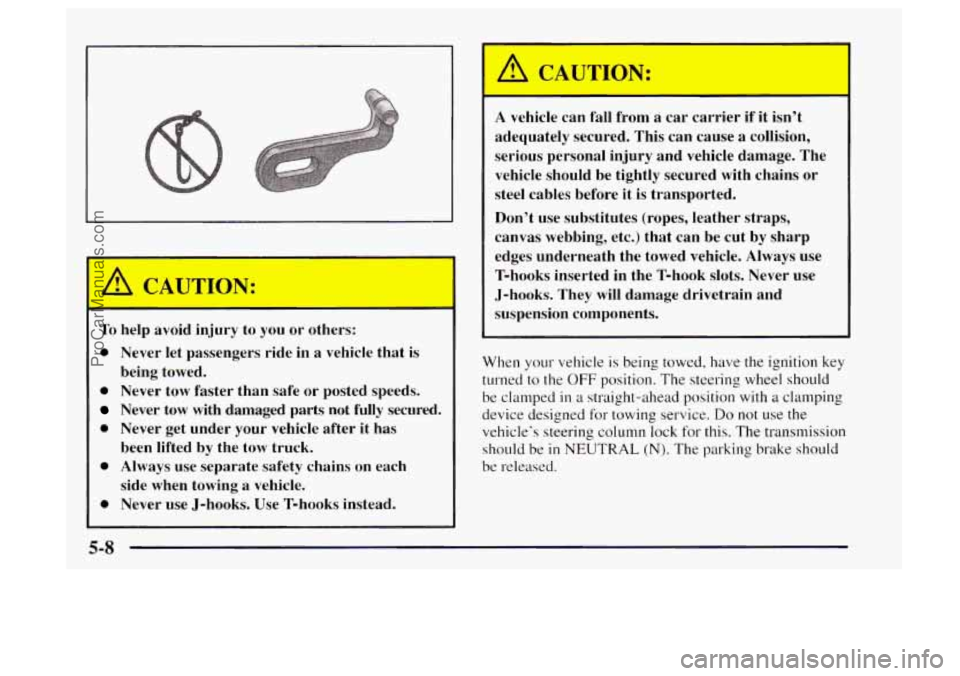
0 Never use J-hooks. Use T-hooks instead.
being towed.
been lifted
by the tow truck.
side when towing a vehicle.
A vehicle can fall from a car carrier if it isn’t
adequately secured. This can cause
a collision,
serious personal injury and vehicle damage. The
vehicle should be tightly secured with chains
or
steel cables before it is transported.
Don’t use substitutes (ropes, leather straps,
canvas webbing, etc.) that can be cut by sharp
edges underneath the towed vehicle. Always use
T-hooks inserted in the T-hook slots. Never use
J-hooks. They will damage drivetrain and
suspension components.
When your vehicle is being towed, have
the ignition key
turned
to the OFF position. The steering wheel should
be clamped
in a straight-ahead position with a clamping
device designed for
towing service. Do not use the
vehicle’s steering column lock for this.
The transmission
should
be in NEUTRAL (N). The parking brake should
be released.
5-8
ProCarManuals.com
Page 195 of 358

If your vehicle has no electrical power, the electrical
solenoid lock must be overridden to shift from
PARK (P) to NEUTRAL
(N). Follow these steps:
1. Push the base
of the leather shift lever boot forward
with your thumb.
1. Lift the boot and find the white solenoid lever.
3. Move the solenoid lever toward the driver’s side to
unlock
it.
4. While holding the solenoid lever in the unlock
position, press the shift lever button and shift into
NEUTRAL
(N).
5. Release the solenoid lever and snap the boot back
into place.
Don’t have your vehicle towed on the drive wheels
unless you must.
If the vehicle l-nust be towed on the
drive wheels, be sure not to exceed
35 mph (56 km/h)
and not to travel more than
50 miles (80 krn) or your
transmission
will be damaged. The drive wheels have
to be supported on a dolly.
5-9
ProCarManuals.com
Page 217 of 358

NOTICE:
When the compact spare is installed, don’t take
your vehicle through an automatic
car wash with
guide rails. The compact spare can get caught on
the rails. That can damage the tire and wheel,
and maybe other parts
of your vehicle.
Don’t use your compact spare on other vehicles.
And don’t
mix your compact spare tire or wheel with
other wheels or tires. They won’t fit. Keep your spare
tire and its wheel together.
NOTICE:
Tire chains won’t fit your compact spare. Using
them can damage your vehicle and can damage
the chains too. Don’t use tire chains on your
compact spare.
If You’re Stuck: In Sand, Mud,
Ice or Snow
What YOU don’t want to do when your vehicle is stuc
to spin your wheels too fast. The method known
as
:k is
“rocking” can help you get out when you’re stuck, but
you must use caution.
If you let your tires spin at high speed, they can
explode, and
you or others could be injured.
And, the transmission or other parts
of the
vehicle can overheat. That could cause an engine
compartment fire or other damage. When you’re
stuck, spin the wheels as little as possible. Don’t
spin the wheels above
35 mph (55 km/h) as shown
on the speedometer.
I
5-31
ProCarManuals.com
Page 218 of 358
NOTICE:
Spinning your wheels can destroy parts of your
vehicle as well as the tires. If you spin the wheels
too fast while shifting your transmission back
and forth, you can destroy your transmission.
For information about using tire chains on your vehicle,
see "Tire Chains''
in the Index.
Rocking Your Vehicle To Get It Out
First, turn your steering wheel left and right. That will
clear the area around your front wheels. Then shift back
and forth between REVERSE
(R) and a forward gear,
spinning the wheels as little as possible. Release the
accelerator pedal while you shift, and press lightly on
the accelerator pedal when the transmission is
in gear.
If that doesn't get you out after a few tries, you may
need to
be towed out. Or, you can use your recovery
hooks
if your vehicle has them. If you do need to be
towed out,
see "Towing Your Vehicle" in the Index.
Using the Recovery Hooks
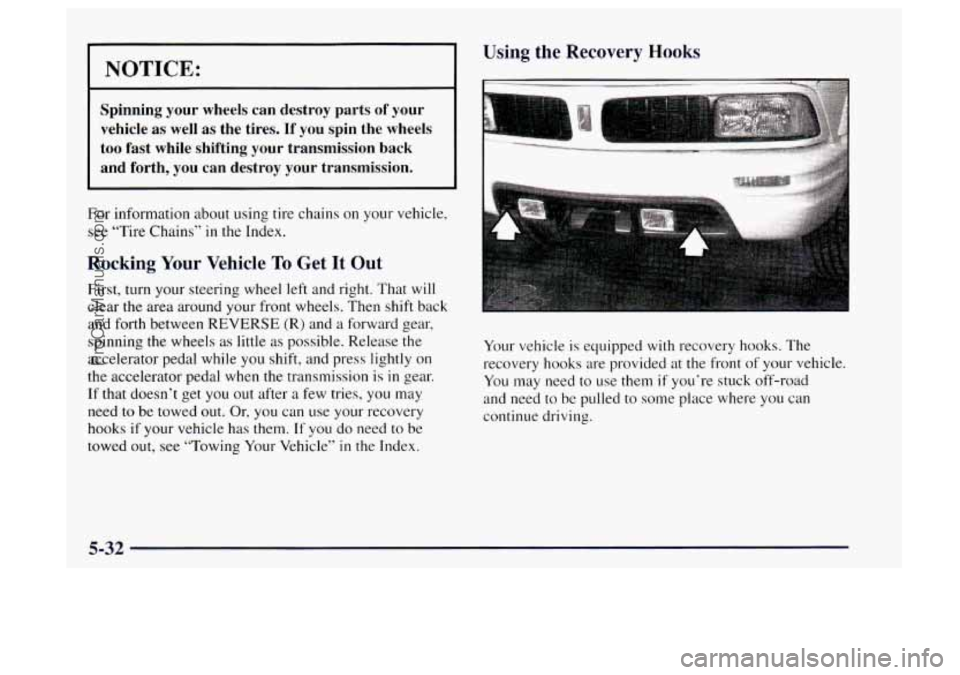
Your vehicle is equipped with recovery hooks. The
recovery hooks are provided at the front
of your vehicle.
You may need to use them
if you're stuck off-road
and need to be pulled to some place where you can
continue driving.
ProCarManuals.com
Page 221 of 358

Section 6 Service and Appearance Care
Here you will find information about the care of your Oldsmobile. This section begins with service and fuel
information, and then it shows how to check important fluid and lubricant levels. There is also technical information
about
your vehicle, and a part devoted to its appearance care.
6-
2
6- 3
6-4
6-5
6-6
6-9
6- 14
6-20
6- 24
6-25
6-29
6-29
6-30
6-34
6-37 Doing
Your Own Service Work
What Kind of Fuel to Use
Using Fuel
in Foreign Countries
Where to Put the Fuel and Filling
the Tank
Checking Things Under the Hood
Checking Your Engine Oil
Automatic Transmission Fluid
Engine Coolant
Where to Fill
the Windshield Washer Fluid
Important Brake Information
Information
on Your Vehicle’s Battery
Tips
on Vehicle Storage
Bulb Replacement Procedures
Windshield Wiper Blade Replacement How and When
to Check Tire Inflation 6-39
6-42
6-44
6-47
6-48
6-50
6-5
1
6-52
6-53
6-54
6-55 6-59
6-60
6-60
6-6
I
When it is Time to Buy New Tires
Wheel Alignment
Cleaning the Inside
of Your Oldsmobile
Care
of the Safety Belts
Cleaning the Outside
of Your Oldsmobile
How to Clean Aluminum Wheels
Underbody Maintenance
Recommended Appearance Care Materials
Your Vehicle Identification Number
(VIN)
The Electrical System
Fuses and Circuit Breakers
Replacement Bulb Types for Your Vehicle
Capacities and Specifications
Normal Replacement Parts
Air Conditioning Specifications
6-1
- -~ -
ProCarManuals.com
Page 228 of 358

When you lift the hood, you'll see these items:
A. Battery
B. Coolant Recovery Tank
C. Engine Oil Dipstick
D. Automatic Transmission Dipstick G. Brake Master Cylinder
E. Engine Oil Fill H. Air Cleaner
F. Power Steering Reservoir
I. Windshield Washer Fluid
6-8
ProCarManuals.com
Page 234 of 358

Operating the enge with the air cleaner off can
cause you or others to be burned. The air cleaner
not only cleans the air, it stops flame
if the engine
backfires. If it isn’t there, and the engine
backfires, you could be burned. Don’t drive with
it
off, and be careful working on the engine with
the air cleaner
off.
NOTICE:
If the air cleaner is off, a backfire can cause a
damaging engine fire. And, dirt can easily get
into your engine, which will damage it. Always
have the air cleaner
in place when you’re driving.
Automatic Transmission Fluid
When to Check and Change
A good time to check your automatic transmission fluid
level is when the engine oil is changed.
Change both the
fluid and filter every 50,000 miles
(83 000 km) if the vehicle is mainly driven under one or
more
of these conditions:
In heavy city traffic where the outside temperature
regularly reaches
90°F (32°C) or higher.
In hilly or mountainous terrain.
0 When doing frequent trailer towing.
0 Uses such as found in taxi, police or delivery service.
If you do not use your vehicle under any of these
conditions, the fluid and filter do not require changing.
See “Scheduled Maintenance Services“
in the Index.
6-14
ProCarManuals.com
Page 235 of 358
![OLDSMOBILE BRAVADA 1997 Owners Manual How to Check
Because this operation can be a little difficult, you ]nay
choose to have this done at your Oldsmobile retailer
Service Department.
If you do it yourself, be sure to follow a](/img/31/58199/w960_58199-234.png "OLDSMOBILE BRAVADA 1997 Owners Manual How to Check
Because this operation can be a little difficult, you ]nay
choose to have this done at your Oldsmobile retailer
Service Department.
If you do it yourself, be sure to follow a")
How to Check
Because this operation can be a little difficult, you ]nay
choose to have this done at your Oldsmobile retailer
Service Department.
If you do it yourself, be sure to follow all the
instructions here.
or you could get a false reading on
the dipstick.
NOTICE:
Too much or too little fluid can damage your
transmission.
Too much can mean that some of
the fluid could come out and fall on hot engine
parts or exhaust system parts, starting
a fire. Be
sure t.o get an accurate reading if you check your
transmission fluid.
Wait at least 30 minutes before checking the
transmission fluid level
if you have been driving:
0 When outside temperatures are above 90°F (32°C).
At high speed for quite a while.
In heavy traffic -- especially in hot weather.
While pulling a trailer.
To get the right reading, the fluid should be at normal
operating temperature, which is 180°F to
200°F
(82°C to 93°C).
Checking Transmission Fluid Hot
Get the vehicle warmed up by driving about 15 miles
(24 knl) when outside temperatures are above 50°F
(10°C). If it's colder than 50°F
(lO"C), drive the
vehicle
in THIRD (3) until the engine temperature gage
moves and then remains steady for
IO minutes. Then
follow the hot check procedures.
ProCarManuals.com
Page 236 of 358

Checking Transmission Fluid Cold
A cold check is made after the vehicle has been sitting
for eight hours or more
with the engine off and is used
only as a reference. Let the engine run at idle for five
minutes if outside temperatures are 50°F
(10°C) or
more. If it's colder than
50°F (IO'C), you may have to
idle the engine longer. Should the fluid level be
low
during a cold check, you must perform a hot check
before adding fluid. This will give
you a more accurate
reading
of the fluid level.
Checking the Fluid Hot or Cold
0
0
0
Park your vehicle on a level place. Keep the
engine running.
With the parking brake applied, place the shift lever
in PARK (P).
With your foot on the brake pedal, move the shift
lever through each gear range, pausing for about
three seconds
in each range. Then, position the shift
lever in
PARK (P).
Let the engine run at idle for three minutes or more. Then, without shutting
off the engine, follow these steps:
1. Flip
the handle up and then pull out the dipstick and
wipe
it with a clean rag or paper towel.
2. Push it back in all the way, wait three seconds and
then
pull it back out again.
6-16
ProCarManuals.com
Page 237 of 358

3.
4.
Check both sides of the dipstick, and read the lower
level. The fluid level must be in the COLD area for a
cold check or in the
HOT area or cross-hatched area
for a hot check.
If the fluid level is in the acceptable range, push the
dipstick back in all the way; then flip the handle
down to lock the dipstick in place.
How to Add Fluid
Refer to the Maintenance Schedule to determine what
kind
of transmission fluid to use. See “Recommended
Fluids and Lubricants” in the Index.
Add fluid only after checking the transmission fluid HOT.
(A COLD check is used only as a reference.) If
the fluid level is low, add only enough of the proper
fluid to bring the level up to the
HOT area for a hot
check.
It doesn’t take much fluid, generally less than
one pint
(0.5 L). Don’t overfill. We recommend you use
only fluid labeled DEXRON@-111, because fluid with
that label is made especially for your automatic
transmission. Damage caused by fluid other than
DEXRON-111 is not covered by your new
vehicle warranty.
0
0
After adding fluid, recheck the fluid level as
described under
“How to Check.”
When the correct fluid level is obtained, push the
dipstick back in all the way; then flip the handle down to lock the dipstick in place.
6-17
ProCarManuals.com