light OLDSMOBILE BRAVADA 1997 Workshop Manual
[x] Cancel search | Manufacturer: OLDSMOBILE, Model Year: 1997, Model line: BRAVADA, Model: OLDSMOBILE BRAVADA 1997Pages: 358, PDF Size: 18.02 MB
Page 173 of 358

Know can trap exhaust gases under your vehicle.
This can cause deadly
CO (carbon monoxide) gas
to get inside. CO could overcome you and kill
you. You can’t see it or smell it,
so you might not
know it
is in your vehicle. Clear away snow from
around the base of your vehicle, especially any
that is blocking your exhaust pipe. And check
around again from time to time to be sure snow
doesn’t collect there.
Open a window just a little
on the side of the
vehicle that’s away from the wind. This will help
keep CO out.
Run your engine only as long as you must. This saves
fuel. When you
run the engine, make it go a little faster
than just idle. That is, push the accelerator slightly. This
uses less
fuel for the heat that you get and it keeps the
battery charged.
You will need a well-charged battery to
restart the vehicle, and possibly for signaling later on
with your headlamps. Let the heater run for awhile.
Then, shut the engine off and close the window almost
all the way to preserve the heat. Start the engine again
and repeat this only when you feel really uncomfortable
from the cold.
But do it as little as possible. Preserve the
fuel as long as you can. To help keep warm, you can get
out of the vehicle and do some fairly vigorous exercises
every half hour or
so until help comes.
4-41
ProCarManuals.com
Page 185 of 358

Trailer Wiring Harness
The light duty trailer wiring is a six-wire harness
assembly. The optional heavy-duty trailer wiring is an
eight-wire harness assembly. The harnesses are stored
under the vehicle,
on the driver’s side corner frame
crossmember. The heavy-duty trailer wiring has
a
30-amp feed wire with an inline fuse located by the
junction block. See “Fuses and Circuit Breakers”
in the
Index. Both harnesses have no connector and should be
wired by
ilt qualified electrical technician. The technician
can use the following color code chart when connecting
the wiring harness to your trailer.
Dark Blue: Use for electric trailer brakes or
auxiliary wiring.
Red: Use for battery charging: it connects to the
starter solenoid (eight-wire harness only).
Light Green: Back-up lamps (eight-wire
harness only).
Brown: Taillamps and parking lamps.
Yellow: Left stoplamp and turn signal.
Dark Green: Right stoplamp and turn signal.
0 White (Heavy Gage): Ground wire.
White (Light Gage): Auxiliary stoplamp.
Securely attach the harness to the trailer, then tape or
strap
it to your vehicle’s frame rail. Be sure you leave it
loose enough so the wiring doesn’t bend or break, but
not
so loose that it drags on the ground. Store the
harness
in its original place. Wrap the harness together
and tie
it neatly so it won’t be damaged.
4-53
ProCarManuals.com
Page 190 of 358

2. Get the vehicles close enough so the jumper cables
can reach, but be sure the vehicles aren’t touching
each other. If they are, it could cause a ground
connection you don’t want. You wouldn’t be able
to start your vehicle, and the bad grounding could
damage the electrical systems.
You could be injured if the vehicles roll. Set the
parking brake firmly on each vehicle. Put an
automatic transmission in
PARK (P). Put a
manual transmission in NEUTRAL (N).
I unnecessary accessories plugged into the cigarette
lighter, or accessory power outlets, if you have this
option. Turn
off all lamps that aren’t needed as well
as radios. This will avoid sparks and help to save
both batteries. In addition, it could save your radio!
3. Turn off the ignition on both vehicles. Unplug
NOTICE:
If you leave your radio on, it could be badly
damaged. The repair wouldn’t be covered by
your warranty.
An electric fan can start up even when the engine
is not running and can injure you. Keep hands,
clothing and tools away from any underhood
electric fan.
I ‘ 5-4
ProCarManuals.com
Page 191 of 358

4. Open both hoods and locate the batteries. Find
the positive
(+) and negative (-) terminals on
each battery.
Using a match near a battery can cause battery
gas to explode. People have been hurt doing this,
and some have been blinded. Use a flashlight
if‘
you need more light.
Be sure the battery has enough water. You
don’t need to add water to the Delco Freedom@
battery installed in every new
GM vehicle. But
if a battery has filler caps, be sure the right
amount of fluid is there.
If it is low, add water
to take care
of that first. If you don’t, explosive
gas could be present.
Battery fluid contains acid that can burn you.
Don’t get it on you.
If you accidentally get it in
your eyes or on your skin, flush the place with
water and get medical help immediately.
5. Check that the jumper cables don’t have loose or
missing insulation.
If they do, you could get a shock.
The vehicles could be damaged too.
Before you connect the cables, here are some basic
things
you should know. Positive (+) will go to
positive (+) and negative (-) will go to an unpainted
metal engine part
or a body metal surfice. Don’t
connect positive
(+) to negative (-j or you’ll get a
short that would damage the battery and maybe other
parts too. And don‘t connect the negative
(-) to
negative
(-).
6. Connect the I-ed
positive
(+) cable to the
positive
(+) terminal
of the vehicle with the
dead battery.
5-5
ProCarManuals.com
Page 218 of 358
NOTICE:
Spinning your wheels can destroy parts of your
vehicle as well as the tires. If you spin the wheels
too fast while shifting your transmission back
and forth, you can destroy your transmission.
For information about using tire chains on your vehicle,
see "Tire Chains''
in the Index.
Rocking Your Vehicle To Get It Out
First, turn your steering wheel left and right. That will
clear the area around your front wheels. Then shift back
and forth between REVERSE
(R) and a forward gear,
spinning the wheels as little as possible. Release the
accelerator pedal while you shift, and press lightly on
the accelerator pedal when the transmission is
in gear.
If that doesn't get you out after a few tries, you may
need to
be towed out. Or, you can use your recovery
hooks
if your vehicle has them. If you do need to be
towed out,
see "Towing Your Vehicle" in the Index.
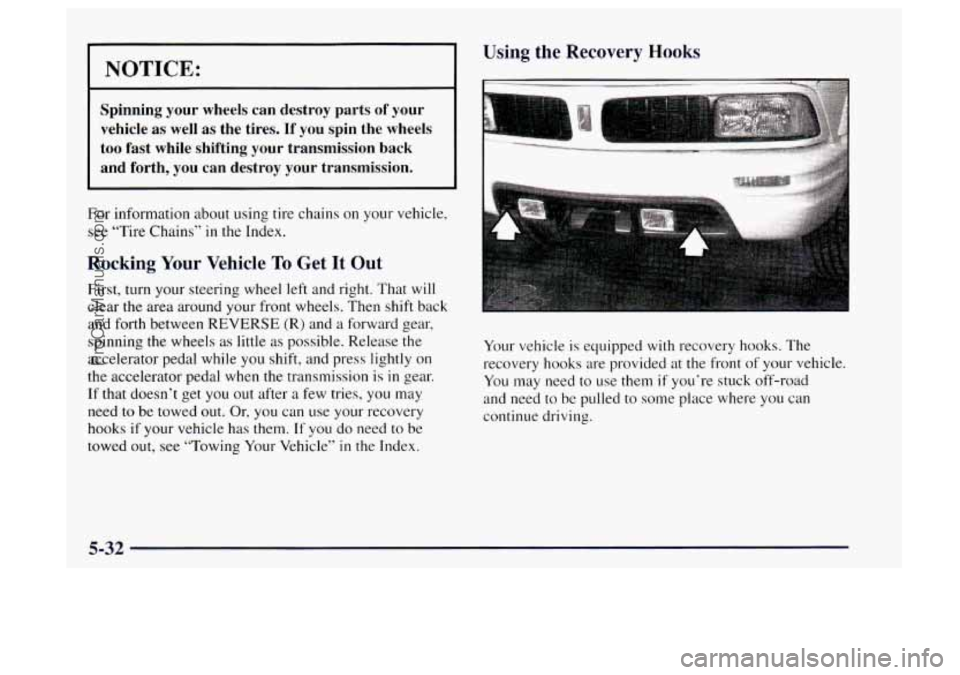
Using the Recovery Hooks
Your vehicle is equipped with recovery hooks. The
recovery hooks are provided at the front
of your vehicle.
You may need to use them
if you're stuck off-road
and need to be pulled to some place where you can
continue driving.
ProCarManuals.com
Page 226 of 358

Be careful not to spill gasoline, Clean gasoline from
painted surfaces as soon
as possible. See “Cleaning the
Outside
of Your Oldsmobile” in the Index.
When you put
the cap back on, turn it to the right
(clockwise) until
you hear a clicking sound. Make sure
you fully install the cap. The diagnostic system can
determine
if the fuel cap has been left off or improperly
installed.
This would allow fuel to evaporate into the
atmosphere. See “Malfunction Indicator Lamp” in
the Index.
I I
I NOTICE:
If you need a new cap, be sure to get the right
type. Your retailer can get one for you.
If you get
the wrong type, it may not fit properly. This may
cause your malfunction indicator lamp to light and your fuel tank and emissions system may be
damaged. See “Malfunction Indicator Lamp’’ in
the Index.
Checking Things Under the Hood
To open the hood, first pull
the handle inside the vehicle
on the lower driver’s side
of
the instrument panel.
6-6
ProCarManuals.com
Page 240 of 358

1
; What to Use
I Refer to the Maintenance Schedule to determine what
’ kind of lubricant to use. See “Recommended Fluids and
i Lubricants” in the Index.
1 , I Engine Coolant
; The cooling system in your vehicle is filled with new
1 DEX-COOL” engine coolant. This coolant is designed
I to remain in your vehicle for 5 years or 150,000 miles
I (240 000 km), whichever occurs first, if you add only
~ DEX-COOL” extended life coolant.
I i The following explains your cooling system and how to
i
~
i
add coolant when it is low. If you have a problem with
engine overheating, see “Engine Overheating” in
the Index.
I
A 50/50 mixture of water and the proper coolant for
1 your Oldsmobile will:
’ 0 Give freezing protection down to -34°F (-37°C).
~ 0 Give boiling protection up to 265 “F (129°C). I
~ 0 Protect against rust and corrosion.
0 Help keep the proper engine temperature.
0 Let the warning lights and gages work as
they should.
NOTICE:
When adding coolant, it is important that you use
only
DEX-COOL TM (silicate-free) coolant.
If silicated coolant is added to the system,
premature engine, heater core or radiator
corrosion may result. In addition, the engine
coolant will require change sooner
-- at
30,000 miles (50 000 km) or 24 months,
whichever occurs first.
What to Use
Use a mixture of one-half clean water (preferably
distilled) and one-half DEX-COOL
TM coolant which
won’t damage aluminum parts. Use GM Engine Coolant
Supplement (sealer) (GM Part
No. 3634621) with any
complete coolant change.
If you use this mixture, you
don’t need to add anything else.
ProCarManuals.com
Page 248 of 358
Brake Wear
Your Oldsmobile has four-wheel disc brakes.
Disc brake pads have built-in wear indicators that make
a
high-pitched warning sound when the brake pads are worn
and new pads are needed. The sound may come and
go or
be heard all the time your vehicle is moving (except when
you are pushing on
the brake pedal firmly).
The brake wear warning sound means that soon
your brakes won’t work well. That could lead to
an accident. When you hear the brake wear
warning sound, have your vehicle serviced.
NOTICE:
Continuing to drive with worn-out brake pads
could result in costly brake repair.
Some driving conditions or climates may cause a brake
squeal when the brakes are first applied or lightly
applied. This does
not mean something is wrong with
your brakes.
Properly torqued wheel nuts are necessary to help
prevent brake pulsation. When tires are rotated, inspect
brake pads for wear and
evenly torque wheel nuts in the
proper sequence to
GM specifications.
Brake linings should always be replaced as complete
axle sets.
See “Brake System Inspection”
in Section 7 of this manual
under
Part C “Periodic Maintenance Inspections.”
Brake Pedal Travel
See your retailer if the brake pedal does not return to
normal height, or
if there is a rapid increase in pedal
travel. This could be a sign of brake trouble.
Brake Adjustment
Every time you make a brake stop, your disc brakes
adjust for wear.
6-28
ProCarManuals.com
Page 260 of 358

I
Mixing tires could cause you to lose control while
driving.
If you mix tires of different sizes or types
(radial and bias-belted tires), the vehicle may not
handle properly, and you could have
a crash.
Using tires of different sizes may also cause
damage to your vehicle.
Be sure to use the same
size and type tires on all wheels.
It’s all right to drive with your compact spare (if
you have one). It was developed for use on
your vehicle.
Uniform Tire Quality Grading
The following information relates to the system
developed by the United States National Highway
Traffic Safety Administration, which grades tires by
treadwear, traction and temperature performance. (This
applies only to vehicles sold in the United States.) The
grades are molded
on the sidewalls of most passenger
car tires. The Uniform Tire Quality Grading system does
not apply to deep tread, winter-type snow tires,
space-saver or temporary use spare tires, tires with
nominal rim diameters of
10 to 12 inches (25 to 30 cm),
or to some limited-production tires.
While the tires available on General Motors passenger
cars and light trucks may vary with respect to these
grades, they must also conform to Federal safety
requirements and additional General Motors Tire
Performance Criteria (TPC) standards.
6-40
ProCarManuals.com
Page 265 of 358
Using Foam-Type Cleaner on Fabric
1.
2.
3.
4.
5.
6.
7.
8.
9.
Vacuum and brush the area to remove any loose dirt.
Always clean a whole trim panel or section. Mask
surrounding trim along stitch
01- welt lines.
Mix Multi-Purpose Powdered Cleaner following the
directions on the container label.
Use suds only and apply with
a clean sponge. Don’t
saturate the material and don’t rub it roughly.
As soon as you’ve cleaned the section, use a sponge
to remove the suds.
Rinse the section with a clean, wet sponge.
Wipe off what’s left with
a slightly damp paper towel
or cloth.
Dry
it immediately with a blow dryer.
Wipe with
a clean cloth.
Using Solvent-Qpe Cleaner on Fabric
First, see if you have to use solvent-type cleaner at all.
Some spots and stains
will clean off better with just
water and mild
soap.
If you need to use a solvent:
1.
2.
3.
4.
Gently scrape excess soil from the trim material with
a clean, dull knife or scraper.
Use very little cleaner, light pressure and clean cloths
(preferably cheesecloth). Cleaning should start at the
outside of the stain, “feathering” toward the center.
Keep changing to
a clean section of the cloth.
When you clean
a stain from fabric, immediately dry
the area with a blow dryer to help prevent
a
cleaning ring.
6-45
ProCarManuals.com