brake fluid OLDSMOBILE BRAVADA 1997 Owners Manual
[x] Cancel search | Manufacturer: OLDSMOBILE, Model Year: 1997, Model line: BRAVADA, Model: OLDSMOBILE BRAVADA 1997Pages: 358, PDF Size: 18.02 MB
Page 55 of 358

a Section 2 Features and Controls
Here you can learn about the many standard and optional features on your Oldsnwbile, and information on starting,
shifting and braking. Also explained are the instrument panel and the warning systems that tell you
if everything is
working properly
-- and what to do if you have a problem.
2-2
2 -4
2-5
2-6
2-7
2-
IO
2-1 1
2- 12
2-13
2-
14
2-15
2-18
2-22
2-34 Important Information
About Keys
Door Locks
Operation of Child Security Locks
Remote Keyless Entry
Battery Replacement for RKE
Preventing
Theft of Your Vehicle
New Vehicle "Break-In"
Ignition Positions
Tips
on Starting Your Engine
Using the Engine Coolant Heater
Automatic Transmission Operation
Parking Brake Guidelines
Important Information
on Engine Exhaust
Operation of Your Windows 2-2s
2-25
2-26
2-27
2-28
2-3
1
2-32
2-33
2-34
2-35
2-48 2-52
Adjusting the Tilt Steering Wheel
Functions
of the Multifunction Lever
How
to Use the HighLow Beam
Headlamp Changer
Windshield Wipers and Fluid
Using Cruise Control
Exterior Lamps Daytime Running Lamps (DRL)
Rearview Mirrors
Storage Compartments
Instrument Panel Overview
All About Your Warning Lights and Gages
Interior
Lamps
ProCarManuals.com
Page 82 of 358

Rear Window Washermiper
WASH
REAR WIPER
This switch is located on the instrument panel.
The rear window wiper operates with a constant five
second delay when the rear wiper switch is
in the ON
position. If the rear glass is opened, the wiper arm will
automatically park on the iiftgate. When the glass
is
completely closed, the wiper will resume the delay mode.
To wash the window, press and hold ON. The wipers
will continue to work after YOLI release the switch,
Press
OFF to turn the wiper off.
The rear window washer uses the same fluid bottle as
the windshield washer. However, the rear window
washer
will run out of fluid before the windshield
washer.
If you can wash your windshield but not your
rear window,
check your fluid level.
Cruise Control
really help on long trips.
Cruise control does not
work at speeds below about
. . .:. ,..< ,~-:,~:,-l 25 mph (40 km/h). .. ..
If you apply your brakes, the cruise control will shut off.
2-28
ProCarManuals.com
Page 180 of 358
Safety Chains
You should always attach chains between your vehicle
and your trailer. Cross the safety chains under the tongue
of the trailer
so that the tongue will not drop to the road
if
it becomes separated from the hitch. Instructions
about safety chains may be provided by the hitch
manufacturer or by the trailer manufacturer.
Follow the
manufxturer’s recommendation for attaching
safety
chains and do not attach them to the bumper. Always
leave just enough slack so you can turn with yot~l. rig.
And, never allow safety chains to drag on the ground.
Trailer Brakes
If your trailer weighs more than 1,000 Ibs. (450 kg)
loaded, then it needs its own brakes -- and they IINIS~ be
adequate. Be sure to read and follow the instructions for
the trailer brakes
so you’ll be able to install, acl.jtlst and
maintain them properly. Your
trailer’s brake system can tap into the vehicle’s
hydraulic brake system only if:
0 The trailer parts can withstand 3,000 psi
(20 650 kPa) of pressure.
0 The trailer’s brake system will use less than
0.02 cubic inch (0.3 cc) of tluid from your vehicle’s
master cylinder. Otherwise, both braking systems
won’t work well.
You could even lose your brakes.
If everything checks out this far, then make the brake
fluid tap at the port on the master cylinder that sends
fluid to the rear brakes. But don’t use copper tubing for
this.
If you do, it will bend and finally break off. Use
steel brake tubing.
4-48
ProCarManuals.com
Page 184 of 358

When You Are Ready to Leave After
Parking on a Hill
1. Apply your regular brakes and hold the pedal down
while you:
0 Start your engine;
0 Shift into a gear; and
0 Release the parking brake.
2. Let up on the brake pedal.
3. Drive slowly until the trailer is clear of the chocks.
4. Stop and have someone pick up and store the chocks.
Maintenance When Trailer Towing
Your vehicle will need service more often when you’re
pulling a trailer. See the Maintenance Schedule for more
on this. Things that are especially important
in trailer
operation are automatic transmission fluid (don’t
overfill), engine
oil, axle lubricant, belt, cooling system
and brake adjustment. Each of these
is covered in this
manual, and the Index will help you find them quickly.
If you’re trailering, it’s a good idea to review these
sections before you start your trip.
Check periodically to see that all hitch nuts and bolts
are tight.
4-52
ProCarManuals.com
Page 221 of 358

Section 6 Service and Appearance Care
Here you will find information about the care of your Oldsmobile. This section begins with service and fuel
information, and then it shows how to check important fluid and lubricant levels. There is also technical information
about
your vehicle, and a part devoted to its appearance care.
6-
2
6- 3
6-4
6-5
6-6
6-9
6- 14
6-20
6- 24
6-25
6-29
6-29
6-30
6-34
6-37 Doing
Your Own Service Work
What Kind of Fuel to Use
Using Fuel
in Foreign Countries
Where to Put the Fuel and Filling
the Tank
Checking Things Under the Hood
Checking Your Engine Oil
Automatic Transmission Fluid
Engine Coolant
Where to Fill
the Windshield Washer Fluid
Important Brake Information
Information
on Your Vehicle’s Battery
Tips
on Vehicle Storage
Bulb Replacement Procedures
Windshield Wiper Blade Replacement How and When
to Check Tire Inflation 6-39
6-42
6-44
6-47
6-48
6-50
6-5
1
6-52
6-53
6-54
6-55 6-59
6-60
6-60
6-6
I
When it is Time to Buy New Tires
Wheel Alignment
Cleaning the Inside
of Your Oldsmobile
Care
of the Safety Belts
Cleaning the Outside
of Your Oldsmobile
How to Clean Aluminum Wheels
Underbody Maintenance
Recommended Appearance Care Materials
Your Vehicle Identification Number
(VIN)
The Electrical System
Fuses and Circuit Breakers
Replacement Bulb Types for Your Vehicle
Capacities and Specifications
Normal Replacement Parts
Air Conditioning Specifications
6-1
- -~ -
ProCarManuals.com
Page 227 of 358

Then go to the front of the vehicle and release the
secondary
hood release.
Lift the hood, release the hood prop from its retainer and
put the hood prop into the slot
in the hood. You may
have a lamp that cornes on when you lift the hood.
A CAUTION:
Things that burn can get on hot engine parts and
start a fire. These include liquids like gasoline,
oil, coolant, brake fluid, windshield washer and
other fluids, and plastic
or rubber. You or others
could be burned. Be careful not to drop or spill
things that will burn onto a hot engine.
I
6-7
-
ProCarManuals.com
Page 228 of 358

When you lift the hood, you'll see these items:
A. Battery
B. Coolant Recovery Tank
C. Engine Oil Dipstick
D. Automatic Transmission Dipstick G. Brake Master Cylinder
E. Engine Oil Fill H. Air Cleaner
F. Power Steering Reservoir
I. Windshield Washer Fluid
6-8
ProCarManuals.com
Page 236 of 358

Checking Transmission Fluid Cold
A cold check is made after the vehicle has been sitting
for eight hours or more
with the engine off and is used
only as a reference. Let the engine run at idle for five
minutes if outside temperatures are 50°F
(10°C) or
more. If it's colder than
50°F (IO'C), you may have to
idle the engine longer. Should the fluid level be
low
during a cold check, you must perform a hot check
before adding fluid. This will give
you a more accurate
reading
of the fluid level.
Checking the Fluid Hot or Cold
0
0
0
Park your vehicle on a level place. Keep the
engine running.
With the parking brake applied, place the shift lever
in PARK (P).
With your foot on the brake pedal, move the shift
lever through each gear range, pausing for about
three seconds
in each range. Then, position the shift
lever in
PARK (P).
Let the engine run at idle for three minutes or more. Then, without shutting
off the engine, follow these steps:
1. Flip
the handle up and then pull out the dipstick and
wipe
it with a clean rag or paper towel.
2. Push it back in all the way, wait three seconds and
then
pull it back out again.
6-16
ProCarManuals.com
Page 245 of 358
NOTICE:
0
0 0
0
When using concentrated washer fluid,
follow the manufacturer’s instructions for
adding water.
Don’t mix water with ready-to-use washer
fluid. Water can cause the solution to freeze
and damage your washer fluid tank and
other parts of the washer system. Also,
water doesn’t clean as well as washer fluid.
Fill your washer fluid tank only
three-quarters full when it’s very cold. This
allows for expansion if freezing occurs,
which could damage the tank if it is
completely full.
Don’t use radiator antifreeze in your
windshield washer. It can damage your
washer system and paint.
Brakes
Brake Fluid
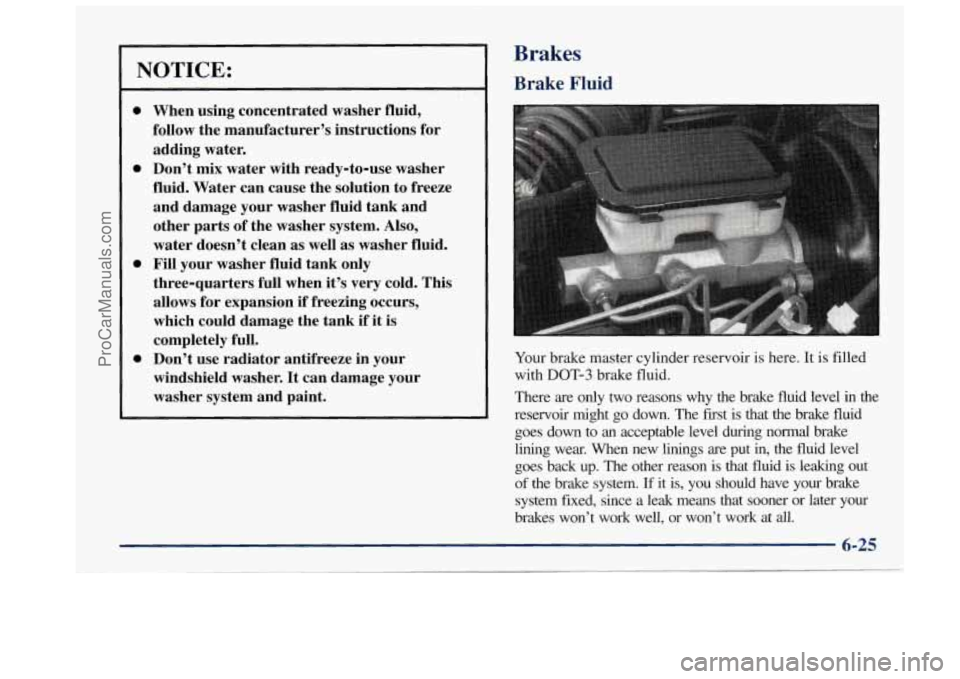
Your brake master cylinder reservoir is here. It is filled
with
DOT-3 brake fluid.
There are only two reasons why the brake fluid level in the
reservoir might go down. The fiist is that the brake fluid
goes down to an acceptable level during normal brake
lining wear. When new linings are put
in, the fluid level
goes back up. The other reason is that fluid is leaking out of the brake system. If it
is, you should have your brake
system fixed, since a leak means that sooner or later your
brakes won’t work well,
or won’t work at all.
6-25
ProCarManuals.com
Page 246 of 358

So, it isn’t a good idea to “top off’ your brake fluid.
Adding brake fluid won’t correct a leak.
If you add fluid
when your linings are worn, then you’ll have too much
fluid when
you get new brake linings. You should add
(or remove) brake fluid,
as necessary, only when work is
done on the brake hydraulic system.
a
-
I CAUTION:
If you have too much brake fluid, it can spill on the
engine. The fluid will burn if the engine is
hot
enough. You or others could be burned, and your
vehicle
could be damaged. Add brake fluid only
when work
is done on the brake hydraulic system.
Refer to the Maintenance Schedule to determine when to
check your brake fluid. See “Periodic Maintenance
Inspections”
in the Index.
Checking Brake Fluid
You can check the brake fluid without taking off the cap.
Just look at the windows
on the brake fluid reservoir.
The fluid levels should be above
MIN. If they aren’t,
have your brake system checked to see
if there is a leak.
After work
is done on the brake hydraulic system, make
sure
the levels are above MIN and below the top of
each window.
6-26
ProCarManuals.com