trailer OLDSMOBILE BRAVADA 1997 Owners Manual
[x] Cancel search | Manufacturer: OLDSMOBILE, Model Year: 1997, Model line: BRAVADA, Model: OLDSMOBILE BRAVADA 1997Pages: 358, PDF Size: 18.02 MB
Page 65 of 358

Parking at Night
Park in a lighted spot, close all windows and lock your
vehicle. Remember to keep your valuables out
of sight.
Put them
in a storage area, or take them with you.
Parking Lots
If you park in a lot where someone will be watching
your vehicle, it’s best to lock
it up and take your keys.
But
what if you have to leave your ignition key? What if
you have to leave something valuable
in your vehicle?
Put your valuables in a storage area, like your
glove
box.
0 Lock all the doors except the driver’s.
New Vehicle “Break-In”
-
NOTICE:
-
Your modern Oldsmobile doesn’t need an
elaborate “break-in.’’ But it will perform better
in the long run if you follow these guidelines:
0
0
0
0
Keep your speed at 55 mph (88 kmk) or
less for the first
500 miles (805 km).
Don’t drive at any one speed
-- fast or
slow
-- for the first 500 miles (805 km).
Don’t make full-throttle starts. Avoid making hard stops for the first
200 miles (322 km) or so. During this time
your new brake linings aren’t yet broken
in. Hard stops with new linings can mean
premature wear and earlier replacement.
Follow this breaking-in guideline every
time you get new brake linings.
Don’t tow a trailer during break-in. See
“Towing a Trailer” in the Index for
more information.
2-11
ProCarManuals.com
Page 70 of 358

It is dangerous to get out of your vehicle if the
shift lever is not fully in
PARK (P) with the
parking brake firmly set. Your vehicle can roll.
Don’t leave your vehicle when the engine
is
running unless you have to. If you have left the
engine running, the vehicle can move suddenly.
You or others could be injured.
To be sure your
vehicle won’t move, even when you’re on fairly
level ground, always set your parking brake and
move the shift lever to
PARK (P).
Your vehicle will be free to roll -- even if your
shift lever is in
PARK (P) -- if your transfer case
is in
NEUTRAL (N). So, be sure the transfer case
is in a drive gear
-- not in NEUTRAL (N). See
“Shifting Into
PARK (P)” in the Index. If you’re
pulling
a trailer, see “Towing a Trailer” in
the Index. Ensure the shift lever
is fully in
PARK (P) range before
starting the engine.
Your vehicle has a
brake-transmission shift interlock. You have to fully
apply your regular brakes before you can
shift from
PARK (P) when the ignition key is in the RUN position.
If you cannot shift
out of PARK (P), ease pressure on
the shift lever
-- press the button on the shift lever and
push the shift lever all the way into PARK (P) as you
maintain brake application. Then move the shift lever
into the gear you wish. See “Shifting Out of PARK (P)”
in the Index.
REVERSE (R): Use this gear to back up.
NOTICE:
Shifting to REVERSE (R) while your vehicle is
moving forward could damage your
transmission. Shift to
REVERSE (R) only after
your vehicle is stopped.
To rock your vehicle back and forth to get out of snow,
ice or sand without damaging your transmission, see
“Stuck: In
Sand, Mud, Ice or Snow” in the Index.
ProCarManuals.com
Page 71 of 358

NEUTRAL (N): In this position, your engine doesn’t
connect with
the wheels. To restart when YOLI’I-~ already
moving, use
NEUTRAL (N) only.
Shifting out of PARK (P) or NEUTRAL (N) while
your engine
is “racing” (running at high speed) is
dangerous. Unless your foot is firmly on the
brake pedal,
your vehicle could move very
rapidly.
You could lose control and hit people or
objects. Don’t shift out of PARK
(P) or
NEUTRAL
(N) while your engine is racing.
I NOTICE:
Damage to your transmission caused by shifting
out of PARK
(P) or NEUTRAL (N) with the
engine racing isn’t covered by your warranty. AUTOMATIC OVERDRIVE
(@): This position
is for
normal driving. If you need 111o1-e power for passing,
and you’re:
Going less than about 35 rnph (56 kidhj, push your
Going about 35 mph (56 kdhj or more, push the
accelerator
peclal about halfway
down.
accelerator all the way
down.
You’ll shift down to the next gear and have more power.
AUTOMATIC OVERDRIVE
(0) should not be used
when towing
a trailer, carrying a heavy load, driving on
steep hills 01- for off-road driving. Select THIRD (3) when
operating the vehicle under
any of these conditions.
THIRD
(3): This position is also used for normal
driving, however
it offers more power but lower fuel
economy than AUTOMATIC OVERDRIVE
(@I. You
should LIS~ THIRD (3) when towing ;I trailer, carrying a
heavy load, driving on steep hills or winding roads or
for off-road driving.
SECOND (2): This position gives you more power but
lower fuel economy. You can use SECOND (2) on hills.
It can help control your speed as you go down steep
mountain roads,
but then you would also want to use
your txakes off’ and on.
ProCarManuals.com
Page 73 of 358
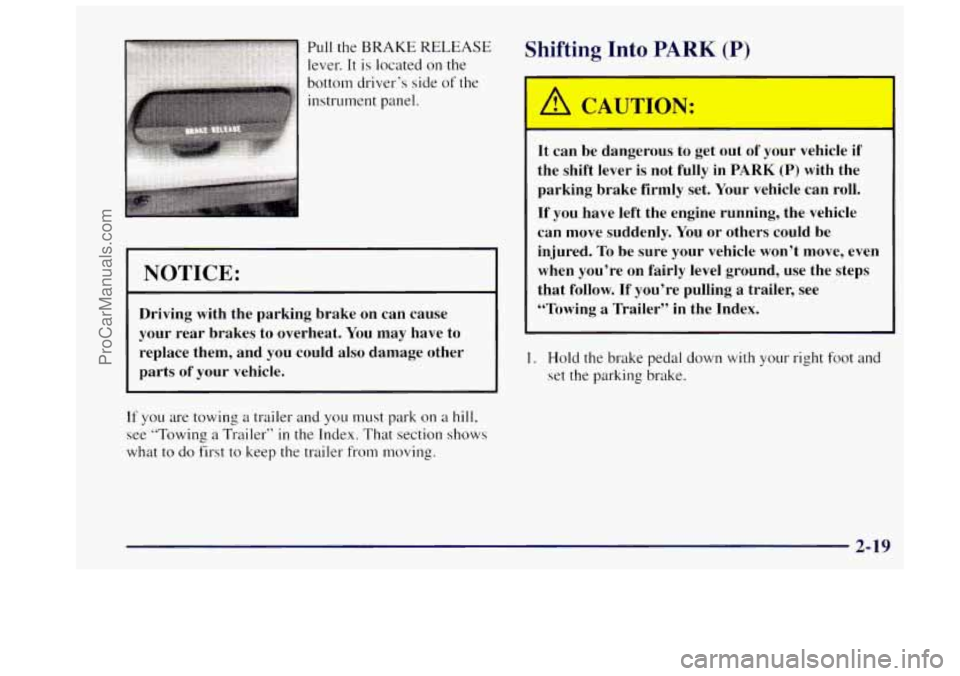
instrument panel.
NOTICE:
Driving with the parking brake on can cause
your rear brakes to overheat. You may have to
replace them, and you could also damage other
parts
of your vehicle.
If you are towing a trailer and you must park on a hill,
see ”Towing a Trailer” in the Index. That section shows
what to do first
to keep the trailer from moving.
Shifting Into PARK (P)
It can be dangerous to get out of your vehicle if
the shift lever is not fully in PARK (P) with the
parking brake firmly set. Your vehicle can roll.
If you have left the engine running, the vehicle
can move suddenly. You or others could be
injured.
To be sure your vehicle won’t move, even
when you’re on fairly level ground, use the steps
that follow.
If you’re pulling a trailer, see
“Towing a Trailer” in the Index.
I. Hold the brake pedal down with your right foot and
set the parking brake.
2-19
ProCarManuals.com
Page 77 of 358

Running Your Engine While
You’re Parked
It’s better not to park with the engine running. But if
ever have to, here are SOT things to know.
Idling the engine with the air system control
off
could allow dangerous exhaust into your vehicle
(see the earlier Caution under “Engine Exhaust”).
Also, idling
in a closed-in place can let deadly
carbon monoxide (CO) into your vehicle even if
the fan switch is at the highest setting. One place
this can happen is
a garage. Exhaust -- with
CO
-- can come in easily. NEVER park in a
garage with the engine running.
Another closed-in place can be a blizzard. (See
“Blizzard” in the
Index.)
It can be dangerous to get out of your vehicle if
the shift lever is not fully in PARK
(P) with the
parking brake firmly set. Your vehicle can roll.
running unless you have to. If you’ve left the
engine running, the vehicle can move suddenly.
You
or others could be injured. To be sure your
vehicle won’t move, even when you’re on fairly
level ground, always set your parking brake and
move the shift lever to PARK (P).
~ Don’t leave your vehicle when the engine is
Follow the proper steps
to be sure your vehicle won’t
nove. See “Shifting Into
PARK (P)” in the Index.
If you’re pulling a trailer, see “Towing a Trailer” in
:he Index.
ProCarManuals.com
Page 80 of 358
Turn and Lane Change Signals
The turn signal has two upward (for right) and two
downward (for left) positions. These positions allow
you
to signal a turn or a lane change.
To signal a turn, move the lever all the way up or down.
When the
turn is finished, the lever will return automatically.
An arrow on
the instrument
panel will flash in the
direction of the turn or
lane change.
To signal a lane change, just raise or lower the lever
until the arrow starts to flash. Hold it there
until you
complete your lane change. The lever will return by
itself when you release it.
As you signal a turn or a lane change, if the arrows don't
flash but just stay on,
a signal bulb may be burned out
and other drivers won't see your
turn signal. If
a bulb is burned out, replace it to help avoid an
accident. If the arrows don't go on at
all when you
signal
a turn, check the fuse (see "Fuses and Circuit
Breakers"
in the Index) and for burned-out bulbs.
If you have
a trailer towing option with added wiring for
the trailer lamps, a different turn signal flasher is used.
With this flasher installed, the signal indicator will flash
even if a turn signal bulb is burned out. Check the front
and rear turn signal lamps regularly to make sure they
are working.
Headlamp HighLow Beam Changer
To change the headlamps from low to high-beam or
high to low-beam,
pull the multifunction lever all the
way toward you. Then release
it.
When the high beams are
on, this indicator light on
the instrument panel will
also be on.
2-26
ProCarManuals.com
Page 112 of 358
If the Light Is Flashing
The following may prevent more serious damage to
your vehicle:
0 Reducing vehicle speed.
0 Avoiding hard accelerations.
0 Avoiding steep uphill grades.
0 If you are towing a trailer, reduce the amount of
cargo being hauled as soon as it is possible.
If the light stops flashing and remains on steady, see
“If
the Light Is On Steady” following.
If the light continues to flash, when it is safe to do so,
stop the vehicle. Find a safe place to park your vehicle.
Turn the key
off, wait at least 10 seconds and restart the
engine.
If the light remains on steady, see “If the Light
Is On Steady” following. If the light is still flashing,
follow the previous steps, and drive the vehicle to your
retailer or qualified service center for service.
If the Light Is On Steady
You may be able to correct the emission system
malfunction by considering the following:
Did you recently put fuel into your vehicle‘?
If so, reinstall the fuel cap, making sure to fully install
the cap.
The diagnostic system can determine if the fuel
cap has been left off or improperly installed. A loose or
missing fuel cap will allow fuel to evaporate into the
atmosphere.
A few driving trips with the cap properly
installed should turn the light off.
Did you just drive through a deep puddle of water?
If so, your electrical system may be wet. The condition
will usually be corrected when the electrical system
dries out.
A few driving trips should turn the light off.
2-58
ProCarManuals.com
Page 133 of 358
Section 4 Your Driving and the Road
Here you’ll find information about driving on different kinds of roads and in varying weather conditions. We’ve also
included many other useful tips on driving.
4- 2
4-3
4-6
4-6 4-7
4-9
4-9
4-1
1
4-12
4-14
4- 15
Defensive Driving
Driving Drunk
Having Control of Your Vehicle
Your Braking System Information
Anti-Lock Brake Information
Braking
in Emergencies
Steering Tips
Off-Road Recovery Tips
Passing Other Vehicles
Losing Control of Your Vehicle
Four-wheel Off-Road.Driving Guidelines Night
Driving
Driving
in Rain and on Wet Roads
Tips Before Leaving on a Long Trip
Avoiding Highway Hypnosis
Driving on
Hills and Mountains
Winter Driving
If You’re Caught in a Blizzard
Loading Your Vehicle
Recreational Vehicle Towing
Helpful Hints for Towing
a Trailer
4-28
4-30
4-35
4-36
4-36
4-3
8
4-40
4-42
4-44
4-49
4-1
ProCarManuals.com
Page 174 of 358

Loading Your Vehicle
The Certification/Tire label is found on the driver’s door
edge, above the door latch. The label shows the size of
your original tires and the inflation pressures needed to
obtain the gross weight capacity
of your vehicle. This is
called the
Gross Vehicle Weight Rating (GVWR). The
GVWR includes the weight
of the vehicle, all occupants,
fuel, cargo and trailer tongue weight,
if pulling a trailer.
The Certification/Tire label also tells you the maximum
weights
for the front and rear axles, called Gross Axle
Weight Rating (GAWR).
To find out the actual loads on your
front and rear axles, you need to
go to a weigh
station and weigh your vehicle.
Your retailer can help
you
with this. Be sure to spread out your load equally on
both sides
of the centerline.
Never exceed the GVWR for your vehicle,
or the
GAWR for either the front
or rear axle.
If you do have a heavy load, you should spread it out.
Similar appearing vehicles may have different GVWR’s
and payloads. Please note
your vehicle’s
Certificationflire label or consult your retailer
for
additional details.
Do not load your vehicle any heavier than the
GVWR, or either the maximum front or rear
GAWR. If you do, parts on your vehicle can
break, or it can change the
way your vehicle
handles. These could cause you to lose control.
Also, overloading can shorten the life of
your vehicle.
4-42
ProCarManuals.com
Page 176 of 358

Payload
The payload capacity is shown on the Certificationrnire
label. This is the maximum load capacity that your
j vehicle can carry. Be sure to include the weight of the
1 occupants as part of your load. If you added any
accessories or equipment after your vehicle left the
factory, remember to subtract the weight of these things
from the payload. Your retailer can help you with this.
Add-on Equipment
When you carry removable items, you may need to put a
limit
on how many people you carry inside your vehicle.
Be sure to weigh your vehicle before you buy and install
the new equipment.
I
1 NOTICE:
I Your warranty doesn't cover parts or i
I
components that fail because of overloading.
Towing a Trailer
If you don't use the correct equipment and drive
properly, you can lose control when you pull
a
trailer. For example, if the trailer is too heavy, the
brakes may not work well
-- or even at all. You
and your passengers could be seriously injured.
Pull
a trailer only if you have followed all the
steps in this section.
Ask your Oldsmobile retailer
for advice and information about towing
a trailer
with your vehicle.
4-44
ProCarManuals.com