wheel OLDSMOBILE BRAVADA 1997 Owners Manual
[x] Cancel search | Manufacturer: OLDSMOBILE, Model Year: 1997, Model line: BRAVADA, Model: OLDSMOBILE BRAVADA 1997Pages: 358, PDF Size: 18.02 MB
Page 15 of 358
In most states and Canadian provinces, the law says to
wear safety belts. Here’s why:
The!! work.
You never know if you’ll be in a crash. If you do have a
crash, you don’t know if it will be a bad one.
A few crashes are mild, and some crashes can be so
serious that even buckled up a person wouldn’t survive.
But most crashes are
in between. In many of them,
people who buckle up can survive and sometimes
walk
away. Without belts they could have been badly hurt
or killed.
After more than
25 years of safety belts in vehicles, the
facts are clear.
In most crashes buckling up does
matter
... a lot!
Why Safety Belts Work
When you ride in or on anything, you go as fast as
it goes.
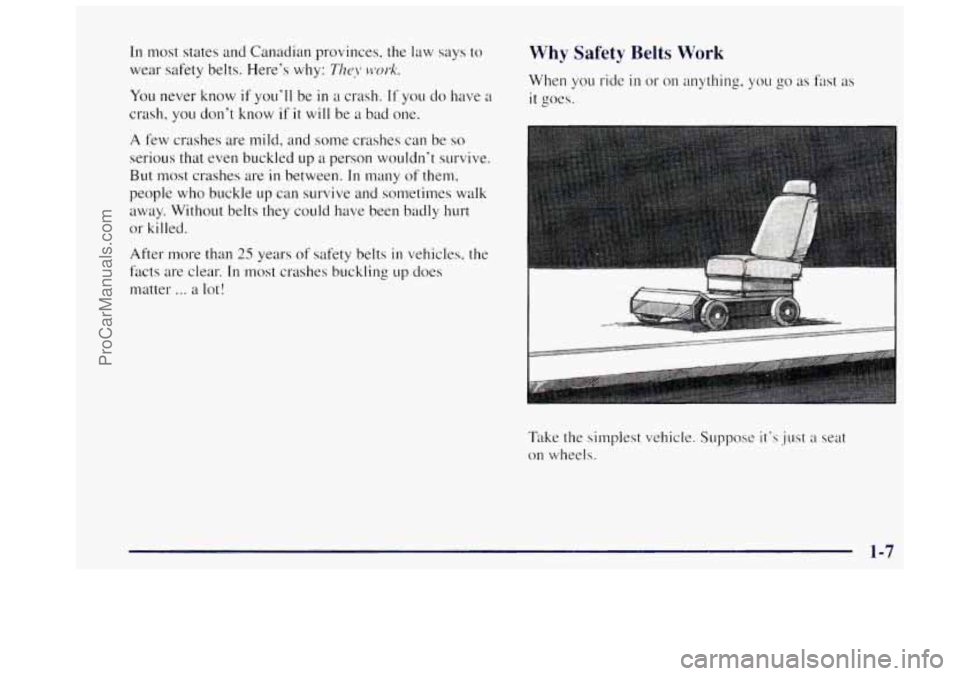
Take the simplest vehicle. Suppose
it’s just a seat
on wheels.
1-7
ProCarManuals.com
Page 28 of 358
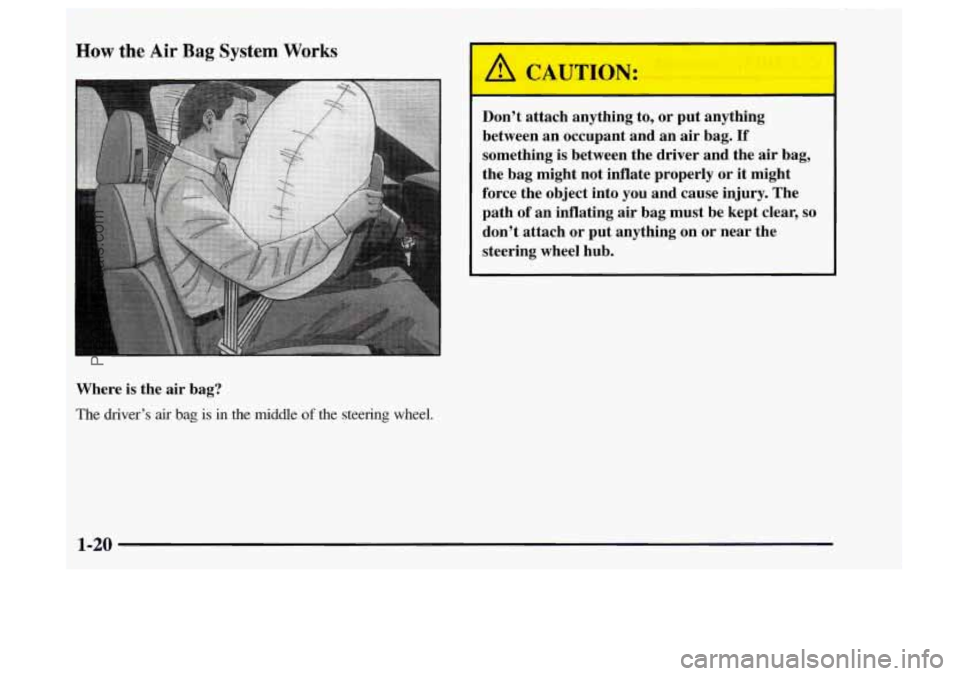
How the Air Bag System Works
Where is the air bag?
The driver’s air bag is in the middle of the steering wheel.
A CAUTION:
Don’t attach anything to, or put anything
between an occupant and an air bag.
If
something is between the driver and the air bag,
the bag might not inflate properly or it might
force the object into you and cause injury. The
path of an inflating air bag must be kept clear,
so
don’t attach or put anything on or near the
steering wheel hub.
1-20
ProCarManuals.com
Page 29 of 358

When should an air bag inflate?
An air bag is designed to inflate in a moderate to severe
frontal or near-frontal crash. The air bag will inflate
only
if the impact speed is above the system’s designed
“threshold level.’’
If your vehicle goes straight into a
wall that doesn’t move or deform, the threshold level is
about
14 to 18 mph (23 to 29 ktdh). The threshold level
can vary, however,
with specific vehicle design, so that
it can be somewhat above or below this range. If your
vehicle strikes something that
will move or deform, such
as a parked car, the threshold level will be higher. The
air bag is not designed to inflate
in rollovers, side
impacts or rear impacts, because inflation would not
help the occupant.
In any particular crash, no one can say whether an air
bag should have inflated simply because of the damage
to a vehicle or because of what the repair costs were.
Inflation is determined by the angle of
the impact and
how quickly the vehicle slows down
in frontal and
near-frontal impacts.
The air bag system is designed to work properly under a
wide range of conditions, including off-road usage.
Observe safe driving speeds, especially on rough terrain.
As always, wear your safety belt. See “Off-Road
Driving“
in the Index for more tips on off-road driving.
What makes an air bag inflate?
In an impact of sufficient severity, the air bag sensing
system detects that the vehicle is
in a crash. The sensing
system triggers
a release of gas from the inflator, which
inflates the air bag. The inflator, air bag and related
hardware
are all part of the air bag module inside the
steering wheel.
How does an air bag restrain?
In moderate to severe frontal or near-frontal collisions,
even belted occupants can contact the steering wheel.
The air bag supplements the protection provided by
safety belts. Air bags distribute the force of the impact
more evenly over the occupant’s upper body, stopping
the occupant more gradually.
But air bags would not
help you
in many types of collisions, including
rollovers, rear impacts and side impacts, primarily
because an occupant’s motion is not toward the air bag.
Air bags should never be regarded as anything more
than
a supplement to safety belts, and then only in
moderate to severe frontal or near-frontal collisions.
ProCarManuals.com
Page 30 of 358
What will you see after an air bag inflates‘?
After an air bag inflates,
it quickly deflates, so quickly
that some people may not even realize the air bag
inflated. Some components of the air bag module
in the
steering wheel hub will be hot for
a short time. The parts
of the bag that come into contact
with you may be
warm, but not too hot to touch. There
will be some
smoke and dust coming from vents
in the deflated air
bag. Air bag inflation doesn‘t prevent the driver from
seeing or from being able to steer the vehicle, nor does
it
stop people from leaving the vehicle.
I
When an air bag inflates, there is dust in the air.
This dust could cause breathing problems
for
people with a history of asthma or other
breathing trouble.
To avoid this, everyone in the
vehicle should get out as soon
as it is safe tu do so.
If you have breathing problenls but can’t get out
of the vehicle after an air bag inflates, then get
fresh air by opening
a window or door.
0
e
e
The air bag is designed to inflate only once. After it
inflates. ~011’11 need some new parts for your air bag
system.
If you don’t get them, the air bag system
won‘t be there to help protect you
in another crash.
A new system will include the air bag module and
possibly other parts. The service manual for your
vehicle covers the need to replace other parts.
Your vehicle is equipped
with a diagnostic module,
which records information about the air bag system.
The module records information about the readiness
of the system, when the sensors are activated and
driver’s safety belt usage at deployment.
Let
only qualified technicians work on your air bag
system. Improper service can mean that
your air bag
system won’t work properly. See your retailer
for service.
NOTICE:
If you damage the cover for the driver’s air bag,
the bag may not work properly.
You may have to
replace the air bag module.
Do not open or break
the air bag cover.
1-22
ProCarManuals.com
Page 55 of 358

a Section 2 Features and Controls
Here you can learn about the many standard and optional features on your Oldsnwbile, and information on starting,
shifting and braking. Also explained are the instrument panel and the warning systems that tell you
if everything is
working properly
-- and what to do if you have a problem.
2-2
2 -4
2-5
2-6
2-7
2-
IO
2-1 1
2- 12
2-13
2-
14
2-15
2-18
2-22
2-34 Important Information
About Keys
Door Locks
Operation of Child Security Locks
Remote Keyless Entry
Battery Replacement for RKE
Preventing
Theft of Your Vehicle
New Vehicle "Break-In"
Ignition Positions
Tips
on Starting Your Engine
Using the Engine Coolant Heater
Automatic Transmission Operation
Parking Brake Guidelines
Important Information
on Engine Exhaust
Operation of Your Windows 2-2s
2-25
2-26
2-27
2-28
2-3
1
2-32
2-33
2-34
2-35
2-48 2-52
Adjusting the Tilt Steering Wheel
Functions
of the Multifunction Lever
How
to Use the HighLow Beam
Headlamp Changer
Windshield Wipers and Fluid
Using Cruise Control
Exterior Lamps Daytime Running Lamps (DRL)
Rearview Mirrors
Storage Compartments
Instrument Panel Overview
All About Your Warning Lights and Gages
Interior
Lamps
ProCarManuals.com
Page 64 of 358

Xemote Liftgate Glass Release
This button on the driver’s
side of the steering column
allows you to release the
liftgate glass from inside the vehicle.
four shift lever must be
in PARK (P) or NEUTRAL (N)
or the release to work.
Theft
Vehicle theft is big business, especially in some cities.
Although your Oldsmobile has a number of
theft-deterrent features, we know that nothing we put
on
it can make it impossible to steal. However, there are
ways you can help.
Key in the Ignition
If you leave your vehicle with the keys inside, it’s an
easy target for joy riders or professional thieves
-- so
don’t do it.
When you park your Oldsmobile and open the driver’s
door, you’ll hear a tone reminding you
to remove your
key from
the ignition and take it with you. Always do
this. Your steering wheel will be locked, and
so will
your ignition and transmission. And remember to lock
the doors.
2-10
ProCarManuals.com
Page 66 of 358

Ignition Positions
Use the key to turn the ignition switch to five
different positions.
C
A L E
ACCESSORY (A): ACCESSORY lets you use things
like the radio and
the windshield wipers when the
engine is
off. Push in the key and turn it toward you.
Your steering wheel will remain locked, just as it was
before you inserted the key.
I NOTICE:
Don’t operate accessories in the ACCESSORY
position for long periods
of time. Prolonged
operation of accessories in the ACCESSORY
position could drain your battery and prevent
you from starting your vehicle.
LOCK
(B): This position locks your ignition, steering
wheel and transmission. It’s a theft-deterrent feature.
You will only be able to remove your key when the
ignition
is turned to LOCK.
OFF (C): This position lets you turn off the engine but
still turn the steering wheel. Use
OFF if you must have
your vehicle
in motion while the engine is off (for
example,
if your vehicle is being towed).
RUN (D): This is the position for driving.
START (E): This starts your engine.
2-12
ProCarManuals.com
Page 67 of 358

NOTICE:
If your key seems stuck in LOCK and you can’t
turn it, be sure you are using the correct key;
if
so, is it all the way in? If it is, then turn the
steering wheel left and right while you turn the
key hard. But turn the key only with your hand.
Using
a tool to force it could break the key or the
ignition switch. If none
of this works, then your
vehicle needs service.
Starti 3 Your Engine
Move your shift lever to PARK (P) or NEUTRAL (N).
Your engine won’t start in any other position -- that’s a
safety feature. To restart when you’re already moving,
use NEUTRAL, (N j only.
.
NOTICE:
Don’t try to shift to PARK (P) if your Oldsmobile
is moving. If you do, you could damage the
transmission. Shift to
PARK (P) only when your
vehicle is stopped.
1. Without pushing the accelerator pedal, turn your
ignition key
to START. When the engine starts. let
go of the key. The idle speed will go down as your
engine gets
warm.
NOTICE:
Holding your key in START for longer than
15 seconds at a time will cause your battery to be
drained much sooner. And the excessive heat can
damage your starter motor.
2-13
ProCarManuals.com
Page 69 of 358

To Use the Coolant Heater
1. Turn off the engine.
2. Open the hood and unwrap the electrical cord.
3. Plug it into a normal, grounded 1 10-volt AC outlet.
[ON:
-
Plugging the cord into an ungrounded outlet
could cause an electrical shock.
Also, the wrong
kind
of extension cord could overheat and cause
a fire.
You could be seriously injured. Plug the
cord into a properly grounded three-prong
110-volt
AC outlet. If the cord won’t reach, use a
heavy-duty three-prong extension cord rated for
at least
15 amps.
4. Before starting the engine, be sure to unplug and store
the cord as it was before to keep it away fi-om moving
engine
parts. If you don’t, it could be damaged. How
long should you keep the coolant heater plugged
in? The answer depends on the outside temperature, the
kind
of oil you have, and some other things. Instead of
trying to list everything here, we ask that you contact
your Oldsrnobile retailer in the area where you’ll be
parking your vehicle. The retailer can give you the best
advice for that particular area.
Automatic Transmission Operation
P
R
N
03
3
2
1
There are several different
positions for your
shift lever.
PARK (P): This locks your rear wheels. It’s the best
position to use when you start your engine because your
vehicle can’t move easily.
2-15
ProCarManuals.com
Page 71 of 358

NEUTRAL (N): In this position, your engine doesn’t
connect with
the wheels. To restart when YOLI’I-~ already
moving, use
NEUTRAL (N) only.
Shifting out of PARK (P) or NEUTRAL (N) while
your engine
is “racing” (running at high speed) is
dangerous. Unless your foot is firmly on the
brake pedal,
your vehicle could move very
rapidly.
You could lose control and hit people or
objects. Don’t shift out of PARK
(P) or
NEUTRAL
(N) while your engine is racing.
I NOTICE:
Damage to your transmission caused by shifting
out of PARK
(P) or NEUTRAL (N) with the
engine racing isn’t covered by your warranty. AUTOMATIC OVERDRIVE
(@): This position
is for
normal driving. If you need 111o1-e power for passing,
and you’re:
Going less than about 35 rnph (56 kidhj, push your
Going about 35 mph (56 kdhj or more, push the
accelerator
peclal about halfway
down.
accelerator all the way
down.
You’ll shift down to the next gear and have more power.
AUTOMATIC OVERDRIVE
(0) should not be used
when towing
a trailer, carrying a heavy load, driving on
steep hills 01- for off-road driving. Select THIRD (3) when
operating the vehicle under
any of these conditions.
THIRD
(3): This position is also used for normal
driving, however
it offers more power but lower fuel
economy than AUTOMATIC OVERDRIVE
(@I. You
should LIS~ THIRD (3) when towing ;I trailer, carrying a
heavy load, driving on steep hills or winding roads or
for off-road driving.
SECOND (2): This position gives you more power but
lower fuel economy. You can use SECOND (2) on hills.
It can help control your speed as you go down steep
mountain roads,
but then you would also want to use
your txakes off’ and on.
ProCarManuals.com