window OLDSMOBILE BRAVADA 1997 Owners Manual
[x] Cancel search | Manufacturer: OLDSMOBILE, Model Year: 1997, Model line: BRAVADA, Model: OLDSMOBILE BRAVADA 1997Pages: 358, PDF Size: 18.02 MB
Page 7 of 358

Vehicle Symbols
These are some of the symbols you may find on your vehicle.
For exumple,
thesc bymbols
aIe used on an
original battery:
POSSIBLE A
CAUTION
INJURY
PROTECT EYES BY
SHIELDING
CAUSTIC
ACID COULD
BATTERY
CAUSE
BURNS
AVOID
SPARKS
OR
FLAMES
SPARK
OR ,111,
COULD FLAME
EXPLODE BATTERY DOOR
LOCK
UNLOCK
FASTEN
&
BELTS SEAT
WINDOW
f j
POWER '* __ I
SIGNALS 6 @
TURN
RUNNING
* 0 DAYTIME . .
LAMPS *'*
FOG LAMPS # 0
WINDSHIELD
WIPER
WINDSHIELD DEFROSTER
WINDOW
DEFOGGER
VENTILATING
**
These sylnbols
are used on
warning and
indicator lights:
COOLANT -
TEMP -
CHARGING I-1
BATTERY SYSTEM
BRAKE
(a)
COOLANT a
ENGINE OIL
PRESSURE
Wb
ANTI-LOCK (@)
BRAKES
Here are some
other synbols
you may see:
FUSE
P
LIGHTER
HORN
)tr
SPEAKER
b
FUEL I&
V
ProCarManuals.com
Page 30 of 358
What will you see after an air bag inflates‘?
After an air bag inflates,
it quickly deflates, so quickly
that some people may not even realize the air bag
inflated. Some components of the air bag module
in the
steering wheel hub will be hot for
a short time. The parts
of the bag that come into contact
with you may be
warm, but not too hot to touch. There
will be some
smoke and dust coming from vents
in the deflated air
bag. Air bag inflation doesn‘t prevent the driver from
seeing or from being able to steer the vehicle, nor does
it
stop people from leaving the vehicle.
I
When an air bag inflates, there is dust in the air.
This dust could cause breathing problems
for
people with a history of asthma or other
breathing trouble.
To avoid this, everyone in the
vehicle should get out as soon
as it is safe tu do so.
If you have breathing problenls but can’t get out
of the vehicle after an air bag inflates, then get
fresh air by opening
a window or door.
0
e
e
The air bag is designed to inflate only once. After it
inflates. ~011’11 need some new parts for your air bag
system.
If you don’t get them, the air bag system
won‘t be there to help protect you
in another crash.
A new system will include the air bag module and
possibly other parts. The service manual for your
vehicle covers the need to replace other parts.
Your vehicle is equipped
with a diagnostic module,
which records information about the air bag system.
The module records information about the readiness
of the system, when the sensors are activated and
driver’s safety belt usage at deployment.
Let
only qualified technicians work on your air bag
system. Improper service can mean that
your air bag
system won’t work properly. See your retailer
for service.
NOTICE:
If you damage the cover for the driver’s air bag,
the bag may not work properly.
You may have to
replace the air bag module.
Do not open or break
the air bag cover.
1-22
ProCarManuals.com
Page 33 of 358
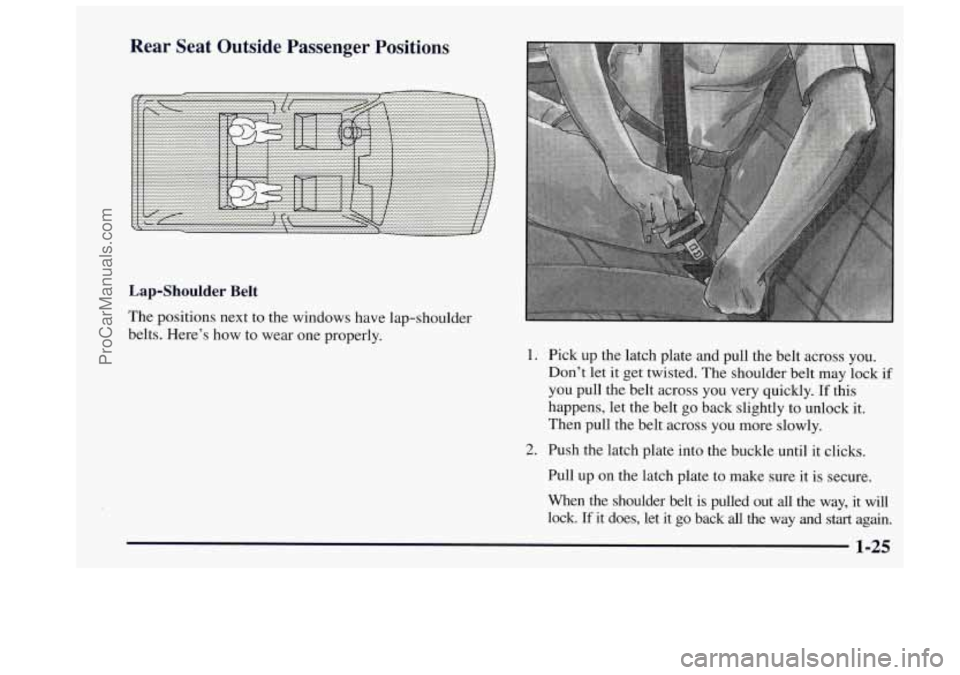
Rear Seat Outside Passenger Positions
Lap-Shoulder Belt
The positions next to the windows have lap-shoulder
belts. Here’s how to wear one properly.
1. Pick up the latch plate and pull the belt across you.
Don’t let it get twisted. The shoulder belt may lock if
you pull the belt across you very quickly. If this
happens, let the belt
go back slightly to unlock it.
Then pull the belt across you more slowly.
2. Push the latch plate into the buckle until it clicks.
Pull up on the latch plate to make sure it is secure.
When the shoulder belt is pulled out all the way,
it will
lock.
If it does, let it go back all the way and start again.
ProCarManuals.com
Page 49 of 358
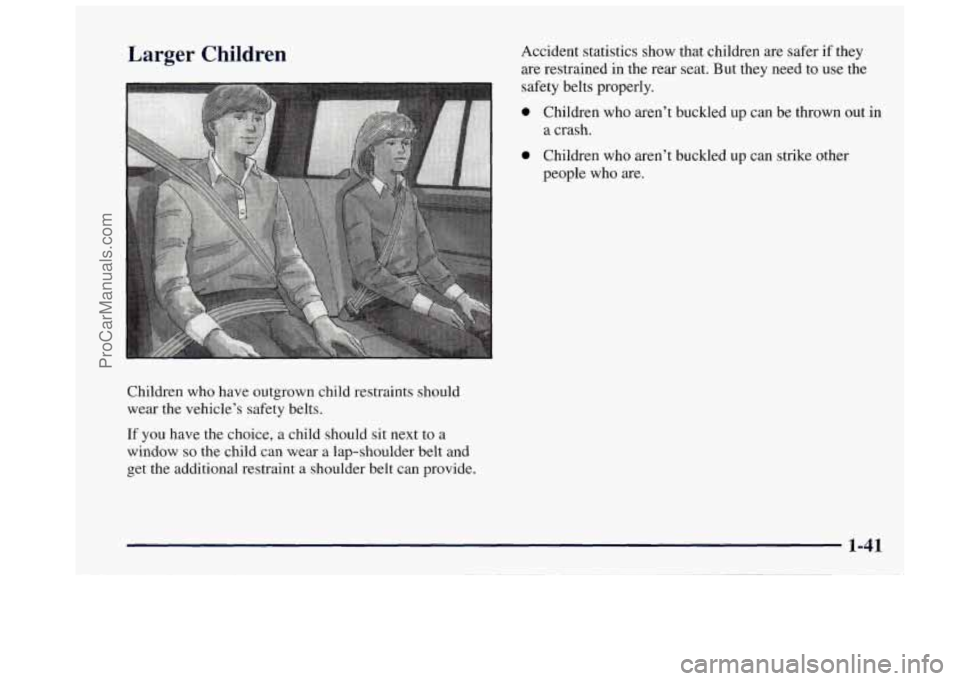
Larger Children Accident statistics show that children are safer if they
are restrained in the rear seat. But they need to use the
Children who have outgrown child restraints should
wear the vehicle’s safety belts.
If you have the choice, a child should sit next to a
window
so the child can wear a lap-shoulder belt and
get the additional restraint a shoulder belt can provide. safety
belts properly.
0 Children who aren’t buckled
a crash.
0 Children who aren’t buckled
people who
are.
up can be thrown out in
up can strike other
1-41
ProCarManuals.com
Page 55 of 358

a Section 2 Features and Controls
Here you can learn about the many standard and optional features on your Oldsnwbile, and information on starting,
shifting and braking. Also explained are the instrument panel and the warning systems that tell you
if everything is
working properly
-- and what to do if you have a problem.
2-2
2 -4
2-5
2-6
2-7
2-
IO
2-1 1
2- 12
2-13
2-
14
2-15
2-18
2-22
2-34 Important Information
About Keys
Door Locks
Operation of Child Security Locks
Remote Keyless Entry
Battery Replacement for RKE
Preventing
Theft of Your Vehicle
New Vehicle "Break-In"
Ignition Positions
Tips
on Starting Your Engine
Using the Engine Coolant Heater
Automatic Transmission Operation
Parking Brake Guidelines
Important Information
on Engine Exhaust
Operation of Your Windows 2-2s
2-25
2-26
2-27
2-28
2-3
1
2-32
2-33
2-34
2-35
2-48 2-52
Adjusting the Tilt Steering Wheel
Functions
of the Multifunction Lever
How
to Use the HighLow Beam
Headlamp Changer
Windshield Wipers and Fluid
Using Cruise Control
Exterior Lamps Daytime Running Lamps (DRL)
Rearview Mirrors
Storage Compartments
Instrument Panel Overview
All About Your Warning Lights and Gages
Interior
Lamps
ProCarManuals.com
Page 56 of 358

Keys
A CAUTION:
-
Leaving young children in a vehicle with the
ignition key
is dangerous for many reasons.
A child or others could be badly injured or
even killed.
They could operate power windows or other
controls or even make the vehicle move. Don't
leave the keys in a vehicle with young children.
2-2
ProCarManuals.com
Page 62 of 358

Resynchronization
Resynchronization may be necessary due to the security
method used by this system. The transmitter does not
send the same signal twice to the receiver. The receiver
will not respond to a signal
it has been sent previously.
This prevents anyone from recording and playing back
the signal from the transmitter.
To resynchronize your transmitter, stand close to your
vehicle and simultaneously press and hold the
LOCK
and UNLOCK buttons on the transmitter for not more
than five seconds. The door locks should cycle to
confirm synchronization.
If the locks do not cycle, see
your retailer for service.
Liftgate
It can be dangerous to drive with the rear
window or liftgate open because carbon
monoxide
(CO) gas can come into your vehicle.
You can’t see or smell CO. It can cause
unconsciousness and even death.
If you must drive with the rear window or liftgate
open or if electrical wiring or other cable
connections must pass through the seal between
the body and the rear window or liftgate:
0 Make sure all windows are shut.
0 Turn the fan on your heating or cooling
system to its highest speed with the setting
on
VENT. That will force outside air into
your vehicle. See “Comfort Controls” in
the Index.
instrument panel, open them
all the way.
0 If you have air outlets on or under the
See “Engine Exhaust” in the Index.
2-8
ProCarManuals.com
Page 65 of 358

Parking at Night
Park in a lighted spot, close all windows and lock your
vehicle. Remember to keep your valuables out
of sight.
Put them
in a storage area, or take them with you.
Parking Lots
If you park in a lot where someone will be watching
your vehicle, it’s best to lock
it up and take your keys.
But
what if you have to leave your ignition key? What if
you have to leave something valuable
in your vehicle?
Put your valuables in a storage area, like your
glove
box.
0 Lock all the doors except the driver’s.
New Vehicle “Break-In”
-
NOTICE:
-
Your modern Oldsmobile doesn’t need an
elaborate “break-in.’’ But it will perform better
in the long run if you follow these guidelines:
0
0
0
0
Keep your speed at 55 mph (88 kmk) or
less for the first
500 miles (805 km).
Don’t drive at any one speed
-- fast or
slow
-- for the first 500 miles (805 km).
Don’t make full-throttle starts. Avoid making hard stops for the first
200 miles (322 km) or so. During this time
your new brake linings aren’t yet broken
in. Hard stops with new linings can mean
premature wear and earlier replacement.
Follow this breaking-in guideline every
time you get new brake linings.
Don’t tow a trailer during break-in. See
“Towing a Trailer” in the Index for
more information.
2-11
ProCarManuals.com
Page 76 of 358

Parking Over Things That Burn Engine
Exhaust
Things that can burn could touch hot exha1
parts under your vehicle and ignite. Don't park
over papers, leaves, dry grass or other things that
can burn.
-1
Engine exhaust can kill. It contains the gas
carbon monoxide
(CO), which you can't see or
smell. It can cause unconsciousness and death.
You might have exhaust coming in if:
0
0
0
0
0
0
Your exhaust system sounds strange
or different.
Your vehicle gets rusty underneath.
Your vehicle was damaged in
a collision.
Your vehicle was damaged when driving
over high points on the road or over
road debris.
Repairs weren't done correctly.
Your vehicle or exhaust system had been
modified improperly.
If you ever suspect exhaust is coming into
your vehicle:
0 Drive it only with all the windows down to
0 Have your vehicle fixed immediately.
blow
out any
CO; and
2-22
ProCarManuals.com
Page 78 of 358
Windows
Power Windows
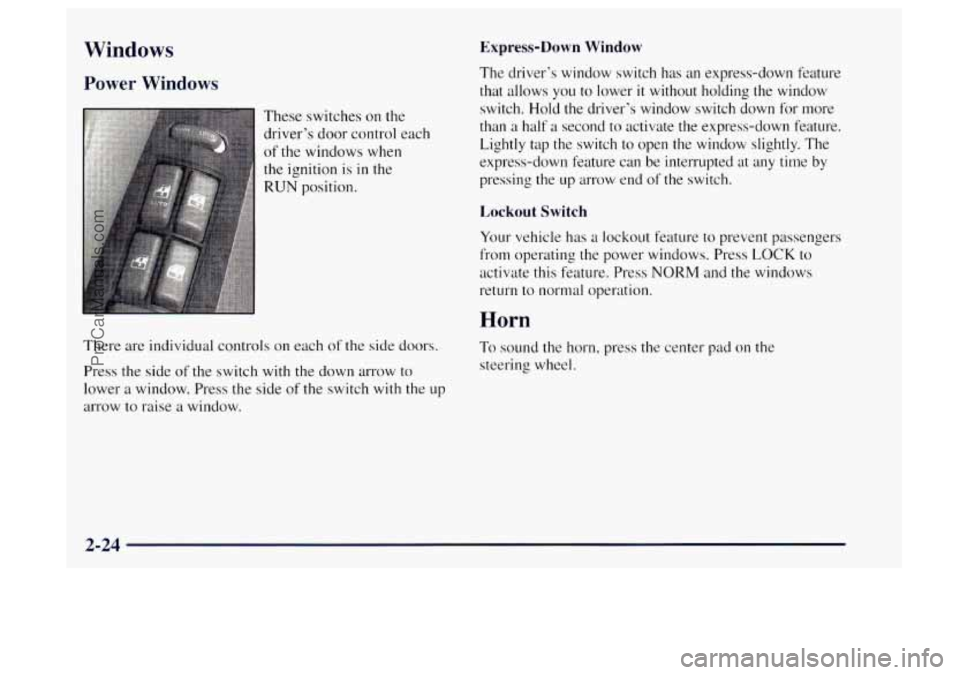
These switches on the
driver’s door control each
of the windows when
the ignition is in the
RUN position.
There are individual controls on each of the side doors.
Press the side of the switch with the down arrow to
lower a window. Press the side of the switch
with the up
arrow to raise a window.
Express-Down Window
The driver’s window switch has an express-down feature
that allows you to lower
it without holding the window
switch.
Hold the driver’s window switch down for more
than a half a second to activate the express-clown feature.
Lightly tap the switch to open the window slightly. The
express-down feature can be interrupted
at any time by
pressing the up arrow end of the switch.
Lockout Switch
Your vehicle has a lockout feature to prevent passengers
from operating the power windows. Press LOCK to
activate this feature. Press
NORM and the windows
return to normal operation.
Horn
To sound the horn, press the center pad on the
steering wheel.
2-24
ProCarManuals.com