brake OLDSMOBILE BRAVADA 1998 Workshop Manual
[x] Cancel search | Manufacturer: OLDSMOBILE, Model Year: 1998, Model line: BRAVADA, Model: OLDSMOBILE BRAVADA 1998Pages: 380, PDF Size: 19.2 MB
Page 260 of 380

Checking Transmission Fluid Cold
A cold check is made after the vehicle has been sitting
for eight hours or more
with the engine off and is used
only as a reference. Let the engine run at idle for five
minutes
if outside temperatures are 50°F (10°C) or
more. If it's colder than
50°F (lO"C), you may have to
idle the engine longer. Should the fluid level be low
during
a cold check, you must perform a hot check
before adding fluid. This will give you a more accurate
reading of the fluid level.
Checking the Fluid Hot or Cold
Park your vehicle on a level place. Keep the
engine running.
With the parking brake applied, place the shift lever
in
PARK (P).
With your foot on the brake pedal, move the shift
lever through each gear range, pausing for about
three seconds
in each range. Then, position the shift
lever in PARK (P).
0 Let the engine run at idle for three minutes or more. Then,
without shutting off the engine, follow
these steps:
I. Flip the handle up
and then pull out
the dipstick and
wipe it
with a clean
rag or paper towel.
2. Push it back in all the way, wait three seconds and
then
pull it back out again.
6-18
ProCarManuals.com
Page 271 of 380

Brakes
Brake Fluid
of the brake system. If it is, you should have yo~~r brake
system tlxed, since
a leak nleans that sooner or later your
brakes won't work well, or won't work at
all.
So. it isn't a good idea to "top oft'' your brake fluid.
Adding brake fluid won't correct
a leak. If you add fluid
when your linings are worn, then you'll have too much
fluid when you get new brake linings. You should add
(or remove) brake fluid, as necessary, only when work is
done on the brake hydraulic system.
Your brake master cylinder reservoir is here.
It is filled
with DOT-3 brake fluid.
There are only two reasons
why the brake fluid level in the
reservoir might go down. The first is that the brake fluid
goes down to an acceptable level during norlnal brake
lining weal-. When new linings are
put in, the fluid level
goes back up. The other reason is that fluid is leaking out
If you have too much brake fluid, it can spill on
the engine. The fluid
will burn if the engine is
hot enough. You or others could be burned,
and your vehicle could be damaged. Add brake
fluid only when work
is done on the brake
hydraulic system.
Refer to the Maintenance Schedule to determine when to
check your brake fluid. See "Periodic Maintenance
Inspections"
in the Index.
6-29
ProCarManuals.com
Page 272 of 380
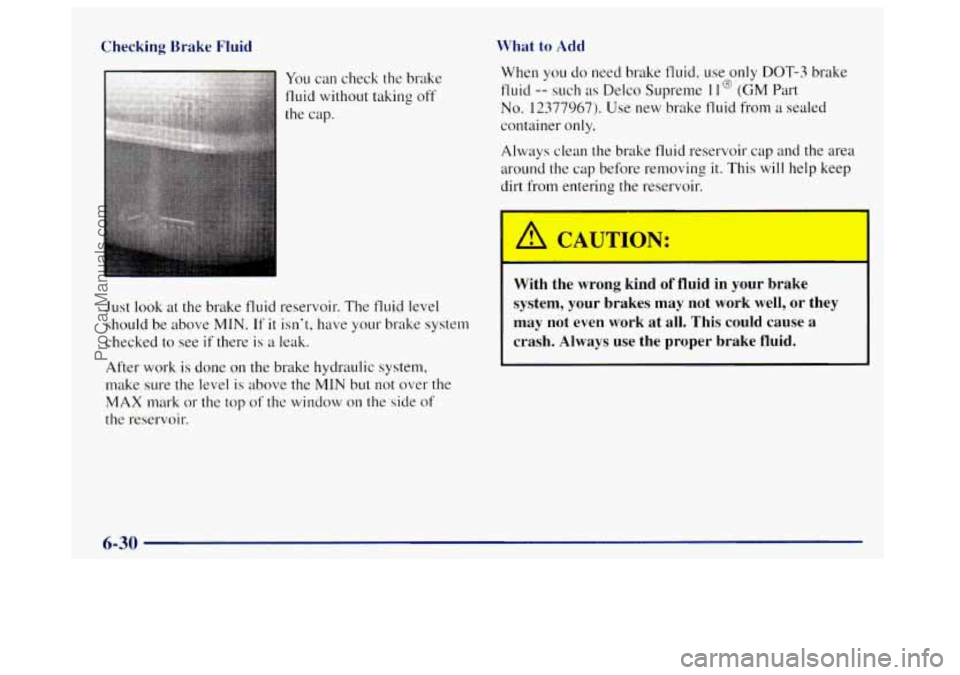
Checking Brake Fluid
Just look at the brake fluid reservoir. The fluid level
should be above
MIN. If it isn't, have your brake system
checked to see
if there is a leak.
After work
is done on the brake hydraulic system,
make sure the level is above the
MIN but not over the
MAX mark or the top of the window on the side of
the reservoir.
What to Add
When you do need brake fluid, use only DOT-3 brake
fluid
-- such as Delco Supreme 1 I@ (GM Part
No. 12377967). Use new brake fluid from a sealed
container only.
Always clean the brake fluid reservoir cap and the area
around the cap before removing
it. This will help keep
dirt from entering the reservoir.
With the wrong kind of fluid in your brake
system, your brakes may not work well, or they
may not even work at all. This could cause a
crash. Always use the proper brake fluid.
6-30
ProCarManuals.com
Page 273 of 380

NOTICE:
0
0
Using the wrong fluid can badly damage
brake system parts. For example, just a few
drops of mineral-based oil, such as engine
oil, in your brake system can damage brake
system parts
so badly that they’ll have to be
replaced. Don’t let someone put in the
wrong kind of fluid.
If you spill brake fluid on your vehicle’s
painted surfaces, the paint finish can be
damaged. Be careful not to spill brake fluid on your vehicle. If you do, wash it off
immediately. See “Appearance Care” in
the Index.
Brake Wear
Your vehicle has four-wheel disc brakes.
Disc brake
pads have built-in wear indicators that make a
high-pitched warning sound when the brake pads are worn
and new pads are needed. The sound may come and go or
be heard
all the time your vehicle is moving (except when
you are pushing
on the brake pedal firmly).
The brake wear warning sound means that soon
your brakes won’t work well. That could lead to
an accident. When you hear the brake wear
warning sound, have your vehicle serviced.
1
1 NOTICE:
Continuing to drive with worn-out brake pads
could result in costly brake repair.
ProCarManuals.com
Page 274 of 380

Some driving conditions or climates may cause a brake
squeal when the brakes are first applied or lightly
applied. This does not mean something is wrong with
your bra
cz k es.
Properly torqued wheel nuts are necessary to help
prevent brake pulsation. When tires are rotated, inspect
brake pads for wear and evenly torque wheel nuts
in the
proper sequence to
GM specifications.
Brake linings should always be replaced as complete
axle sets.
See “Brake System Inspection” in Section
7 of this
manual under Part
C “Periodic Maintenance
Inspections.’’
.e Pedal Travel
See your retailer if the brake pedal does not return to
normal height, or
if there is a rapid increase in pedal
travel. This could be a sign
of brake trouble.
Brake Adjustment
Every time you make a brake stop, your disc brakes
adjust for wear.
Replacing Brake System Parts
The braking system on a modern vehicle is complex.
Its many parts have to be
of top quality and work well
together
if the vehicle is to have really good braking.
Your vehicle was designed and tested
with top-quality
GM brake parts. When you replace parts of your braking
system
-- for example, when your brake linings wear
down and you have to have new ones put in
-- be sure
you get new approved
GM replacement parts. If you
don’t, your brakes may no longer work properly. For
example, if someone puts in brake linings that are wrong
for your vehicle, the balance between your front and
rear brakes can change
-- for the worse. The braking
performance you’ve come
to expect can change in many
other ways
if someone puts in the wrong replacement
brake parts.
Battery
Every new vehicle has a Delco Freedom@ battery. You
never have to add water to one of these. When it’s time
for
a new battery, we recommend a Delco Freedom
battery. Get one that has the replacement number shown
on the original battery’s label.
6-32
ProCarManuals.com
Page 286 of 380
NOTICE:
The wrong wheel can also cause problems with
bearing life, brake cooling, speedometer or
odometer calibration, headlamp aim, bumper
height, vehicle ground clearance and tire
clearance to the body and chassis.
See “Changing a Flat Tire” in the Index for
more information.
Used Replacement Wheels
/1 MI CP ““‘3N:
Putting a used wheel on your vehicle is
dangerous. You can’t know how it’s been used or
hotv
far it’s been driven. It could fail suddenly
and cause an accident.
If you have to replace a
wheel, use a new GM original equipment wheel.
Tire Chains
NOTICE:
______
Don’t use tire chains. They can damage your
vehicle because there’s not enough clearance.
Use another type of traction device only if its
manufacturer recommends it for use on your
vehicle and tire size combination and road
conditions. Follow that manufacturer’s
instructions. To help avoid damage to your
vehicle, drive slowly, readjust or remove the
device
if it’s contacting your vehicle, and don’t
spin your wheels.
Appearance Care
Remember, cleaning products can be hazardous. Some
are toxic. Others can burst into flame
if you strike a
match or get them on a hot part of the vehicle. Some are
dangerous if you breathe their fumes in a closed space.
When you use anything from a container to clean your
vehicle, be sure to follow the manufacturer’s warnings
and instructions. And always open your doors or
windows when you’re cleaning the inside.
ProCarManuals.com
Page 299 of 380

FuseKircuit Breaker
13
14
15
16
17
18
19
20
21
22
23
24
Usage Engine Compartment Fuse Block
Auxiliary Power
Power Locks Motor
4WD Switch, Engine Controls
(VCM, PCM, Transmission)
Supplemental Inflatable Restraint,
SDM Module
Front Wiper
Not Used
Radio Battery
Not Used
HVAC (Manual), HVAC
I
(Automatic), HVAC Sensors
(Automatic)
Anti-Lock Brakes
Rear Wiper
Radio, Ignition The fuse
block is under the hood at the driver’s side of
the engine compartment.
Remove the cover
by turning the fastener to the left. To
reinstall the fuse panel cover, push in and turn the
fastener to the right.
ProCarManuals.com
Page 300 of 380

FUSE
PULLER
DL 1T
STARTER
FlPUMP
PRINTED IN USA
I Name
TRL TRN
TRR TRN
TRL BTU
VEH
B/U
RT TURN
Usage
Trailer Left Turn
Trailer Right Turn
Trailer Back-up Lamps
Vehicle Back-up Lamps
Right Turn Signal Front
4
1
1
1
Name
LT TURN
LT TRN
RT TRN
RR PRK
TRL PRK
LT HDLP
RT HDLP
FR PRK INT BAT
ENG
1
ECM B
ABS ECM
1
HORN
BTSI
Usage
Left Turn Signal Front
Left Turn Signal Rear
Right Turn Signal Rear Right Rear Parking Lamps
Trailer Parking Lamps Left Headlamp
Right Headlamp
Front Parking Lamps
I/P Fuse Block Feed
Engine Sensors/Solenoids, MAP,
CAM, PURGE, VENT
Engine Control Module, Fuel
Pump, Module, Oil Pressure
Anti-Lock Brake System
Engine Control Module Injectors
Horn
Brake-Transmission Shift
Interlock
6-58
ProCarManuals.com
Page 301 of 380
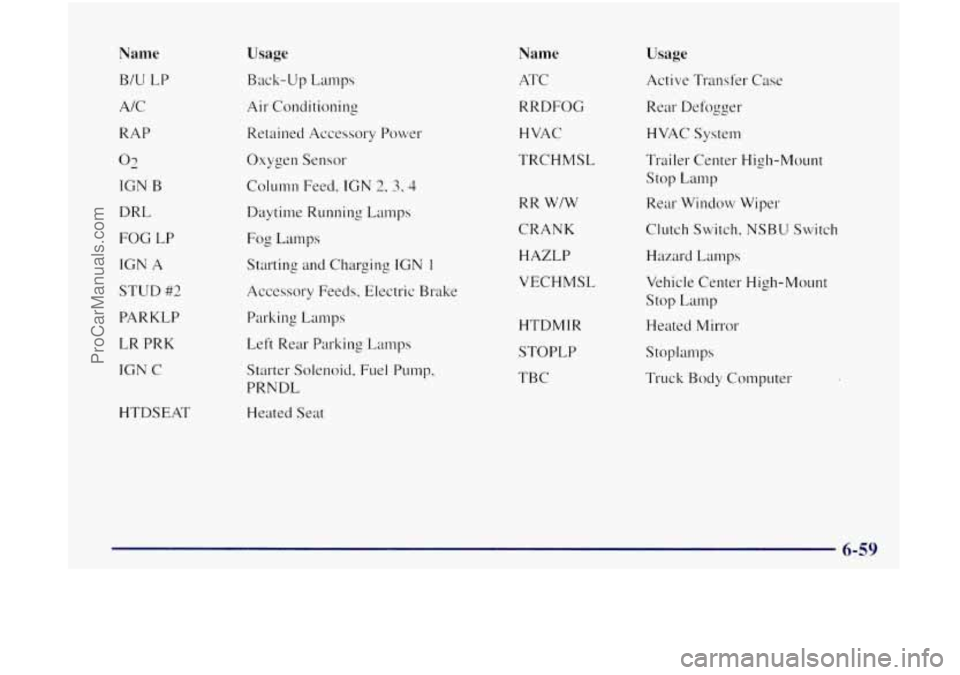
Name
BIU LP
AIC
RAP
02
IGN B
DRL
FOG LP
IGN
A
STUD #2
PARKLP
LR PRK
IGN C
HTDSEAT
Usage
Back-up Lamps
Air Conditioning
Retained Accessory Power
Oxygen Sensor
Column Feed,
IGN 2, 3, 4
Daytime Running Lamps
Fog Lamps
Starting and Charging
IGN 1
Accessory Feeds, Electric Brake
Parking Lamps
Left Rear Parking Lamps
Starter Solenoid. Fuel PLIIIIP,
PRNDL
Heated Seat
Name
ATC
RRDFOG
HVAC
TRCHMSL
RR WIW
CRANK HAZLP
VECHMSL
HTDMTR
STOPLP
TBC
Usage
Active Transfer Case
Rear Defogger HVAC System
Trailer Center High-Mount
stop Lamp
Rear Window Wiper
Clutch Switch, NSBU Switch
Hazard Lamps
Vehicle Center High-Mount
Stop Lamp
Heated Mirror
Stoplan1ps
Truck Body Computer
ProCarManuals.com
Page 311 of 380

Short Trip/City Maintenance Schedule
The services shown in this schedule up to 100,000 miles
(166 000 km) should be performed after 100,000 miles
(1 66 000 km) at the same intervals. The services shown
at 150,000 miles
(240 000 km) should be performed at
the same interval after 150,000 miles
(240 000 km).
See ”Owner Checks and Services” and “Periodic
Maintenance Inspections‘‘ following.
Footnotes
-i- The U.S. Environmental Protection Agency or the
California Air Resources Board has determined that the
failure to perform this maintenance item
will not nullify
the emission warranty or limit recall liability prior to the
completion
of the vehicle’s useful life. We, however,
urge that all recommended maintenance services be
performed at the indicated intervals and the maintenance
be recorded.
## Lubricate the front suspension, ball joints, steering
linkage, parking brake cable guides, propshaft splines,
universal joints and brake pedal springs.
+ A good time to check your brakes is during tire
rotation. See ;‘Brake System Inspection” under “Periodic
Maintenance Inspections”
in Part C of this schedule.
4:‘i: Drive axle service (see “Recommended Fluids and
Lubricants”
in the Index for proper lubricant to use):
Drain and refill at first oil change. At subsequent oil
changes, check fluid level and add fluid as needed.
If
driving in dusty areas or towing a trailer, drain fluid
and refill every 15,000 miles
(25 000 km).
More frequent lubrication may be required for
off-paved-road use.
7-7
ProCarManuals.com