child seat Oldsmobile Bravada 2003 s User Guide
[x] Cancel search | Manufacturer: OLDSMOBILE, Model Year: 2003, Model line: Bravada, Model: Oldsmobile Bravada 2003Pages: 410, PDF Size: 20.1 MB
Page 44 of 410
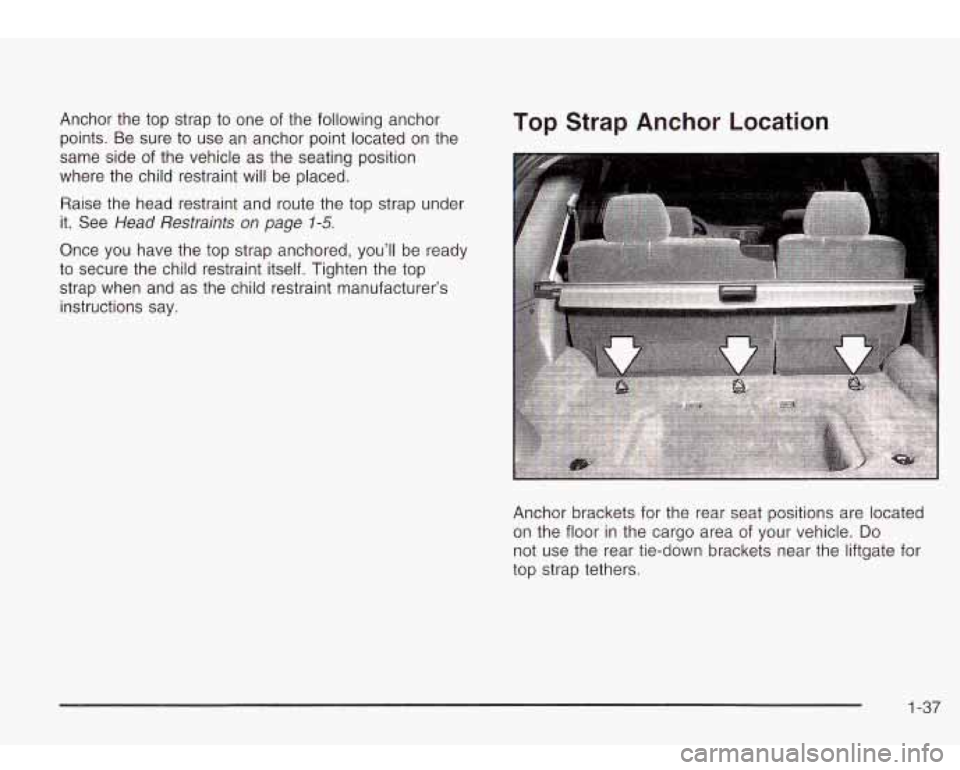
Anchor the top strap to one of the following anchor
points. Be sure
to use an anchor point located on the
same side of the vehicle
as the seating position
where the child restraint will be placed.
Raise the head restraint and route the top strap under
it. See
Head Restraints on page 1-5.
Top Strap Anchor Location
Once you have the top strap anchored, you’ll be ready
to secure the child restraint itself. Tighten the top
strap when and as the child restraint manufacturer’s
instructions say.
Anchor brackets for the rear seat positions are located
on the
floor in the cargo area of your vehicle. Do
not use the rear tie-down brackets near the liftgate for
top strap tethers.
1-37
Page 45 of 410
Lower Anchorages and Top Tethers
for Children (LATCH System)
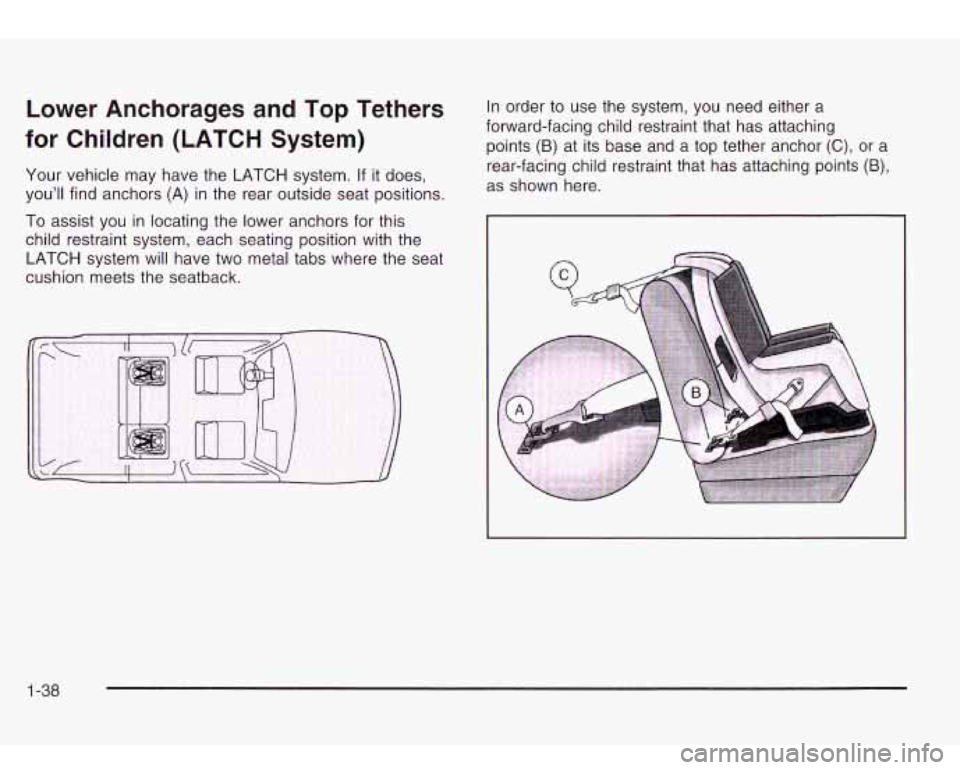
Your vehicle may have the LATCH system. If it does,
you’ll find anchors (A)
in the rear outside seat positions.
To assist you in locating the lower anchors for this
child restraint system, each seating position with the
LATCH system will have two metal tabs where the seat
cushion meets the seatback. In
order to use the system, you need either a
forward-facing child restraint that has attaching
points
(B) at its base and a top tether anchor (C), or a
rear-facing child restraint that has attaching points
(B),
as shown here.
1-38
Page 46 of 410
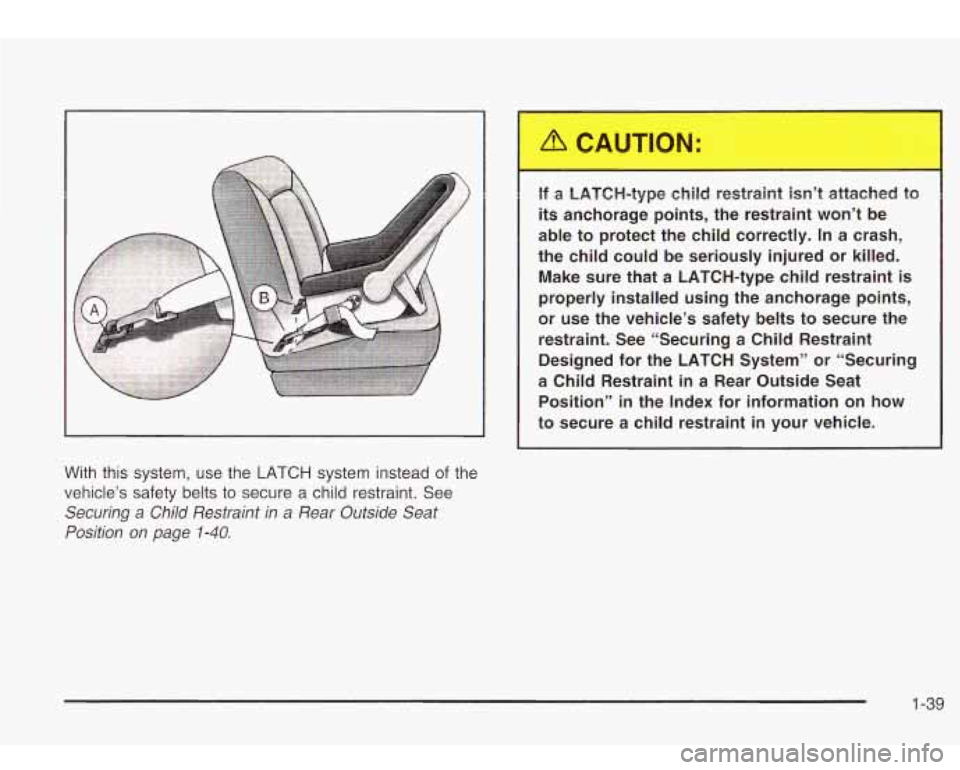
With this system, use the LATCH system instead of the
vehicle’s safety belts to secure a child restraint. See
Securing a Child Restraint in a Rear Outside Seat
Position on page
1-40.
If a LATCH-type child restraint isn’t attached to
its anchorage points, the restraint won’t be
able
to protect the child correctly. In a crash,
the child could be seriously injured or killed.
Make sure that
a LATCH-type child restraint is
properly installed using the anchorage points,
or use the vehicle’s safety belts to secure the restraint. See “Securing a Child Restraint
Designed for the LATCH System’’ or “Securing
a Child Restraint in a Rear Outside Seat
Position” in the Index for information on how
to secure a child restraint in your vehicle.
1-39
Page 47 of 410
Securing a Child Restraint Designed
for the LATCH System
1. Find the anchors for the seating position you want
to use, where the bottom of the seatback meets the
back
of the seat cushion.
2. Put the child restraint on the seat.
3. Attach the anchor points on the child restraint to the
anchors in the vehicle. The child restraint
instructions will show you how.
4. If the child restraint is forward-facing, attach the top
strap to the top strap anchor. See
Top Strap on
page
1-36. Tighten the top strap according to
the child restraint instructions.
directions to be sure it is secure.
5. Push and pull the child restraint in different
To remove the child restraint, simply unhook the top strap from the top tether anchor and then disconnect the
anchor points.
Securing a Child Restraint in a Rear
Outside Seat Position
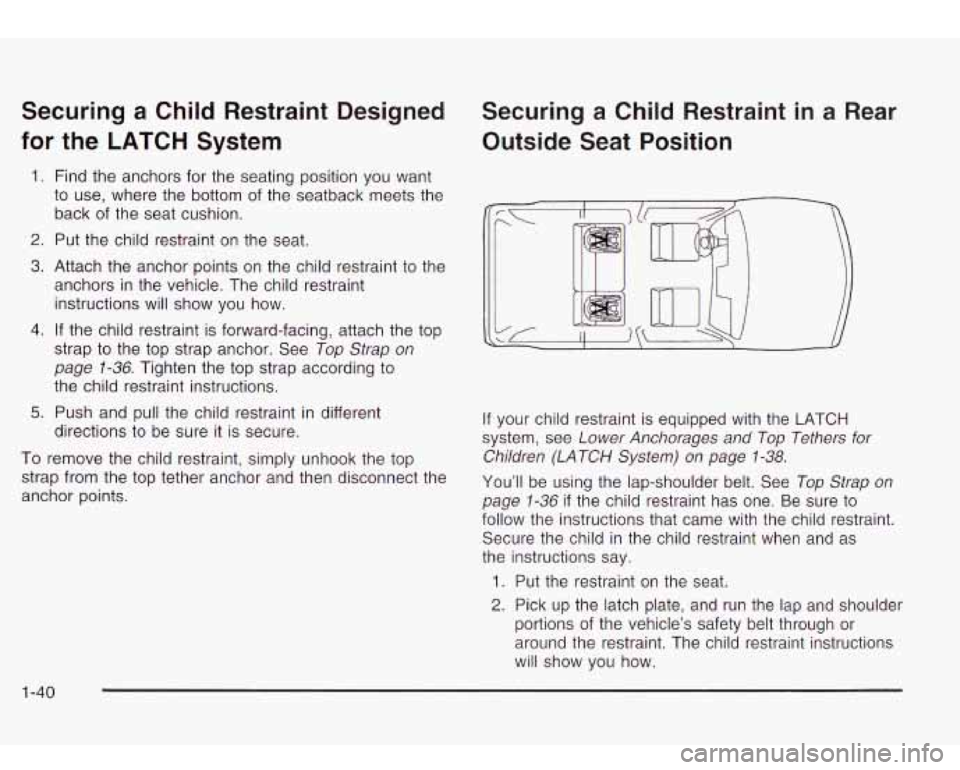
If your child restraint is equipped with the LATCH
system, see
Lower Anchorages and Top Tethers for
Children (LATCH System)
on page 1-38.
You’ll be using the lap-shoulder belt. See Top Strap on
page
1-36 if the child restraint has one. Be sure to
follow the instructions that came with the child restraint.
Secure the child in the child restraint when and as
the instructions say.
1. Put the restraint on the seat.
2. Pick up the latch plate, and run the lap and shoulder
portions of the vehicle’s safety belt through or
around the restraint. The child restraint instructions
will show you how.
1-40
Page 49 of 410
1
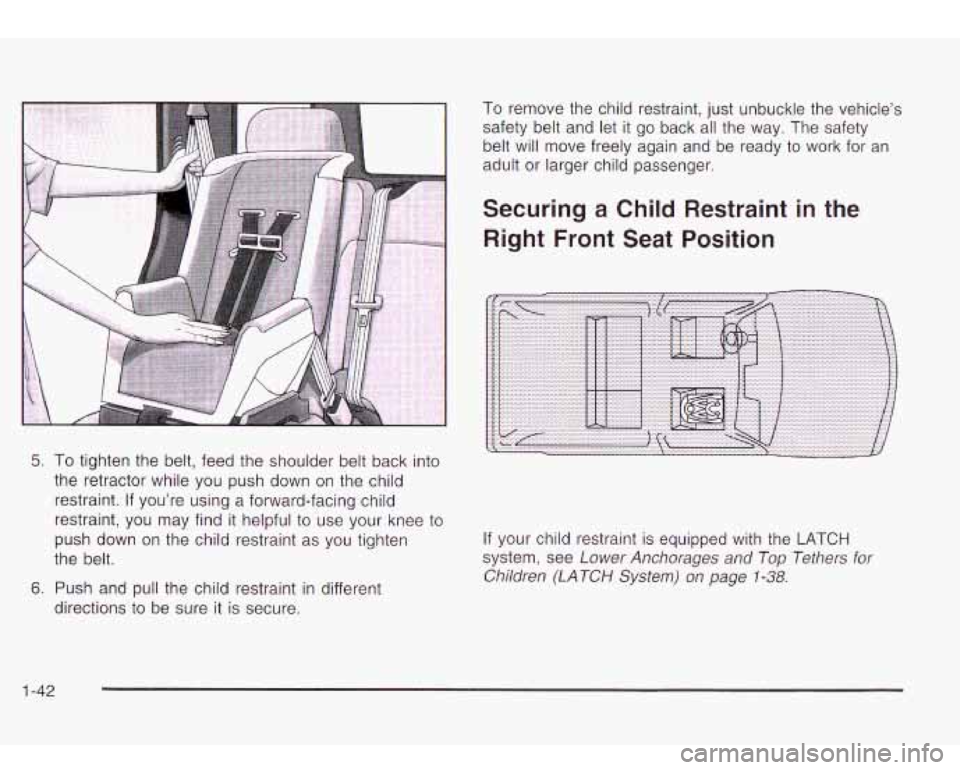
5. To tighten the belt, feed the shoulder belt back into
the retractor while you push down on the child
restraint.
If you’re using a forward-facing child
restraint, you may find it helpful
to use your knee to
push down on the child restraint as you tighten
the belt.
6. Push and pull the child restraint in different
directions
to be sure it is secure. To remove the child
restraint, just unbuckle the vehicle’s
safety belt and let it go back
all the way. The safety
belt will move freely again and be ready
to work for an
adult or larger child passenger.
Securing a Child Restraint in the
Right Front Seat Position
If your child restraint is equipped with the LATCH
system, see Lower Anchorages and Top Tethers for
Children (LATCH System) on page 1-38.
1 -42
Page 50 of 410
Your vehicle has a right front passenger air bag. Never
put a rear facing child restraint in this seat. Here's whl-
A child in a rear-facing child restraint can be
seriously injured or killed
if the right front
passenger's air bag inflates. This is because
the back of the rear-facing child restraint
would be very close to the inflating air bag.
Always secure a rear-facing child restraint in a
rear seat.
Although a rear seat is a safer place, you can secure a
forward-facing child restraint in the right front seat.
You'll be using the lap-shoulder belt. See
Top Strap on
page 7-36 if the child restraint has one. Be sure to
follow the instructions that came with the child restraint.
Secure the child in the child restraint when and as
the instructions say.
1. Because your vehicle has a right front passenger's
air bag, always move the seat as far back as it will
go before securing a forward-facing child restraint.
See
Power Seats on page 7-2.
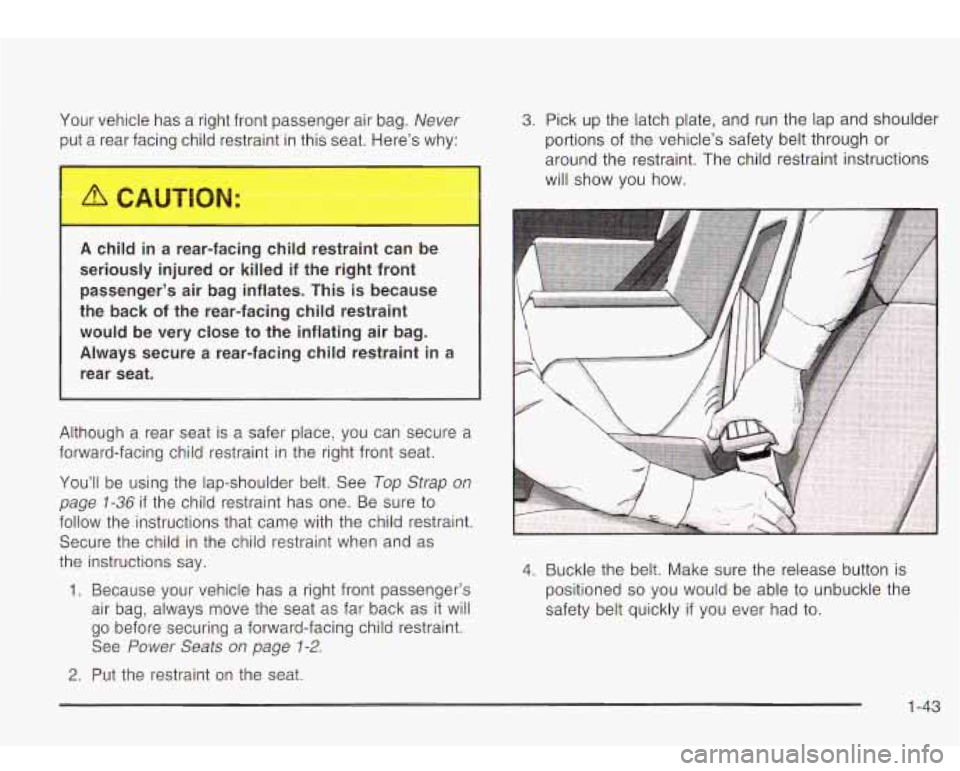
3. Pick up the latch plate, and run the lap and shoulder
portions of the vehicle's safety belt through
or
around the restraint. The child restraint instructions
will show you how.
4. Buckle the belt. Make sure the release button is
positioned
so you would be able to unbuckle the
safety belt quickly
if you ever had to.
2. Put the restraint on the seat.
1-43
Page 52 of 410
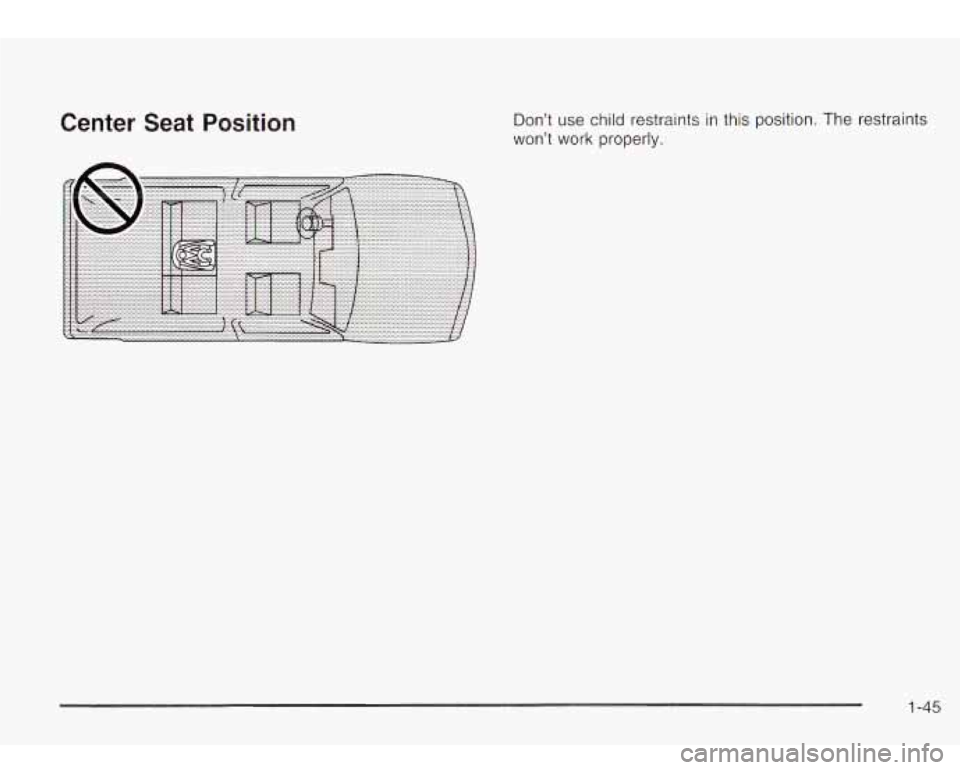
Center Seat Position Don’t use child restraints in this position. The restraints
won’t work properly.
1-45
Page 248 of 410
Don’t leave an unsecured child resL,int in
your vehicle.
When you carry something inside the
vehicle, secure it whenever you
can.
Don’t leave a seat folded down unless you
need to.
There’s also important loading information for off-road
driving in this manual.
Electronically Controlled Air
Suspension System
Your vehicle may be equipped with an electronically
controlled air suspension system that automatically
keeps your vehicle level as you load and unload. The
system includes a compressor, two height sensors
and two air springs supporting the rear axle. The system also has an internal clock to prevent
overheating.
If the system overheats, all leveling function
stops until the system cools down. During this time, the
indicator light on the air inflator system will be flashing.
The ignition has
to be on for the system to inflate, in
order
to raise the vehicle to the standard ride height after
loading. The system can lower the vehicle
to the
standard ride height after unloading with the ignition on
and also for up
to 30 minutes after the ignition has
been turned
off.
You may hear the compressor operating when you load
your vehicle, and periodically as the system adjusts
the vehicle
to the standard ride height.
Load leveling will not function normally with the inflator
hose attached
to the inflator outlet. Remove the
inflator hose from the outlet during loading and
unloading.
If the vehicle is parked for an extended period of time,
some bleed down of the suspension is normal. Upon
starting the vehicle, proper height will be achieved.
4-43
Page 389 of 410
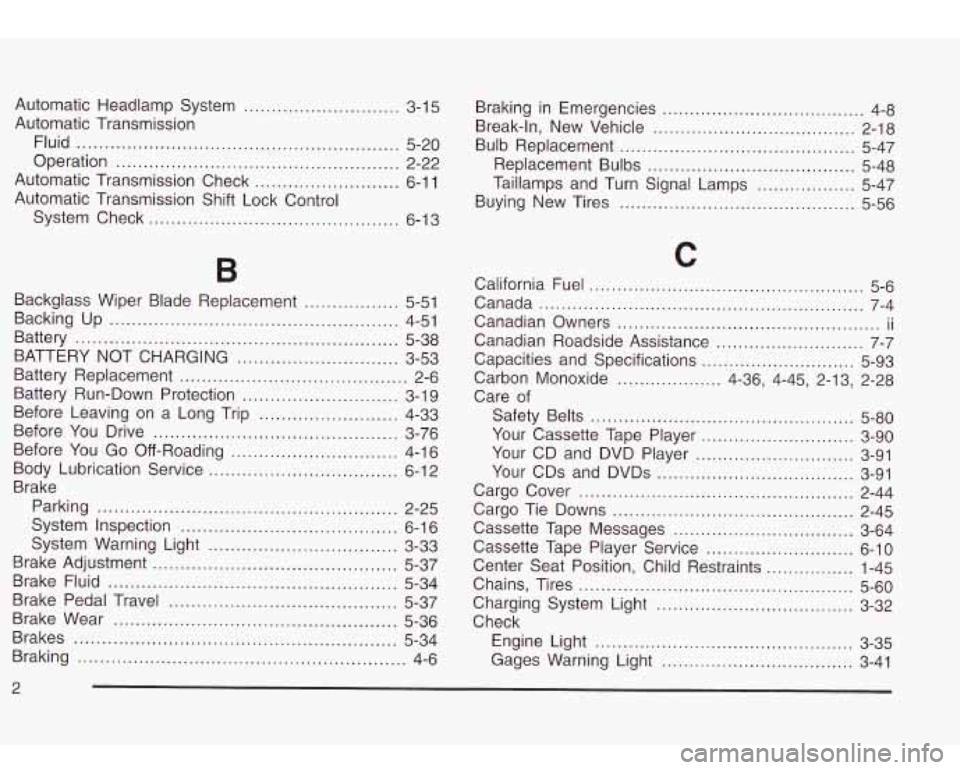
Automatic Headlamp System ............................ 3-1 5
Automatic Transmission
Fluid
.......................................................... 5-20
Operation
................................................... 2-22
Automatic Transmission Check
.......................... 6-1 1
Automatic Transmission Shift Lock Control
System Check
....................................... ... 6-13
Backglass Wiper Blade Replacement
................. 5-51
Battery
.......................................................... 5-38
Battery Replacement
......................................... 2-6
Battery Run-Down Protection
............................ 3-1 9
Before Leaving on a Long Trip
......................... 4-33
Before You Drive
............................................ 3-76
Before You Go Off-Roading
.............................. 4-16
Body Lubrication Service
.................................. 6-12
Brake
Parking
...................................................... 2-25
System Inspection
....................................... 6-1 6
System Warning Light
.................................. 3-33
Brake Adjustment
............................................ 5-37
Brake Fluid
.................................................... 5-34
Brake Pedal Travel
..................................... 5-37
Brake Wear
............................................... 5-36
Brakes
.......................................................... 5-34
Braking
........................................................... 4-6
Backing
Up
.................................................... 4-51
BATTERY NOT CHARGING
............................. 3-53 Braking
in Emergencies
..................................... 4-8
Break.ln. New Vehicle
..................................... 2-18
Bulb Replacement
........................................... 5-47
Replacement Bulbs
...................................... 5-48
Buying New Tires
........................................... 5-56
Taillamps
and Turn Signal Lamps
.................. 5-47
C
California Fuel .................................................. 5-6
Canada
........................................................... 7-4
Canadian Owners
................................................ ii
Canadian Roadside Assistance ........................... 7-7
Capacities and Specifications
............................ 5-93
Care of
Carbon Monoxide
................... 4-36,
4-45, 2-13, 2-28
Safety Belts
................................................ 5-80
Your Cassette Tape Player
............................ 3-90
Your CD and DVD Player
............................. 3-91
Your CDs and DVDs
.................................... 3-91
Cargo Cover
.................................................. 2-44
Cargo Tie Downs
............................................ 2-45
Cassette Tape Messages
................................. 3-64
Cassette Tape Player Service
........................... 6-10
Center Seat Position, Child Restraints
................ 1-45
Chains, Tires
.............................................. 5-60
Charging System Light
................................ 3-32
Check
Engine Light
........................................... 3-35
Gages Warning Light
................................... 3-41
2
Page 390 of 410
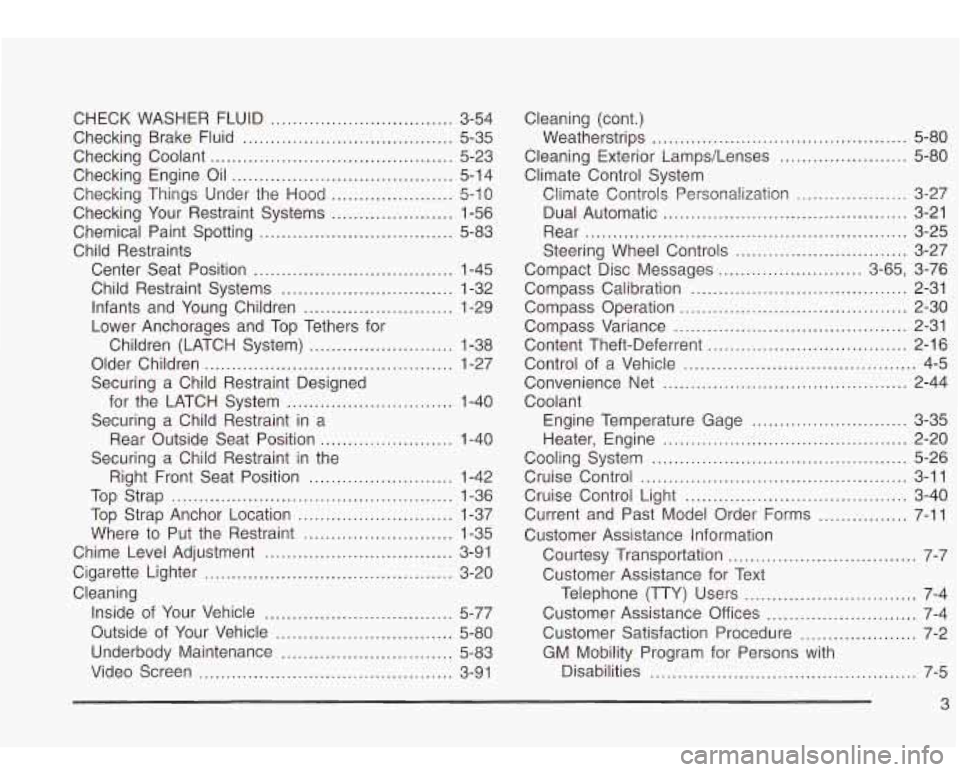
CHECK WASHER FLUID ............. ......... 3-54
Checking Brake Fluid
................................... 5-35
Checking Coolant
......................................... 5-23
Checking Engine Oil
........................................ 5-14
Checking Things Under the Hood
...................... 5-10
Checking Your Restraint Systems
...................... 1-56
Chemical Paint Spotting
................................... 5-83
Child Restraints Center Seat Position
.................................... 1-45
Child Restraint Systems
... .................... 1-32
Infants and Young Children
........................... 1-29
Lower Anchorages and Top Tethers for
Children (LATCH System)
.............. ..... 1-38
Older Children
.................................... . 1-27
Securing a Child Restraint Designed for the LATCH System
.............................. 1-40
Securing a Child Restraint in a
Rear Outside Seat Position
........................ 1-40
Securing a Child Restraint in the
Right Front Seat Position
.......................... 1-42
Top Strap
................................................... 1-36
Top Strap Anchor Location
............................ 1-37
Where to Put the Restraint
........................... 1-35
Chime Level Adjustment
.................................. 3-91
Cigarette Lighter
............................................. 3-20
Cleaning Inside of Your Vehicle
.................................. 5-77
Outside of Your Vehicle
................................ 5-80
Underbody Maintenance
............................... 5-83
Video Screen
.............................................. 3-91 Cleaning
(cont.)
Weatherstrips
.............................................. 5-80
Cleaning Exterior Lamps/Lenses
....................... 5-80
Climate Controls Personalization
.................... 3-27
Dual Automatic
............................................ 3-21
Rear
.......................................................... 3-25
Steering Wheel Controls
............................... 3-27
Compact Disc Messages
.......................... 3-65, 3-76
Compass Calibration
.......... ..................... 2-31
Compass Operation
..................................... 2-30
Compass Variance
.......................................... 2-31
Content Theft-Deferrent
.................................... 2-16
Control of
a Vehicle ....................................... 4-5
Convenience Net
.................................. .. 2-44
Coolant Engine Temperature Gage
............................ 3-35
Climate Control System
Heater, Engine
............................................ 2-20
Cooling System
.............................................. 5-26
Cruise Control
................................................ 3-11
Cruise Control Light
........................................ 3-40
Current and Past Model Order Forms
................ 7-11
Customer Assistance Information Courtesy Transportation
...................... 7-7
Customer Assistance for Text
Telephone (TTY) Users
............................... 7-4
Customer Assistance Offices
........................... 7-4
Customer Satisfaction Procedure
..................... 7-2
GM Mobility Program for Persons with
Disabilities
................................................ 7-5
3