oil level Oldsmobile Bravada 2003 s User Guide
[x] Cancel search | Manufacturer: OLDSMOBILE, Model Year: 2003, Model line: Bravada, Model: Oldsmobile Bravada 2003Pages: 410, PDF Size: 20.1 MB
Page 279 of 410
Automatic Transmission Fluid
When to Check and Change
A good time to check your automatic transmission fluid
level is when the engine oil is changed.
Change both the fluid and filter every
50,000 miles
(83
000 km) if the vehicle is mainly driven under one or
more of these conditions:
In heavy city traffic where the outside temperature
9 In hilly or mountainous terrain.
0 When doing frequent trailer towing.
regularly
reaches
90°F (32°C) or higher.
Uses such as found in taxi, police or delivery
If you do not use your vehicle under any of these
conditions, change the fluid and filter every
100,000 miles (1 66 000 km).
service.
How to Check
Because this operation can
be a little difficult, you may
choose
to have this done at the dealership service
department.
If you do it yourself, be sure to follow all the instructions
here, or you could get a false reading on the dipstick.
Notice: Too much or too little fluid can damage
your transmission.
Too much can mean that some
of the fluid could come out and fall on hot engine
part or exhaust system parts, starting
a fire.
Too little fluid could cause the transmission to
overheat.
Be sure to get an accurate reading if you
check your transmission fluid.
Wait at least 30 minutes before checking the
transmission fluid level
if you have been driving:
When outside temperatures are above
90°F (32°C).
At high speed for quite a while.
In heavy traffic-especially in hot weather
While pulling a trailer.
To get the right reading, the fluid should be at normal
operating temperature, which is 180°F
to 200°F
(82°C to 93°C).
5-20
Page 281 of 410
How to Add Fluid
Refer to the Maintenance Schedule to determine what
kind of transmission fluid
to use. See Part D:
Recommended Fluids and Lubricants on page 6- 17.
Add fluid only after checking the transmission fluid while
it is hot.
(A cold check is used only as a reference.) If
the fluid level is low, add only enough of the proper fluid
to bring the level up
to the HOT area for a hot check.
It doesn’t take much fluid, generally less than one
pint (0.5 L).
Don’t overfill.
Notice: We recommend you use only fluid labeled
DEXRON@
-111, because fluid with that label is
made especially for your automatic transmission.
Damage caused by fluid other than DEXRON@
-111 is
not covered by your new vehicle warranty.
After adding fluid, recheck the fluid level as
described under “How
to Check”.
When the correct fluid level is obtained, push the
dipstick back
in all the way; then flip the handle
down
to lock the dipstick in place.
Engine Coolant
The cooling system in your vehicle is filled with
DEX-COOL@ engine coolant. This coolant is designed
to remain in your vehicle for 5 years or 150,000 miles
(240 000 km), whichever occurs first, if you add
only DEX-COOL@ extended life coolant. The following explains
your cooling system and how
to
add coolant when it is low. If you have a problem
with engine overheating, see
Engine Overheating on
page 5-24.
A 50/50 mixture of clean, drinkable water and
DEX-COOL@ coolant will:
Give freezing protection down to -34°F (-37°C).
Give boiling protection up to 265°F (129°C).
Protect against rust and corrosion.
Help keep the proper engine temperature.
Let the warning lights and gages work as they
should.
Notice: When adding coolant, it is important that
you use only
DEX-COOL@ (silicate-free) coolant.
If coolant other than DEX-COOL@ is added to
the system, premature engine, heater core or
radiator corrosion may result. In addition, the engine
coolant will require change sooner
-- at 30,000 miles
(50,000 km) or 24 months, whichever occurs first.
Damage caused by the
use of coolant other
than DEX-COOL@
is not covered by your new
vehicle warranty.
5-22
Page 282 of 410
What to Use
Use a mixture of one-half clean, drinkable water and
one-half
DEX-COOLB coolant which won’t damage
aluminum parts.
If you use this coolant mixture,
you don’t need
to add anything else.
Ac,,ng only plain water to your cooling
system can be dangerous. Plain water, or
some other liquid such as alcohol, can boil before the proper coolant mixture will. Your
vehicle’s coolant warning system is set for the
proper coolant mixture.
With plain water or the
wrong mixture, your engine could get too hot
but you wouldn’t get the overheat warning.
Your engine could catch fire and you or others could be burned. Use a
50/50 mixture of clean,
drinkable water and
DEX-COOL@ coolant.
Notice: If you use an improper coolant mixture,
your engine could overheat and be badly damaged.
The repair cost wouldn’t be covered by your
warranty. Too much water
in the mixture can freeze
and crack the engine, radiator, heater core and
other parts.
If you have to add coolant more than four times a year,
have your dealer check your cooling system.
Nofice: If you use the proper coolant, you don’t
have to add extra inhibitors or additives which claim
to improve the system. These can be harmful.
Checking Coolant
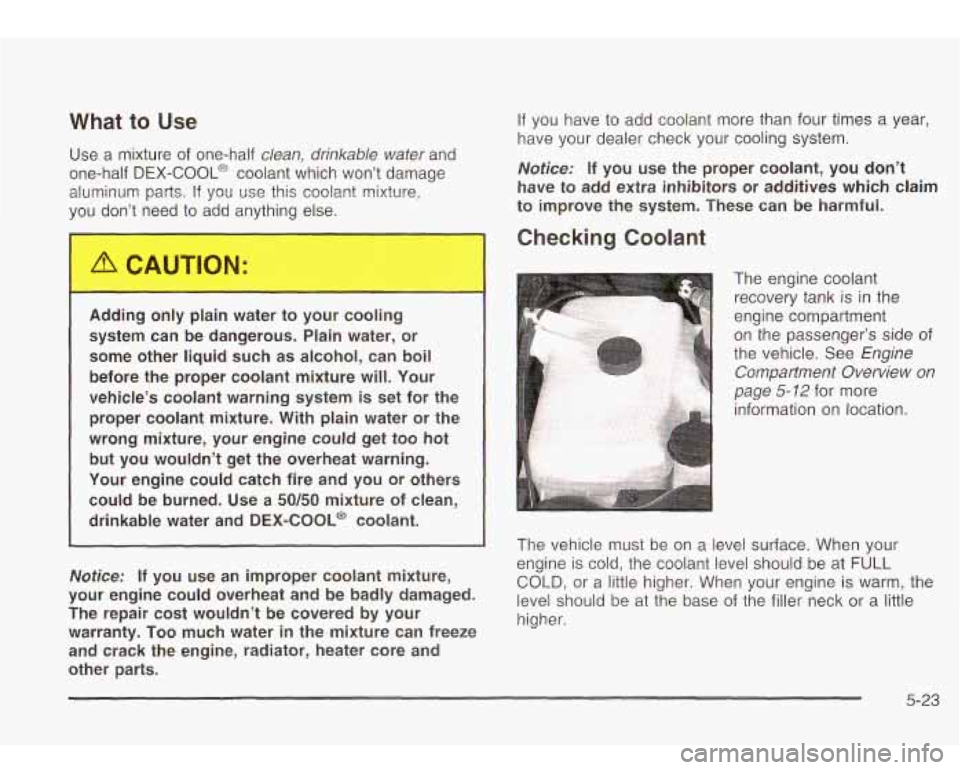
The engine coolant
recovery tank is
in the
engine compartment
on the passenger’s side of
the vehicle. See
Engine
Compartment Overview on
page
5-72 for more
information on location.
The vehicle must be on a level surface. When your
engine is cold, the coolant level should be
at FULL
COLD, or a little higher. When your engine is warm, the
level should be at the base of the filler neck or a little
higher.
5-23
Page 285 of 410
If you get the overheat warning with no sign of steam,
try this for a minute or
so:
1. In heavy traffic, let the engine idle in neutral while
stopped.
If it is safe to do so, pull off the road, shift
to
PARK (P) or NEUTRAL (N) and let the
engine idle.
speed and open the window as necessary.
If you no longer have the overheat warning, you can
drive. Just to be safe, drive slower for about
10 minutes.
If the warning doesn’t come back on, you can drive
normally.
If the warning continues and you have not stopped, pull
over, stop, and park your vehicle right away.
2. Turn on your heater to full hot at the highest fan
If there’s still no sign of steam, you can push down the
accelerator until the engine speed
is about twice as
fast as normal idle speed for at least three minutes while
you’re parked.
If you still have the warning, turn off
the engine and get everyone out of the vehicle until it
cools down.
You may decide not to lift the hood but to get service
help right away.
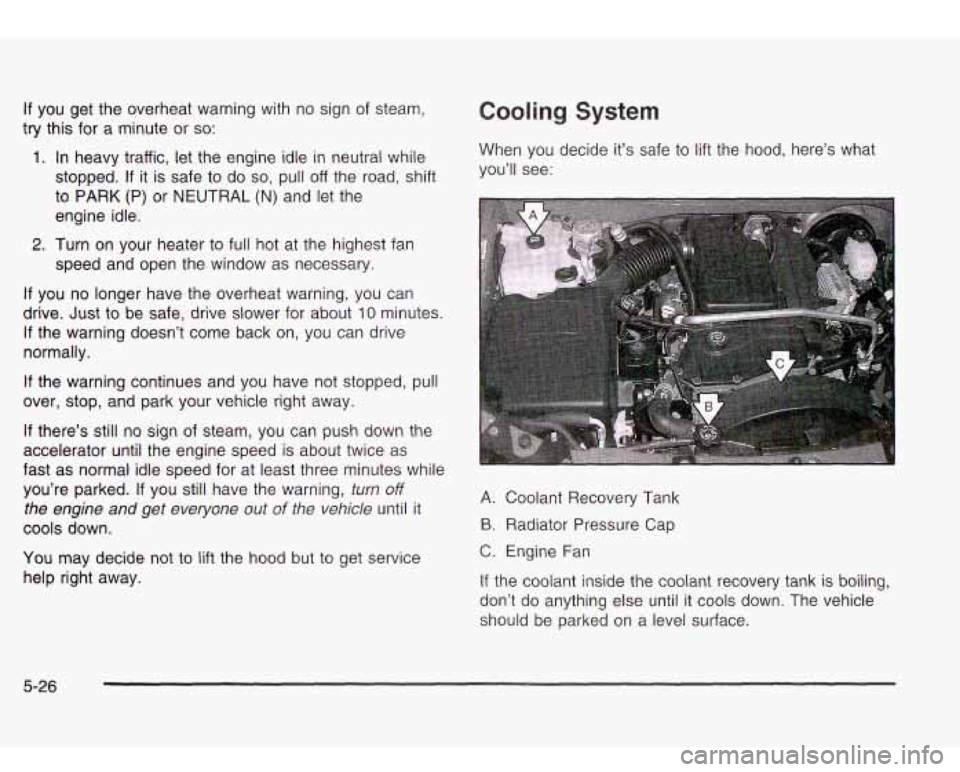
Cooling System
When you decide it’s safe to lift the hood, here’s what
you’ll see:
A. Coolant Recovery Tank
B. Radiator Pressure Cap
C. Engine Fan
If the coolant inside the coolant recovery tank is boiling,
don’t do anything else until it
cools down. The vehicle
should be parked on a level surface.
5-26
Page 287 of 410
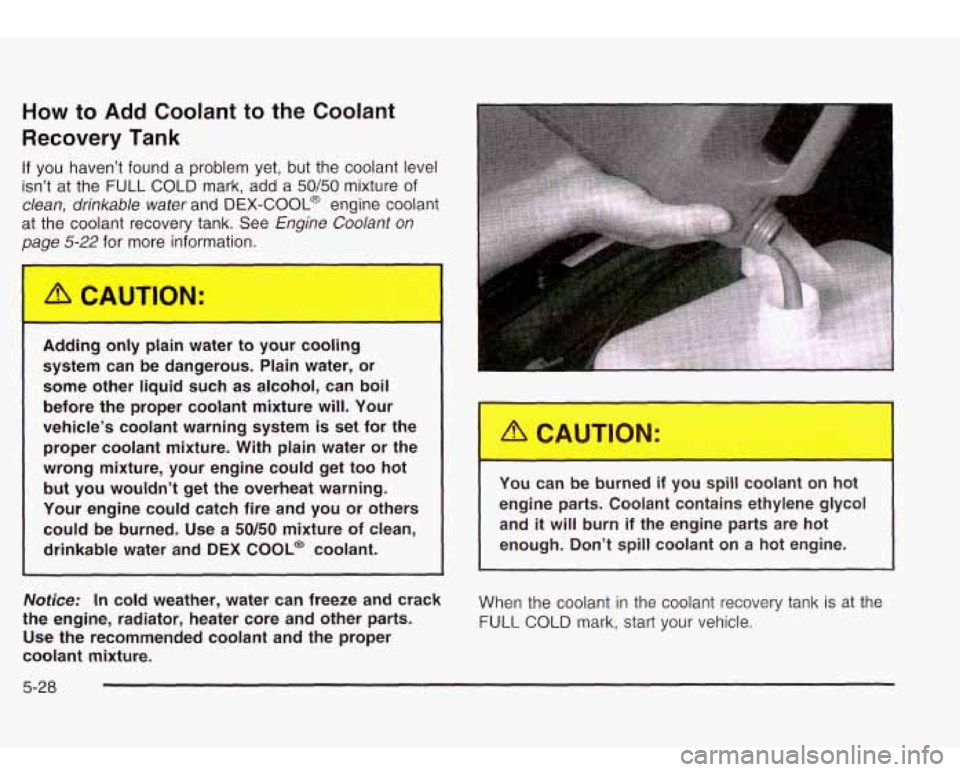
How to Add Coolant to the Coolant
Recovery Tank
If you haven’t found a problem yet, but the coolant level
isn’t at the FULL COLD mark, add a
50/50 mixture of
clean, drinkable water and DEX-COOL@ engine coolant
at the coolant recovery tank. See
Engine Coolant on
page 5-22 for more information.
water to your cooli
-
system can be dangerous. Plain water, or
some other liquid such as alcohol, can boil
before the proper coolant mixture will. Your
vehicle’s coolant warning system is set for the proper coolant mixture. With plain water
or the
wrong mixture, your engine could get too hot but you wouldn’t get the overheat warning.
Your engine could catch fire and you or others
could be burned. Use a
50/50 mixture of clean,
drinkable water and
DEX COOL@ coolant.
Notice: In cold weather, water can freeze and crack
the engine, radiator, heater core and other parts. Use the recommended coolant and the proper
coolant mixture. You
can be burned
.. jou spill coolant on hot
engine parts. Coolant contains ethylene glycol
and
it will burn if the engine parts are hot
enough. Don’t spill coolant on a hot engine.
When the coolant in the coolant recovery tank is at the
FULL COLD mark, start your vehicle.
5-28
Page 358 of 410
Scheduled Maintenance
The services shown in this schedule up to 100,000 miles
(166 000 km) should be repeated after 100,000 miles
(166 000 km) at the same intervals for the life of
this vehicle. The services shown at
150,000 miles
(240 000 km) should be repeated at the same interval
after
150,000 miles (240 000 km) for the life of this
vehicle.
See
Part B: Owner Checks and Services on page 6- 10
and Part C: Periodic Maintenance Inspections on
page 6- 15.
Footnotes
t The US. Environmental Protection Agency or the
California Air Resources Board has determined that the
failure to perform this maintenance item will not nullify
the emission warranty or limit recall liability prior
to
the completion of the vehicle 's useful life. We, however,
urge that all recommended maintenance services be
performed at the indicated intervals and the
maintenance be recorded.
+ A good time to check your brakes is during tire
rotation. See Brake System Inspection
on page 6- 16.
Engine Oil Scheduled Maintenance
Change engine oil and filter as indicated by the GM
Oil Life System (or every 12 months, whichever
occurs first). Reset the system.
Your vehicle has a computer system that lets you know
when
to change the engine oil and filter. This is
based on engine revolutions and engine temperature,
and not on mileage. Based on driving conditions,
the mileage
at which an oil change will be indicated can
vary considerably. For the
oil life system to work
properly, you must reset the system every time the oil is
changed.
When the system has calculated that oil life has been
diminished, it will indicate that an oil change is
necessary. A CHANGE ENGINE
OIL light will come on.
Change your oil as soon as possible within the next
two times you stop for fuel. It is possible that,
if you are
driving under the best conditions, the oil life system
may not indicate that an oil change is necessary for over
a year. However, your engine oil and filter must be
changed at least once a year and at this time the system
must be reset.
It is also important to check your oil
regularly and keep
it at the proper level.
If the system is ever reset accidentally, you must
change your oil at
3,000 miles (5 000 km) since your
last oil change. Remember
to reset the oil life system
whenever the oil is changed. See
Engine Oil on
page 5-13 for information on resetting the system.
After the services are performed, record the date, odometer reading and who performed the service on the
maintenance record pages in Part
E of this schedule.
An Emission Control Service.
6-5
Page 363 of 410
Part B: Owner Checks and Services
Listed in this part are owner checks and services
which should be performed at the intervals specified to
help ensure the safety, dependability and emission
control performance of your vehicle.
Be sure any necessary repairs are completed at once.
Whenever any fluids or lubricants are added to your
vehicle, make sure they are the proper ones, as shown
in Part
D.
At Each Fuel Fill
It is important for you or a service station attendant to
perform these underhood checks at each fuel fill.
Engine Oil Level Check
Check the engine oil level and add the proper oil if
necessary. See Engine Oil on page 5-13 for further
details.
Engine Coolant Level Check
Check the engine coolant level and add DEX-COOL@
coolant mixture
if necessary. See Engine Coolant
on page 5-22
for further details.
Windshield Washer Fluid Level Check
Check the windshield washer fluid level in the windshield
washer tank and add the proper fluid
if necessary.
See
Windshield Washer Fluid on page 5-33 for further
details.
At Least Once a Month
Tire Inflation Check
Make sure tries are inflated to the correct pressures.
Don’t forget to check your spare tire. See
Tires on
page 5-52
for further details.
Cassette Tape Player Service
Clean cassette tape player. Cleaning should be done
every
50 hours of tape play. See Audio Systern(s)
on page 3-56 for further details.
6-1 0
Page 364 of 410
At Least Twice a Year
Restraint System Check
Make sure the safety belt reminder light and all your
belts, buckles, latch plates, retractors and anchorages
are working properly. Look for any other loose or
damaged safety belt system parts. If you see anything
that might keep a safety belt system from doing its
job, have it repaired. Have any torn or frayed safety belts
replaced.
Also look for any opened or broken air bag coverings,
and have them repaired or replaced. (The air bag
system does not need regular maintenance.)
Wiper Blade Check
Inspect wiper blades for wear or cracking. Replace
blade inserts that appear worn or damaged or that
streak or miss areas of the windshield.
Also see
Cleaning the Outside of Your Vehicle on page 5-80.
Spare Tire Check
At least twice a year, after the monthly inflation check of
the spare tire determines that the spare is inflated
to
the correct tire inflation pressure, make sure that
the spare tire is stored securely. Push, pull, and then try
to rotate or turn the tire. If it moves, use the wheel
wrenchhatchet
to tighten the cable. See Changing a Flat
Tire on page
5-62.
Engine Air Cleaner Filter Restriction
Indicator Check
Your vehicle may be equipped with an engine air
cleaner filter restriction indicator located on the air
cleaner in the engine compartment. The indicator lets
you know when the air cleaner filter is dirty and needs
to
be changed. Check the indicator at least twice a year
or when your engine oil is changed, whichever
occurs first. See
Engine Air Cleaner/Fi/fer on page 5-18
for more information. Inspect your air cleaner filter
restriction indicator more often
if the vehicle is used in
dusty areas or under
off road conditions.
Weatherstrip Lubrication
Silicone grease on weatherstrips will make them last
longer, seal better, and not stick or squeak. Apply
silicone grease with a clean cloth. During very cold,
damp weather more frequent application may be required. See
Part D: Recommended Fluids and
Lubricants on page
6-17.
Automatic Transmission Check
Check the transmission fluid level; add if needed. See
Automatic Transmission Fluid on page 5-20. A fluid loss
may indicate a problem. Check the system and repair
if needed.
6-1 1
Page 390 of 410
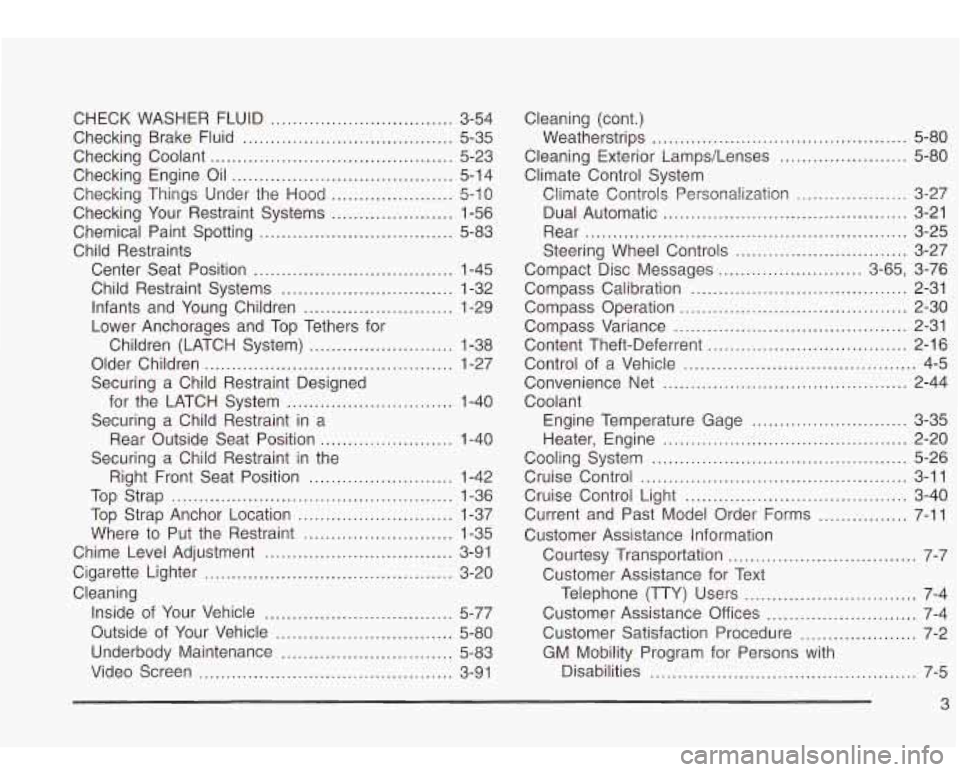
CHECK WASHER FLUID ............. ......... 3-54
Checking Brake Fluid
................................... 5-35
Checking Coolant
......................................... 5-23
Checking Engine Oil
........................................ 5-14
Checking Things Under the Hood
...................... 5-10
Checking Your Restraint Systems
...................... 1-56
Chemical Paint Spotting
................................... 5-83
Child Restraints Center Seat Position
.................................... 1-45
Child Restraint Systems
... .................... 1-32
Infants and Young Children
........................... 1-29
Lower Anchorages and Top Tethers for
Children (LATCH System)
.............. ..... 1-38
Older Children
.................................... . 1-27
Securing a Child Restraint Designed for the LATCH System
.............................. 1-40
Securing a Child Restraint in a
Rear Outside Seat Position
........................ 1-40
Securing a Child Restraint in the
Right Front Seat Position
.......................... 1-42
Top Strap
................................................... 1-36
Top Strap Anchor Location
............................ 1-37
Where to Put the Restraint
........................... 1-35
Chime Level Adjustment
.................................. 3-91
Cigarette Lighter
............................................. 3-20
Cleaning Inside of Your Vehicle
.................................. 5-77
Outside of Your Vehicle
................................ 5-80
Underbody Maintenance
............................... 5-83
Video Screen
.............................................. 3-91 Cleaning
(cont.)
Weatherstrips
.............................................. 5-80
Cleaning Exterior Lamps/Lenses
....................... 5-80
Climate Controls Personalization
.................... 3-27
Dual Automatic
............................................ 3-21
Rear
.......................................................... 3-25
Steering Wheel Controls
............................... 3-27
Compact Disc Messages
.......................... 3-65, 3-76
Compass Calibration
.......... ..................... 2-31
Compass Operation
..................................... 2-30
Compass Variance
.......................................... 2-31
Content Theft-Deferrent
.................................... 2-16
Control of
a Vehicle ....................................... 4-5
Convenience Net
.................................. .. 2-44
Coolant Engine Temperature Gage
............................ 3-35
Climate Control System
Heater, Engine
............................................ 2-20
Cooling System
.............................................. 5-26
Cruise Control
................................................ 3-11
Cruise Control Light
........................................ 3-40
Current and Past Model Order Forms
................ 7-11
Customer Assistance Information Courtesy Transportation
...................... 7-7
Customer Assistance for Text
Telephone (TTY) Users
............................... 7-4
Customer Assistance Offices
........................... 7-4
Customer Satisfaction Procedure
..................... 7-2
GM Mobility Program for Persons with
Disabilities
................................................ 7-5
3
Page 392 of 410
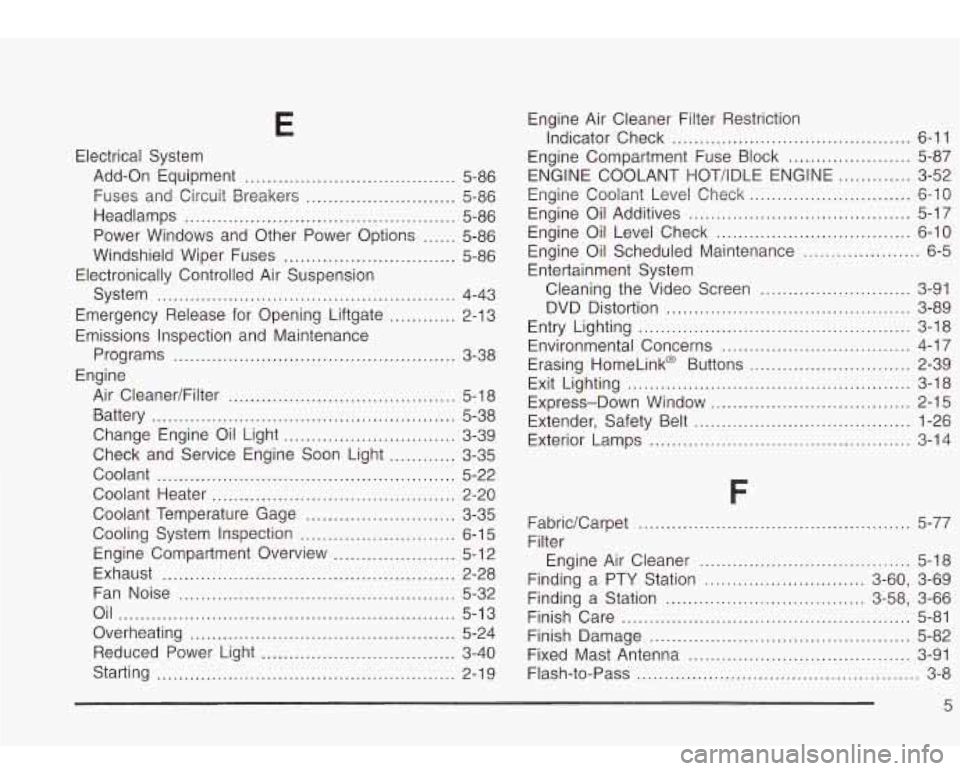
E
Electrical System
Add-on Equipment
...................................... 5-86
Fuses and Circuit Breakers
........................... 5-86
Headlamps
................................................. 5-86
Power Windows and Other Power Options
...... 5-86
Windshield Wiper Fuses
............................... 5-86
Electronically Controlled Air Suspension
System
...................................................... 4-43
Emergency Release for Opening Liftgate
............ 2-13
Emissions Inspection and Maintenance Programs
................................................... 3-38
Engine Air Cleaner/Filter
......................................... 5-1 8
Battery
....................................................... 5-38
Change Engine Oil Light
............................... 3-39
Check and Service Engine Soon Light
............ 3-35
Coolant
...................................................... 5-22
Coolant Heater
............................................ 2-20
Cooling System Inspection
............................ 6-15
Engine Compartment Overview
...................... 5-1 2
Exhaust ..................................................... 2-28
Fan Noise
.................................................. 5-32
Oil ............................................................. 5-13
Overheating
................................................ 5-24
Reduced Power Light
................................... 3-40
Starting
...................................................... 2-1 9
Coolant Temperature
Gage
........................... 3-35 Engine
Air Cleaner Filter Restriction
Indicator Check
............................. ... 6-11
Engine Compartment Fuse Block
................... 5-87
Engine Coolant Level Check
............................. 6-10
Engine Oil Additives
........................................ 5-17
Engine Oil Level Check
................................... 6-10
Engine Oil Scheduled Maintenance
..................... 6-5
Entertainment System Cleaning the Video Screen
........................... 3-91
DVD Distortion
............................................ 3-89
Entry Lighting
.............................................. 3-18
Environmental Concerns
........................ ... 4-17
Erasing HomeLinkO Buttons
................... ... 2-39
Exit Lighting
................................................... 3-18
Express-Down Window
.................................... 2-15
Extender, Safety Belt
....................................... 1-26
Exterior Lamps
........................................... 3-14
ENGINE COOLANT HOT/IDLE ENGINE
............. 3-52
F
FabridCarpet ................................................. 5-77
Filter
Engine Air Cleaner
...................................... 5-18
Finding a PTY Station
............................. 3-60, 3-69
Finding a Station
.................................... 3-58, 3-66
Finish Care
.................................................... 5-81
Finish Damage
............................................... 5-82
Fixed Mast Antenna
........................................ 3-91
Flash-to-Pass
................................................... 3-8
5