light Oldsmobile Cutlass 1999 s Owner's Guide
[x] Cancel search | Manufacturer: OLDSMOBILE, Model Year: 1999, Model line: Cutlass, Model: Oldsmobile Cutlass 1999Pages: 336, PDF Size: 2.37 MB
Page 100 of 336
yellowblue
2-42
Mirrors
Inside Day/Night Rearview Mirror
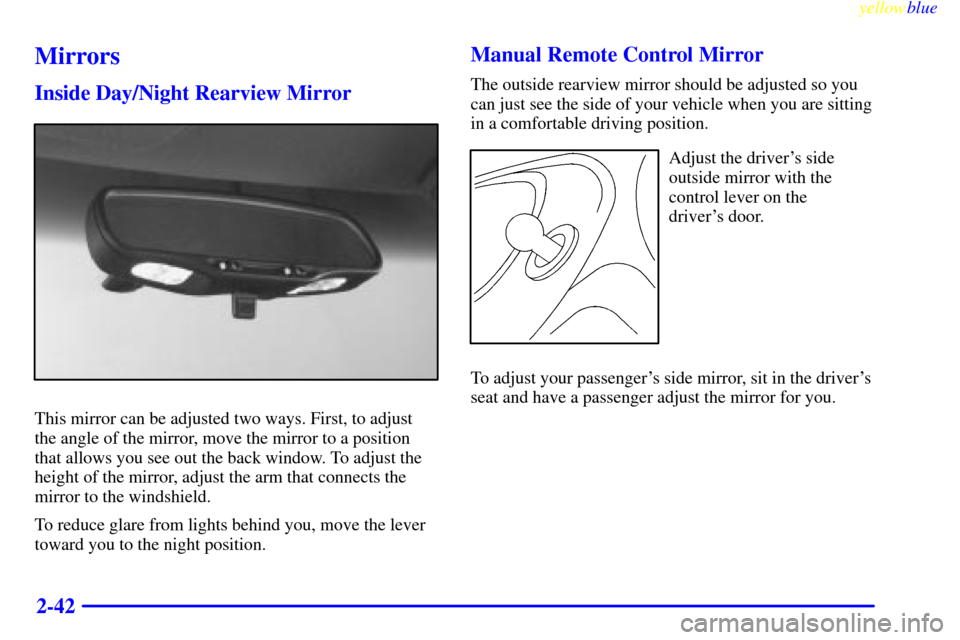
This mirror can be adjusted two ways. First, to adjust
the angle of the mirror, move the mirror to a position
that allows you see out the back window. To adjust the
height of the mirror, adjust the arm that connects the
mirror to the windshield.
To reduce glare from lights behind you, move the lever
toward you to the night position.
Manual Remote Control Mirror
The outside rearview mirror should be adjusted so you
can just see the side of your vehicle when you are sitting
in a comfortable driving position.
Adjust the driver's side
outside mirror with the
control lever on the
driver's door.
To adjust your passenger's side mirror, sit in the driver's
seat and have a passenger adjust the mirror for you.
Page 103 of 336

yellowblue
2-45 Center Console Cupholder
The console provides space for holding a cup or soft
drink container. The cupholder is located at the rear of
the shift lever.
Rear Seat Cupholder
Pull down the door on the rear of the center console to
use the rear seat cupholder.
Convenience Net (If Equipped)
Your vehicle may have a convenience net. You'll see it
just inside the back wall of the trunk.
Put small loads, like grocery bags, behind the net. It can
help keep them from falling over during sharp turns or
quick starts and stops.
The net isn't for larger, heavier loads. Store them in the
trunk as far forward as you can.
You can unhook the net so that it will lie flat when
you're not using it.
Sun Visors
To block out glare, you can swing down the visors. You
can also swing them to the side.
Visor Vanity Mirror
Lift the cover to expose the visor vanity mirror.
Illuminated Visor Vanity Mirror
(If Equipped)
This mirror is located on the passenger's side visor.
When you lift the cover, the light will turn on.
Page 107 of 336

yellowblue
2-49
The main components of your instrument panel are:
A. Fog Lamp Switch
B. Instrument Panel Intensity Control
C. Turn Signal/Multifunction Lever
D. Cruise Control Switches (If Equipped)
E. Horn
F. Instrument Panel Cluster
G. Windshield Wiper/Washer Lever
H. Ignition Switch
I. Hazard Warning Flashers Switch
J. Fuse PanelsK. Climate Control System
L. Accessory Power Outlet
M. Cigarette Lighter
N. Gear Shift Lever
O. Audio System
P. Parking Brake
Q. Tilt Wheel
R. Hood Release Lever
S. Trunk Release Button
T. Instrument Panel Cupholder
Page 108 of 336

yellowblue
2-50
Instrument Panel Cluster
Your vehicle is equipped with this cluster, which includes indicator warning lights and gages that are explained on the
following pages. Be sure to read them.
Page 110 of 336
yellowblue
2-52 Tachometer
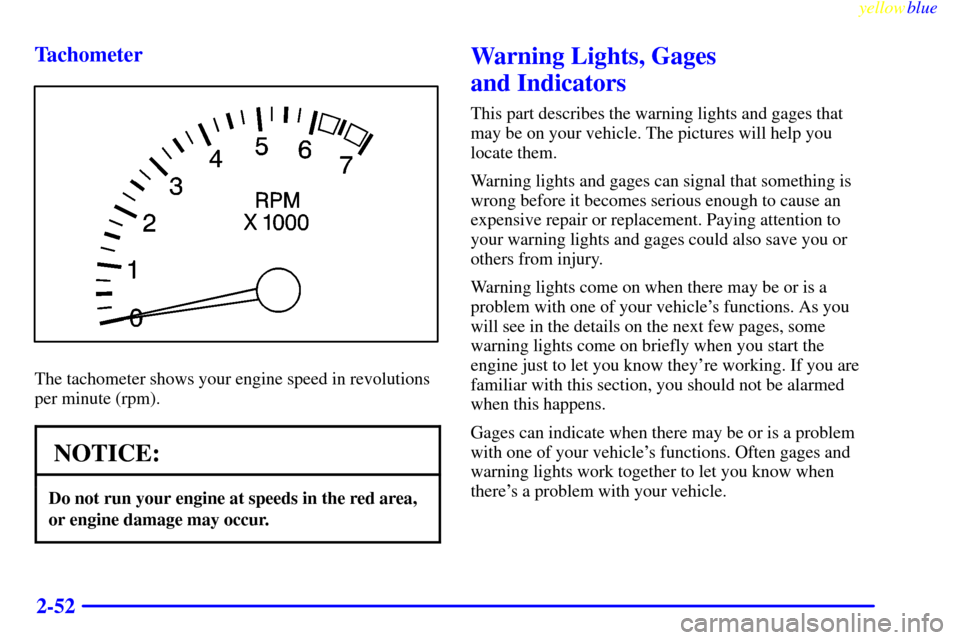
The tachometer shows your engine speed in revolutions
per minute (rpm).
NOTICE:
Do not run your engine at speeds in the red area,
or engine damage may occur.
Warning Lights, Gages
and Indicators
This part describes the warning lights and gages that
may be on your vehicle. The pictures will help you
locate them.
Warning lights and gages can signal that something is
wrong before it becomes serious enough to cause an
expensive repair or replacement. Paying attention to
your warning lights and gages could also save you or
others from injury.
Warning lights come on when there may be or is a
problem with one of your vehicle's functions. As you
will see in the details on the next few pages, some
warning lights come on briefly when you start the
engine just to let you know they're working. If you are
familiar with this section, you should not be alarmed
when this happens.
Gages can indicate when there may be or is a problem
with one of your vehicle's functions. Often gages and
warning lights work together to let you know when
there's a problem with your vehicle.
Page 111 of 336
yellowblue
2-53
When one of the warning lights comes on and stays on
when you are driving, or when one of the gages shows
there may be a problem, check the section that tells you
what to do about it. Please follow this manual's advice.
Waiting to do repairs can be costly
-- and even
dangerous. So please get to know your warning lights
and gages. They're a big help.
Safety Belt Reminder Light
When the key is turned to ON or START, a chime will
come on for about eight seconds to remind people to
fasten their safety belts, unless the driver's safety belt is
already buckled.
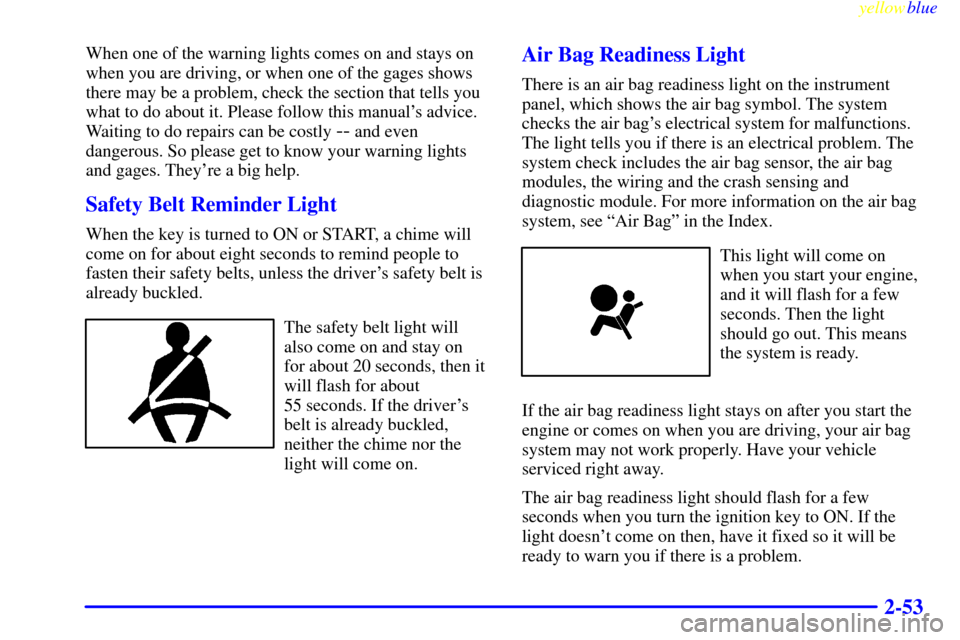
The safety belt light will
also come on and stay on
for about 20 seconds, then it
will flash for about
55 seconds. If the driver's
belt is already buckled,
neither the chime nor the
light will come on.
Air Bag Readiness Light
There is an air bag readiness light on the instrument
panel, which shows the air bag symbol. The system
checks the air bag's electrical system for malfunctions.
The light tells you if there is an electrical problem. The
system check includes the air bag sensor, the air bag
modules, the wiring and the crash sensing and
diagnostic module. For more information on the air bag
system, see ªAir Bagº in the Index.
This light will come on
when you start your engine,
and it will flash for a few
seconds. Then the light
should go out. This means
the system is ready.
If the air bag readiness light stays on after you start the
engine or comes on when you are driving, your air bag
system may not work properly. Have your vehicle
serviced right away.
The air bag readiness light should flash for a few
seconds when you turn the ignition key to ON. If the
light doesn't come on then, have it fixed so it will be
ready to warn you if there is a problem.
Page 112 of 336

yellowblue
2-54 Charging System Indicator Light
The charging system
indicator light will come on
when you turn on the
ignition, but the engine is
not running, as a check to
show you it is working.
When the engine is running, it should go out.
If it stays on, or comes on while you are driving and you
hear a chime, you may have a problem with the
electrical charging system. It could indicate that you
have a loose generator drive belt or another electrical
problem. Have it checked right away. Driving while this
light is on could drain your battery.
If you must drive a short distance with the light on, be
certain to turn off all your accessories, such as the radio
and air conditioner.
Brake System Warning Light
Your vehicle's hydraulic brake system is divided into
two parts. If one part isn't working, the other part can
still work and stop you. For good braking, though, you
need both parts working well.
If the warning light comes on, there is a brake problem.
Have your brake system inspected right away.
This light should come on
briefly when you turn the
ignition key to ON. If it
doesn't come on then, have
it fixed so it will be ready to
warn you if there's
a problem.
If the light and chime come on while you are driving,
pull off the road and stop carefully. You may notice that
the pedal is harder to push. Or, the pedal may go closer
to the floor. It may take longer to stop. If the light is still
on, have the vehicle towed for service. (See ªTowing
Your Vehicleº in the Index.)
Page 113 of 336
yellowblue
2-55
CAUTION:
Your brake system may not be working properly
if the brake system warning light is on. Driving
with the brake system warning light on can lead
to an accident. If the light is still on after you've
pulled off the road and stopped carefully, have
the vehicle towed for service.
When the ignition is on, the brake system warning light
will also come on when you set your parking brake. The
light will stay on if your parking brake doesn't release
fully. If it stays on after your parking brake is fully
released, it means you have a brake problem.
Anti-Lock Brake System Warning Light
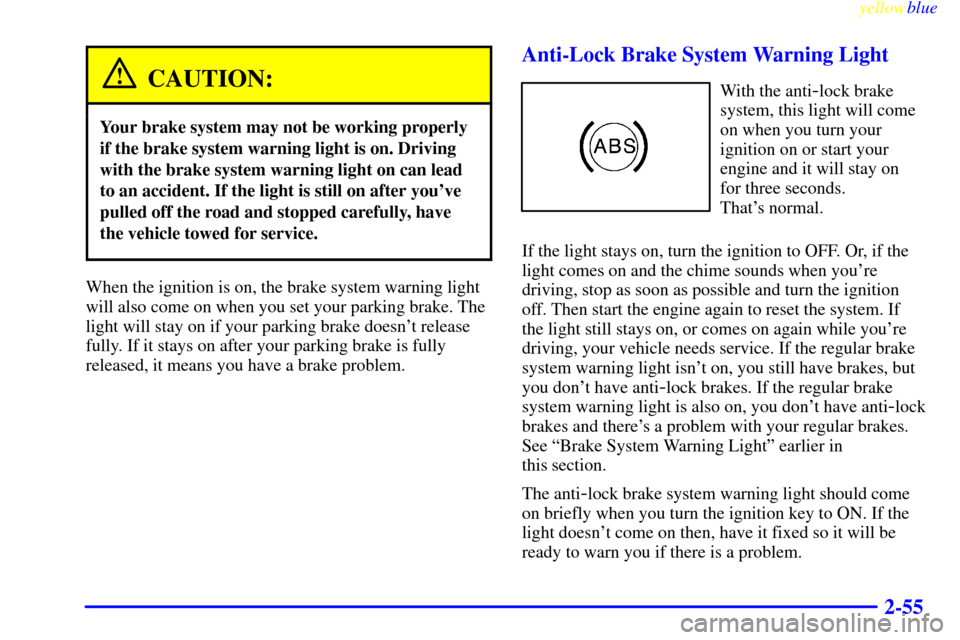
With the anti-lock brake
system, this light will come
on when you turn your
ignition on or start your
engine and it will stay on
for three seconds.
That's normal.
If the light stays on, turn the ignition to OFF. Or, if the
light comes on and the chime sounds when you're
driving, stop as soon as possible and turn the ignition
off. Then start the engine again to reset the system. If
the light still stays on, or comes on again while you're
driving, your vehicle needs service. If the regular brake
system warning light isn't on, you still have brakes, but
you don't have anti
-lock brakes. If the regular brake
system warning light is also on, you don't have anti
-lock
brakes and there's a problem with your regular brakes.
See ªBrake System Warning Lightº earlier in
this section.
The anti
-lock brake system warning light should come
on briefly when you turn the ignition key to ON. If the
light doesn't come on then, have it fixed so it will be
ready to warn you if there is a problem.
Page 114 of 336

yellowblue
2-56 Engine Coolant Temperature Gage
This gage shows the engine
coolant temperature. If the
gage pointer moves into the
red area, the light comes on
and you hear a chime, your
engine is too hot! It means
that your engine coolant
has overheated.
If you have been operating your vehicle under normal
driving conditions, you should pull off the road, stop
your vehicle and turn off the engine as soon as possible.
In ªProblems on the Road,º this manual shows what to
do. See ªEngine Overheatingº in the Index.
Low Coolant Warning Light
This light comes on
briefly when you turn
your ignition on.
If this light comes on and stays on and you hear a chime,
the vehicle should promptly be pulled off the road and
the coolant level checked.
See ªEngine Coolantº in the Index. If there are visible
signs of steam, see ªEngine Overheatingº in the Index
before opening the hood. Have your vehicle serviced as
soon as you can.
Page 115 of 336
yellowblue
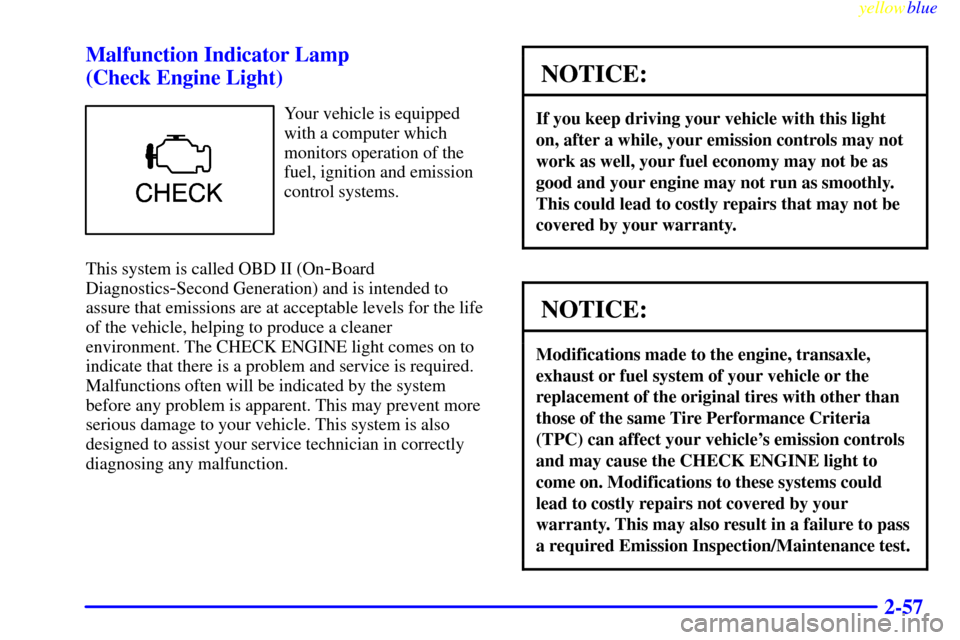
2-57 Malfunction Indicator Lamp
(Check Engine Light)
Your vehicle is equipped
with a computer which
monitors operation of the
fuel, ignition and emission
control systems.
This system is called OBD II (On
-Board
Diagnostics
-Second Generation) and is intended to
assure that emissions are at acceptable levels for the life
of the vehicle, helping to produce a cleaner
environment. The CHECK ENGINE light comes on to
indicate that there is a problem and service is required.
Malfunctions often will be indicated by the system
before any problem is apparent. This may prevent more
serious damage to your vehicle. This system is also
designed to assist your service technician in correctly
diagnosing any malfunction.
NOTICE:
If you keep driving your vehicle with this light
on, after a while, your emission controls may not
work as well, your fuel economy may not be as
good and your engine may not run as smoothly.
This could lead to costly repairs that may not be
covered by your warranty.
NOTICE:
Modifications made to the engine, transaxle,
exhaust or fuel system of your vehicle or the
replacement of the original tires with other than
those of the same Tire Performance Criteria
(TPC) can affect your vehicle's emission controls
and may cause the CHECK ENGINE light to
come on. Modifications to these systems could
lead to costly repairs not covered by your
warranty. This may also result in a failure to pass
a required Emission Inspection/Maintenance test.