trailer Oldsmobile Cutlass Supreme 1993 Owner's Manuals
[x] Cancel search | Manufacturer: OLDSMOBILE, Model Year: 1993, Model line: Cutlass Supreme, Model: Oldsmobile Cutlass Supreme 1993Pages: 340, PDF Size: 16.21 MB
Page 61 of 340
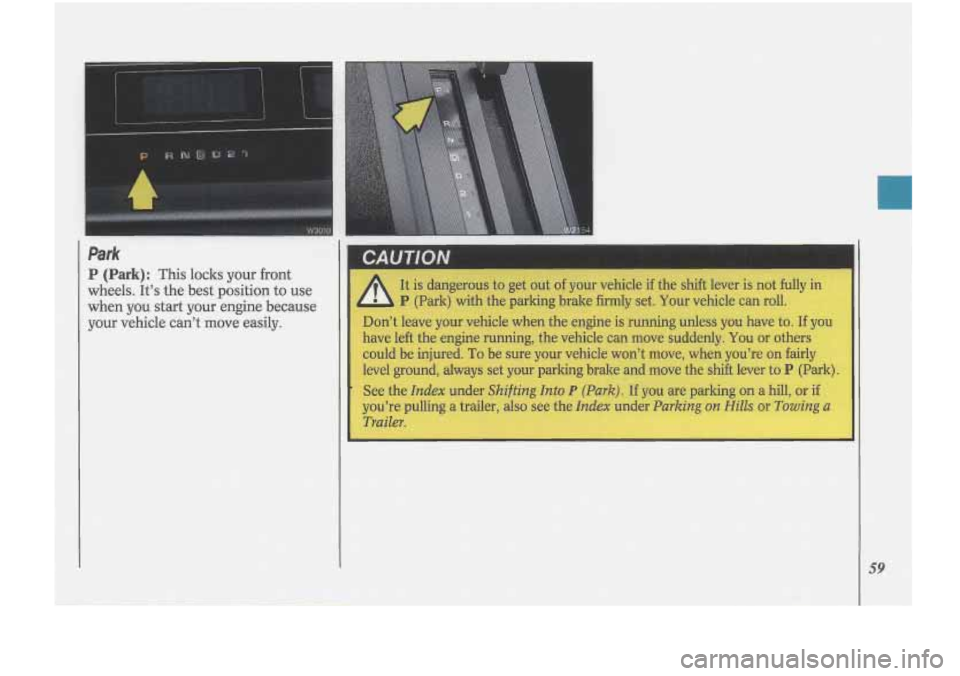
Park
P (Park): This loclcs your front
wheels. It’s the best position
to use
when you start your engine because
your vehicle can’t move easily.
A
I It is dangerous to get out of your vehicle if the shift lever is not fully in
P (Park) with the parking brake firmly set. Your vehicle can roll.
Don’t leave your vehicle when the engine
is running unless you have to. If you
have left the engine running, the vehicle can move suddenly. You or others
could be injured.
To be sure your vehicle won’t move, when you’re on fairly
level ground, always set your parking brake and move the shift lever to
P (Park).
See the
Index under Shifting Into P (Park). If you are parking on a hill, or if
you’re pulling a trailer, also see the
Index under Parking on Hills or Towing a I
Trailer. I
59
Page 64 of 340
Features & ControIs
62
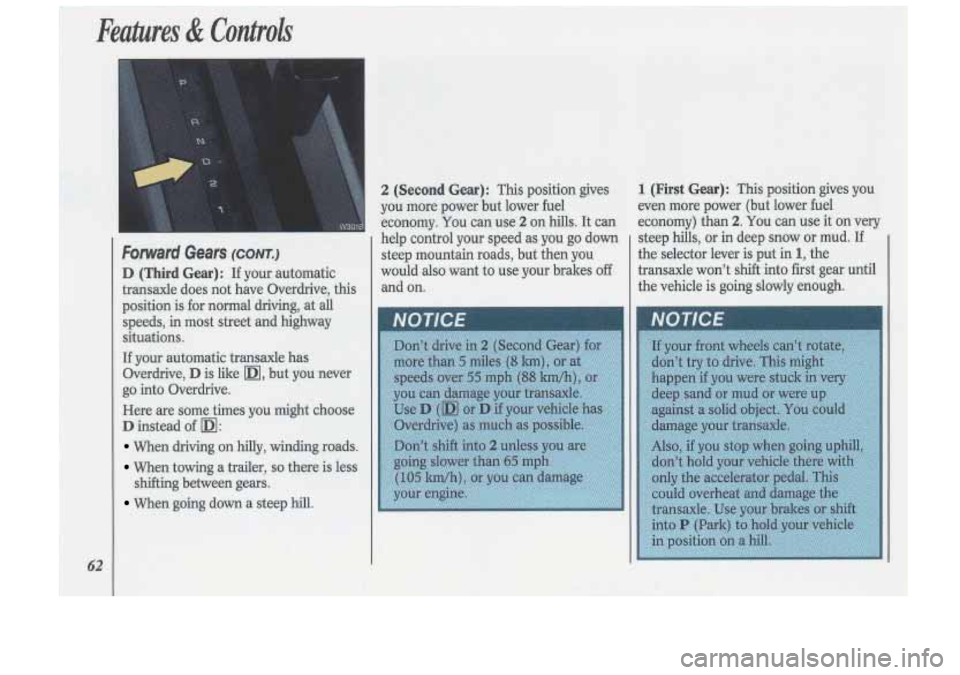
Forward Gears (CONT.)
D (Third Gear): If your automatic
transaxle does not have Overdrive, this
position is for normal driving, at all
speeds, in most street and highway
situations.
If your automatic transaxle has
Overdrive,
D is like m, but you never
go into Overdrive.
Here are some times you might choose
D instead of m:
When driving on hilly, winding roads.
When towing a trailer, so there is less
When going down a steep hill.
shifting between gears.
2 (Second Gear): This
position gives
you more power but lower fuel
economy.
You can use 2 on hills. It can
help control your speed as you go down
steep mountain roads, but then you
would also want to use your brakes
off
and on.
1 (First Gear): This position gives you
even more power (but lower fuel
economy) than
2. You can use it on very
steep hills, or in deep snow or mud.
If
the selector lever is put in 1, the
transaxle won’t shift into first gear until
the vehicle
is going slowly enough.
Page 65 of 340
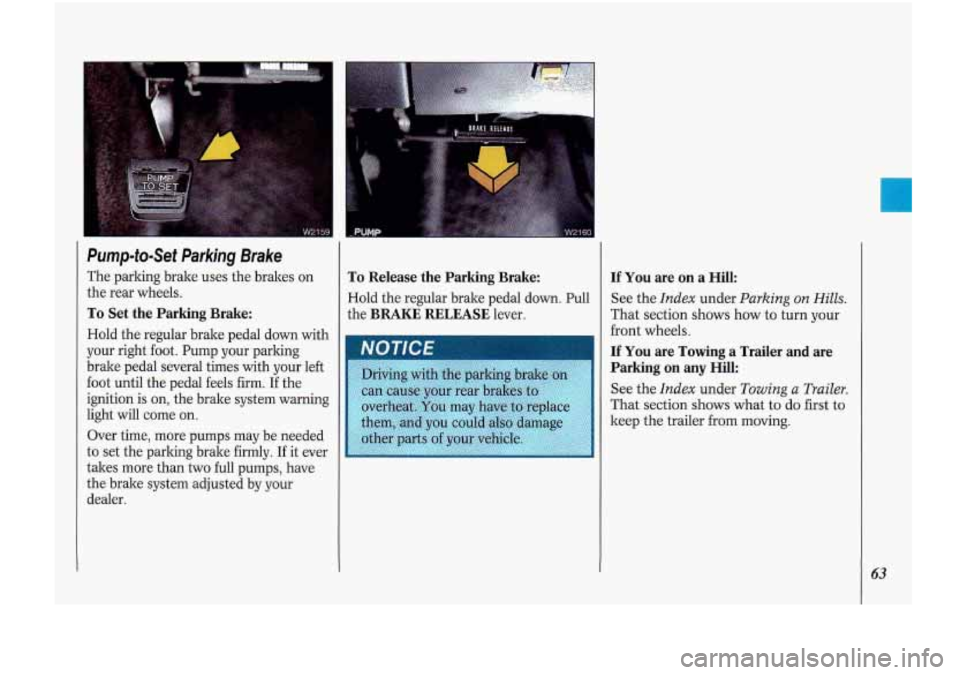
Pump-to-Set Parking Brake
The parking brake uses the brakes on
the rear wheels.
To Set the Parking Brake:
Hold the regular bralte pedal down with
your right foot. Pump your parking
brake pedal several times with your left
foot until the pedal feels firm. If the
ignition is
on, the brake system warning
light will come on.
Over time, more pumps may be needed
to set the parlung brake firmly. If it ever
takes more than two full pumps, have
the brake system adjusted by your
dealer.
..
To Release the Parking Brake:
Hold the regular brake pedal down. Pull
the
BRAKE RELEASE lever.
If You are on a Hill:
See the Index under Parking on Hills.
That section shows how to turn your
front wheels.
If You are Towing a Trailer and are
Parking on any Hill:
See the Index under Towing a Trailer.
That section shows what to do first to
keep the trailer from moving.
63
Page 66 of 340
Features & Controli
64
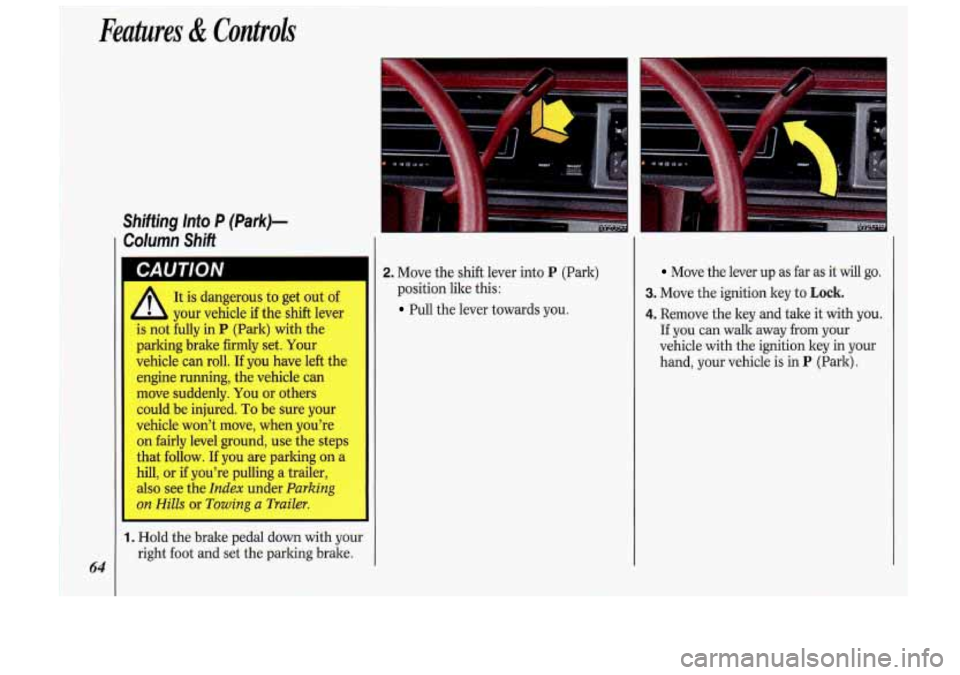
Shifting lnto P (Park)-
Column Shift
It is dangerous to get out of
your vehicle if the shift lever
is not fully in
P (Park) with the
parking brake firmly set. Your
vehicle can roll. If you have left the
engine running, the vehicle can
move suddenly.
You or others
could be injured.
To be sure your
vehicle won't move, when you're
on fairly level ground, use the steps
that follow.
If you are parking on a
hill, or if you're pulling a trailer,
also see the
Index under Parking
on Hills or Towing a Trailer.
1. Hold the brake pedal down with your
right foot and set the parking brake.
'." ' I
2. Move the shift lever into P (Park)
position like this:
Pull the lever towards you.
Move the lever up as far as it will go.
3. Move the ignition key to Lock.
4. Remove the key and tale it with you.
If you can walk away from your
vehicle with the ignition key in your
hand, your vehicle
is in P (Park).
Page 67 of 340
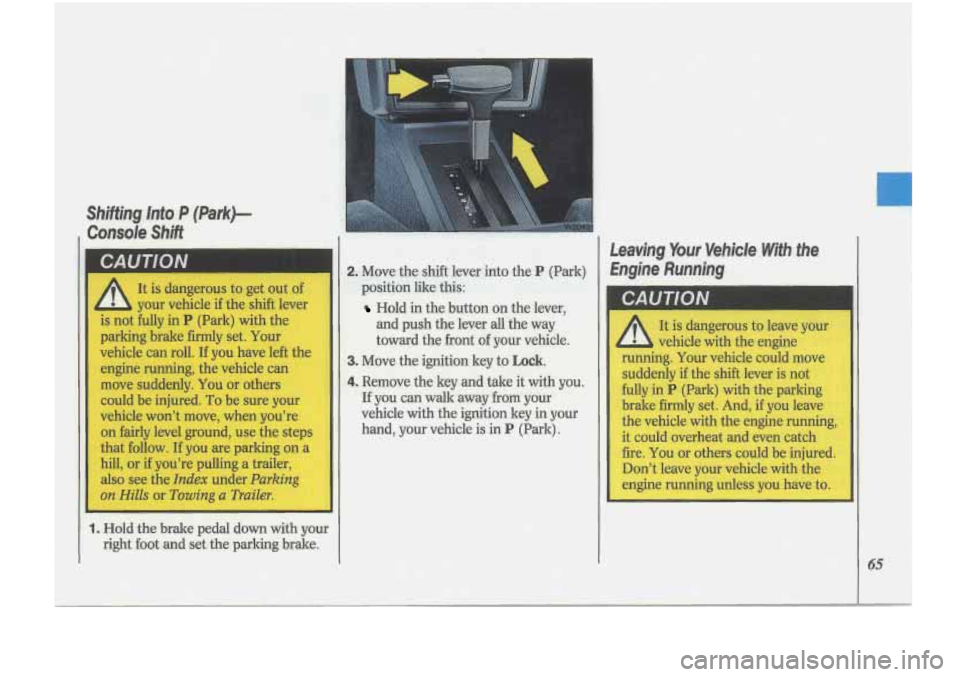
Shjfthg ‘Into P (Park)-
Console
Shift
A
It is dangerous to get out of
your vehicle
if the shift lever
is not fully
in P (Park) with the
parking brake firmly set. Your
vehicle can roll. If you have left the
engine running, the vehicle can
move suddenly. You or others
could be injured.
To be sure your
vehicle won’t move, when you’re
on fairly level ground, use the steps
that follow. If you are parking
on a
hill, or
if you’re pulling a trailer,
also see the
Index under Parking
on Hills or Towing a Trailer.
1. Hold the brake pedal down with your
right foot
and set the parking brake.
2. Move the shift lever into the P (Park)
position like this-:.
Hold in the button on the lever,
and push the lever
all the way
toward the front of your vehicle.
3. Move the ignition key to Lock.
4. Remove the key and take it with you.
If you can wallc away from your
vehicle with the ignition key
in your
hand, your vehicle is in
P (Park).
Leaving Yo,ur Vehicle Wfih the
Engine Running
I
Page 69 of 340
CAUTION --
A
Idling the engine with the air system control OFF could allow dangerous
exhaust into your vehicle (see the earlier CAUTION under
Engine
Zxhaust).
Also, idling in a closed-in place can let deadly carbon monoxide (GO) into your
vehicle even if the fan switch is at the highest setting. One place this can
happen is a garage. Exhaust-with CO-can come in easily.
NEVER park in a
garage with the engine running.
Another closed-in place can be a blizzard. (See the
Index under Blizzard.)
It can be dangerous to get out of your vehicle if the shift lever is not fully in
P (Park) with the parking brake firmly set. Your vehicle can roll. Don't leave
your vehicle when the engine is running unless you have to. If you've left the
engine running, the vehicle can move suddenly. You or others could be injured.
To be sure your vehicle won't move, even when you're on fairly level ground,
always set your parking brake and move the shift lever to
P (Park).
If you are parking on a hill, or if you're pulling
a trailer, also see the Index
under Parking on Hills or Towing a Trailer.
Page 141 of 340
Part 4
Here you’ll find information about driving on different kinds of roads and
in varying weather conditions
. We’ve
also included many other useful tips
on driving
.
Your Driving and the Road
Road Signs ........................................................................\
....................................... 140
Defensive Driving
........................................................................\
............................ 144
Drunken Driving
........................................................................\
............................ 145
Control of a Vehicle
Braking
........................................................................\
......................................... 148
Anti-Lock Brakes ........................................................................\
......................... 149
Steering Tips
........................................................................\
................................ 154
Steering in Emergencies
........................................................................\
.............. 155
Driving at Night
........................................................................\
............................... 159
Driving in the Rain
........................................................................\
.......................... 161
Passing ........................................................................\
......................................... 156
Driving in Fog, Mist and Haze
........................................................................\
....... 164
City Drmng
........................................................................\
...................................... 165 ..
Freeway Driving ........................................................................\
............................. 166
Driving a Long Distance ........................................................................\
................ 168
Hill and Mountain Roads ........................................................................\
............... 170
Winter Driving
........................................................................\
................................ 173
Parking
on Hills ........................................................................\
.............................. 171
Towing a Trailer
........................................................................\
............................... 176 139
Page 178 of 340
1 76
If You're Caught in a Blizzard
(CONT.)
Run your engine only as long as you
must. This saves fuel. When you run
the engine, male it go a little faster
than just idle. That is, push the
accelerator slightly. This
uses less fuel
for the heat that you get and it keeps
the battery charged. You will need a
well-charged battery to restart the
vehicle and possibly for signaling later
on with your headlights. Let the
heater run for a while.
Then, shut the engine
off and close
the window almost all the way to
preserve the heat. Start the engine
again and repeat this only when you
feel really uncomfortable from the
cold. But do it as little
as possible.
Preserve the fuel as long as you can.
To help keep warm, you can get out of
the vehicle and do some fairly
vigorous exercises every half-hour or
so until help comes.
If You're Stuck in Deep Snow
This manual explains how to get the
vehicle out of deep snow without
damaging it. See the
Index under
Rocking Your Vehicle. I
I
tiAUIIUN
I A If vou don't use the correct "
, equipment and drive
properly, you can lose control when
you pull
a trailer. For example, if
the trailer is too heavy, the brakes
may not work well-or even at all.
You and your passengers could be
seriously injured. Pull a trailer
only
if you have followed all the steps in
this section.
Page 179 of 340
Do not tow a trailer if you have a
convertible with the 3.4L VIN Code X
engine.
Your Oldsmobile can tow a trailer. To
identify what the vehicle trailering
capacity is for your vehicle, you should
read the information in
Weight of the
Trailer that appears later in this section.
But trailering is different than just
driving your vehicle by itself. Trailering
means changes in handling, durability,
and fuel economy. Successful, safe
trailering takes correct equipment, and
it has to be used properly.
That’s the reason for this section. In it
are many time-tested, important
trailering tips and safety rules. Many of
these are important for your safety and that
of your passengers.
So please read
this section carefully before you pull a
trailer.
Load-pulling components such as the
engine, transaxle, wheel assemblies, and
tires are forced to work harder against
the drag of the added weight. The
engine
is required to operate at
relatively higher speeds and under
greater loads, generating extra heat.
What’s more, the trailer adds
considerably to wind resistance,
increasing the pulling requirements.
All of that means changes in:
Handling
Durability
Fuel economy
If You Do Decide to Pull a Trailer
If you do, here are some important
points.
There are many different laws having
to do with trailering. Make sure your
rig
will be legal, not oplly where you
live but also where you’ll be driving.
A
good source for this information can
be state or provincial police.
Consider using a sway control. You
can ask a hitch dealer about sway
controls.
Don’t tow a trailer at all during the
first
500 miles (800 km) your new
vehicle is driven. Your engine, axle or other parts could be damaged.
177
Page 180 of 340
Your Driving and the Road
1 78
If You Do Decide to Pull a Trailer
(CONT.)
Then, during the first 500 miles
(800 km) that you tow a trailer, don’t
drive over
50 mph (80 lun/h) and
don’t make starts
at full throttle. This
helps your engine and other parts of
your vehicle wear in at the heavier
loads.
Three important considerations have
to do with weight:
Weight of the Trailer
How heavy can a trailer safely be? It
should never weigh more than 1,000
pounds
(450 kg), unless you have a
3.1L
V6 with the heavy-duty cooling
package. Then your vehicle can tow
up to
2,000 pounds (900 kg). But
even that can
be too heavy. It depends
on how you plan to use your rig. For
example, speed, altitude, road grades,
outside temperature and how much
your vehicle is used to pull a trailer
are all important. And, it can also
depend on any special equipment that
you have on your vehicle. You can ask
your dealer for our trailering
information or advice, or you can
write us at: Oldsmobile Customer Assistance
P.O. Box 30095
Lansing, MI 48909
In Canada, write to:
Network
General Motors of Canada Limited
Customer Assistance Center
1908 Colonel Sam Drive
Oshawa, Ontario, L1H 8P7