steering Oldsmobile Cutlass Supreme 1994 s User Guide
[x] Cancel search | Manufacturer: OLDSMOBILE, Model Year: 1994, Model line: Cutlass Supreme, Model: Oldsmobile Cutlass Supreme 1994Pages: 276, PDF Size: 14.73 MB
Page 127 of 276
Here you’ll find information about driving on different kinds of roads
and
in varying weather conditions .
We’ve also . included many other
useful tips on driving
.
Part 4
Your Driving and the Road
Defensive Driving ........................................................................\
............................ 126
Drunken Driving
........................................................................\
............................ 126
Control of a Vehicle
Braking
........................................................................\
......................................... 128
Anti-Lock Brakes
........................................................................\
......................... 129
Steering Tips
........................................................................\
................................ 130
Steering in Emergencies
........................................................................\
.............. 131
Passing ........................................................................\
......................................... 132
Driving
at Night ........................................................................\
............................... 134
Driving in the Rain ........................................................................\
.......................... 135
City Driving 137
Freeway Driving ........................................................................\
............................. 137
Hill and Mountain Roads
........................................................................\
............... 139
Winter Driving
........................................................................\
................................ 140
Towing a Trailer
........................................................................\
............................... 143
.. ........................................................................\
......................................
125
Page 132 of 276
Your Driving and the Road
Braking in Emergencies
Use your anti-lock braking system when
you need to. With anti-lock, you can
steer and brake at the same time. In
many emergencies, steering can help
you more than even the very best
braking.
130
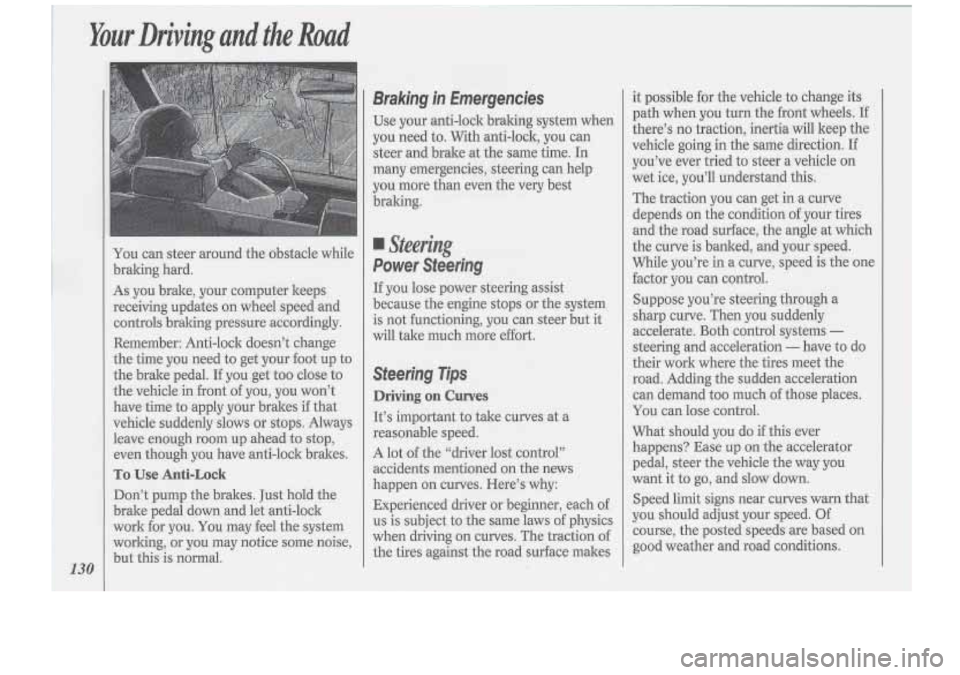
You can steer around the obstacle while
braking hard.
As you brake, your computer keeps
receiving updates on wheel speed and
controls braking pressure accordingly.
Remember: Anti-lock doesn’t change
the time you need to get your foot up to
the brake pedal.
If you get too close to
the vehicle in front of you, you won’t
have time to apply your brakes
if that
vehicle suddenly slows or stops. Always
leave enough room up ahead to stop,
even though you have anti-lock brakes.
To Use Anti-Lock
Don’t pump the brakes. Just hold the
brake pedal down and let anti-lock
work for you.
You may feel the system
working, or you may notice some noise,
but this
is normal.
Steering
Power Steering
If you lose power steering assist
because the engine stops or the system
is not functioning, you can steer but it
will take much more effort.
Steering Tips
Driving on Curves
It’s important to take curves at a
reasonable speed.
A lot of the “driver lost control”
accidents mentioned on the news
happen on curves. Here’s why:
Experienced driver or beginner, each
of
us is subject to the same laws of physics
when driving on curves. The traction of
the tires against the road surface makes it
possible for the vehicle to change its
path when you turn the front wheels. If
there’s
no traction, inertia will keep the
vehicle going in the same direction. If
you’ve ever tried to steer a vehicle on
wet ice, you’ll understand this.
The traction you can get in a curve
depends on the condition of your tires
and the road surface, the angle at which
the curve is banked, and your speed.
While you’re in a curve, speed is the one
factor you can control.
Suppose you’re steering through a
sharp curve. Then you suddenly
accelerate. Both control systems
-
steering and acceleration - have to do
their work where the tires meet the
road. Adding the sudden acceleration
can demand too much of those places.
You can lose control.
What should you do
if this ever
happens? Ease
up on the accelerator
pedal, steer the vehicle the way you
want it to go, and slow down.
Speed limit signs near curves warn that
you should adjust your speed. Of
course, the posted speeds are based on
good weather and road conditions.
Page 134 of 276
Your Driving and the Road
132
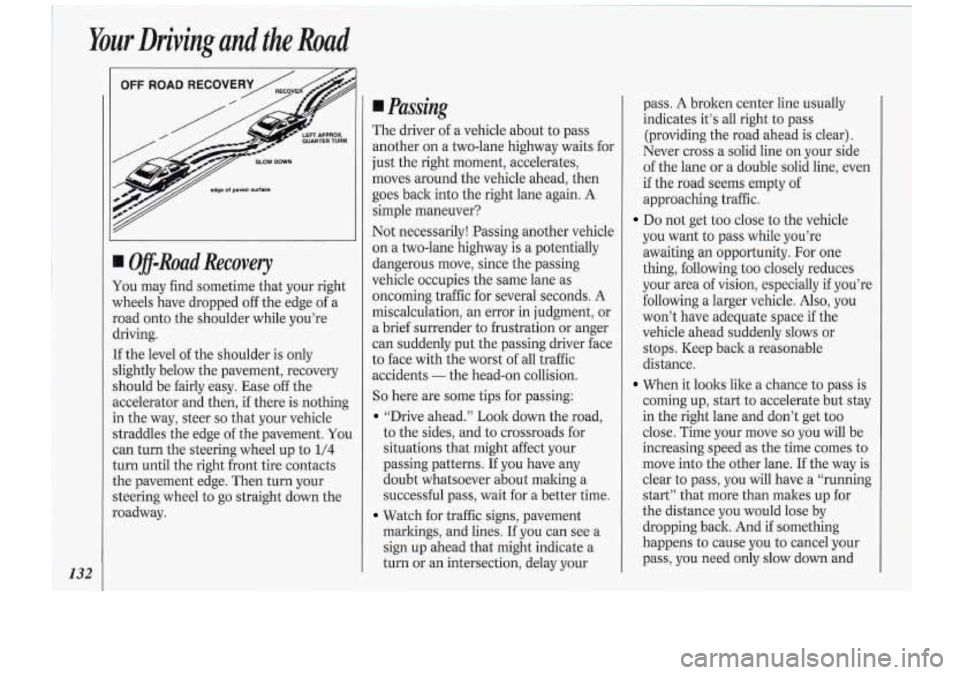
m-Road Recovery
You may find sometime that your right
wheels have dropped off the edge of a
road onto the shoulder while you’re
driving.
If the level of the shoulder is only
slightly below the pavement, recovery
should be fairly easy. Ease
off the
accelerator and then, if there is nothing
in the way, steer
so that your vehicle
straddles the edge of the pavement.
You
can turn the steering wheel up to 1/4
turn until the right front tire contacts
the pavement edge. Then turn your
steering wheel to go straight down the
roadway.
Passing
The driver of a vehicle about to pass
another on a two-lane highway waits for
just the right moment, accelerates,
moves around the vehicle ahead, then
goes back into the right lane again. A
simple maneuver?
Not necessarily! Passing another vehicle
on a two-lane highway is a potentially
dangerous move, since the passing
vehicle occupies the same lane as
oncoming traffic for several seconds. A
miscalculation, an error in judgment, or
a brief surrender to frustration
or anger
can suddenly put the passing driver face
to face with the worst of all traffic
accidents
- the head-on collision.
So here are some tips for passing:
“Drive ahead.” Look down the road,
to the sides, and to crossroads for
situations that might affect your
passing patterns.
If you have any
doubt whatsoever about making
a
successful pass, wait for a better time.
markings, and lines.
If you can see a
sign up ahead that might indicate
a
turn or an intersection, delay your
Watch for traffic signs, pavement pass. A broken center line
usually
indicates it’s all right to pass
(providing the road ahead is clear).
Never cross a solid line on
your side
of the lane or a double solid line, even
if the road seems empty of
approaching traffic.
Do not get too close to the vehicle
you want to pass while you’re
awaiting an opportunity. For one
thing, following too closely reduces
your area of vision, especially if you’re
following a larger vehicle. Also, you
won’t have adequate space
if the
vehicle ahead suddenly slows or
stops. Keep back a reasonable
distance.
When it looks like a chance to pass is
coming up, start to accelerate but stay
in the right lane and don’t get
too
dose. Time your move so you will be
increasing speed as the time comes to
move into the other lane.
If the way is
clear to pass, you will have a “running
start” that more than makes up for
the distance you would lose by
dropping back. And
if something
happens to cause
you to cancel your
pass, you need only slow down and
Page 136 of 276
Your Driving and the Road
134
steering, acceleration, or braking
(including engine bralting by shifting to
a lower gear). Any sudden changes
could cause the tires to slide. You may
not realize the surface is slippery until
your vehicle is skidding. Learn to
recognize warning clues
- such as
enough water, ice or packed snow on
the road to make a “mirrored surface”
- and slow down when you have any
doubt.
Remember: Any anti-lock braking system (ABS) helps avoid only the
braking skid.
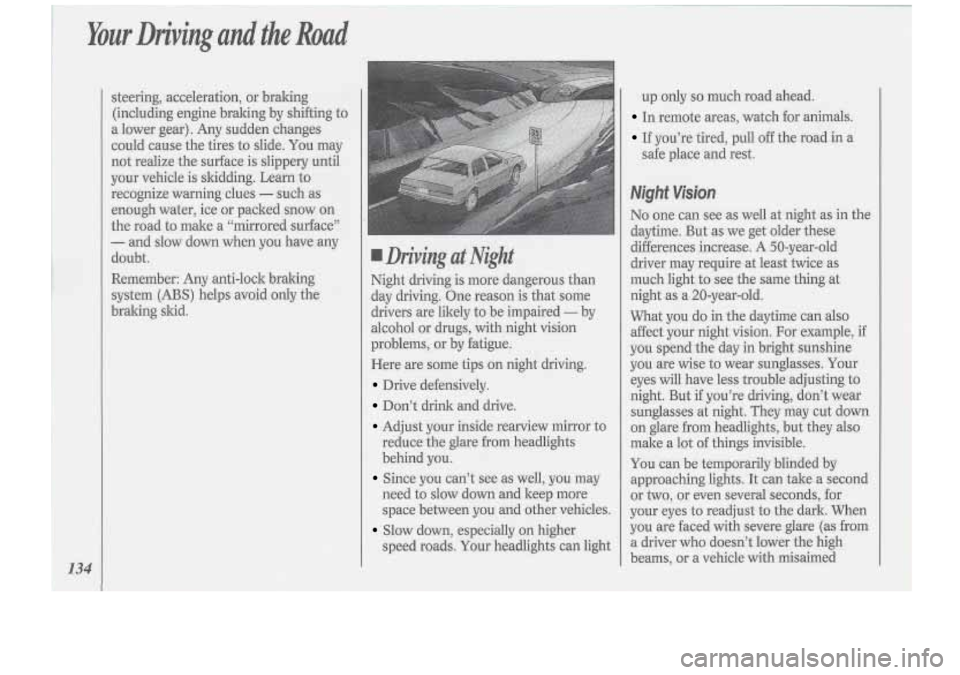
Driving at Night
Night driving is more dangerous than
day driving. One reason is that some
drivers are likely to be impaired
- by
alcohol or drugs, with night vision
problems, or by fatigue.
Here are some tips on night driving.
Drive defensively.
Don’t drink and drive.
Adjust your inside rearview mirror to
reduce the glare from headlights
behind you.
Since you can’t see as well, you may
need to slow down and keep more
space between you and other vehicles.
speed roads. Your headlights can light
Slow down, especially on higher up
only
so much road ahead.
In remote areas, watch for animals.
If you’re tired, pull off the road in a
safe place and rest.
Night Vision
No one can see as well at night as in the
daytime. But as we get older these
differences increase. A 50-year-old
driver may require at least twice as
much light to see the same thing at
night as
a 20-year-old.
What you do in the daytime can also
affect your night vision. For example,
if
you spend the day in bright sunshine
you are wise to wear sunglasses. Your
eyes will have less trouble adjusting to
night. But if you’re driving, don’t wear
sunglasses at night. They may cut down
on glare from headlights, but they also
make a lot of things invisible.
You can be temporarily blinded by
approaching lights. It can take a second
or two, or even several seconds, for
your eyes to readjust to the dark. When
you are faced with severe glare (as from
a driver who doesn’t lower the high
beams, or a vehicle with misaimed
i
Page 143 of 276
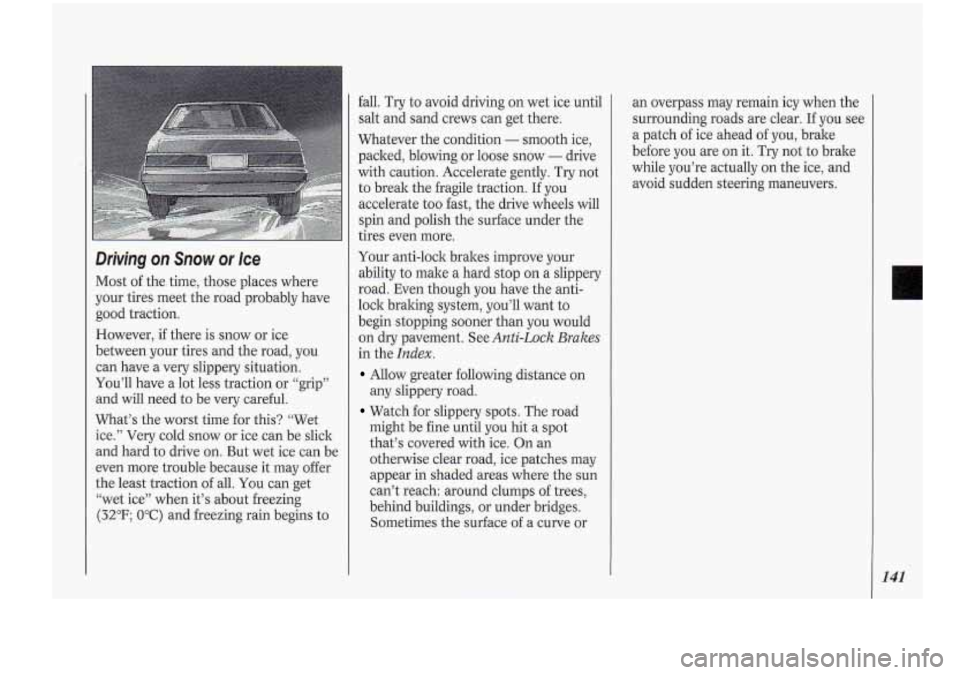
Driving on Snow or Ice
Most of the- time, those places where
your tires meet the road probably have
good traction.
However, if there is snow or ice
between your tires and the road, you
can have a very slippery situation.
You’ll have a lot less traction or “grip”
and will need to be very careful.
What’s the worst time for this? “Wet
ice.” Very cold snow or ice can be slick
and hard to drive on. But wet ice can be
even more trouble because it may offer
the least traction
of all. You can get
“wet ice” when it’s about freezing
(32°F; O’C) and freezing rain begins to fall. Try
to avoid driving
on wet ice until
salt and sand crews can get there.
Whatever the condition
- smooth ice,
packed, blowing or loose snow
- drive
with caution. Accelerate gently. Try not
to break the fragile traction. If you
accelerate too fast, the drive wheels will
spin and polish the surface under the
tires even more.
Your anti-lock brakes improve your
ability to make a hard stop on a slippery
road. Even though you have the anti-
lock braking system, you’ll want to
begin stopping sooner than you would
on dry pavement. See
Anti-Lock Brakes
in the Index.
Allow greater following distance on
any slippery road.
Watch for slippery spots. The road
might be fine until you hit a spot
that’s covered with ice. On an
otherwise clear road, ice patches may
appear in shaded areas where the sun
can’t reach: around clumps
of trees,
behind buildings, or under bridges.
Sometimes the surface of
a curve or an
overpass may remain icy when the
surrounding roads are clear.
If you see
a patch
of ice ahead of you, brake
before you are
on it. Try not to brake
while you’re actually on the ice, and
avoid sudden steering maneuvers.
141
Page 148 of 276
Your Driving and the Road
146
Safety Chains
You should always attach chains
between your vehicle and your trailer.
Cross the safety chains under the
tongue of the trailer
so that the tongue
will not drop to the road if it becomes
separated from the hitch. Instructions
about safety chains may be provided by
the hitch manufacturer or by the trailer
manufacturer. Follow the
manufacturer’s recommendation for
attaching safety chains. Always leave
just enough slack
so you can turn with
your rig. And, never allow safety chains
to drag
on the ground.
Trailer Brakes
Because you have anti-lock brakes,
don’t try to tap into your vehicle’s brake
system at all.
If you do, both brake
systems won’t work well or
at all.
Driving with a Trailer
Towing a trailer requires a certain
amount of experience. Before setting
out for the open road, you’ll want to get
to laow your rig. Acquaint yourself with
the feel
of handling and braking
with the added weight of the trailer.
And always keep in mind that the
vehicle you are driving is now a good
deal longer and not nearly
so responsive
as your vehicle is by itself.
Before you start, check the trailer hitch
and platform, safety chains, electrical
connector, lights, tires and mirror
adjustment.
If the trailer has electric
brakes, start your vehicle and trailer
moving and then apply the trailer brake
controller by hand to be sure the brakes
are working. This lets you check your
electrical connection at the same time.
During your trip, check occasionally to
be sure that the load is secure, and that
the lights and any trailer brakes are still
working.
Following Distance
Stay at least twice as far behind the
vehicle ahead as you would when
driving your vehicle without a trailer.
This can help you avoid situations that
require heavy braking and sudden
turns.
Passing
You’ll need more passing distance up
ahead when you’re towing a trailer.
And, because you’re a good deal longer,
you’ll need to go much farther beyond
the passed vehicle before you can return
to your lane.
Backing Up
Hold the bottom of the steering wheel
with one hand. Then, to move the
trailer to the left, just move that hand to
the left. To move the trailer to the right,
move your hand
to the right. Always
back up slowly and,
if possible, have
someone guide you.
Making Turns
When you’re turning with a trailer,
make wider turns than normal. Do this
so your trailer won’t strike soft
shoulders, curbs, road signs, trees, or
other objects. Avoid jerky or sudden
maneuvers. Signal well in advance.
Page 157 of 276
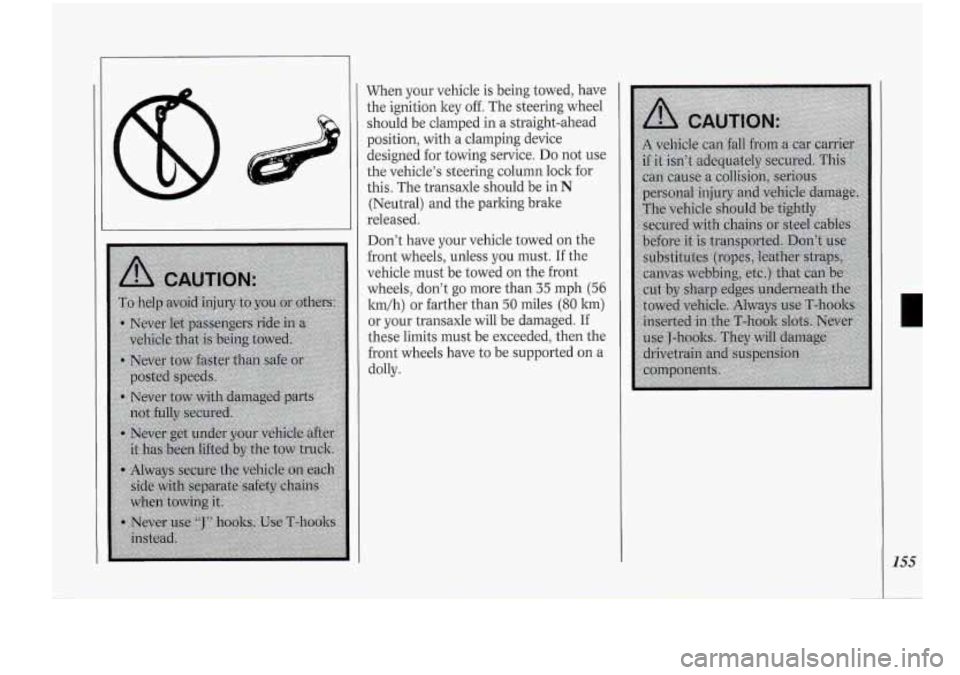
When your vehicle is being towed, have
the ignition key
off. The steering wheel
should be clamped in a straight-ahead
position, with a clamping device
designed for towing service. Do not use
the vehicle’s steering column lock for
this. The transaxle should be in
N
(Neutral) and the parking brake
released.
Don’t have your vehicle towed on the
front wheels, unless
you must. If the
vehicle must be towed on the front
wheels, don’t go more than
35 mph (56
ltm/h) or farther than 50 miles (80 ltm)
or your transaxle will be damaged. If
these limits must be exceeded, then the
front wheels have to be supported on a
dolly.
c
155
Page 167 of 276
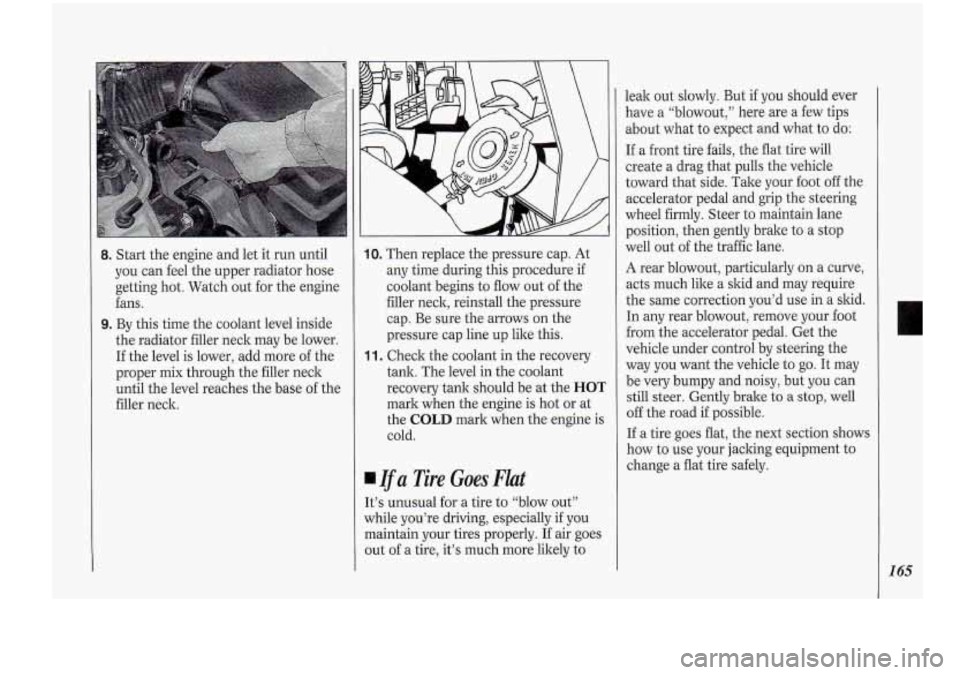
8. Start the engine and let it run until
you can feel the upper radiator hose
getting hot. Watch out for the engine
fans.
9. By this time the coolant level inside
the radiator filler neck may be lower.
If the level is lower, add more of the
proper mix through the filler neck
until the level reaches the base of the
filler neck.
10. Then replace the pressure cap. At
any time during this procedure if
coolant begins to flow out of the
filler neck, reinstall the pressure
cap. Be sure the arrows on the
pressure cap.line up like this.
11. Check the coolant in the recovery
tank. The level in the coolant
recovery tanlc should be at the
HOT
mark when the engine is hot or at
the
COLD mark when the engine is
cold.
Ifa Tire Goes Flat
It’s unusual for a tire to “blow out”
while you’re driving, especially
if you
maintain your tires properly. If air goes
out of a tire, it’s much more likely to
leak out slowly. But if you should ever
have
a “blowout,” here are a few tips
about what to expect and what to
do:
If a front tire fails, the flat tire will
create a drag that pulls the vehicle
toward that side. Take your foot off the
accelerator pedal and grip the steering
wheel firmly. Steer to maintain lane
position, then gently brake to a stop
well out of the traffic lane.
A rear blowout, particularly on a curve,
acts much like a slid and may require
the same correction you’d use
in a skid.
In any rear blowout, remove your foot
from the accelerator pedal. Get the
vehicle under control by steering the
way you want the vehicle to go. It may
be very bumpy and noisy, but you can
still steer. Gently brake to a stop, well
off the road if possible.
If a tire goes flat, the next section shows
how to use your jacking equipment to
change a flat tire safely.
165
Page 184 of 276
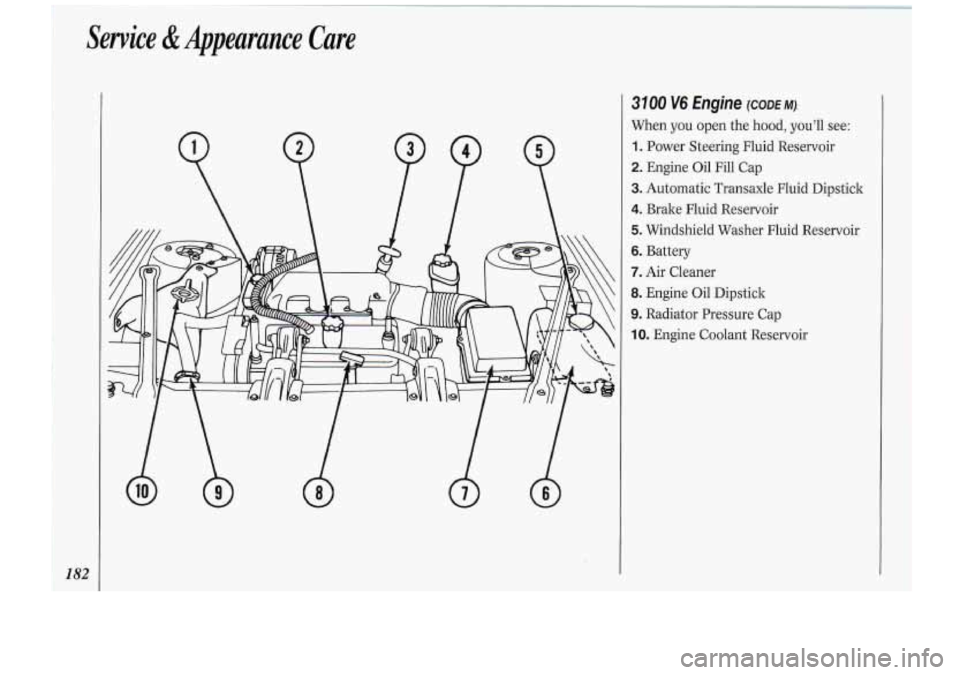
Service & Appearanctr Care
3700 V6 Engine (CODE M).
When you open the hood, you’ll see:
1. Power Steering Fluid Reservoir
2. Engine Oil Fill Cap
3. Automatic Transaxle Fluid Dipstick
4. Brake Fluid Reservoir
5. Windshield Washer Fluid Reservoir
6. Battery
7. Air Cleaner
8. Engine Oil Dipstick
9. Radiator Pressure Cap
IO. Engine Coolant Reservoir
Page 185 of 276
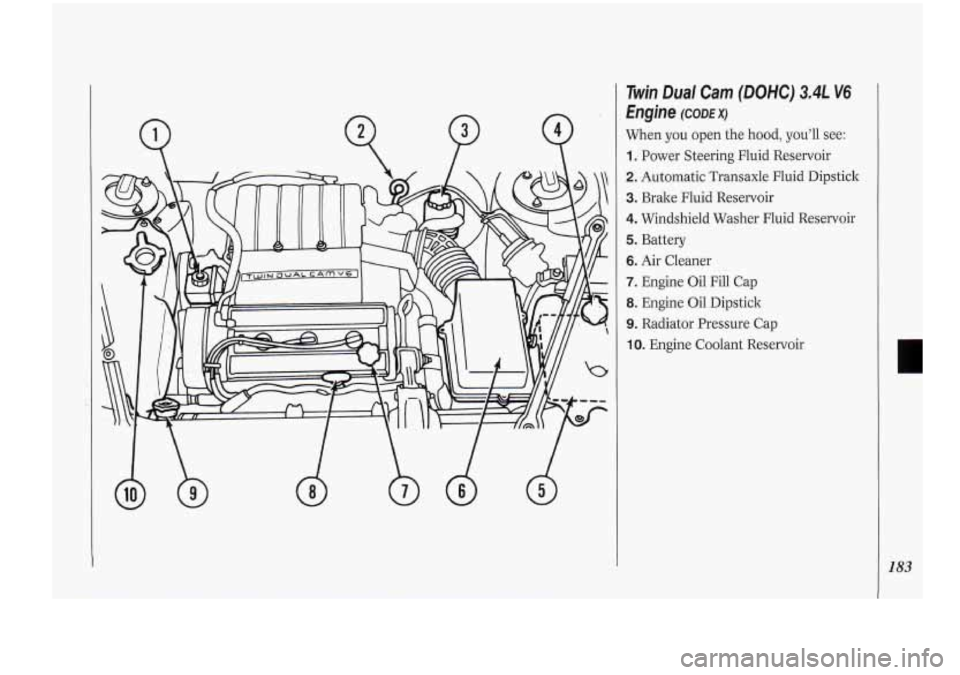
Twin Dual Cam (DOHC) 3.4L V6
Engine (CODE x)
When you open the hood, you’ll see:
1. Power Steering Fluid Reservoir
2. Automatic Transaxle Fluid Dipstick
3. Brake Fluid Reservoir
4. Windshield Washer Fluid Reservoir
5. Battery
6. Air Cleaner
7. Engine Oil Fill Cap
8. Engine Oil Dipstick
9. Radiator Pressure Cap
IO. Engine Coolant Reservoir
183