wheel Oldsmobile Cutlass Supreme 1994 s Owner's Guide
[x] Cancel search | Manufacturer: OLDSMOBILE, Model Year: 1994, Model line: Cutlass Supreme, Model: Oldsmobile Cutlass Supreme 1994Pages: 276, PDF Size: 14.73 MB
Page 159 of 276
NOTICE:
Towing a vehicle over rough
surfaces could damage
a vehicle.
Damage can occur
from vehicle to
ground or vehicle to wheel-lift
equipment.
To help avoid damage,
install a towing dolly and raise
vehicle until adequate clearance is
obtained between the ground
and/or wheel-lift equipment.
Do not attach winch cables or
J-
hooks to suspension components
when using car carrier equipment.
Always use T-hooks inserted in the
T-hook slots.
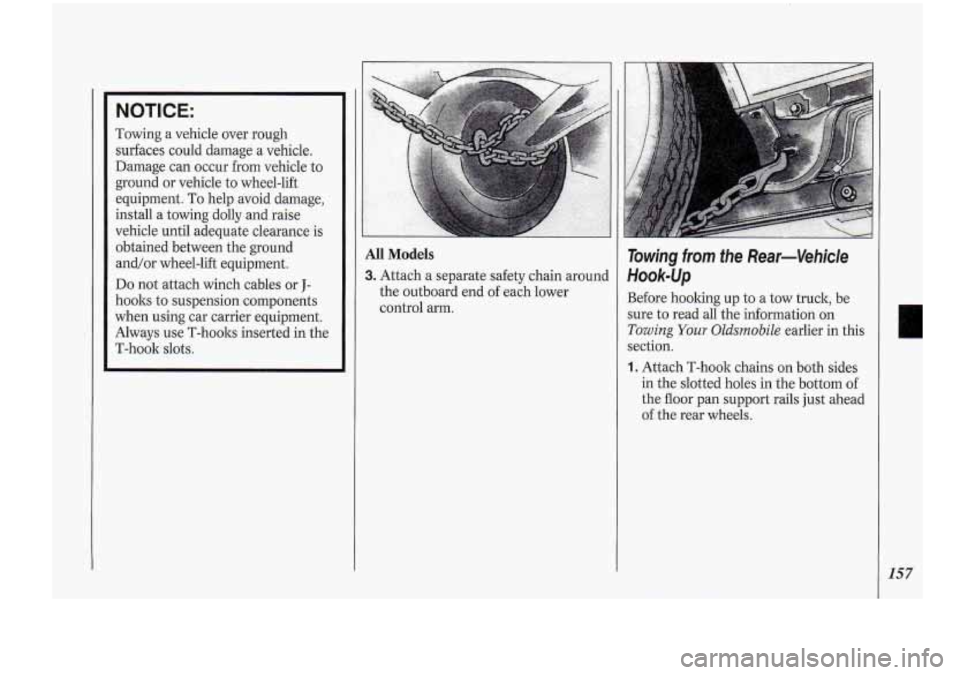
AN Models
3. Attach a separate safety chain around
the outboard end
of each lower
control arm.
157
Page 167 of 276
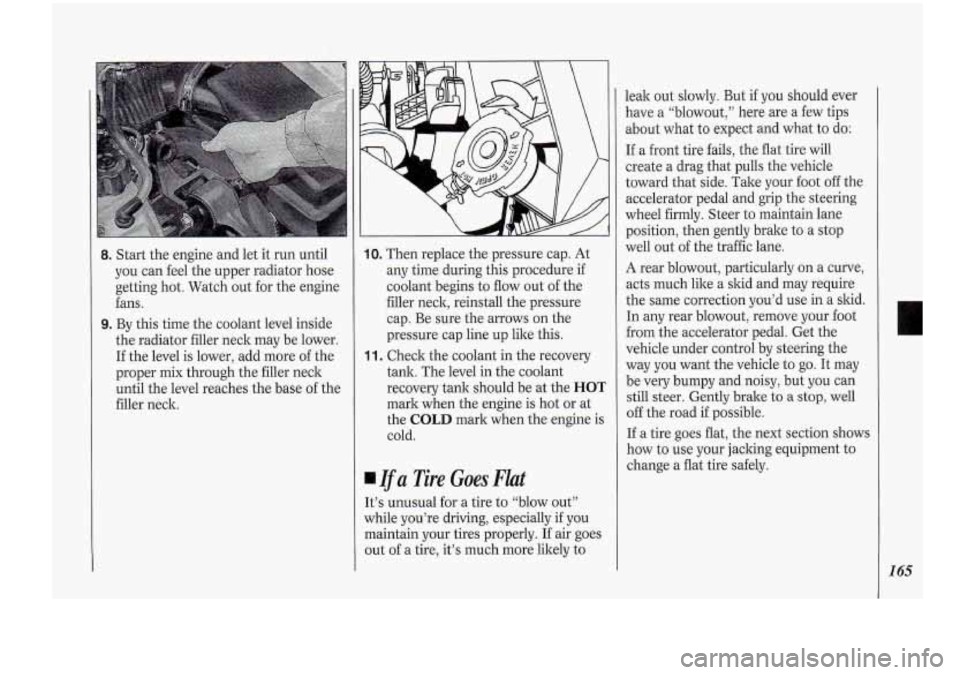
8. Start the engine and let it run until
you can feel the upper radiator hose
getting hot. Watch out for the engine
fans.
9. By this time the coolant level inside
the radiator filler neck may be lower.
If the level is lower, add more of the
proper mix through the filler neck
until the level reaches the base of the
filler neck.
10. Then replace the pressure cap. At
any time during this procedure if
coolant begins to flow out of the
filler neck, reinstall the pressure
cap. Be sure the arrows on the
pressure cap.line up like this.
11. Check the coolant in the recovery
tank. The level in the coolant
recovery tanlc should be at the
HOT
mark when the engine is hot or at
the
COLD mark when the engine is
cold.
Ifa Tire Goes Flat
It’s unusual for a tire to “blow out”
while you’re driving, especially
if you
maintain your tires properly. If air goes
out of a tire, it’s much more likely to
leak out slowly. But if you should ever
have
a “blowout,” here are a few tips
about what to expect and what to
do:
If a front tire fails, the flat tire will
create a drag that pulls the vehicle
toward that side. Take your foot off the
accelerator pedal and grip the steering
wheel firmly. Steer to maintain lane
position, then gently brake to a stop
well out of the traffic lane.
A rear blowout, particularly on a curve,
acts much like a slid and may require
the same correction you’d use
in a skid.
In any rear blowout, remove your foot
from the accelerator pedal. Get the
vehicle under control by steering the
way you want the vehicle to go. It may
be very bumpy and noisy, but you can
still steer. Gently brake to a stop, well
off the road if possible.
If a tire goes flat, the next section shows
how to use your jacking equipment to
change a flat tire safely.
165
Page 168 of 276
Problems on the Road
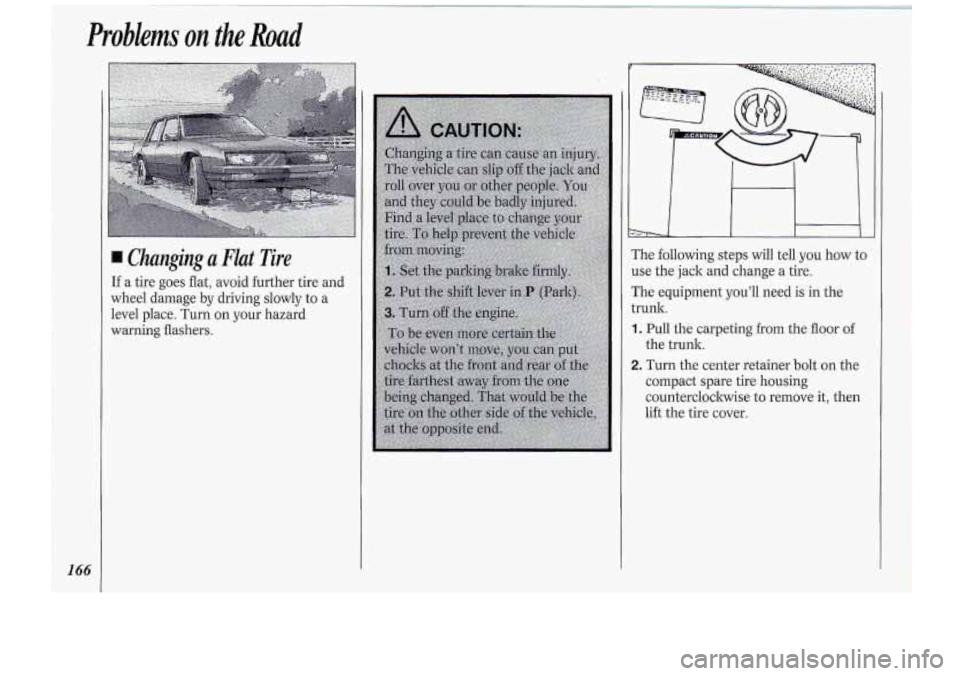
Changing a Flat Tire
If a tire goes flat, avoid further tire and
wheel damage by driving slowly to a
level place. Turn on your hazard
warning flashers. The
following steps will tell-you how to
use the jack and change a tire.
The equipment you’ll need is in the
trunk.
1. Pull the carpeting from the floor of
the trunk.
2. Turn the center retainer bolt on the
compact spare tire housing
countercloclmise to remove it, then
lift the tire cover.
Page 169 of 276
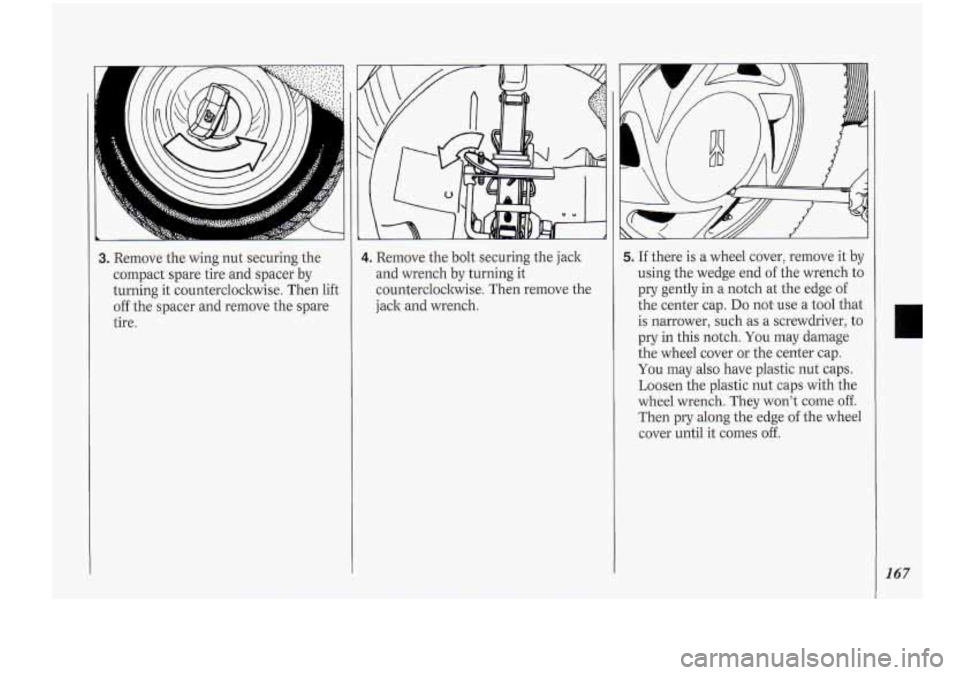
3. Remove the wing nut securing the
compact spare tire and spacer by
turning it countercloclwise. Then lift
off the spacer and remove the spare
tire.
4. Remove the bolt securing the jack
and wrench by turning
it
countercloclwise. Then remove the
jack and wrench.
5. If there is a wheel cover, remove it by
using the wedge end
of the wrench to
pry gently in
a notch at the edge.of
the center cap.
Do not use a tool that
is narrower, such as a screwdriver, to
pry in this notch.
You may damage
the wheel cover or the center cap.
You may also have plastic nut caps.
Loosen the plastic nut caps with the
wheel wrench. They won’t come
off.
Then pry along the edge of the wheel
cover until it comes
off.
167
Page 170 of 276
Problems on the Road
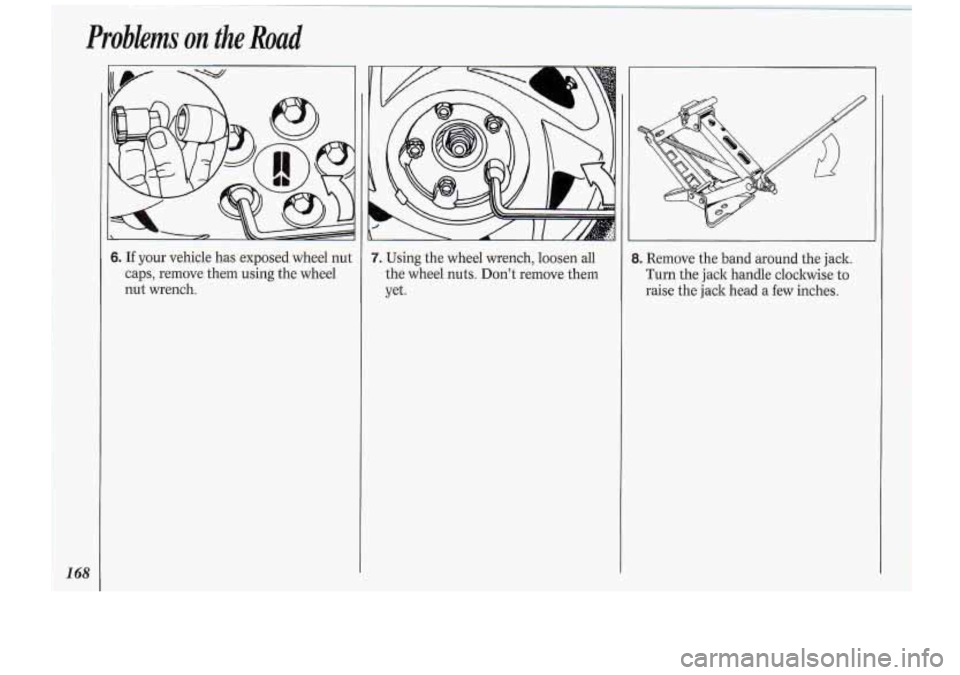
6. If your vehicle has exposed wheel nut
caps, remove them using the wheel
nut wrench.
7. Using the wheel wrench, loosen all
the wheel nuts. Don’t remove them
yet. 3. Remove the band around the jack.
Turn the jack handle clockwise
to
raise the jack head a few inches.
Page 171 of 276
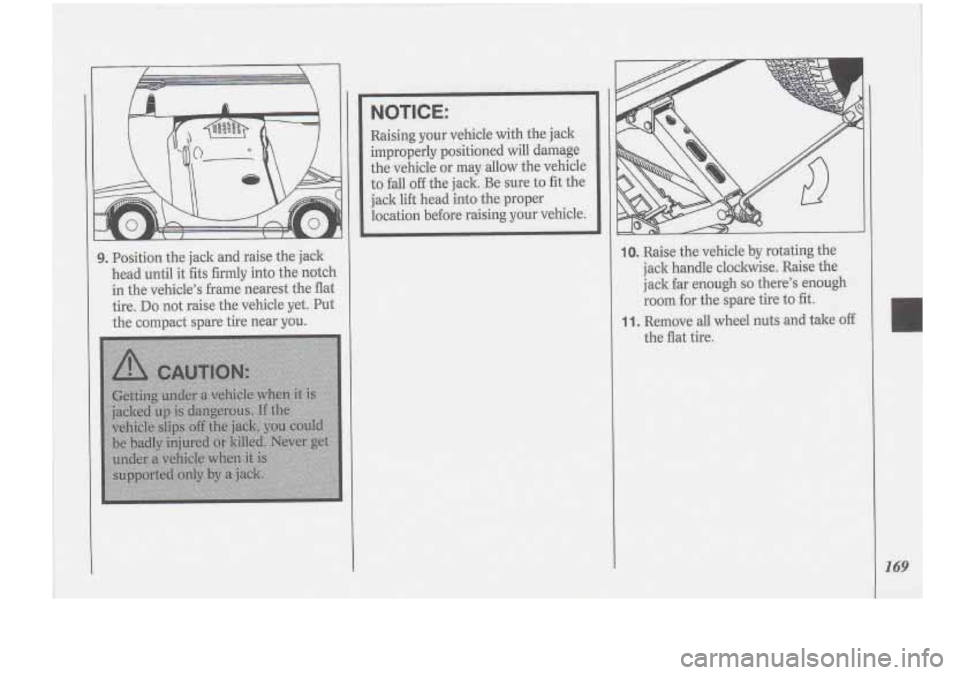
9. Position the jack and raise the jack
head until it fits
firmly into th’e notch
in the vehicle’s -frame nearest the flat
tire.
Do not raise the vehicle yet. -Put
the compact spare tire near
you.
NOTICE:
IO. Raise the vebide by rotating the
jack han8dle clockwise. Raise the
jack far enough
so there’s enough
room for the spare tire to fit.
the flat tire.
1 1. Remove all wheel nuts and take off
Page 172 of 276
Probkms on the Road
1 70
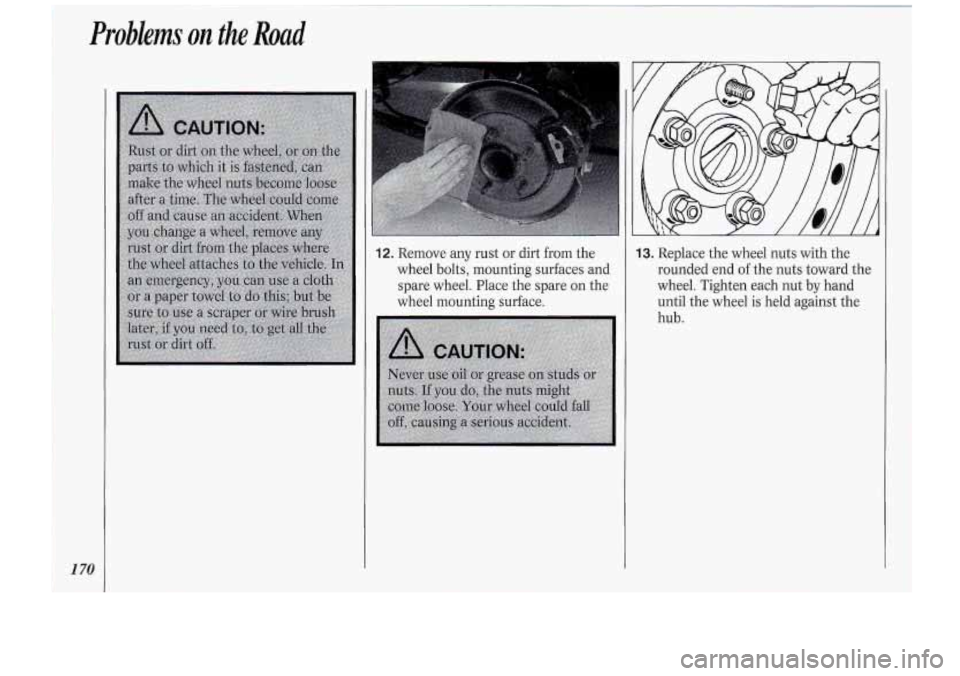
12. Remove any rust or dirt from the
wheel bolts, mounting surfaces and
spare wheel. Place the spare on the
wheel mounting surface. 13. Replace the wheel nuts with the
rounded end
of the nuts toward the
wheel. Tighten each nut by hand
until the wheel is held against the
hub.
Page 173 of 276
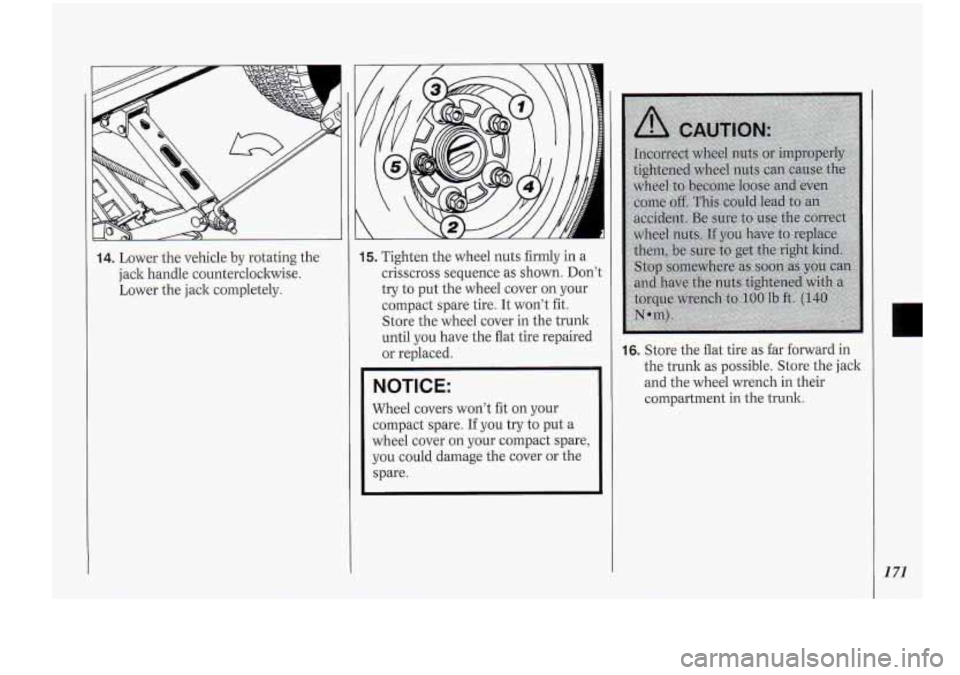
14. Lower the vehicle by rotating the
jack handle counterclockwise.
Lower the jack completely. 15. Tighten the wheel nuts firmly in a
cr&cross sequence as shown. Don’t
try to put the wheel cover on your
compact spare tire. It won’t fit. Store the wheel cover in the trunk
until you have the flat tire repaired
or replaced.
NOTICE:
Wheel covers won’t fit on your
compact spare. If you try to put a
wheel cover on your compact spare,
you could damage the cover or the
spare.
16. Store the flat tire as far forward in
the trunk as possible. Store the jack
and the wheel wrench in their
compartment in the trunk.
171
Page 196 of 276
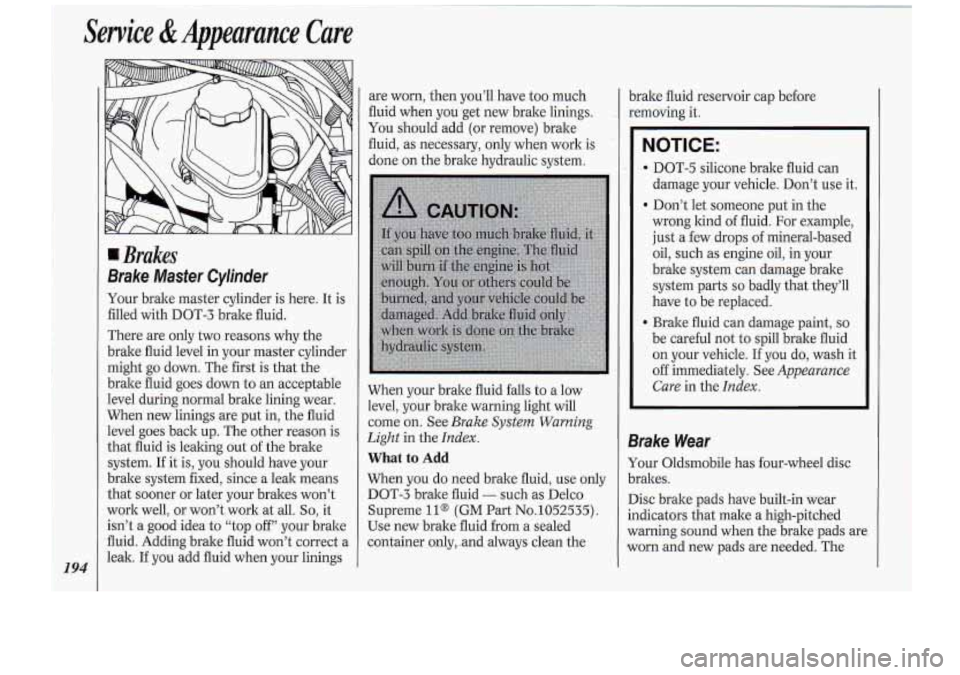
are worn, then you'll have. too much
ff uid when you get new brake linings.
YOU should add (or remove) brake
fluid, as necessary, only when work is
done
on the brake hydraulic system.
194
When your brake fldd falls to a low
level, your brake warning light will
come on. See
Brake Syste-m Warning
Light in the Index.
What to Add
When you do need brake fluid, use o.nly
DOT-3 brake fluid - such as Delco
Supreme
11s (GM Part No. 1052535).
Use new brake fluid from a sealed
container
only, .and always clean the brake
fluid reservoir cap
before
removing it.
Brake Wear
Your Oldsmobile has four-wheel disc
brakes.
Disc brake pads have builtin wear
indicators that make
a high-pitched
warning sound when the brake pads are
worn and new pads are needed. Be
Page 210 of 276
208
How to Check
Use a good quality pocket-type gage to
check tire pressure. Simply looking at
the tires will not tell you the pressure,
especially if you have radial tires
-
which may look properly inflated even if
they’re underinflated.
If your tires have valve caps, be sure to
put them back on. They help prevent
leaks by keeping out dirt and moisture.
~
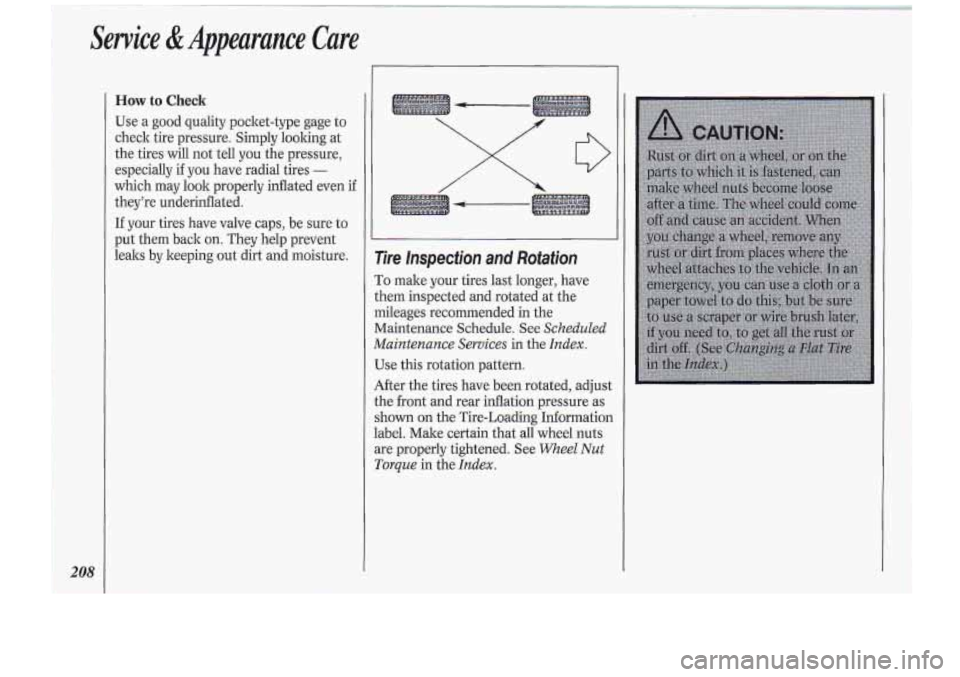
Tire lnspection and Rotation
To make your tires last longer, have
them inspected and rotated at the
mileages recommended in the
Maintenance Schedule.
See Scheduled
Maintenance Services
in the Index.
Use this rotation pattern.
After the tires have been rotated, adjust
the front and rear inflation pressure as
shown
on the Tire-Loading Information
label. Make certain that all wheel nuts
are properly tightened. See
Wheel Nut
Torque in the Index.