check oil Oldsmobile Cutlass Supreme 1994 Owner's Manuals
[x] Cancel search | Manufacturer: OLDSMOBILE, Model Year: 1994, Model line: Cutlass Supreme, Model: Oldsmobile Cutlass Supreme 1994Pages: 276, PDF Size: 14.73 MB
Page 96 of 276
94
P
,w 0I.L LOW
EVEL COOLANT I
I
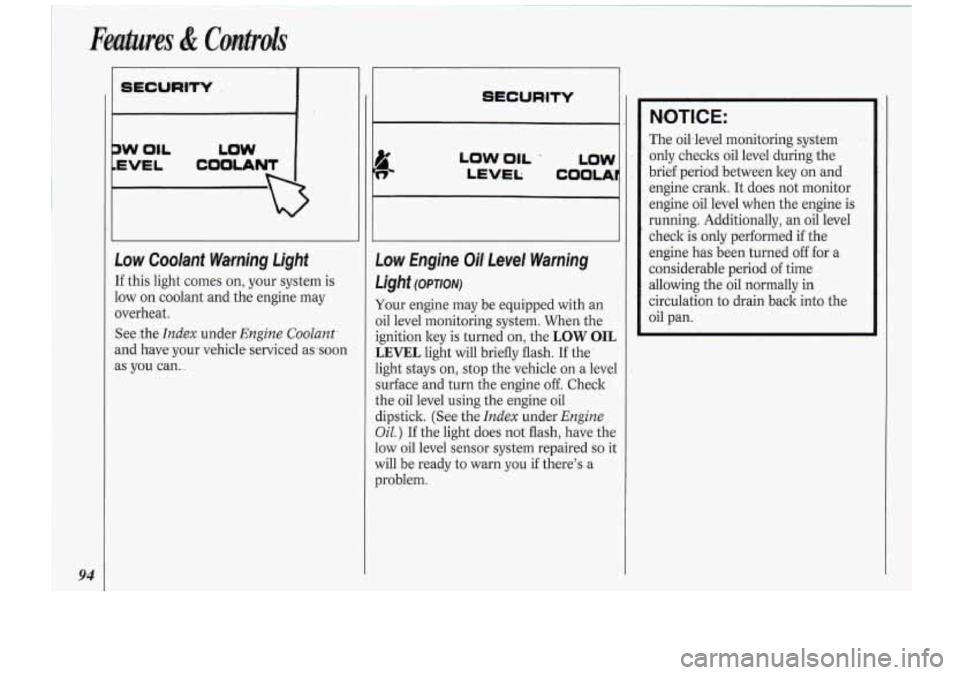
Low Coolant Wa-mjng Light
If this light comes on, your system is
low on coolant and the engine may
overheat.
See .the
Index. under Engine Coolant.
and have your vehicle serviced as.soon
as you can
...
LOW 'OIL .
LEV-E L; COOLA
Low Engine Oil- Level Warning
Light
(omorv)
Your engine may be equipped with an
oil level monitoring system. When. the
ignition key is turned on, the
LOW OIL
LEVEL light will briefly flash. If the
light stays
on, stop the vehicle on a level
surface and turn the engine off. Check
the oil level using the engine oil
dipstick. (See the
Index under Engine
Oil.) If the light does not flash, have the
low oil level sensor system repaired
so it
will be ready to warn you if there's a
problem.
NOTIC E:
The oil.leve1 monitoring system
only checks oil level during the
brief period between key on and
engine crank. It does not monitor
engine oil level when the engine is
running. Additionally, an oil level
check is only performed if the
engine has been turned off for a
considerable peri.od of time
allowing the oil normally in
circulation to drain back into the
oil pan.
Page 100 of 276
Features & Controls
98
NOTICE:
If you keep driving your vehicle
with this light on, after
a while the
emission controls won’t work as
well, your fuel economy won’t be as
good and your engine may not run
as smoothly. This could lead to
costly repairs not covered by your
warranty. CHECK
GAGES
1 ANTI-
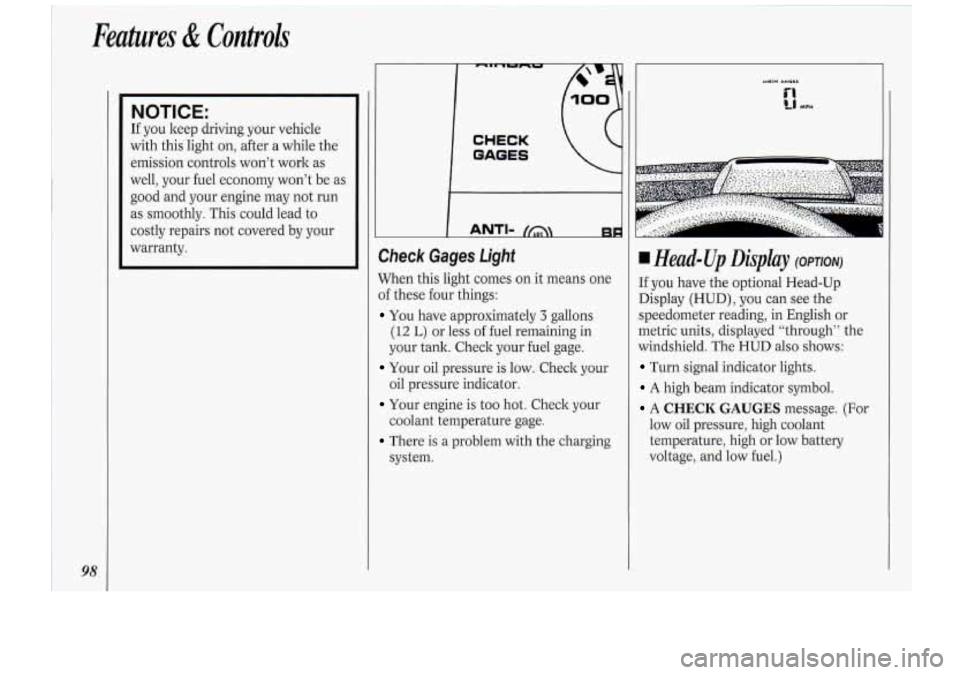
Check Gages Light
When this light comes on it means one
of these four things:
You have approximately 3 gallons
(12 L) or less of fuel remaining in
your tank. Check your fuel gage.
Your oil pressure is low. Check your
oil pressure indicator.
Your engine is too hot. Check your
coolant temperature gage.
There is a problem with the charging
system.
Head-Up Displcly (OP~ONJ
If you have the optional Head-Up
Display (HUD), you can see the
speedometer reading, in English or
metric units, displayed “through” the
windshield. The
HUD also shows:
Turn signal indicator lights.
A high beam indicator symbol.
A CHECK GAUGES message. (For
low oil pressure, high coolant
temperature, high or low battery
voltage, and low fuel.)
Page 140 of 276
Your Driving and the Road
The exit sp leed is usu.alll J posted.
Reduce your speed according to your
speedometer, not to your sense
of
motion. After driving for any distance at
higher speeds, you may tend to think
you are going slower than you actually
are.
4 Before Leaving on a Long
Trip
Make sure you’re ready. Try to be well
rested.
If you must start when you’re
not
fr&- such as after a day’s work
- don’t plan to make too many miles
that first part of the journey. Wear
comfortable clothing and shoes
you can
easily drive in.
Is your vehicle ready for a long trip? If
you keep it serviced and maintained, it’s
ready
to go. If it needs service, have it
done before starting out. Of course,
you’ll find experienced and able service
experts in Oldsmobile dealerships all
across North America. They’ll be ready
and willing to help
if you need it.
Here are some things you can check
before a trip:
a
Windshield Washer Fluid: Is the
reservoir full? Are all windows clean
inside and outside?
Wiper Blades: Are they in good
Fuel, Engine Oil, Other Fluids: Have
Lights: Are they all working? Are the
shape?
you checked all levels?
lenses clean?
Tires: They are vitally impartant to a
safe, trouble-free trip.
Is the tread
good enough far long-distance
driving? Are the tires all inflated
to
the recommended pressure?
weather outlook along your route?
Should you delay your trip a short
time to avoid
a major storm system?
Maps: Do you have up-to-date maps?
Weather Forecasts: What’s the
I Highway Hypnosis
Is there actually such a condition as
“highway hypnosis”? Or is it just plain
falling asleep at the wheel? Call it
highway hypnosis, lack of~awareness, or
whatever.
Page 150 of 276
Mainfenance When Trailer Towing
Your vehicle will need service :nore
often when you’re pulling a trailer. See
the
Maintenance Schedule for more on
this. Things that are especially
important in trailer operation are
automatic transaxle fluid (don’t
overfill), engine oil, belts, cooling
system, and brake adjustment. Each of
these is covered in this manual, and the
Index will help you find them quickly. If
you’re trailering, it’s a good idea to
review these sections before you start
your trip.
Check periodically to see that all hitch
nuts and bolts are tight.
Page 186 of 276
Service & Appearance Care
Engine Oil
If the LOW OIL LEVEL light on the
instrument panel comes
on, it means
you need to check your engine oil level
right away. For more information, see
Low Oil Level Light in the Index. You
should check your engine oil level
regularly; this is an added reminder.
It’s a good idea to check your engine .oil
:
every time you get fuel. In order to get
an accurate reading, the oil must be
warm and the vehicle must be on level
ground.
Turn
off the engine and give the 0il.a
few minutes to drain back into the
oil
pan. If you don’t, the oil dipstick might
not show the actual level.
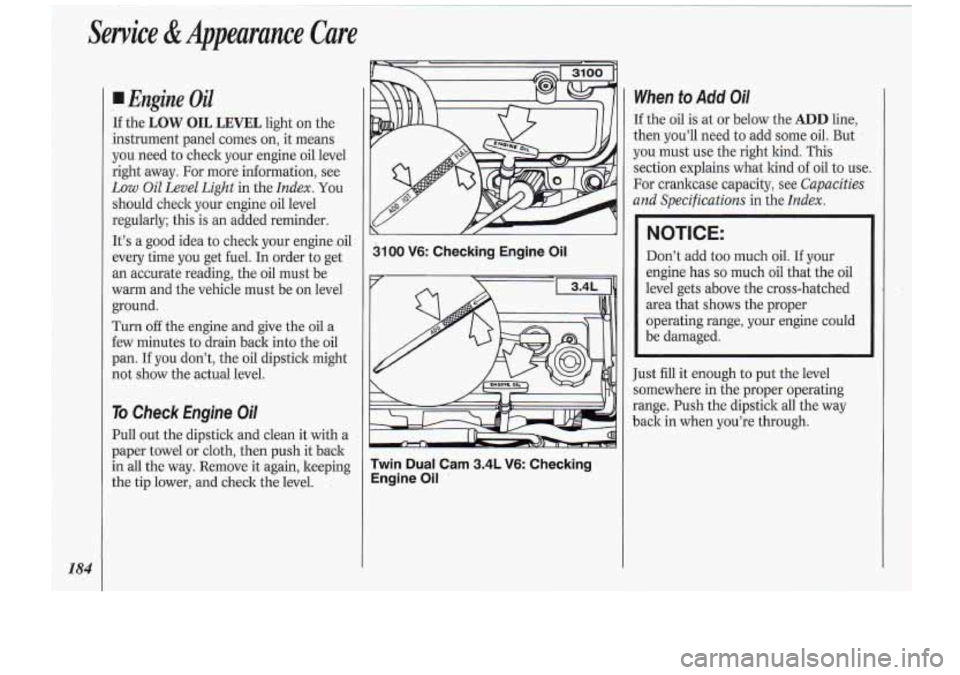
To Check Engine Oil
Pull out the dipstick and clean it with-a
paper towel or cloth, then push it bzck
in all the way. Remove it again, keeping
the tip lower, and check the level.
3100 V6: Checking Engine Oil
Twin
Dual Cam 3.4L V6: Checking
Engine Oil
’
When to Add Oil
If the oil is at or below the ADD line,
then you’ll need to add some
oil. But
you must use the right kind. This
section explains what kind
of oil to use.
For crankcase capacity, see
Capacities
and Specifications
in the Index.
NOTICE:
Don’t add too much oil. If your
engine has
so much oil that the oil
level gets above the cross-hatched
area that shows the proper
operating range, your engine could
be damaged.
Just fill it enough to put the level
somewhere in the proper operating
range. Push the dipstick all the way
back in when you’re through.
Page 189 of 276
cold weather, 0°F (-18°C) or colder. If
your vehicle has this option, see
Engine
Coolant Heater
in the Index.
What to Do wifh Used Oil
Did you know that used engine oil
contains certain elements that may be
unhealthy for your skin and could even
cause cancer? Don’t let used oil stay on
your skin for very long. Clean your skin
and nails with soap and water, or a
good hand cleaner. Wash or properly
throw away clothing or rags containing
used engine oil.. (See the manufacturer’s
warnings about the use and disposal of
oil products.)
Used oil can be areal threat to the
environment. If you change your own
oil, be sure to drain all free-flowing oil
from the filter before disposal. Don’t
ever dispose of oil by putting it in the
trash, pouring it on the ground, into
sewers, or into streams or bodies of
water. Instead, recycle it by taking it to
a place that collects used oil. If you
have a problem properly disposing of
your used oil, ask your dealer, a service
station or a local recycling center for
help.
Air Cleaner
Refer to the Maintenance Schedule to
determine when to replace the air filter
and the crankcase ventilation filter.
See
Scheduled Maintenance Services i3
the
Index.
NOTICE:
If the air cleaner is off, a backfire
can cause a damaging engine fire.
And, dirt can easily get into your
engine, which will damage
it.
Always have the air cleaner in place
when you’re driving.
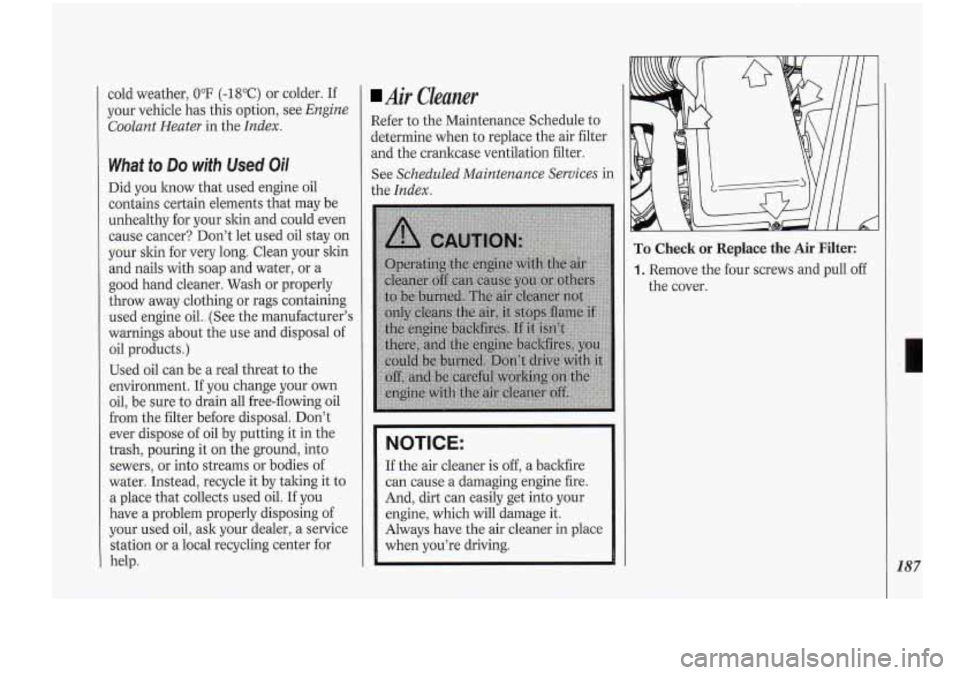
To Check or Replace the Air Filter:
1. Remove the four screws and pull off
the cover.
187
Page 190 of 276
Service & Appearance Care
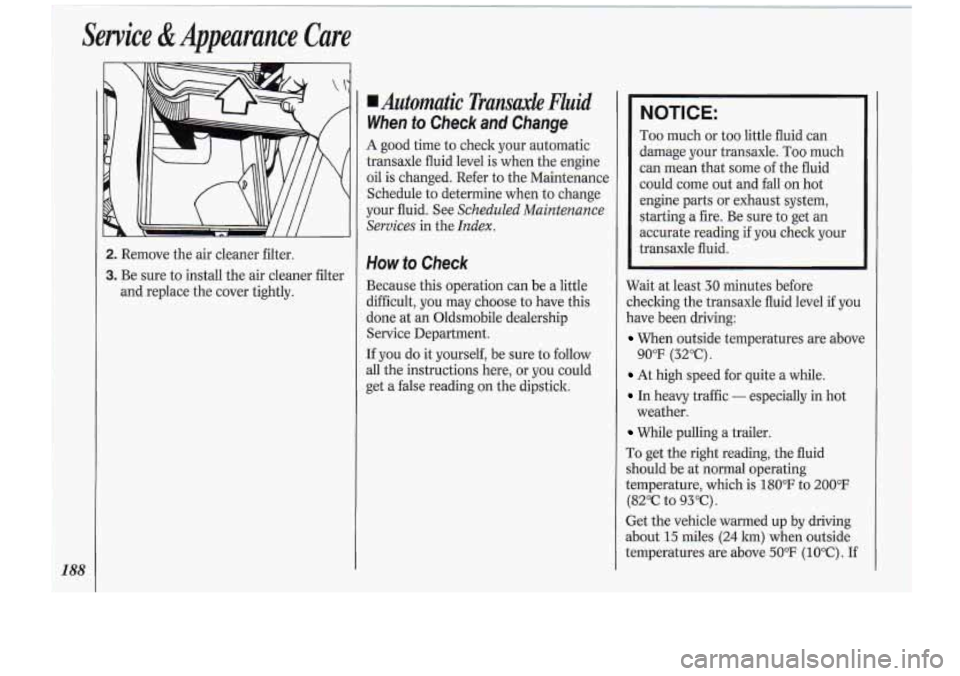
2. Remove the air cleaner filter.
3. Be sure to install the air cleaner filter
and replace the cover tightly.
Automatic Transaxk Fluid
When fo Check and Change
A good time to check your automatic
transaxle fluid level is when the engine
oil is changed. Refer to the Maintenance
Schedule to determine when to change
your fluid. See
Scheduled Maintenance
Services
in the Index.
How to Check
Because this operation can be a little
difficult, you may choose to have this
done at an Oldsmobile dealership
Service Department.
If you do it yourself, be sure to follow
all the instructions here, or
you could
get
a false reading on the dipstick.
NOTICE:
Too much or too.little fluid can
damage your transaxle.
Too much
can mean that some of the fluid
could come out and fall
on hot
engine parts
or exhaust system,
starting a
fire. Be sure to get an
accurate reading if you check your
transaxle fluid.
Wait at least
30 minutes before
checking the transaxle fluid level
if you
have been driving:
When outside temperatures are above
At high speed for quite a while.
In heavy traffic - especially in hot
90°F (32°C).
weather.
While pulling a trailer.
To get the right reading, the fluid
should be at
normal operating
temperature, which is 18O"F-to
2OOpF
(82°C to 93T).
Get the vehicle warmed up by driving
about
15 miles (24 lun) 'when outside
temperatures are above
50°F (10°C). If
Page 193 of 276
NOTICE:
If you use an improper coolant mix,
your engine could overheat and be
badly damaged. The repair cost
wouldn’t be covered by your
warranty.
Too much water in the
mix can freeze and crack the
engine, radiator, heater core and other parts.
Adding Coolant
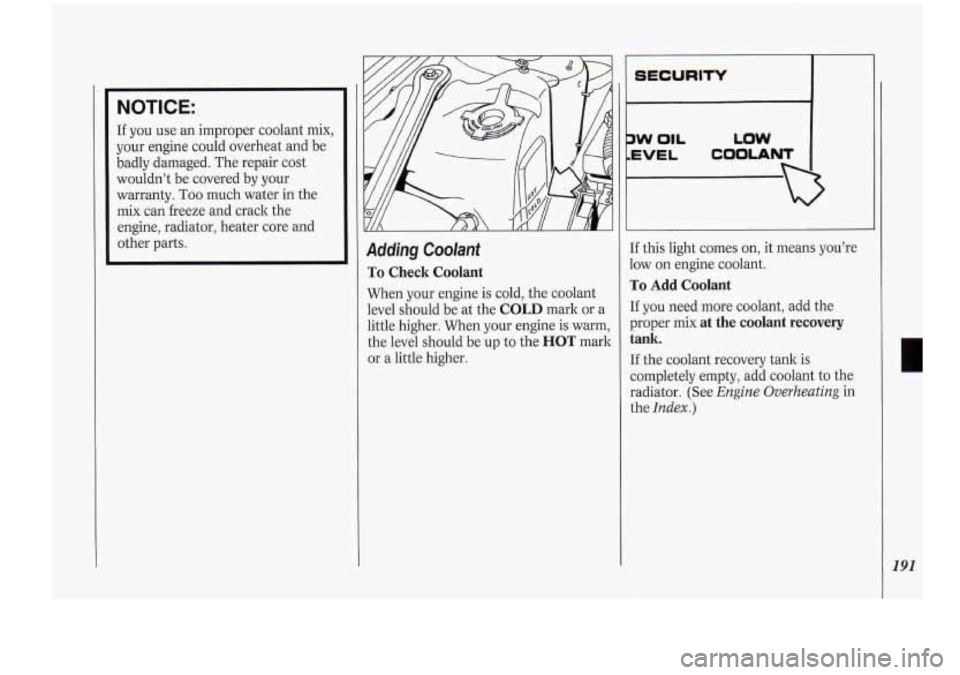
To Check Coolant
When your engine is cold, the coolant
level should be at the
COLD mark or a
little higher. When your engine is warm,
the level should be up to the
HOT mark
or a little higher.
1 SECURITY I
P
w OIL LOW
EVEL COOLANT I
If this light comes on, it means you’re
low on engine coolant.
To Add Coolant
If you need more coolant, add the
proper mix
at the coolant recovery
tank.
If the coolant recovery tank is
completely empty, add coolant to the
radiator. (See
Engine Overheating in
the
Index.)
191
Page 244 of 276
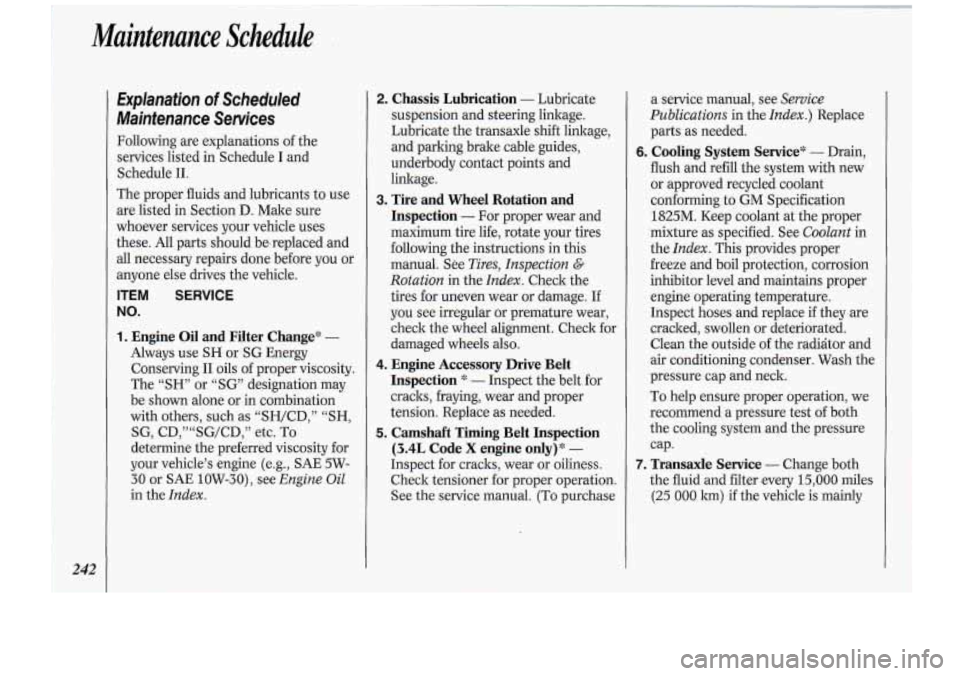
Maintenance Schedule
242 ~
Explanation of~scheduled
Mainfenance Services
Following are explanations of the
services listed in Schedule I and
Schedule
11.
The proper fluids and lubricants to use
are listed in Section D. Make sure
whoever services your vehicle
uses
these. All parts should be-replaced and
all necessary repairs done before you or
anyone else drives the vehicle.
ITEM SERVICE
NO.
1. Engine Oil and Filter Change* -
Always use SH or SG Energy
Conserving I1 oils of proper viscosity.
The “SH” or “SG” designation may
be shown alone or in combination
with others, such as “SH/CD,” “SH,
SG, CD,”“SG/CD,” etc. To
determine the preferred viscosity for
your vehicle’s engine (e.g., SAE 5W-
30 or SAE 10W-30), see
Engine Oil
in the Index.
2. Chassis Lubrication - Lubricate
suspension and steering linkage.
Lubricate the transaxle shift linkage,
and parking brake cable guides,
underbody contact points and
linkage.
3. Tire and Wheel Rotation and
Inspection
- For proper wear and
maximum tire life, rotate your tires
following the instructions in this
manual. See
Tires, Inspection 6
Rotation in the hdex. Check the
tires for uneven wear or damage.
If
you see irregular or premature wear,
check the wheel alignment. Check for
damaged wheels also.
Inspection *‘ - Inspect the belt for
cracks, fraying, wear and proper
tension. Replace as needed.
5. Camshaft Timing Belt Inspection
(3.4L Code X engine only) * -
Inspect for cracks, wear or oiliness.
Check tensioner for proper operation.
See the service manual.
(To purchase
4. Engine Accessory Drive Belt
a service manual, see Service
Publications
in the Index.) Replace
parts as needed.
6. Cooling System Service* - Drain,
flush and refill the system with new
or approved recycled. coolant
conforming
to GM Specification
1825M. Keep coolant at the proper
mixture as specified. See
Coolant in
the
Index. This provides proper
freeze and boil protection, corrosion
inhibitor level and maintains proper
engine operating temperature.
Inspect hoses and replace
if they are
cracked, swollen or deteriorated.
Clean the outside of the radiator and
air conditioning condenser. Wash the
pressure cap and neck.
To help ensure proper operation, we
recommend a pressure test of both
the cooling system and the pressure
cap.
7. Transaxle Service - Change both
the fluid and filter .every
15,000 miles
(25
000 lm) if the vehicle is mainly
Page 245 of 276
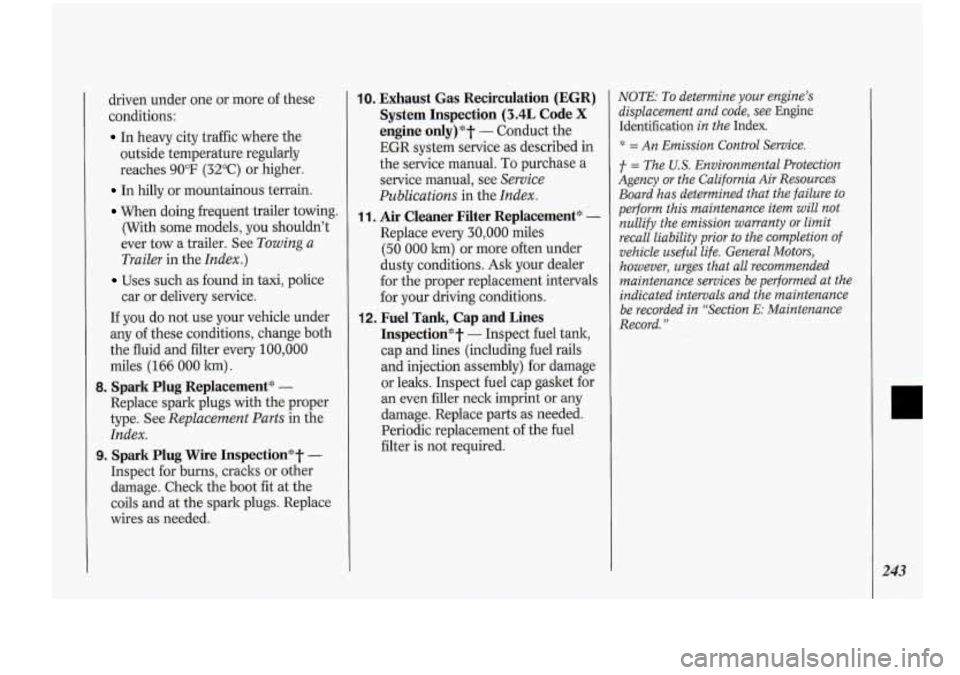
driven under one or more of these
c.onditions:
In heavy city traffic where the
outside temperature: regularly
reaches
90°F (32°C) or higher.
In hilly or mountainous terrain.
When doing frequent trailer towing.
(With some models, you shouldn’t
ever tow
a trailer. See Towing a
Trailer
in the Index.)
Uses such as.found in taxi, police
car or delivery service.
If-you do not use your vehicle under
any of these conditions, change both
the fluid and filter every
100,000
miles (166 000 km) .
Replace spark plugs with the proper
type. See
Replacement-Parts in the
Index.
9. Spark Plug Wire Inspection*T -
Inspect for burns, .cracks or other
damage. Check the boot fit at the
coils and at the spark plugs. Replace
wires as needed.
8. Spark PIug~Replacement* -
-10. Exhaust Gas Recirculation (EGR)
System Inspection
(3.4L Code X
engine only)*? - Conduct the
EGR system service-as described in
the service manual.
To purchase a
service manual, see Service
Publications
in the Index.
1 1. Air Cleaner Filter Replacementgc -
Replace every 30,000 miles
(50 000 lun) or more often under
dusty conditions. Ask your dealer
for the proper replacement intervals
for your driving conditions.
12. Fuel Tank, Cap and Lines
Inspectiong‘t
- Inspect fuel tank,
cap and lines (including fuel rails
and injection assembly). for damage
or leaks. Inspect fuel cap gasket for
an even filler neck imprint or any
damage. Replace parts as needed.
Periodic replacement of the fuel
filter is not required.
NOTE: To determine your engine’s
displacement and code, see
Engine
Identification
in the Index.
* = An Emission Control Service.
f = The U.S. Environmental Protection
Agency
or the California Air Resources
Board has determined that the failure to
perform this maintenance item will not
nullify the emission warranty
or limit
recall liability prior to the completion of
vehicle
useful life. General Motors,
however, urges that all recommended
maintenance services be performed at the
indicated intervals and the maintenance
be recorded in “Section
E: Maintenance
Record.”
243