stop start Oldsmobile Cutlass Supreme 1995 s User Guide
[x] Cancel search | Manufacturer: OLDSMOBILE, Model Year: 1995, Model line: Cutlass Supreme, Model: Oldsmobile Cutlass Supreme 1995Pages: 340, PDF Size: 16.68 MB
Page 151 of 340
A cornering skid and an acceleration skid are best
handled by easing your foot
off the acce1,erator pedal.
If your. vehicle starts to slide, ease your foot off the ’’
accelerator pedal and’ quickly steer the way you want the
vehicle to go. If you start steering quickly enough,.your
vehicle may straighten out. Always be ready for a
second skid if
it occurs.
Of course, traction is reduced vvhen water, snow, ice,
gravel,
or other material is on the road. For safety, you’ll
want to slow down and adjust your driving to these
conditions. It is important to slow down on slippery
surfaces because stopping distance will ,be longer and
vehicle‘ control more limited.
While driving-on
a surface with reduced traction, try .
your best to avoid sudden steering, acceleration, or
braking (including engine braking by shifting to a lower
gear). Any sudden changes could cause the tires to slide.
You may
pot realize the surface is slippery until your
vehicle is skidding. Learn to recognize warning clues
--
such as enough water, ice or packed snow on the road to
make a “mirrored surface” -- and slow down when you
have any doubt.
Remember: Any anti-lock brake system
(ABS) helps
avoid,only the braking skid.
Driving at Night
I ~
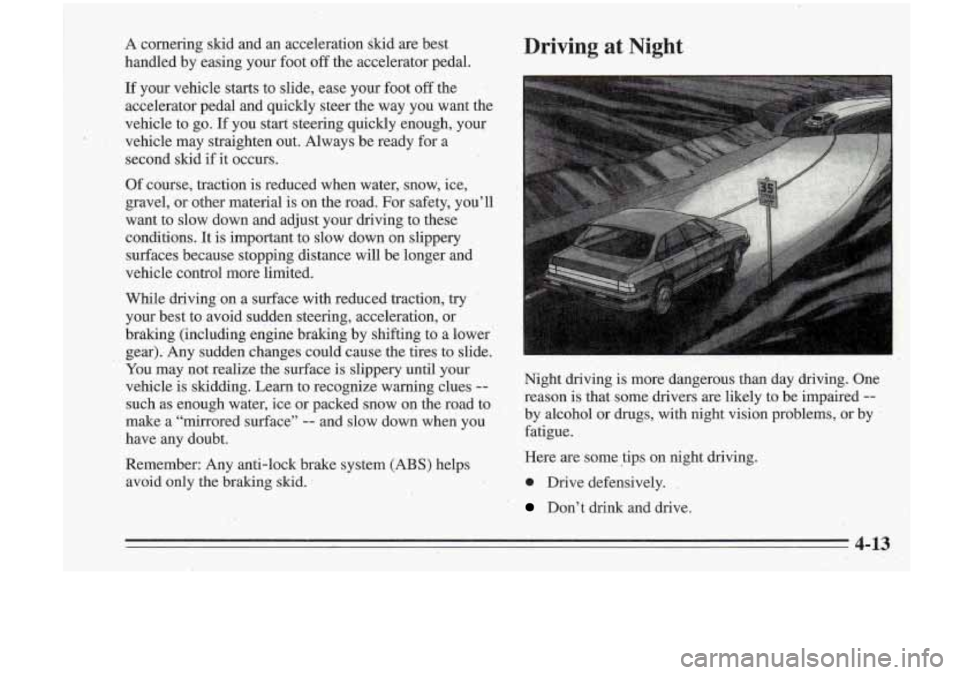
Night driving is rnore’dangerous than day driying. One
reason is that some drivers are likely to be impaired-
--
by alcohol or drugs, with night vision problems, or by .
fatigue.
Here are some tips on night driving.
0 Drive defensively. -
’ Don’t drink and drive.
4-13 ,.
Page 153 of 340
Driving in the Rain
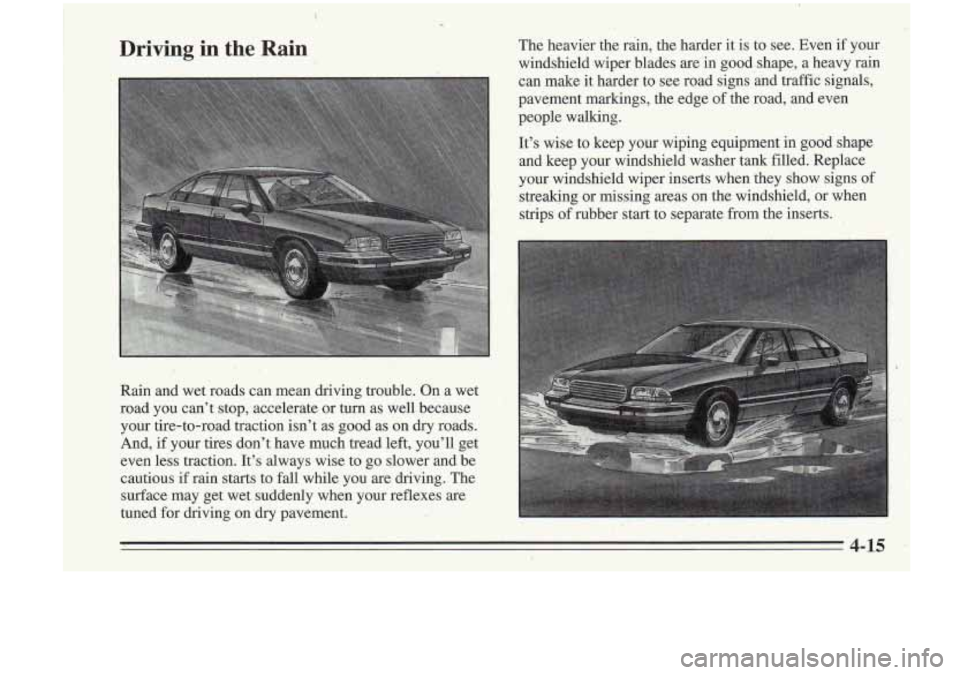
Rain and wet roads can mean driving trouble. On a wet
road you can’t stop, aGcelerate or turn as well because
your tire-to-road traction isn’t as, good as on dry roads.
And, if your tires don’t have much tread left, you’ll get
even less traction.. It’s always wise to go slower and be
cautious
if rain starts to fall while you are driving. The
surface may get wet suddenly when your reflexes are
tuned for driving on.dry pavement. The
heavier the rain, the harder it is to see. Even if your
windshield wiper blades are in good shape, a heavy
rain
can make it harder to see road signs and traffic signals,
pavement markings, the edge of the road, and even
people walking.
It’s wise to keep your wiping equipment in good shape
and keep your windshield washer tank filled. Replace
your windshield wiper inserts when they show signs of
streaking or mising areas on the windshield, or when
strips of rubber start to separate from the inserts.
i
. 4-15
~~ I
Page 157 of 340
3 Once you are m,oving on the freeway, make certain you
allow a reasonable following distance. Expect to move
slightly slower at night.
When you want to leave the freeway, move to the proper
lane well in advance.
If you-miss your exit do not, under
any circumstances, stop and back up. Drive on to the
next exit.
The exit ramp can be curved, sometimes quite sharply.
The exit speed is usually. posted.
Reduce your speed according to your speedometer, not
to your sense of motion. After driving for any distance
at higher speeds, you may tend to think you are going
slower’than you actually are.
Before Leaving on a Long- Trip
Make sure you’re ready. Try to be well rested. If you
must
start when you’re not fresh -- such as after a day’s
work
.-- don’t plan to make too many miles that first part
of the journey. Wear comfortable clothing and shoes you
can easily drive in. Is your vehicle ready
for a long trip? If you keep it
serviced and maintained, it’s ready to go.
If it needs
service, have it done before starting out. Of course,
you’ll find experienced and able service experts in
Oldsmobile retailers all across North America. They’ll
be ready and willing to help
if you need it.
Here are some things you can check before a trip:
0
0
0
0
0
0
0
,Windshield Washer Fluid: Is the reservoir full? Are
all windows clean inside and outside?
Wiper Blades: Are they in good shape?
Fuel, Engine Oil, Other FZuids: Have you checked
all levels?
,
Lights: Are .they all working? Are the lenses clean?
Tires: They are vitally important to a safe,
trouble-free trip. Is the tread gaod enough for
long-distance driving? Are the tires all inflated to the
recommended pressure?
Weather Forecasts: What’s the weather outlook
along your route? Should you delay your trip a short
time‘to avoid a major
storm system?
Maps: Do you have up-to-date maps?
,
Page 171 of 340
Making ’hrns When towing a trailer, the green arrows on your
.~ ~~~ ~ ~~ ~ instrument panel will flash for turns even if the bulbs on
the trailer are burned oat. Thus, you may think drivers
c e.. NOTICE: behind you are seeing your signal when they are not. It’s
, important to check occasionally to be sure the trailer
Making very sharp turns while trailering could bulbs ‘be still w’orking.
cause the trailer to come in contact with the
vehicle. Your vehicle could
be damaged. Avoid Driving On Grades
I- making very sharp turns while trailering. I
When you’re turning with a trailer, make wider turns
than normal.
Do this so your trailer won’t strike soft
shoulders, curbs, road
signs, trees, or other objects.
Avoid,jerky or sudden maneuvers. Signal well in
advance.
lhrn Signals When Towing a Trailer
When you tow a trailer, your vehicle has to have a
different turn signal flasher and extra wiring. The green
arrows on your instrument panel will flash whenever
you signal a turn
or lane change. Properly hooked up,
the trailer lamps
will also flash, telling other drivers
you’re about to turn, change lanes or,stop. Reduce
speed and shift to a lower gear
before you start
down a long or steep downgrade. If you don’t shift
down, you might have to use your brakes
so much that
they would get hot and no longer work well.
On a long uphill grade, shift down and reduce your
speed to around
45 mph (70 kdh) to reduce the
possibility of engine and transaxle overheating.
If you are towing a trailer, you may prefer to drive in
THIRD (3) instead of DRIVE (D) (or, as you need to, a
lower gear).
4-33
Page 172 of 340
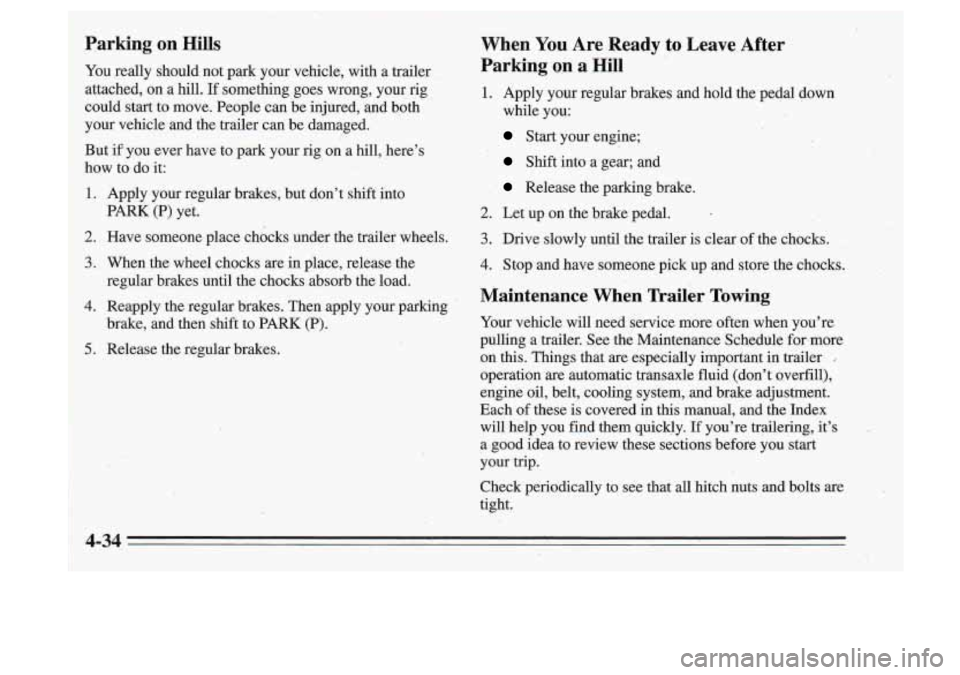
Parking on Hills
You really should not park your vehicle, with a trailer
attached,
on a hill. If something goes wrong, your rig
could start to move. People can be injured, and
both^
your vehicle and the trailer can be darnaged.
But if you ever have to park your rig on a hill, here’s
how to do it:
.I. Apply your regular brakes, but don’t shift into
.. !PARK (P) yet.
2. ‘Have someone place chocks under the trailer wheels.
3. When the wheel chocks are in place, release the
regular brakes until the chocks absorb the load.
4. Reapply the regular brakes. Then apply your parking
brake, and then shift to PARK
(P).
When You Are Ready to Leave After
Parking o,n a
Hill
1. Apply your regular brakes and hold the pedal down
8’. .
while you:
Start your engine;
Shift into a gear; and
Release the parking brake.
2. Let up on the brake pedal.
3. Drive slowly until the trailer is dear of the chocks.
4. Stop and have someone pick up and store the chocks.
Maintenance When Trailer Towing
Your vehicle will need service more often when you’re
pulling a trailer. See the Maintenance Schedule for,more
.on this. Things that are especially important in trailer
operation are automatic transaxle fluid (don’t oyerfill),
engine oil, belt, cooling system, .and brake adjustment.
Each of these
is covered in this manual, and the Index
will help you find them quickly. If you’re trailering, it’s
a good idea
to review these sections before you start
your trip.
Check periodically to see that all hitch nuts and bolts are
tight.
4-34,
Page 263 of 340
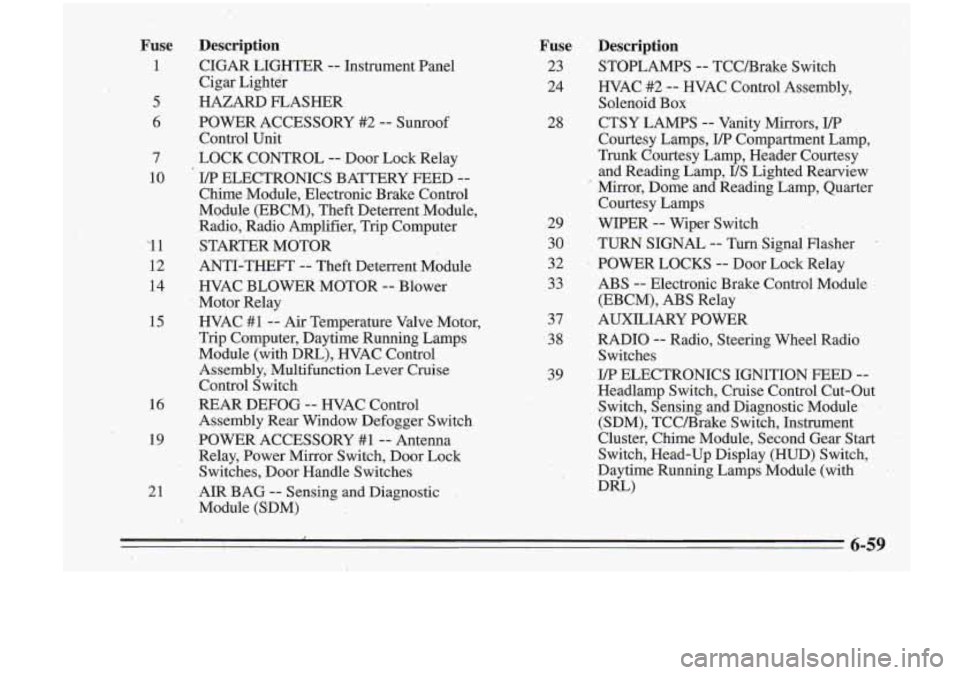
Fuse Description
1 CIGAR LIGHTER -- Instrument Panel
Cigar Lighter
5 HAZARD FLASHER
6 POWER ACCESSORY #2 -- Sunroof
Control Unit
7 LOCK CONTROL
-- Door Lock Relay
10
I/P ELECTRONICS BATTERY FEED --
Chime Module, Electronic Brake Control
Module (EBCM), Theft Deterrent Module,
Radio, Radio Amplifier, Trip Computer
'1 1 STARTER MOTOR
12 ANTI-THEFT -- Theft Deterrent Module
14 HVAC BLOWER-MOTOR -- Blower
Motor Relay
15 HVAC #1 -- Ai-r Temperature Valve Motor,
Trip Computer, Daytime Running Lamps
Module (with Dm), WAC Control
Assembly, Multifunction Lever Cruise
Control Switch
16 REAR DEFOG -- HVAC Control
Assembly Rear Window Defogger Switch
19 POWER ACCESSORY #1-- Antenna
Relay, Power Mirror Switch, Door Lock
Switches, Door Handle Switches
Fuse Description
23 STOPLAMPS -- TCCBrake Switch
24 HVAC #2
.-- HVAC Control Assembly,
28 CTSY LAMPS
-- Vanity Mirrors, I/P
Solenoid Box
Courtesy Lamps,
I/P Compartment Lamp,
Trunk Courtesy Lamp, Header Courtesy
and Reading Lamp,
US Lighted Rearview
' Mirror, Dome and Reading Lamp, Quarter
Courtesy Lamps
29 WIPER -- Wiper Switch
30 TURN SIGNAL
-- Turn, Signal Flasher -
32 POWER LOCKS -- Door Lock-Relay
33 ABS
-- Electropic Brake Control Module
37 AUXILIARY POWER
38 RADIO
-- Radio, Steering Wheel Radio
39 ELECTRONICS IGNITION FEED
-- '
(EBCM), ABS Relay
Switches
Headlamp Switch, Cruise Control Cut-Out
Switch, Sensing and Diagnostic Module
-'
(SDM), TCCBrake Switch, Instrument
Cluster, Chime Module, Second 'Gear Start
Switch, Head-Up Display (HUD) Switch,
Daytime Running Lamps Module (with
Dm)
21 AIR BAG -- Sensing and Diagnostic
Module (SDM)
6-59
Page 328 of 340
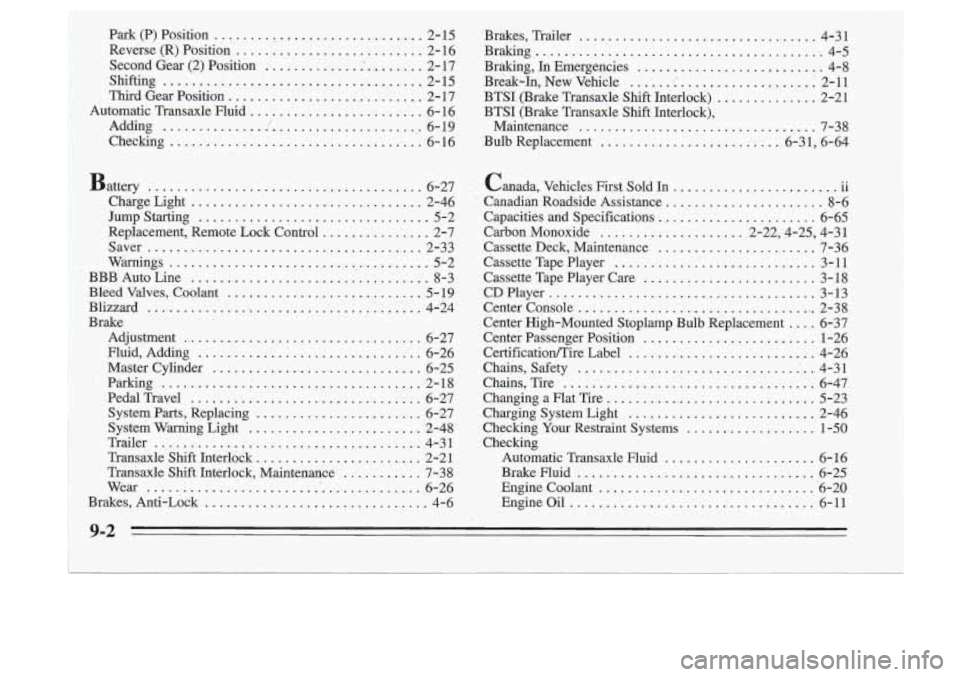
.. Park (P) Position ........ .................... 2- 15 Brakes. Trailer ................................. 4-31
Reverse(R). Position
.......................... 2-16 Braking ........................................ 4-5
Second Gear (2) Position
....................... 2-17 Braking, In Emergencies .......................... 4-8
ng
..................................... 2- 15 Break-In, New Vehicle ...... 1 ................... 2-11
c Transaxle Fluid
........................ 6- 16 BTSI (Brake Transaxle Shift Interlock),
rd Gear Position
........................... 2- 17 BTSI (Brake Transaxle Shift Interlock) .............. 2-21
Checking
................................... 6-16 Bulb Replacement ..................... ... 6-31, 6-64
Adding
.............. ! ...................... 6-
19 Maintenance ................................. 7-38
:Battery
...................................... 6-27 Canada, Vehicles First Sold In ....................... 11 ..
Charge Light ................................. 2-46 . Canadian Roadside Assistance ...................... 8-6
.Jump Starting
........... .................... 5-2 Capacities and Specifications ...................... 6-65
. Replacement, Remote Lock Control ............... 2-7 Carbon Monoxide .................... 2-22,4-25, 4-31
Saver
...................................... 2-33 Cassette Deck, Maintenance ...................... 7-36
Warnings
..................................... 5-2 Cassette Tape Player ............................ 3-11
uto Line
................................. 8-3 Cassette Tape Player Care ........................ 3-18
Center High-Mounted Stoplamp Bulb Replacement
.... 6-37
. Adjustment .................................. 6-27 Center Passenger Position ........................ 1-26
.Fluid, Adding
............................... 6-26 Certificatiomire Label .......................... 4-26
:Bleed Valves,
Coolant
........................... 5- 19 CD Player ...................................... 3-13
..:Blizzard
........................................ 4-24 Center Console .................................. 2-38
.. .Master Cylinder .............................. 6-25 Chains, Safety .................................. 4-31
Parking
............ : ....................... 2- 18 Chains, Tire ................................... 6-47
Pedal Travel
................................. 6-27 Changing a Flat Tire ............................. 5-23
System Warning Light
......................... 2-48 Checking Your Restraint Systems ........... , ....... 1-50
Trailer
..................................... 4-3 1 Checking
System Parts, Replacing
....................... 6-27 Charging System Light .......................... 2-46
Transaxle Shift Interlock
....................... 2-21 Automatic Transaxle Fluid ..................... 6-16
Transaxle Shift Interlock, Maintenance
........... 7-38 BrakeFluid ................................. 6-25
Wear
....................................... 6-26 Engine Coolant .............................. 6-20
' Brakes, Anti-Lock ............................... 4-6 Engineoil .................................. 6-11
I 9-2
I .