service Oldsmobile Cutlass Supreme 1995 s Owner's Guide
[x] Cancel search | Manufacturer: OLDSMOBILE, Model Year: 1995, Model line: Cutlass Supreme, Model: Oldsmobile Cutlass Supreme 1995Pages: 340, PDF Size: 16.68 MB
Page 205 of 340
I Section 6 Service and Appearance Care
rn
Here you will find information about the care of your We
hope you’ll want to keep your GM vehicle all GM.
Oldsmobile. This section begins with service and fuel Genuine GM parts have
one of these marks:
information, and
then it shows how to check important
fluid and lubricant levels. There is also technical
information about your vehicle, and a part devoted to its
appearance care.
Service
Your Oldsmobile retailer knows your vehicle best and
wants you to be happy with it. We hope you’ll
go to
your retailer for all your service needs. You’ll get
genuine GM parts and GM-trained and supported
service people.
I-
-
6-1
Page 206 of 340
~ ~~~~ ~ ~.. ~~ ~-. _~~~i ~
~~ ~~ ..,. . ... ~-I-.-...------_ ~
Doing Your Own Service Work
If you want to do some of your own service work, you’ll
want to get the proper Oldsmobile Service Manual. It
tells you much-more about how to service your
Oldsmobile than this manual can.
To order the proper
service manual, see “Service Publications” in the Index.
Your vehicle has an ‘air bag system. Before attempting to
do your own service work, see “Servicing Your Air
Bag-Equipped Oldsmobile” in the Index.
You should keep a record with.all parts receipts and list
the mileage and the date of any service work you
perform. See “Maintenance Record” in the Index.
NOTICE:
If you try to do your own service work without
bowing enough about it, your vehicle could be
damaged.
6-2
Page 207 of 340
Fuel
Use regular unleaded gasoline rated at 87 octane or
higher. It should meet specifications ASTM
D4814 in
the United States and CGSB
3.5-92 in Canada. These
fuels should have the proper additives,
so you should not
have to add anything to the fuel.
In the United States and Canada, it’s easy to be sure you
get the right kind of gasoline (unleaded). You’ll see
UNLEADED right on the pump. And only unleaded
nozzles will fit into your vehicle’s filler neck.
Be sure the posted octane.is at least 87.
If the octane is
less than 87, you may get a heavy knogking noise when
you drive.
If it’s bad enough, it can‘damage your engine.
If you’re using fuel rated at 87 octane or higher and you
still’hear heavy knocking, your engine needs service.
But don’t worry
if you hear a little pinging noise when
you’re accelerating
or driving up a hill. That’s normal,
and you don’t have to buy a higher octane fuel to get rid
of pinging. It’s the heavy, constant knock that means
you have a problem.
‘4
What about gasoline with blending materials that
contain oxygen (oxygenates), such as MTBE or alcohol?
MTBE is “methyl tertiary-butyl ether.” Fuel that is no
more than
15% MTBE is fine for your vehicle.
Ethanol is ethyl or grain alcohol. Properly-blended fuel
that is no more than
10% ethanol is fine for your
vehcle.
Methanol is methyl or wood alcohol.
NOTICE:
Fuel that is more than 5% methanol is bad for
your vehicle. DonTt use it. It can corrode metal
parts in your fuel system and also damage plastic
and rubber parts. That damage wouldn’t b,e
, covered under your warranty. And even at 5% or
less,, there must be “cosolvents”
and corrosion
preventers in
this fuel to help avoid these
problems.
Page 208 of 340
I
Gasolines for Cleaner Air
Your use of gasoline with deposit control additives will
help prevent deposits from forming in your engine and
fuel system. That helps keep your engine in tune and
your emission control system working properly. It’s
good for your vehicle, and you’ll be doing your part for
cleaner air.
Many gasolines are now blended with oxygenates. General Motors recommends that you use gasolines with
these blending materials, such as MTBE and ethanol. By
doing
so, you can help clean the air, especially in those
parts of the country that have high carbon monoxide levels.
In addition, some gasoline suppliers are now producing
reformulated gasolines. These gasolines are specially
designed to reduce vehicle emissions. General Motors
recommends that you use reformulated gasoline. By doing
so, you can help clean the air, especially in those
parts of the country that have high ozone levels.
You should ask your service station operators if their
gasolines contain deposit control additives and
oxygenates, and
if they have been reformulated to
reduce vehicle emissions.
Fuels in Foreign Countries
If you plan on driving in another country outside the
U.S. or Canada, unleaded fuel may be hard to find. Do
not use leaded gasoline. If you use even one tankful,
your emission controls won’t work well or at all. With
continuous use, spark plugs can get fouled, the exhaust
system can corrode, and your engine oil can deteriorate
quickly. Your vehicle’s oxygen sensor will be damaged.
All of that means costly repairs that wouldn’t be covered
by your warranty.
To check on fuel availability, ask an auto club, or
contact a major oil company that does business in the
country where you’ll be driving.
You can also write us at the following address for
advice. Just tell
us where you’re going and give your
Vehicle Identification Number (VIN).
General Motors Overseas Distribution Corporation
North American Export Sales (NAES)
1908 Colonel Sam Drive
Oshawa, Ontario
L1H 8P7
6-4 .I
Page 219 of 340
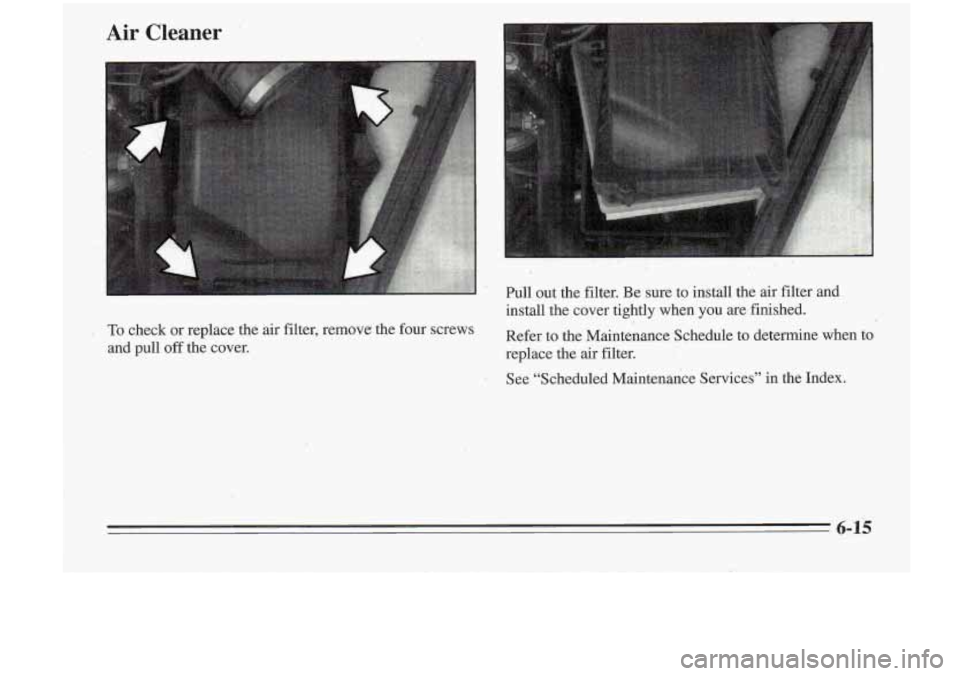
Air Cleaner
Pull out the filter. Be sure to install the air filter and
install the cover tightly when you are finished.
To check or replace the air filter, remove the four screws Refer to the Schedule to determine when to’
and pull off the cover.
replace the air filter.
See “Scheduled Maintenance Services” in the Index.
6-15
Page 220 of 340
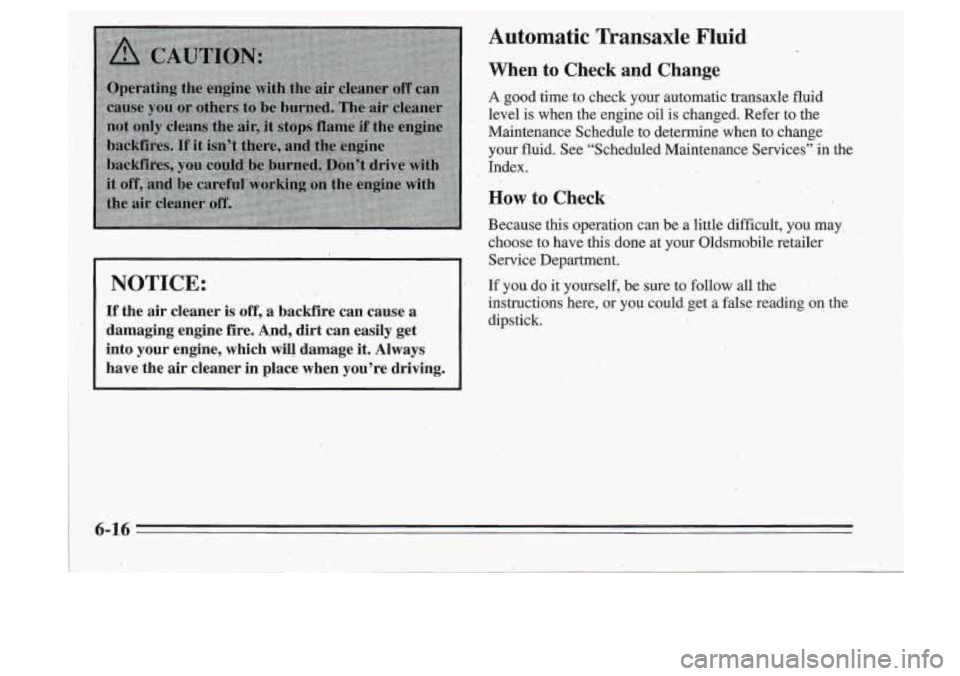
NOTICE:
If the air cleaner is off, a backfire can cause a
damaging engine fire. And, dirt can easily ,get
into your engine, which will damage it. Always
have the air cleaner in place when you’re driving.
Automatic Transaxle Fluid
When to Check and Change
A good time to check your automatic transaxle fluid
level is when the engine oil is changed. Refer to the
Maintenance Schedule to determine when to change
your fluid. See “Scheduled Maintenance Services’’ in the
Index.
How to Check
Because this operation can be a little difficult, you may
choose to have this done at your Oldsmobile retailer
Service Department.
If yon do it yourself, be sure to follow all the
instructions here,
or you could get a false reading on the
dipstick.
Page 246 of 340
Tire Inspection and Rotqtion
Tires should be inspected every 6,000 to 8,000 miles
(IO 000 to 13 000 km) for any signs of unusual wear. If
unusual wear is present, rotate your tires as soon as
possible and check wheel alignment. Also check for
damaged tires or wheels. See “When it’s Time for New
Tires” and ‘‘Fheel Replacement” later
in this section for
more information.
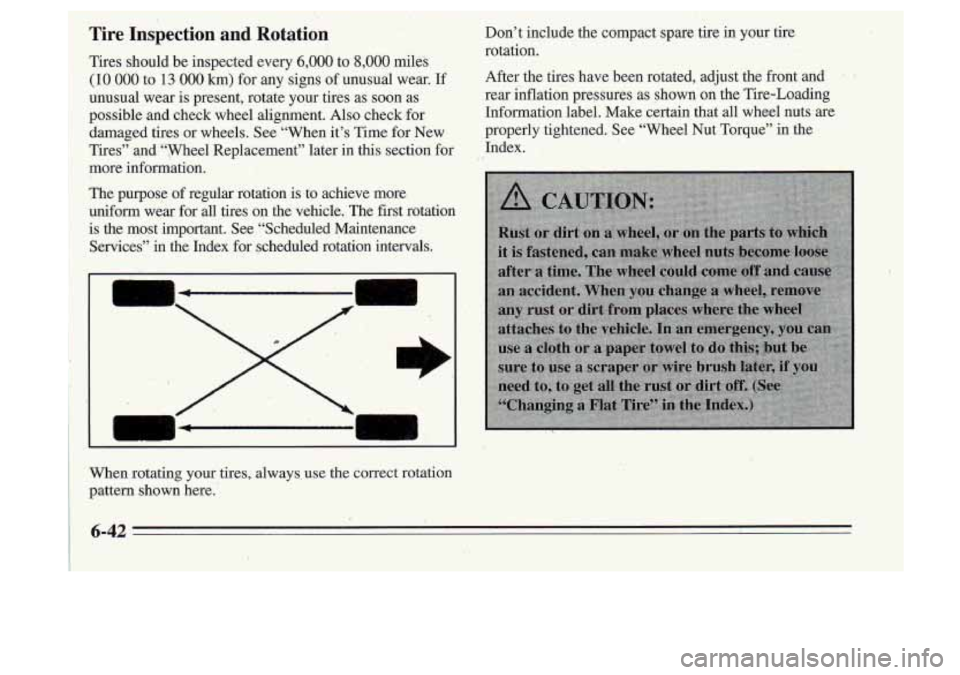
The purpose
of regular rotation isto achieve more
uniform wear for
all tires on the vehicle. The first rotation
is the most important. See “Scheduled Maintenance
Services” in the Index for scheduled rotation intervals.
I 1 I I
Don’t include the compact spare tire in your
rotation.
After the tires have been rotated, adjust the
f
tire
ront and
’,
rear idlation pressures as shown. on the Tire-Loading
Information label. Make certain that
all wheeI nuts are,
properly tightened. See “Wheel Nut Torque” in the
Index.
When rotating
your tires, always, use the correct rotation
pattern sho.wn here.’
6-42
I
Page 247 of 340
‘\..
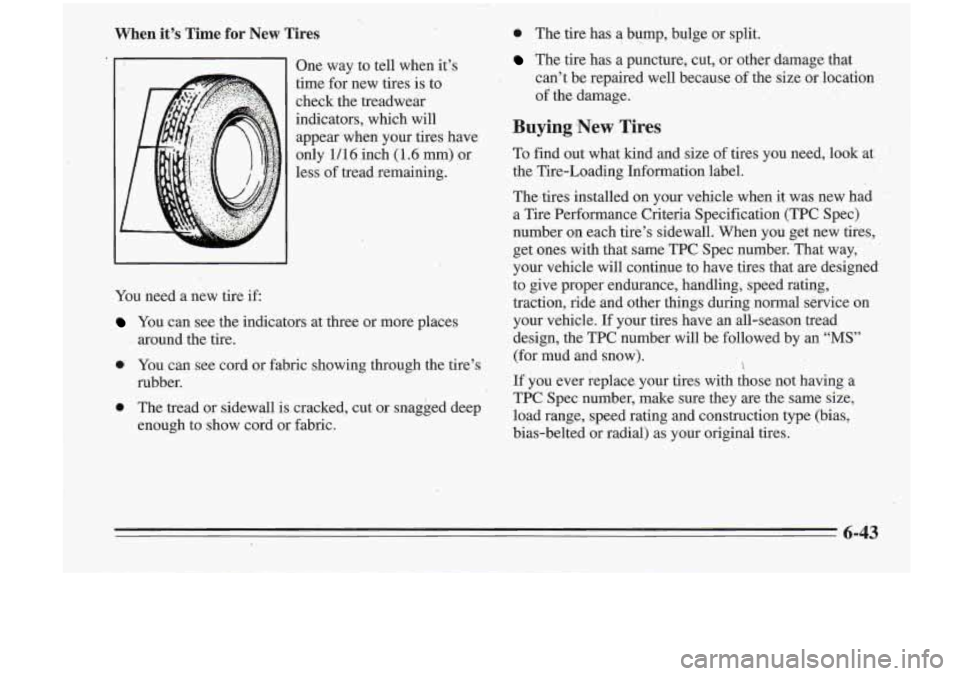
When it’s Time for New Tires
One way to tell when it’s
time for new tires
is to
check the treadwear
indicators, which will appear’ when your tires have
only
1/16 inch (1.6 mm) or
less of tread remaining.
You need a new
tire if:
You can see the indicators at three or more places
around the tire.
a’ You can see cord or fabric showing through the tire’s ’
rubber. I
0 The tread or sidewall is cracked, cut or snagged deep
enough to show cord or fabric.
0 The tire has a 1 bump, -., bulge or split.
The tire has a puncture, cut, or other damage that
can’t be repaired well because of the
size or location
of the damage.
Buying \New Tires
To find out what kind and size of tires you need, look at
the Tire-Loading Information label.
Theltires installed
on your vehicle .when it was new had
a Tire Performance Criteria Specification (TPC Spec)
number on each tirk’s sidewall. When you get new tires,
get ones with that same TPC Spec number. That way,
your vehicle will coniinue to have tires that are designed- to give proper endurance, handling, speed rating,
traction, ride and other things during normal service on
your vehicle. If your tires have an all-season tread
design, the TPC number will be foilowed by an
“MS”
(for mud and snow).
If you ever replace, your tires with those not having a
TPC Spec number, make sure they are the same size,
load range, speed rating and construction type (bias,
bias-belted or radial) as your original tires.
Page 258 of 340
Aluminum Wheels (If So Equipped)
Your aluminum wheels have a protective coating similar
to the painted surface
of your vehicle. Don’t use strong
soaps, chemicals, chrome polish, abrasive cleaners or
abrasive cleaning brushes on them because you could
damage this coating. After .rinsing thoroughly, a wax
may be applied.
NOTICE:
If you have aluminum wheels, don’t use an
automatic car wash that has hard silicon carbide
cleaning brushes. These brushes can take the
protective coating
off your aluminum wheels.
Tires
To clean your tires, use a stiff brush with a tire cleaner.
When applying a tire dressing always take care to wipe
off any overspray or splash from‘painted surfaces.
Petroleum-based products may damage the paint finish.
Sheet Metal Damage
If your vehicle is damaged and requires sheet metal
repair or replacement, make sure the body repair shop
applies anti-corrosion material to the parts repaired or
replaced to restore corrosion protection.
Finish Damage
Any stone chips, fractures or deep scratches in the finish
should be repaired right away. Bare metal will corrode
quickly and may develop into a major repair expense.
Minor chips and scratches can be repaired with touch-up
materials available from your retailer or other service
outlets. Larger areas of finish damage can be corrected
in your retailer’s body and paint shop.
6-54
Page 261 of 340
I.
Vehicle Identification Number (VIN)
I
U I
ENGINE / 1.&5 ASSEMBLY
CODE MODEL YEAR PLANT
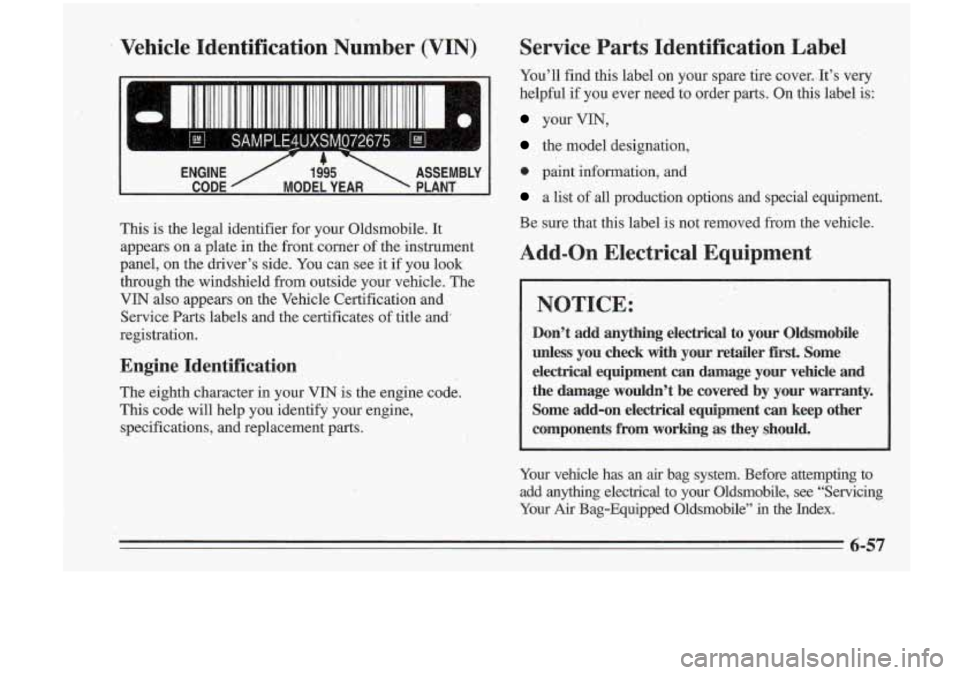
This is the legal identifier for your Oldsmobile. It
appears on a plate in the front corner of the instrument
panel,
on the driver’s side. You can see it if you look
through the windshield from outside your vehicle. The
VIN also appears on the’vehicle Certification and
Service
Parts labels and the certificates of title and’
registration.
Engine Identification
The eighth character in your VIN is the engine code.
This code will help you identify your engine,
specifications, and replacement parts.
Service Parts Identification Label
You’ll find this label on your spare tire cover. I It’s very
helpful if you ever need
to order parts. On this label is:
your VIN,
the model designation,
9 paint information, and
a list of all production options and special equipment.
Be sure that this label
is not removed from the vehicle.
Add-on Electrical Equipment
NOTICE:
Don’t add anything electrical to your Oldsmobile
unless you check with your, retailer
first. Some
electrical equipment can damage your vehicle and
the damage wouldn’t be covered by your warranty. Some add-on electrical eqtiipment can keep other
components from working
as they should.
Your vehicle has an air bag system. Before attempting to
add anythng electrical to your Oldsmobile, see “Servicing
Your
Air Bag-Equipped Oldsmobile” in the Index.