light Oldsmobile Cutlass Supreme 1995 s Owner's Guide
[x] Cancel search | Manufacturer: OLDSMOBILE, Model Year: 1995, Model line: Cutlass Supreme, Model: Oldsmobile Cutlass Supreme 1995Pages: 340, PDF Size: 16.68 MB
Page 122 of 340
Automatic Control
For the most efficient operation, you ,should.set the
system temperature and press the knob. The system will
select the best fan speed and air flow, settings to keep
you comfortable. The air conditioning compressor will
run
if the outside temperature is above 40°F (4.5 ” C).
YOU may notice
a delay of three to four minutes before
the fan comes on.
Manual Control
If you prefer to manually control the heating, cooling
and ventilation
in your vehicle, push UPPER, BI-LEV,
LOWER, DEFOG or
DEE AUTO will go off the
display. Set the system to the temperature and fan
speed you want. The system will try to maintain the
temperature you set using the mode you select. The
following suggestions will help the system run more
efficiently in manual mode.
Air Conditioning
On very hot days, open the windows long enough to
let hot inside
air escape. This reduces the time the
compressor has to run, which should help fuel economy.
For quick cool-down on very hot days, use RECIRC. If
this setting is used for long periods
of time, the air in
your vehicle may become too dry. For normal cooling on hot days, use UPPER with the
A/C button pushed
in. The system will.bring in outside
air and cool it.
On
cool but .sunny days, the sun may warm your upper ,
body, but your lower body may not be warm enough. You
can use BI-LEV with the A/C’ button pushed in.’
The system will bring in outside air and direct it to your
upper body, while sending slightly warmed air to your
lower body. You may notice this temperature difference
more at some times than.others.
Heating
On cold days use LOWER. The system will bring in
outside air, heat it and send it to the floor ducts.
If your vehicle has an engine coolant heater, you, can use
it to help your system provide warm air faster when it’s
cold outside
(0°F (-18°C) or lower). An engine coolant
heater warms the‘coolant your engine and heating
system use to provide heat. See “Engine Coolant
Heater” in the Index.
Ventilation
For mild outside temperatures when little heating or
cooling is needed, use-UPPER to direct outside air through
your vehicle.
Your vehicle also has the flow-through
ventilation system described later in
this section.
3-6
-
Page 125 of 340
I
AM/I?M Stereo Radio
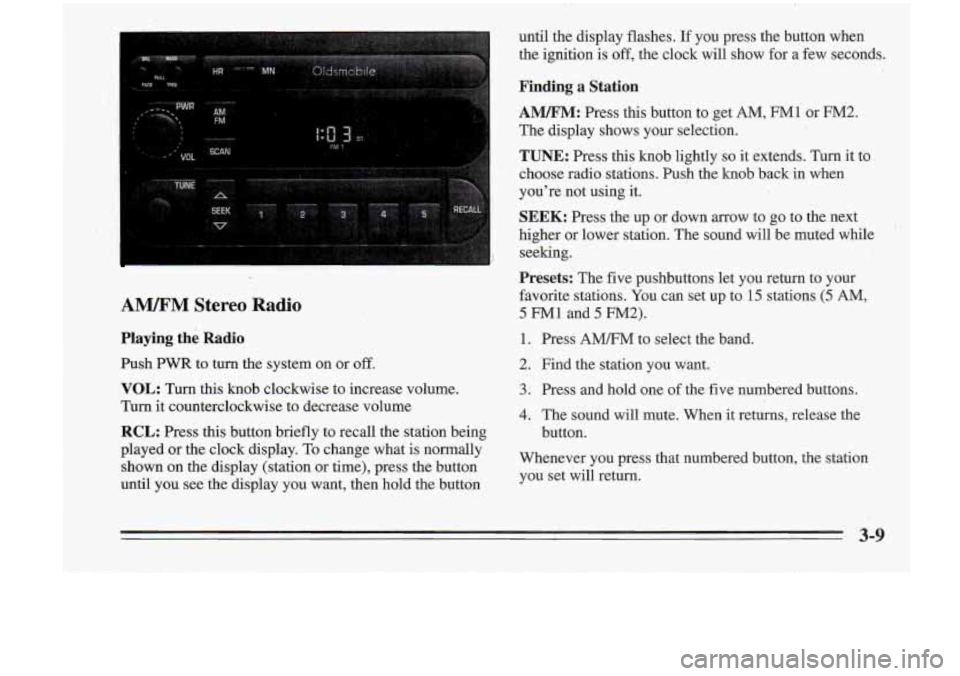
Playing the Radio
Push PWR to turn the system on or off.
until the display flashes. If you press the button when
the ignition
is off, the clock will show for a' few seconds.
Finding a Station
AM/FM: Press this button to get AM, FM1 or M.2.
The display shows your selection.
TUNE:'Press this knob lightly
so it extends. Turn it to
choose radio stations. Push the knob back in when
you're not using it.
VOL: Turn this knob clockwise to increase volume.
Turn it counterclockwise to decrease volume
RCL: Press this button briefly to recall the station being
SEEK: Press the up or dawn arrow to go to the next
higher or lower station. The sound will be muted while
seeking.
Presets: The five pushbuttons let you return to your
favorite stations- You can set up to
-15 stations (5 AM,
5 FM1 and 5 FM2).
1. Press AMm' to select the band.
2. Find the station you want. ..
3. Press .and hold one of the five numbered buttons.
4. The sound will mute. When it returns, release the
button.
Played
Or the 'lock To change what is nomallY Whenever you press that numbered button, the station
shown on the display (station
or time), press the button you set will return.
until you see the display you want, then hold the button
3-9
Page 126 of 340
SCAN: Press this button and release to listen to stations
a few seconds. The radio will go to a station, stop for a
few seconds, then go on to the next station. Press the
button again to stop scanning. The sound will be muted
while scanning, and SCAN will appear on the display.
If
you-
the display.
PSCAN: Press SCAN for more than two s,econds, and
PSCAN will appear on the display. The radio will go to
the first preset station, stop for-a few seconds, then go
on to the next preset station. Press SCAN again to stop
scanning.
Setting the Tone
BASS:
Press this knob lightly so it extends. Turn the
knob to increase or decrease bass. The middle position
is
a detent.
TREB: Press this knob lightly so it extends..Then pull
the knob all the way out. Turn it to increase or decrease
treble. The middle position is a detent.
Push the knob back in when you’re not using it.
Adjusting the Speakers
BAL:
Press this knob lightly so it extends. Turn the
knob to move,the sound to the left or right speakers. The
middle position is a detent and balances the speakers.
FADE: Press the knob lightly .so it extends. Then pull
the knob
all the way out. Turn it to move the sound to
the front or rear speakers.. The middle position is a
detent and balances the speakers.
Push the knob back in when you’re not using it.
3-10
Page 134 of 340
To help avoid hearing loss or damage:
Adjust the volume control to the lowest setting.
0 Increase volume slowly until you hear comfortably
and clearly.
NOTICE:
Before you add any sound equipment to your
vehicle
-- like a tape player, CB radio, mobile
telephone or two-way radio
-- be sure you can
add what you want.
If you can, it’s very
important to do it properly. Added sound
equipment may interfere with the operation of
your vehicle’s engine, Delco@ radio or other
systems, and even damage them. And, your
vehicle’s systems may interfere with the
operation of sound equipment that has been
added improperly.
So, before adding sound equipment, check with
your retailer and be sure to check Federal rules
covering mobile radio and telephone units.
~
Care of Your Cassette Tape Player
A tape player that is not cleaned regularly is subject to
reduced sound quality, ruining the cassette or damaging the mechanism. Tape cassettes that are not properly
stored
in their plastic cases away ,from contaminants,
direct sunlight, and extreme heat may not operate
properly and could cause premature failure
of the tape
player.
Your tape player should be cleaned with every
50 hours
of use to provide optimum performance. Your radio may
display Cln to indicate that you have used your tape
player for
50 hours without resetting the tape clean
timer. If you notice a reduction in sound quality,
regardless
of when the tape player was last cleaned, try
playing a different cassette to see if the tape or the tape
player is at fault. If the second cassette results
in no
improvement in sound quality, try cleaning the tape
player.
Proper tape player cleaning should be done with a
scrubbing action, nonabrasive cleaner cassette. This is a
wet-type cleaning system that uses a cleaning cassette
with pads that scrub the tape head as the hubs
of the
cleaner cassette turn.
To properly clean your tape player,
follow the instructions with the cleaning cassette. If you
I
Page 135 of 340
use this type of cleaner, the radio may display an error'
and eject the cartridge.
This is nongal and is the result
of an added feature in the tape player that detects broken
tapes.
If an error occurs, you will need to insert the ;
cleaning cassette at least three times to thoroughly clean
the tape player.
You may prefer to use a non-scrubbing action, wet-type
cleaner.
This type of cleaner uses a fabrio belt to clean
the tape head. This type of cleaner cassette will not-
cause an error, but it may not ckan the tape player as
thoroughly as the scrubbing-type cleaner.
n scrubbing action cleaner is available through your
retailer
(GM Part No. 12344600).
Cassettes are subject 'to wear, and the sound quality may
degrade over time. Always verify that the cassette tape
is
in good condition and the tape player is clean before
obtaining service on your tape player.
Care of Your Compact Discs
Handle discs carefully. Store them in th,eir original cases
or other protective cases and away from direct sunlight
and dust.
If the surface of a disc is soiled, dampen a
clean, soft cloth ,in
a mild, neutral detergent solution and
clean it, wiping from the center to the edge.
Be sure never to touch the signal surface when handling
discs. Pick up discs by grasping the outer edges
or the
edge of the hole and the outer edge.
Fixed Mast Antenna
The fixed mast antenna can withstand most car washes
without being damaged.
If the mast should ever become
slightly bent, you can straighten it out by hand. If the
mast
is badly bent, as it might be by van.dals, you should
replace it.
I
Check every once in a while to be sure the mast is still
tightened to the fender.
3-19
Page 144 of 340
I
Anti-Lock Brakes (A S)
Your Oldsmobile has an advanced electronic braking
system that
will help prevent a braking skid.
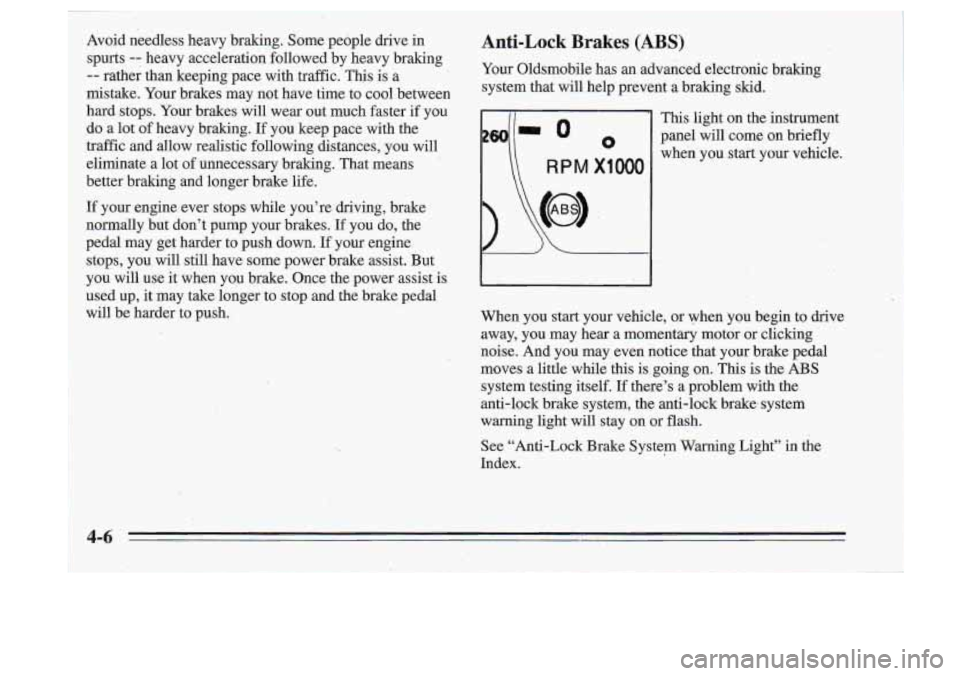
This light on the instrument
panel will come on briefly
when you start vour vehicle.
RPM X1000
When you start your vehicle, or when you begin to drive
away, you may hear a momentary motor or clicking
noise. And you may even notice that your brake pedal
moves a little while this is going on. This
is the ABS
system testing itself. If there’s a problem with the
anti-lock brake system, the anti-lock brake system
warning light will stay on or flash.
See “Anti-Lock Brake System Warning Light”
in the
Index.
..
Page 146 of 340
Remember: Anti-iock doesn’t change the time you need
to get your foot up to the brake pedal.
If you get too
close to the .vehicle in front of you, you won’t have time
to apply your brakes
if that vehicle suddenly. slows or
stops. Always leave enough room up ahead to stop, even
though
you have anti-lock brakes.
,_ Steering
Power Steering
If you lose power steering assist because the engine
stops
or the system is not, functioning, you can steer but
it will take much more effort.
. ..
To Use Anti-Lock
Don’t pump the brakes. Just hold the brake pedal down
and let anti-lock work for you. You may feel the system
working, or you may notice some noise, but this is
normal. When your anti-lock system is adjusting brake
pressure to help avoid a braking skid, the LOW TRAC
light will come’on., See “Anti-Lock Brake System
Active Light”
in the Index.
Braking .,in Emergencies
Usti your anti-lock braking system when you’need to.
With anti-lock, you can steer and brake at the same
time.
In many emergencies, steering can help you more
than even the very best braking.
.‘
Steering Tips
Driving on Curves
It’s important to take curves at a reasonable speed.
A lot of the “driver lost control” accidents mentioned on
the news happen on curves. Here’s why:
Experienced driver or beginner, each
of us is subject to
the samelaws of physics when driving on curves. The
traction of the tires against the road surface makes it
possible for the vehicle to change its path when you
turn
the front wheels. If there’s no traction, inertia will keep
the vehicle going in the same direction. If you’ve ever
tried to steer a vehicle on wet ice, you’ll understand this.
The traction you can get in a curve depends on the
condition of your tires and the road surface, $the angle at
which the curve is banked, and your speed. While
you’re in a curve, speed is the one factor you can
control.
Page 150 of 340
0
0
.. ..
Check your mirrors, glance over your shoklder, and
start your left lane change signal before moving out
of the right lane to pass. When you are far’enough
ahead of the passed vehicle to see its front in your
inside mirror, activate your right$ lane ,change signal
and move back into the right lane. (Remember that
your right outside mirror
is convex. The vehicle you
just passed may seem to be,farther away from
you
than it really is.)
Try not to pass more than one vehicle at a tihe on
two-lane roads. Reconsider before passing the next
vehicle.
Don’t overtake a slowly moving vehicle too rapidly.
Even though the brake lights are not flashing, it.may
be slowing down or starting tu turn.
If you’re being passed, make it easy for the
following driver to get ahead of you. Perhaps you
cmease a,little to the right.
.. : ‘ . .. ~
Loss of Control
Let’s review what driving experts say about what ’
happens when the three control systems (brakes, steering
and acceleration) don’t have enough friction where the
tires meet .the road
to do what ‘the driver has asked.
In any emergency, don’t give up. Keep trying to steer and constantly seek an es-c-gpe route or area
.~f less
danger.
Skidding
In a skid, a driver can lose control of the vehicle.
Defensive drivers avoid most skids by taking reasonable
care suited to existing conditions, and by not
“overdriving” those conditions. But skids are always
possibk.
The three types of skids correspondjo your
Oldsmobile’s three control systems. In the braking skid
your wheels aren’t rolling.
In the steering or cornering
skid, too much speed or steering in
a curve causes tires
to slip and lose cornering force. And in the acceleration
skid too much throttle causes the driving wheels to,spin.
, .*
I
4-12
Page 152 of 340
Adjust your inside rearview mirror to reduce the
. glare from headlamps behind you.
,e Since you can’t see as well, you may need to slow
down and keep more space between you .and other
. .. : vehicles.
Slow down, especially
on higher speed roads. Your
beadlpps can light up only
so much road ahead.
In remote areas, watch for animals.
If you’re tired, pull off the road in a safe place and
Night, Vision
No :one can see as well at night as in the daytime. But as
we get older these differences increase. A 50-year-old
driver may require at. least twice as much light to see the
same thing at night as a 20-year-old.
What you do
in the daytime can also affect your night
vision.
For example, if you spend the day in bright .
sunshine you are wise to wear sunglasses. Your eyes will
have less trouble adjusting to night.
Bat if you’re
driving, don’t wear sunglasses at night. They may cut
down on glare from headlamps, but they also make a lot
of things invisible. rest.
You
can be temporarily blinded by approaching lights. It
can take a second or two, or even several seconds, for
your eyes to readjust to the dark. When you are faced
with severe glare (as from a driver who doesn’t lower
the high beams, or a vehicle with misaimed headlamps), slow down a little. Avoid staring directly into the
approaching lights.
Keep your windshield and all
the glass on your vehicle
clean
-- inside and out. Glee at night is made much
worse by dirt on the glass. Even the inside of the glass
can build up a film caused by dust. Dirty glass makes
lights dazzle and flash more than clean glass would,
making the pupils
of your eyes contract repeatedly.
Remember that your headlamps light up far less of
a
roadway when you are in a turn or curve. Keep your
eyes moving; that way, ips easier to pick out dimly
lighted objects. Just as your headlamps should be checked regularly for proper aim,
SO should your eyes
be examined regularly. Some drivers suffer from night
blindness
3- the inability to see in dim light -- and aren’t
even aware of it.
4-14 .. .. .
Page 154 of 340
!
Driving too fast through large water puddles or even going through some car washes can cause problems, too.
The water may affect your brakes. Try to avoid puddles.
But if you can’t, try to slow down before you hit them.
Hydroplaning
Hydroplaning is dangerous. So much water can build up
under your tires that they can actually ride on the water.
This can happen if the road is wet enough and you’re
going fast enough. When your vehicle is hydroplaning,
it has little or no contact with the road. Hydroplaning doesn’t .happen often. But
it can if your
tires haven’t much tread or
if the pressure in one or
more
is low. It can happen if a lot, of water is standing on
the road. If you can see reflections froin trees, telephone
poles,
or other vehicles, and raindrops “dimple” the
water’s surface, there could be hydroplaning.
Hydroplaning usually happens at higher speeds. There
just isn’t a hard and fast
rule about hydroplaning. The
best advice
is to slow down when it is iaining.
Some Other Rainy weather Tips
1
0
0
0
,Turn on your low-beam headlights -- not just your
parking lights
-- to help make you ,more visible to
others.
Besides slowing down, allow some extra following distance. And be especially carefbl when you pass
another vehicle. Allow yourself more clear room
ahead, and, be prepared to have your view restricted
by road spray.
Have good tires with proper tread depth. (See “Tires” in the Index.)