lock Oldsmobile Cutlass Supreme 1995 s Service Manual
[x] Cancel search | Manufacturer: OLDSMOBILE, Model Year: 1995, Model line: Cutlass Supreme, Model: Oldsmobile Cutlass Supreme 1995Pages: 340, PDF Size: 16.68 MB
Page 144 of 340
I
Anti-Lock Brakes (A S)
Your Oldsmobile has an advanced electronic braking
system that
will help prevent a braking skid.
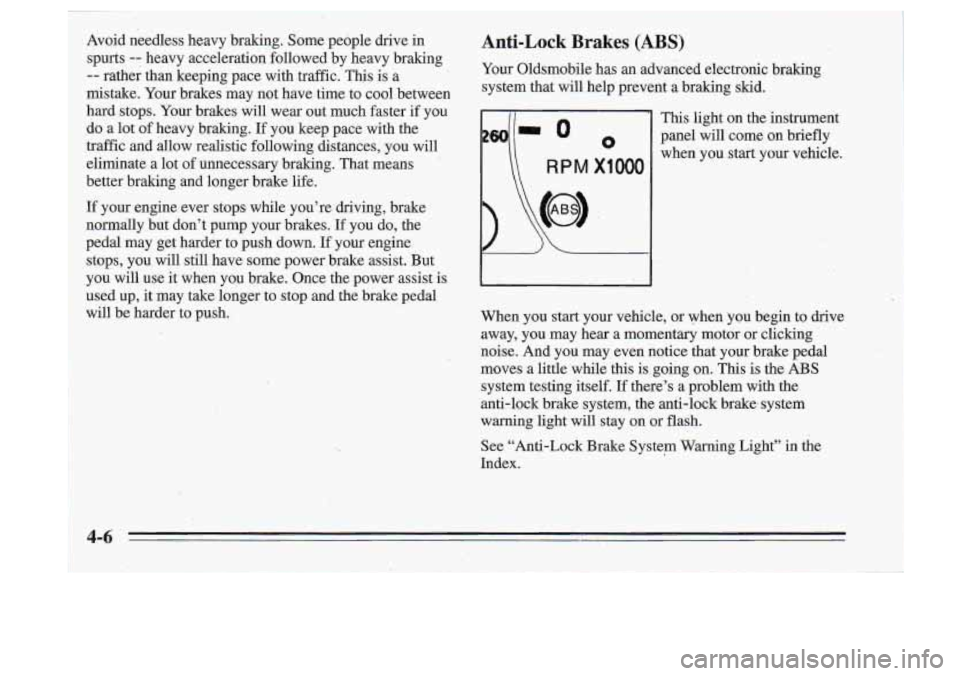
This light on the instrument
panel will come on briefly
when you start vour vehicle.
RPM X1000
When you start your vehicle, or when you begin to drive
away, you may hear a momentary motor or clicking
noise. And you may even notice that your brake pedal
moves a little while this is going on. This
is the ABS
system testing itself. If there’s a problem with the
anti-lock brake system, the anti-lock brake system
warning light will stay on or flash.
See “Anti-Lock Brake System Warning Light”
in the
Index.
..
Page 145 of 340
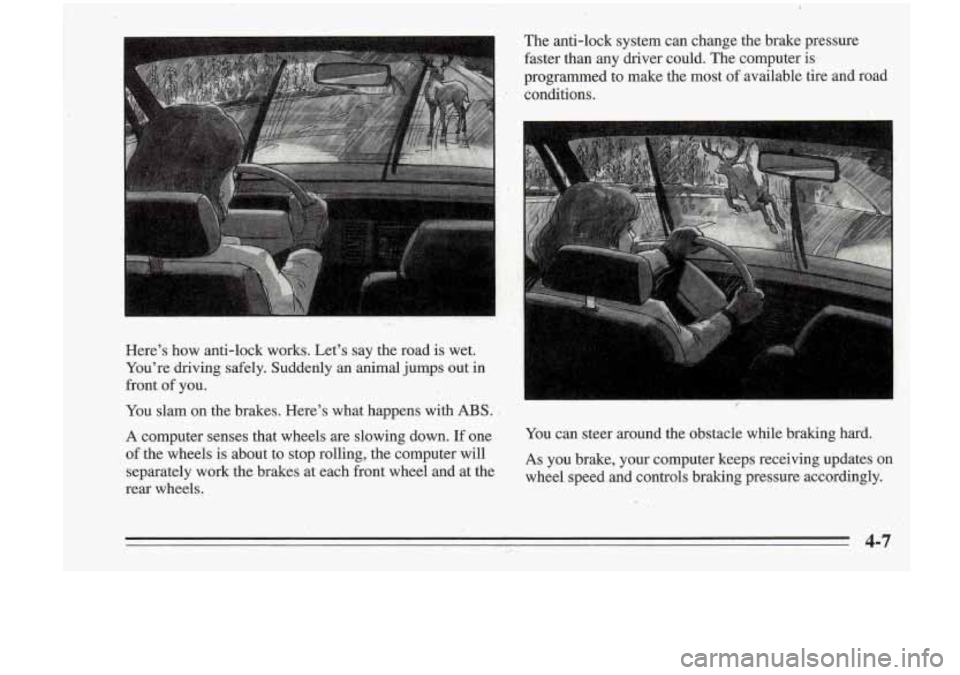
Here's how anti-lock works. Let's say the road is wet.
You're driving safely. Suddenly
an animal juqps out in
front of you. '
You slam on the brakes. Here's what happens with ABS:
A computer senses that wheels are slowing down. If one
of the wheels is about to stop rolling, the computer will
separately work the brakes at each front wheel and at the
rear wheels. The
anti-lock system can change the brake pressure
faster than any
driver could. The computer is
programmed to make the most
of available tire and.road
conditions.
You' can steer around the obstacle while braking hard.
As you brake, your computer keeps receiving updates on
wheel speed and controls braking pressure accordingly.
Page 146 of 340
Remember: Anti-iock doesn’t change the time you need
to get your foot up to the brake pedal.
If you get too
close to the .vehicle in front of you, you won’t have time
to apply your brakes
if that vehicle suddenly. slows or
stops. Always leave enough room up ahead to stop, even
though
you have anti-lock brakes.
,_ Steering
Power Steering
If you lose power steering assist because the engine
stops
or the system is not, functioning, you can steer but
it will take much more effort.
. ..
To Use Anti-Lock
Don’t pump the brakes. Just hold the brake pedal down
and let anti-lock work for you. You may feel the system
working, or you may notice some noise, but this is
normal. When your anti-lock system is adjusting brake
pressure to help avoid a braking skid, the LOW TRAC
light will come’on., See “Anti-Lock Brake System
Active Light”
in the Index.
Braking .,in Emergencies
Usti your anti-lock braking system when you’need to.
With anti-lock, you can steer and brake at the same
time.
In many emergencies, steering can help you more
than even the very best braking.
.‘
Steering Tips
Driving on Curves
It’s important to take curves at a reasonable speed.
A lot of the “driver lost control” accidents mentioned on
the news happen on curves. Here’s why:
Experienced driver or beginner, each
of us is subject to
the samelaws of physics when driving on curves. The
traction of the tires against the road surface makes it
possible for the vehicle to change its path when you
turn
the front wheels. If there’s no traction, inertia will keep
the vehicle going in the same direction. If you’ve ever
tried to steer a vehicle on wet ice, you’ll understand this.
The traction you can get in a curve depends on the
condition of your tires and the road surface, $the angle at
which the curve is banked, and your speed. While
you’re in a curve, speed is the one factor you can
control.
Page 148 of 340
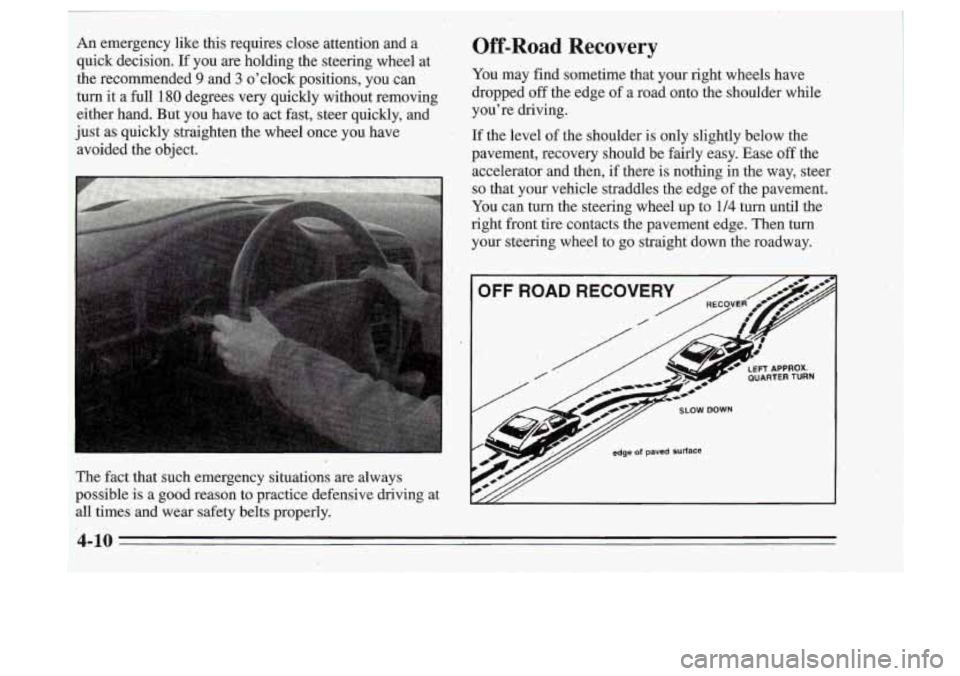
An emergency like this requires close attention and a '
quick decision. If you are holding the steering wheel at
the recommended
9 and 3 o'clock positions, you .can
turn it a
full 180 degrees very quickly without removing
either hand. But you have to act fast, steer quickly, and
just
as quickly straighten the wheel once you have
avoided the object.
..
I'
,.
The fact. that such emergency situations are always
possible is a good reason
to practice defensive driving at
all times
and wear safety belts properly.
4-10
Page 151 of 340
A cornering skid and an acceleration skid are best
handled by easing your foot
off the acce1,erator pedal.
If your. vehicle starts to slide, ease your foot off the ’’
accelerator pedal and’ quickly steer the way you want the
vehicle to go. If you start steering quickly enough,.your
vehicle may straighten out. Always be ready for a
second skid if
it occurs.
Of course, traction is reduced vvhen water, snow, ice,
gravel,
or other material is on the road. For safety, you’ll
want to slow down and adjust your driving to these
conditions. It is important to slow down on slippery
surfaces because stopping distance will ,be longer and
vehicle‘ control more limited.
While driving-on
a surface with reduced traction, try .
your best to avoid sudden steering, acceleration, or
braking (including engine braking by shifting to a lower
gear). Any sudden changes could cause the tires to slide.
You may
pot realize the surface is slippery until your
vehicle is skidding. Learn to recognize warning clues
--
such as enough water, ice or packed snow on the road to
make a “mirrored surface” -- and slow down when you
have any doubt.
Remember: Any anti-lock brake system
(ABS) helps
avoid,only the braking skid.
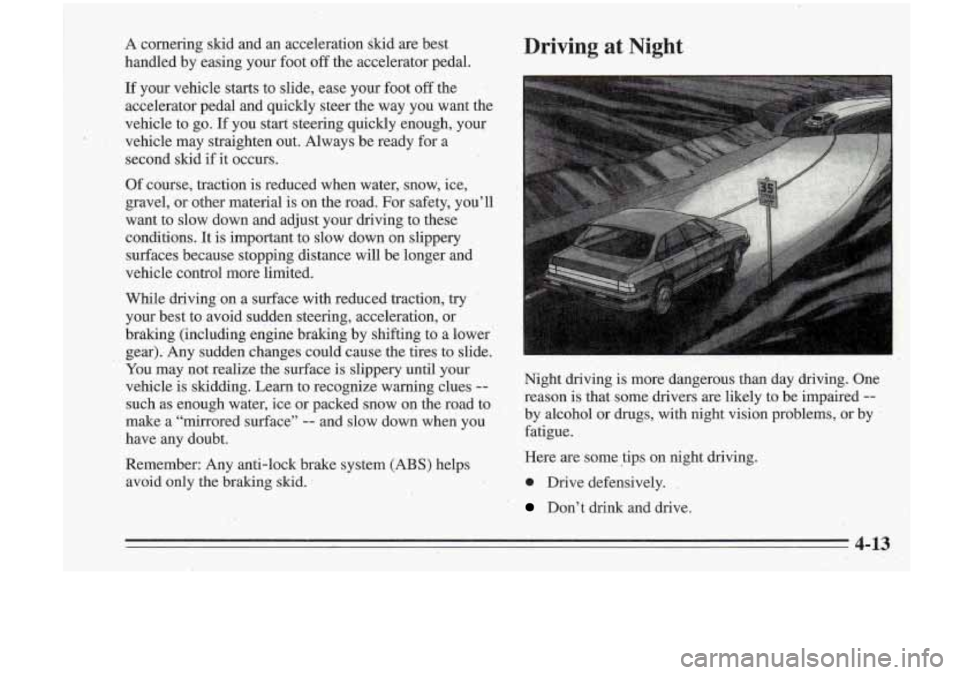
Driving at Night
I ~
Night driving is rnore’dangerous than day driying. One
reason is that some drivers are likely to be impaired-
--
by alcohol or drugs, with night vision problems, or by .
fatigue.
Here are some tips on night driving.
0 Drive defensively. -
’ Don’t drink and drive.
4-13 ,.
Page 161 of 340
Driving on Snow or Ice
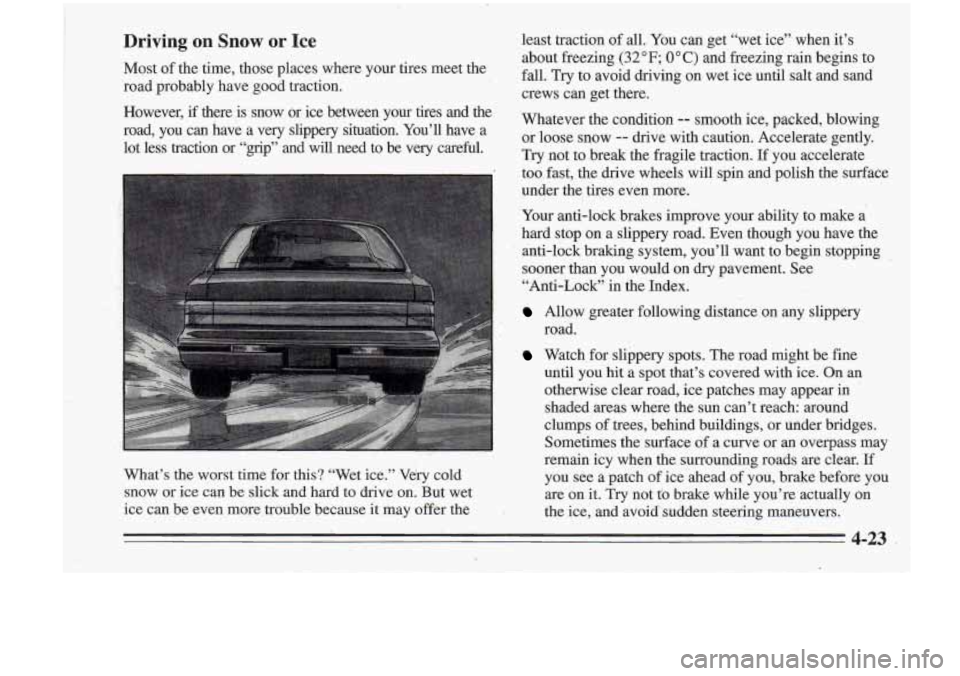
Most of the time, those places where your tires meet the
road probably have good traction. least traction
of all.
You can get “wet ice” when it’s
about freezing
(32°F; OOC) and freezing rain begins to
fall. Try to avoid driving on wet ice until salt and sand
crews can get there.
road.
Watch for slippery spots. The road might be fine
until you
hit a spot that’s covered with ice. On an
otherwise clear road, ice patches may appear in
shaded areas where the sun can’t reach: around
clumps of trees, behind buildings, or urider bridges.
Sometimes the surface of a curve or an averpass may
remain icy when the. surrounding roads
are clear. If
too. fast, the drive wheels will spin and polish the surface
under the tires even more.
‘Your anti-lokk brakes improve your ability to make a
hard stop
on a slippery road. Even though you have the
anti-lock braking system, you’ll want to begin stopping
sooner than you would on dry pavement. See
“Anti-Lock”
in the Index.
Allow greater following distance on any slippery
What’s the worst time for this? “Wet ice.”
V&y cold
snow or ice can be slick and hard to drive on. But wet
ice can be even more, trouble because
it may offer the you
see a-patch of ice ahead of you, brake before you
are on it. Try not
to brake while you’re actually on
the ice, and avoid‘sudden steering maneuvers.
4-23 .
Page 169 of 340
Hitches
It’s important to have the correct hitch equipment.
Crosswinds, large trucks going by, and rough roads are
a
few reasons why you’ll need’the right hitch. Here are
some rules to follow:
0
0
Will you have to make any holes in the body of your
vehicle when you install a:trader hitch?
If you do,
then be sure to seal the holes later when you remove
the hitch.
If you don’t seal them, deadly carbon
monoxide (CO) from your exhaust can get into your
vehicle (see “Carbon Monoxide”
in the Index). Dirt
and water can, too.
The bumpers on your vehicle are not intended for
hitches. Do not attach rental lvtches or other
bumper-type hitches to them. Use only a
frsune-mounted hitch that does not attach to the
bumper.
Safety Chains
You should always attach chains between your vehicle
and your trailer. Cross the safety chains under the tongue
of the trailer
so that the tongue will not drop to the road
if it becomes separated from the.hitch. Instructions
about safety chains may be provided by the hitch
manufacturer or by the trailer manufacturer. Follow the
manufacturer’s recommendation
for attaching safety
chains and do not attach them to‘the bumper. Always
leave just enough slack
so you can turn with your rig.
And, never allow safety chains to drag on the ground.
Trailer Brakes
Because you have anti-lock brakes, do not try to tap into
your vehicle’s brake system.
If you do, both brake
systems won’t work well, or at all.
Page 180 of 340
r. ..
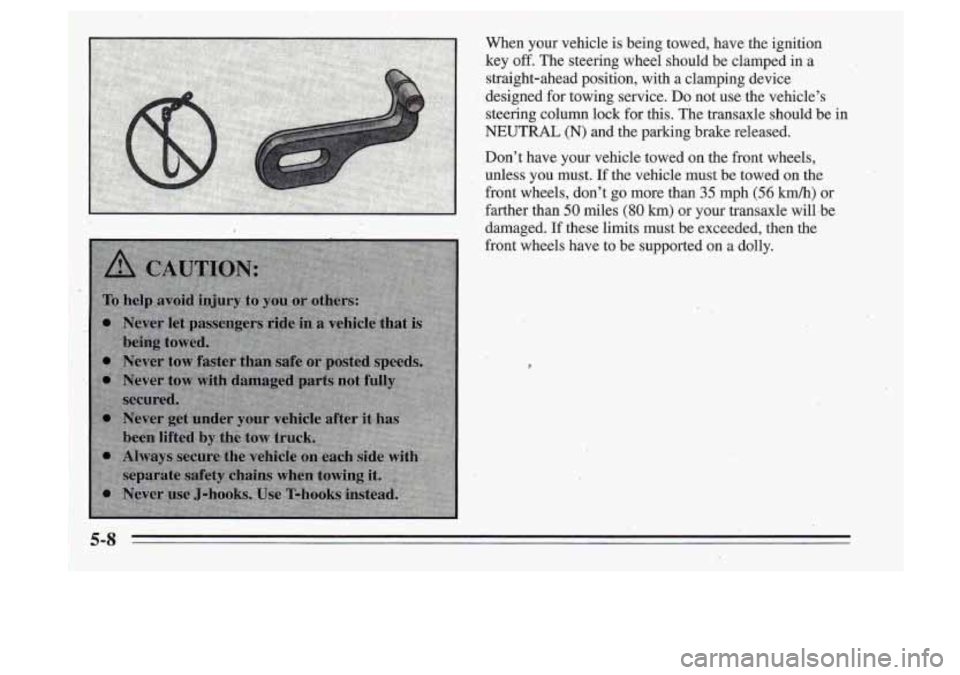
When your vehicle is being towed, have the ignition
key
off. The steering wheel should be clamped in a
straight-ahead position, with a clamping device
designed for towing service.
DQ not use the vehicle’s
steering column lock for this. The transaxle should be’in
NEUTRAL (N) and the parking brake released.
Don’,t have your vehicle towed on the front wheels,
unless you must.. If the vehicle ‘must be towed
on the
front wheels, don’t go more
than 35 mph (56 km/h) or
farther than
50 miles (80 km) or your transaxle wilLbe
damaged. If these limits must be exceeded, then the
front wheels have
to be supported on a dolly.
Page 196 of 340
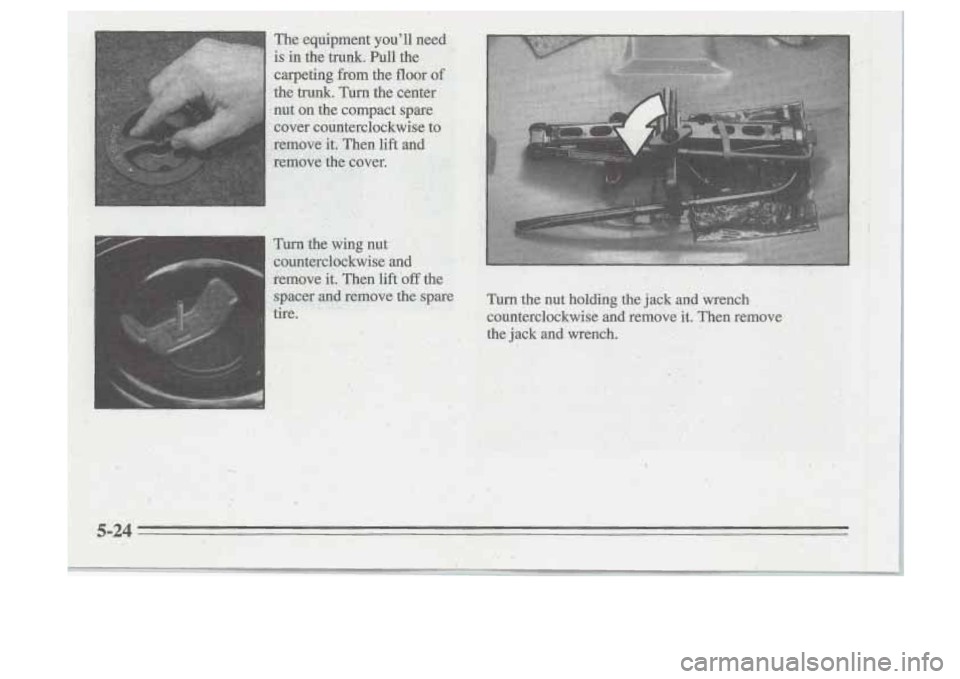
I
” I
Turnthe Wing nut ’
-counterclockwise and ,.
spacer .m@ qernoye the spare
‘tire. .. . Turn the nut holding the jack and wrench. ,
counterclockwise and remove ,it. Then remove ,
the,jack and wrench. .,
I
Page 198 of 340
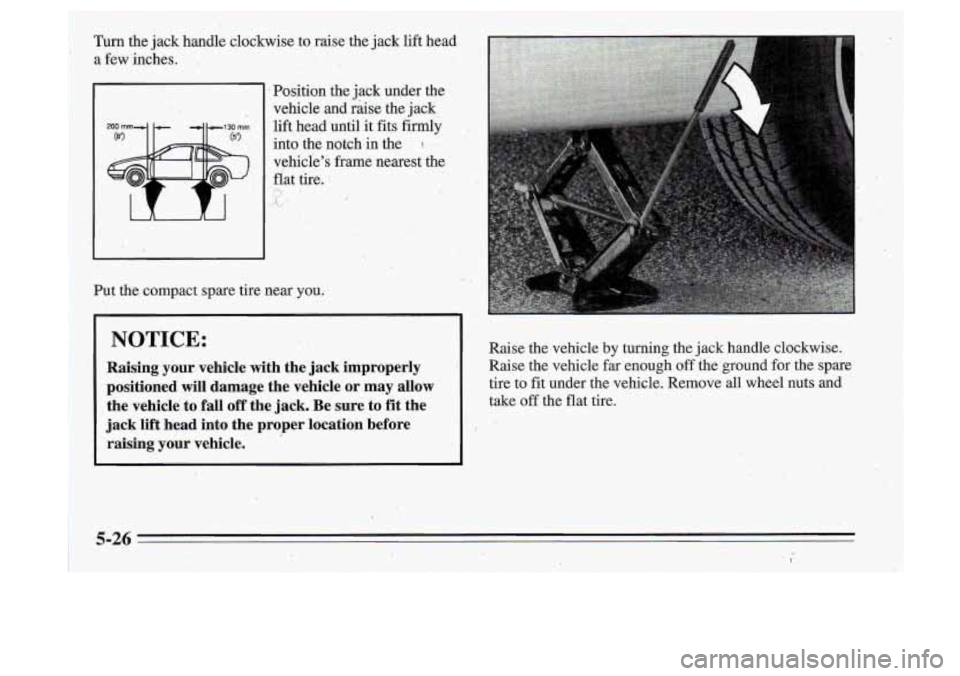
a few inches.
Position the jack under the
vehicle and raise the jack
lift head until it fits firmly
into the notch in the
vehicle's frame nearest the
flat tire.
-. ,
I?
Put the compact spare tire near you.: ..
NOTICE: ,-
Rasing your-vehicle With the jack improperly ' I
positioned mi damage .the wehide or mqy allow
the ,vehicl-e'. to. fall off the jack. Be-suri to fit the
jacklift head iato
the proper Location before
mising your vehicIe.
I I
I. .. ..
Kaise the,velaicle by turning the jack handle clockwise.
Raise the vehicle
far enough o€€-the,grsund for the spare.
tire to fit under the vehicle,. Remove all wheel nuts &d
take off !he flat tire. t
5-26
1