cooling Oldsmobile Cutlass Supreme 1995 Owner's Manuals
[x] Cancel search | Manufacturer: OLDSMOBILE, Model Year: 1995, Model line: Cutlass Supreme, Model: Oldsmobile Cutlass Supreme 1995Pages: 340, PDF Size: 16.68 MB
Page 108 of 340
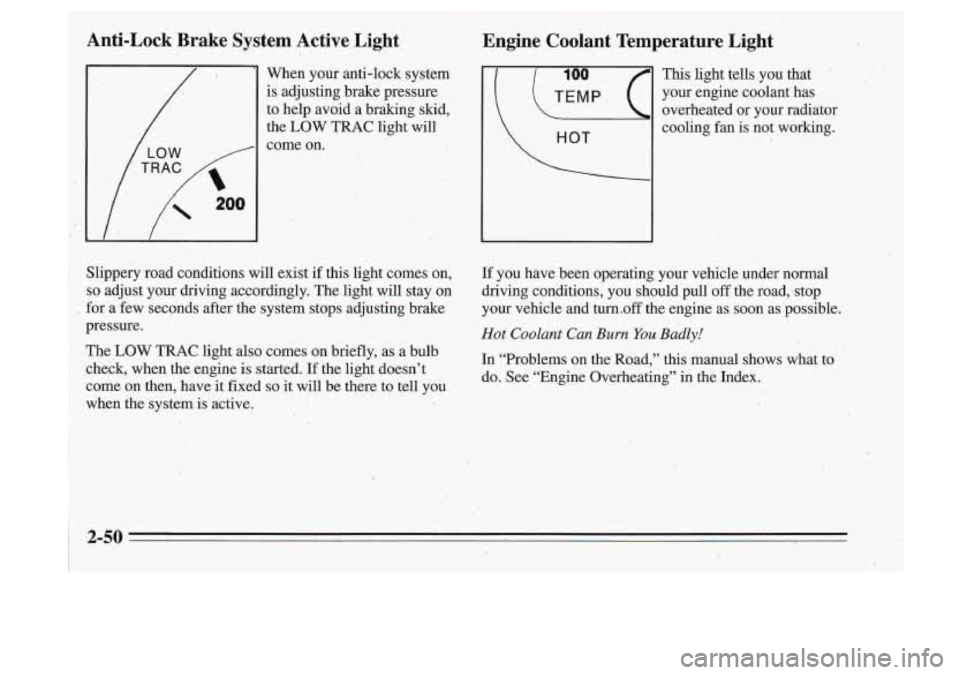
Anti-Lock Brake System Active Light
When your anti-lock system
is adjusting brake pressure
to help avoid a braking skid,
the LOW TRAC light will
come on.
Slippery road conditions will exist if this light comes on,
so adjust your driving accordingly. The light will stay on
for a few seconds after the system stops adjusting brake
pressure.
The LOW TRAC light also comes on briefly, as a bulb
check, when the engine is started. If the light doesn’t
come on then, have it fixed
so it will be there to tell you
when the system is active.
‘ This light tells.you that
your engine coolant has
, overheated or your radiator
cooling fan is not working.
If you have been operating your vehicle under normal
driving conditions, you should pull
off the road;stop’
your vehicle and turn.off the engine as soon as possible.
Hot Coolant Can Burn You Badly!
In “Problems on the~Road,” this manual shows what to
do. See “Engine Overheating”
in the Index.
2-50
Page 117 of 340
Section 3 Comfort Controls and Au,dio Systems
In this section you'll find out how to operate the comfort With this system, you can control the heating, cooling '
control systems and audio systems offered with your and ventilation in your vehicle. The system works best if
Oldsmobile. Be sure to read about the particular system you keep your windows closed while using it.
supplied with your vehicle.
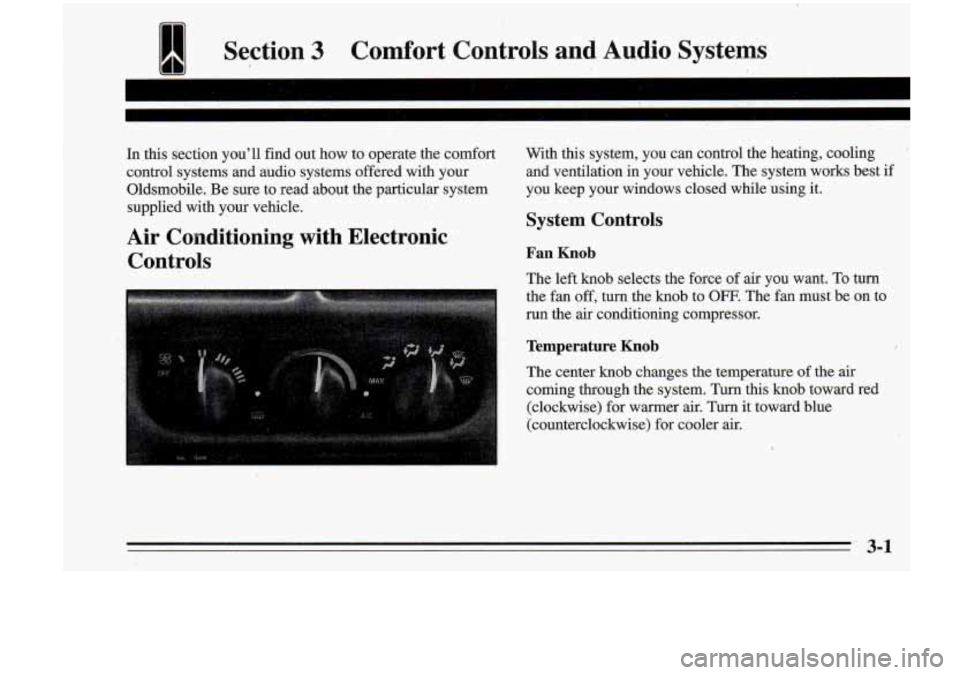
System Controls
Air Conditioning with Electronic Controls
Fan ,Knob
The left knob selects the force of air you want. To turn
the
fan off, turn the knob to OFF. The fan must be on to
run the air conditioning compressor.
Temperature I(nob
The center knob changes the temperature of the .air
coming through the system.
Turn this knob toward red
(clockwise) for warrner
air. Turn it toward blue
(counterclockwise)
for cooler air.
3-1
Page 119 of 340
Air Conditioning
On very hot days, open the windows long enough to let
hot inside air escape. This reduces the time the
compressor has to run, which should help fuel economy.
For quick cool-down on very hot days, use
MAX with
the temperature knob all the way in the blue area. If this
setting is used. for long periods of time, the air in your
vehicle may become too dry.
For normal cooling on hot days, use
VENT with the
temperature knob
in the blue area and the NC'button
pushed
in. The system will bring in outside air and cool it.
On cool but sunny days, the sun may warm your upper
body, but your lower body may not be warm enough.
You can use BI-LEVEL with the,terhperature
knob in
the middle and the
A/C button pushed in. The system
will bring
in outside air and direct it to your upper body,
while sending slightly warmed
air to your lower body.
You may notice this temperature difference more at
. '
some times than others.
J
Heating
On cold days use FLOOR with the temperature knob all
the way
in the red area. The system will bring in outside
air, heat it and send it to the floor ducts.
If your vehicle has an engine coolant heatkr, you can use
it to help your system provide warm air faster when it's
cold outside
(0" F (-1 8 O C) or lower). An engine coolant-
heater
warms the coolant your engine and heating
system use to provide heat. See "Engine Coolant
Heater" in the Index.
Ventilation
For mild outside temperatures when little heating or
cooling is needed, use
VENT to direct outside air through
your vehicle. Your vehicle also has the flow-through
ventilation system described later in this section.
Defogging and Defrosting Windows
Your system' has two settings for clearing the front and
side windows. To defrost the windows'quickly, use
DEFROST with the temperature knob all the way in the
red area. To warrn passengers while keeping the
windows' clean, use
QEFOG.
3-3
Page 122 of 340
Automatic Control
For the most efficient operation, you ,should.set the
system temperature and press the knob. The system will
select the best fan speed and air flow, settings to keep
you comfortable. The air conditioning compressor will
run
if the outside temperature is above 40°F (4.5 ” C).
YOU may notice
a delay of three to four minutes before
the fan comes on.
Manual Control
If you prefer to manually control the heating, cooling
and ventilation
in your vehicle, push UPPER, BI-LEV,
LOWER, DEFOG or
DEE AUTO will go off the
display. Set the system to the temperature and fan
speed you want. The system will try to maintain the
temperature you set using the mode you select. The
following suggestions will help the system run more
efficiently in manual mode.
Air Conditioning
On very hot days, open the windows long enough to
let hot inside
air escape. This reduces the time the
compressor has to run, which should help fuel economy.
For quick cool-down on very hot days, use RECIRC. If
this setting is used for long periods
of time, the air in
your vehicle may become too dry. For normal cooling on hot days, use UPPER with the
A/C button pushed
in. The system will.bring in outside
air and cool it.
On
cool but .sunny days, the sun may warm your upper ,
body, but your lower body may not be warm enough. You
can use BI-LEV with the A/C’ button pushed in.’
The system will bring in outside air and direct it to your
upper body, while sending slightly warmed air to your
lower body. You may notice this temperature difference
more at some times than.others.
Heating
On cold days use LOWER. The system will bring in
outside air, heat it and send it to the floor ducts.
If your vehicle has an engine coolant heater, you, can use
it to help your system provide warm air faster when it’s
cold outside
(0°F (-18°C) or lower). An engine coolant
heater warms the‘coolant your engine and heating
system use to provide heat. See “Engine Coolant
Heater” in the Index.
Ventilation
For mild outside temperatures when little heating or
cooling is needed, use-UPPER to direct outside air through
your vehicle.
Your vehicle also has the flow-through
ventilation system described later in
this section.
3-6
-
Page 159 of 340
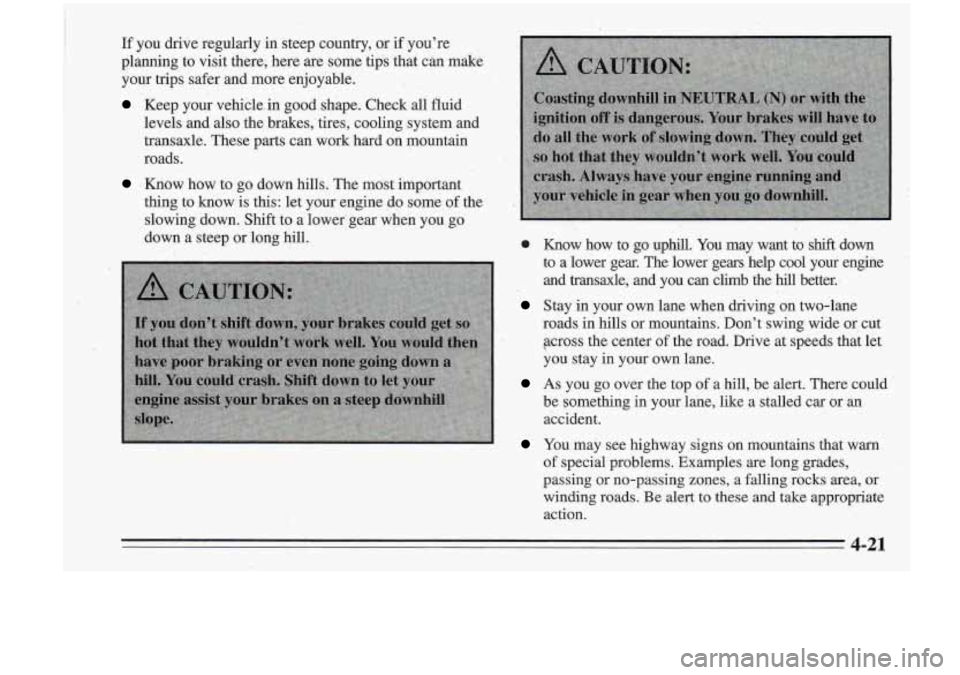
If you drive regularly in steep country, or if you're
planning to visit there, here are some tips that can make
your trips safer and more enjoyable.
Keep your vehicle-in good shape. Check all fluid
1evel.s and. also the brakes; tires, cooling system and
..
transaxle. These parts can work,hard on mountain
roads.
Know how to go down hills. The most important
thing to know is this: let your' engine do some of the
slowing down. Shift to a lower, gear when you go
down a steep or long hill.
e Know, how to gauphill. You may want to shift down
to a lower gek The 1ower.gearshelp cool your engine
and tramaxle, and you can climb the hill better.,
Stay in your own lane when driving on two-lane
roads
iri hills or mountains. Don't swing wide or cut
'% across the center of the road, Drive at speeds that let
you stay
in your own lane.
As you go over the top of a hill, be alert. There, dould
be something in your lane, like a stalled ca~
or an
accident.
You.m&y see highway ,signs on mountains that warn
,of special problems. Examples are long grades,
passing
or no-passing zones, a falling rocks &ea, or
winding roads. Be aleq to these aad'take appropriate
action.
,,
4-21
Page 172 of 340
Parking on Hills
You really should not park your vehicle, with a trailer
attached,
on a hill. If something goes wrong, your rig
could start to move. People can be injured, and
both^
your vehicle and the trailer can be darnaged.
But if you ever have to park your rig on a hill, here’s
how to do it:
.I. Apply your regular brakes, but don’t shift into
.. !PARK (P) yet.
2. ‘Have someone place chocks under the trailer wheels.
3. When the wheel chocks are in place, release the
regular brakes until the chocks absorb the load.
4. Reapply the regular brakes. Then apply your parking
brake, and then shift to PARK
(P).
When You Are Ready to Leave After
Parking o,n a
Hill
1. Apply your regular brakes and hold the pedal down
8’. .
while you:
Start your engine;
Shift into a gear; and
Release the parking brake.
2. Let up on the brake pedal.
3. Drive slowly until the trailer is dear of the chocks.
4. Stop and have someone pick up and store the chocks.
Maintenance When Trailer Towing
Your vehicle will need service more often when you’re
pulling a trailer. See the Maintenance Schedule for,more
.on this. Things that are especially important in trailer
operation are automatic transaxle fluid (don’t oyerfill),
engine oil, belt, cooling system, .and brake adjustment.
Each of these
is covered in this manual, and the Index
will help you find them quickly. If you’re trailering, it’s
a good idea
to review these sections before you start
your trip.
Check periodically to see that all hitch nuts and bolts are
tight.
4-34,
Page 187 of 340
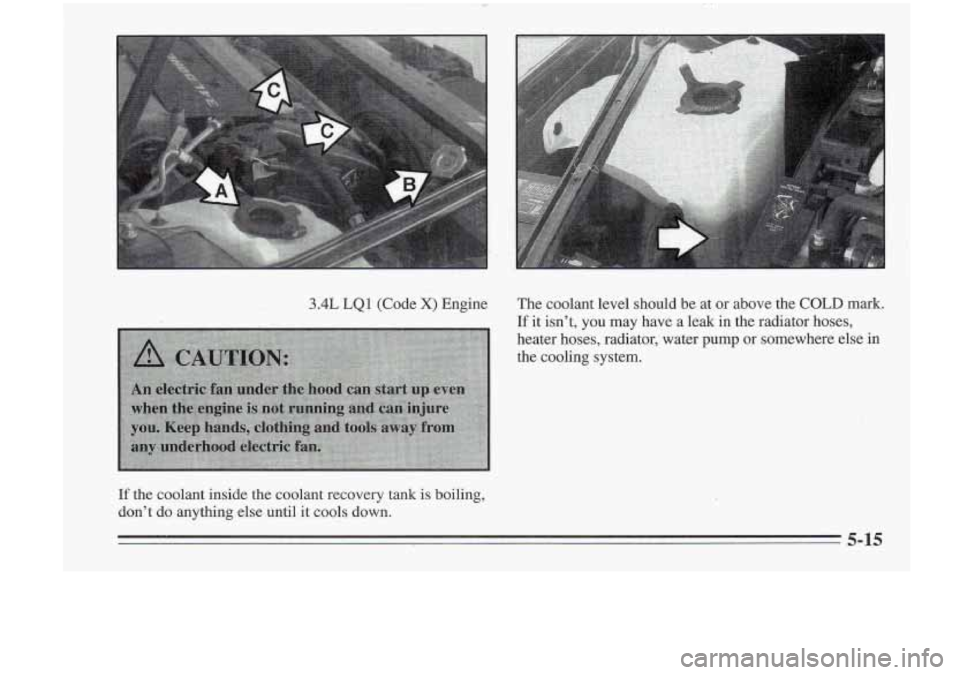
3.4L LO1 (Code X) Engine Y The coolant level should be at or above the COLD mark.
If it isn’t, you may have a leak in the radiator hoses,
heater hoses, radiator, water
pump or somewhere else in
the
cooling system.
If the coolant inside the coolant recovery tank is boiling,
don’t do anything else (until it
cools down.
5-15
Page 189 of 340
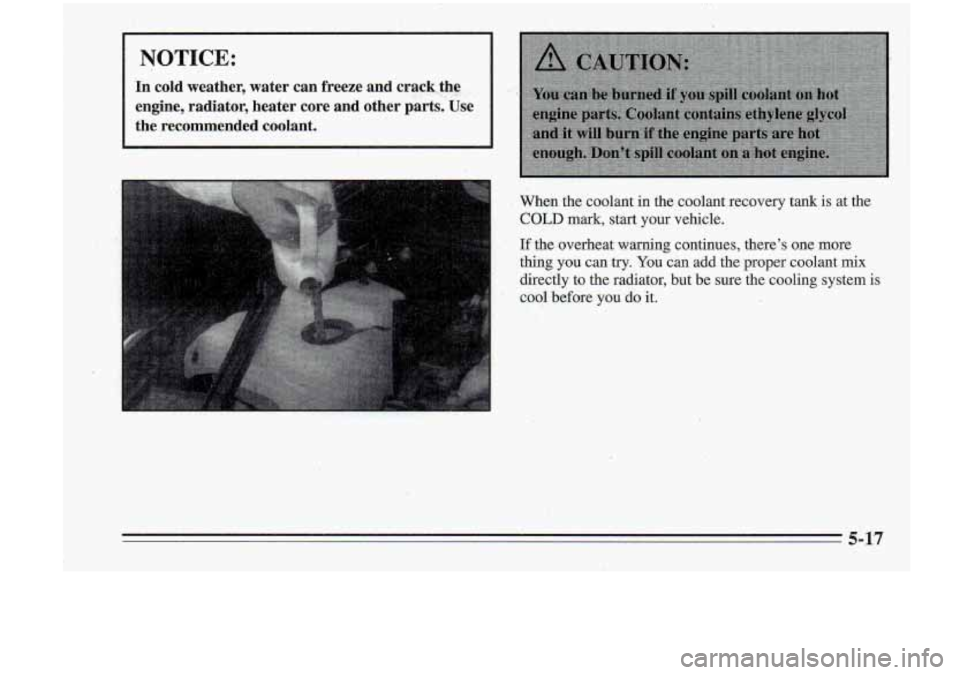
NOTICE:
In cold weather, water can freeze and crack,,the ... , . i . ar
engine, radiator, heater core and other parts.' Use
the recommended coolant.
When the coolant in the coolant recovery tank is at the
COLD mark, start your vehicle.
If the overheat warning continues, there's one more
thing you can try.
You can add the proper coolant mix
directly to the radiator, but be sure the cooling system is
cool before you do it.
5-17
Page 190 of 340
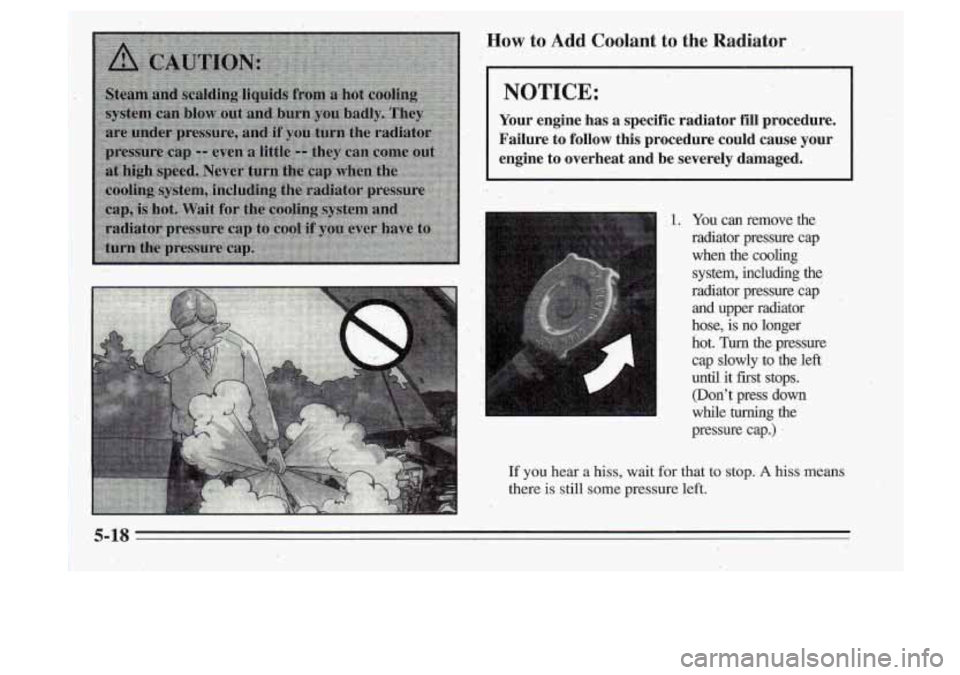
NOTICE:
Your engine has a specific radiator fill procedure.
Failure
to follow this procedure could cause your
engine
to overheat and be severely damaged.
1. You can remove the
radiator pressure cap
when the
cooling
system, including the
radiator pressure cap
and upper radiator
hose,
is no l6nger
hot.
Turn the pressure
cap slowly to theleft
until
it first stops.
(Don’t press down
while turning.the
pressure cap.)
-
If you hear a hiss, wait for that to stop. A hiss means
there is still some pressure left.
,5-18 ..
Page 265 of 340
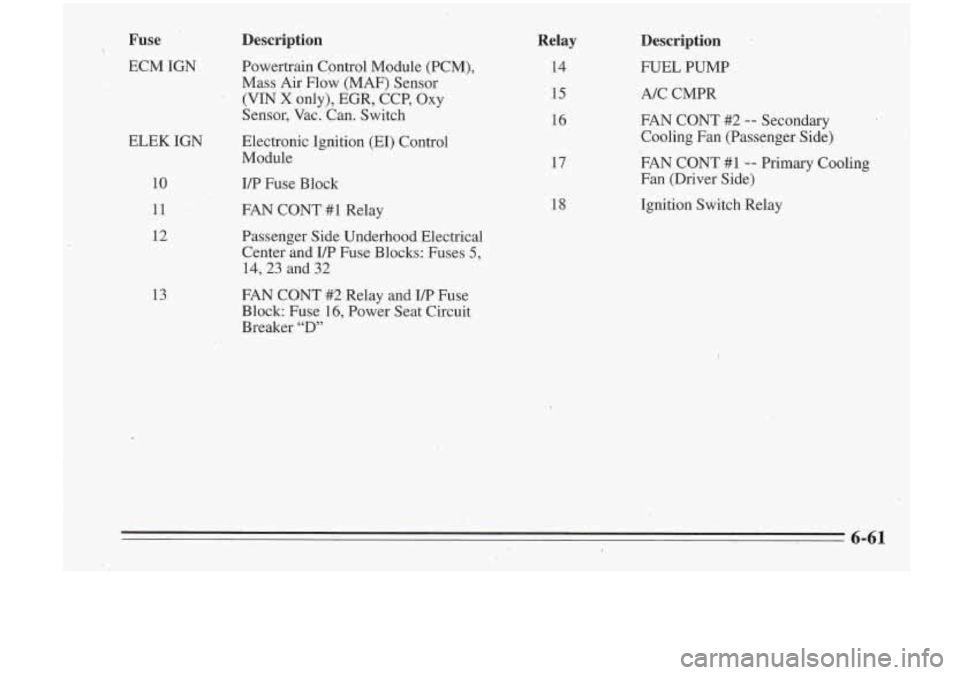
Fuse Description
ECM IGN Powertrain Cpntrol Module (PCM), Mass Air Flow (MAF) Sensor
(VIN X only), EGR, CCP, Oxy
Sensor, Vac. Can. Switch
ELEK IGN Electronic Ignition
(m) Control
Module
10
11
12
13
I/P Fuse Block
FAN CONT
#1 Relay
Passenger Side Underhood Electrical Center and
UP Fuse Blocks: Fuses 5,
14,23 and 32
FAN CONT #2:Relay and ITP Fuse
Block Fuse 16, Power Seat Circuit
Breaker
“D”
Relay
14
15
16
17
18
Description
FUEL PUMP
A/C CMPR
FAN CONT #2 --- Secondary
Cooling Fan (Passenger Side)
FAN CONT #1
-- Primary Cooling
Fan (Driver Side)
Ignition Switch Relay