fuel cap Oldsmobile Cutlass Supreme 1996 Owner's Manuals
[x] Cancel search | Manufacturer: OLDSMOBILE, Model Year: 1996, Model line: Cutlass Supreme, Model: Oldsmobile Cutlass Supreme 1996Pages: 356, PDF Size: 18.48 MB
Page 112 of 356
0 Reduce vehicle speed.
0 Avoid hard accelerations.
Avoid steep uphill grades.
I 0 If towing a trailer, reduce the amount of cargo being
hauled as soon as it is possible.
If the lightstops flashing and remains,on steady, see “If
the Light
Is On Steady” following.
If
the light continues to flash, when it is safe to do so,
stop the vehicle. Put your vehicle in PARK (P). Turn the
key off, wait at least
10 seconds and restart the engine.
~ If the light remains on steady, see “If the Light Is On
Steady” following. If the light is still flashing, follow
the
1 previous steps, and drive the vehicle to your retailer or
qualified service center for service.
1
If the Light Is On Steady
You may be able to correct the emission system
malfunction by considering the.following:
Did you just put fuel into your vehicle?
If
so, reinstall the fuel cap, making sure to fully install
the cap. The diagnostic system can determine if the fuel
cap has been left
off or improperly installed. This will
allow fuel to .evap.orate into the atmosphere. A few
driving trips should turn the light
off.
Did you just drive through a deep puddle of water?
If
so, your electrical system may be wet. The condition
will usually be corrected when the electrical system
dries out. A few driving trips should turn the light
off.
Are you low on fuel?
As your engine starts to run out of fuel, your engine may
not
run as efficiently as designed since small amounts of
air are sucked into the fuel line causing a misfire.
The
system can detect this. Adding fuel should correct this
condition. Make sure to install the fuel cap properly. It
will take a few driving trips to turn the light off.
Page 116 of 356
Low Fuel Light
0 ’ FUEL
E@
UNLEADED FUEL ONLY
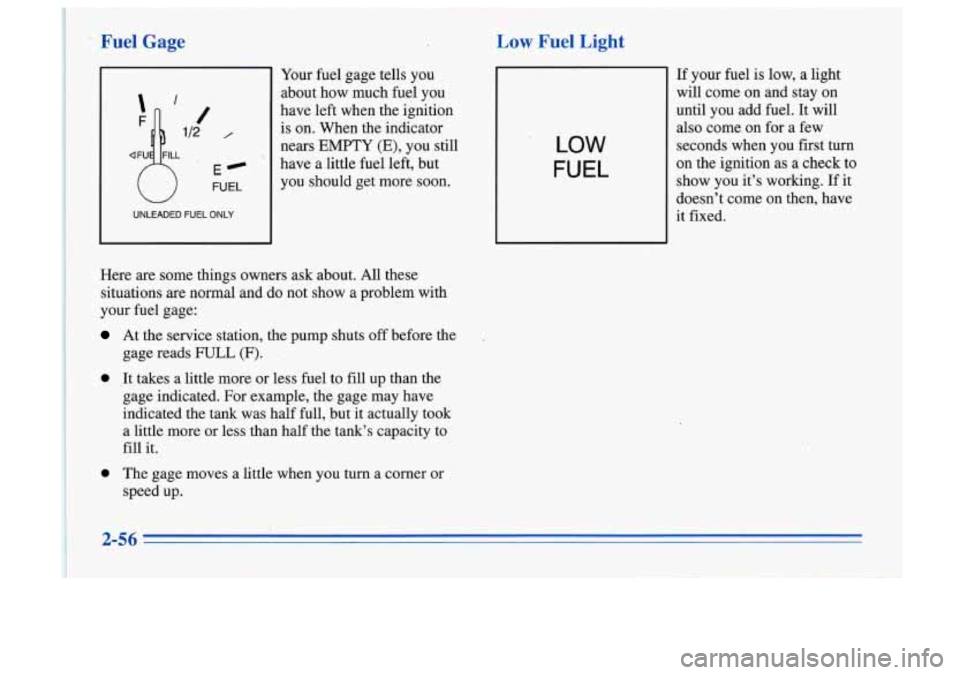
Your fuel gage tells you
about how much fuel you
have left when the ignition
is on. When the indicator
nears EMPTY (E), you still
have a little fuel left, but
you should get more soon.
Here
are some things owners ask about. All these
situations are normal and do not show a problem with
your fuel gage:
At the service station, the pump shuts off before the
0 ,It takes a little more or less fuel to fill up than the
gage
reads FULL
(F).
gage indicated. For example, the gage may have
indicated the tank was half full, but it actually took
a little more or less than half the tank’s capacity to
fill
it.
0 The gage moves a little when you turn a corner or
speed up,.
LOW
FUEL
If your fuel is low, a light
will come on and stay on
until you add fuel. It will
also come on for a few seconds when you first turn
on the ignition as a check
to
show you it’s working. If it
doesn’t come on then, have
it fixed.
2-56
Page 121 of 356
Air Conditioning
On very hot days, open the windows long enough to’let
hot, inside air escape. This reduces the time the
compressor has to run, which should help fuel economy.
For quick cool-down on very hot days, use
MAX with
the temperature knob all
the way in the blue area. If this
setting is used for long periods of time, the air in your
vehicle may become too
dry.
For normal cooling on hot days, use VENT with the
temperature knob in the blue area and the A/C button
pushed in. The system will bring in outside air and
cool it.
On cool but sunny days, the sun may warm your upper
body, but your lower body may not be warm enough.
You can use BI-LEVEL with the temperature knob set
for comfort and the A/C button pushed in. The system
will bring in outside air and direct it to your upper body,
while sending slightly warmed air
to your lower body.
You may notice this temperature difference more at
some times than others.
Heating
On cold days, use FLOOR with the temperature knob all
the way in the red area. The system will bring in outside
air, heat it and send it to the floor ducts.
If your vehicle has an engine coolant heater, you can use
it to help your system provide warm air faster when it’s
cold outside (0°F (-18°C) or lower). An engine coolant
heater warms the coolant your engine and heating
system use to provide heat. See “Engine Coolant
Heater” in the Index.
Ventilation
For mild outside temperatures when little heating or
cooling is needed, use VENT to direct outside air
through your vehicle. Your vehicle also has the
flow-through ventilation system described later in
this section.
Defogging and Defrosting
Your system has two settings for clearing the front and
side windows. To defrost the windows quickly, use
DEFROST with the temperature knob all the way in the
red area. To warm passengers while keeping the
windows clean, use DEFOG.
3-3
Page 124 of 356
Manual Control
If you prefer to manually control the heating, cooling and ventilation in your vehicle, set the system to the
temperature and fan speed you want. Next, push the
desired airflow direction pushbutton. The system will
try to maintain the temperature you set using the mode
you select. The following suggestions will help the
system run more efficiently in manual mode.
Air Conditioning
On very hot days, open the windows long enough to
let hot, inside air escape. This reduces the time the
compressor has to run, which should help fuel economy.
For quick cool-down on very hot. days, use RECIRC.
If this setting is used for long periods of time, the air
in
your vehicle may become too dry.
For normal cooling on hot days, use UPPER with the
A/C button pushed in. The system will bring in outside
air and cool
it.
Heating
On cold days, use LOWER. The system will bring in
outside air, heat it and send it to the floor ducts.
If your vehicle has an engine coolant heater, you can use
it to help your system provide warm air faster when it’s
cold outside
(0°F (-18°C) or lower). An engine coolant
heater warms the coolant your engine and heating
system use to provide heat. See “Engine Coolant
Heater” in the Index.
Ventilation
For mild outside temperatures when little heating or
cooling is needed, use UPPER to direct outside air
through your vehicle. Your vehicle also has the
.
flow-through ventilation system, described later in
this section.
Defogging and Defrosting
Your system has two settings for clearing the front and
side windows.
To defrost the windows quickly, use DEF.
To warm passengers while keeping the windows clean,
use DEFOG.
On
cool but sunny days, the sun may warm your upper
body, but your lower body may not be warm enough.
You can use
BI-LEV with the A/C button pushed in.
I The system will bring in outside air and direct it to your
upper body, while sending slightly warmed air
to your
3-6
Page 175 of 356
. Loading ' Your' Vehicle
Tm OCCUPANTS VEHICLE .CAP. WT,
TIRE-LOADING INFORMATION
FRT. CTR. RR. TOTAL LBS. KG
MAX. LOADING & GVWR SAME AS VEHICLE
CA.PAClTY WEIG'HT
XXX COLD TIRE
TIRE
SIZE SPEED PRESSURE.
RTG
PSI/KPa
FRT.
RR.
SPA.
IF TIRES ARE HOT, ADD 4PSV28KPa.
SEE OWNER'S MANUAL FOR ADDITIONAL
INFORMATION
i
A
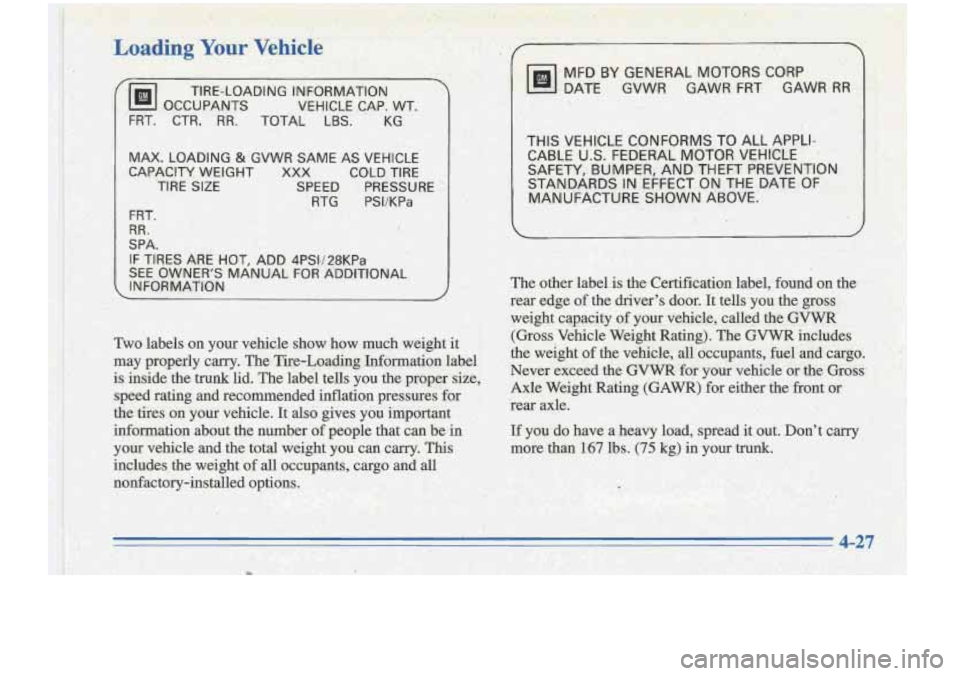
Two labels on your vehicle show how much wei.ght it
may properly carry. The Tire-Loading Information label is inside the
trunk lid. The label tells you the proper size,
speed rating and recommended inflation pressures'for
the tiies on your vehicle. It also gives you important
.
information about the number of people that can be in
your vehicle and the total weight you, can carry. This
includes, the weight 'of all occupants, ,cargo and all
nonfactory-installed options.
r I
mi
I.
MFD'BY GENERAL MOTORS CORP
DATE GVW8 GAWR FRT
. GAWR RR
'THIS VEHICLE C-ONFORMS TO ALL APPLI-
CABLE U.S. FEDERAL
MOTOR VEHICLE
SAFETY, BUMPER, AND THEFT PREVENTION
STANDARDS
IN EF,FECT ON THE DATE Of
MANUFACTURE SHOWN ABOVE.
L 1
The other label is the Certification label, found on the
rear edge
of the driver's door. It tells .you the gross
weight aqacity of your vehicle, called the GVWR
(Gross\Vehicle Weight Rating). The GVWR includes
the weight
of the vehicle, all occupantS, fuel and cargo.
Never: exceed the
GVWR for your vehicie or the Gross
Axle Weight Rating (GAWR) for either, the front or
'rear axle.
If you do have a heavy bad, spread it out. Don't carry
more than 167 lbs. (75 kg) in your trunk:
Page 177 of 356
Towing a Trailer
If you don’t use the correct equipment and drive
properly, you can lose control when you pull
a
trailer. For example, if the trailer is too heavy, the
brakes may not work well
-- or even at all. You
and your passengers could be seriously injured.
Pull
a trailer only if you have followed all the
steps
in this section. Ask your Oldsmobile retailer
for advice and information about towing
a trailer
with your vehicle.
NOTICE:
Pulling a trailer improperly can damage your
vehicle and. result in-costly repairs not covered by
your warranty.
To pull a trailer correctly, follow
the advice in this part, and see your Oldsmobile
retailer for important information about towing
a trailer with your vehicle.
Your vehicle can tow a trailer. To identify what the
vehicle trailering capacity is for your vehicle, you
should read the information in “Weight of the Trailer”
that appears ‘later in this section. But trailering is
different than just driving your vehicle by itself.
Trailering means changes in handling, durability, and fuel economy. Successful, safe trailering takes correct
equipment, and it has to be used properly.
4-29
Page 225 of 356
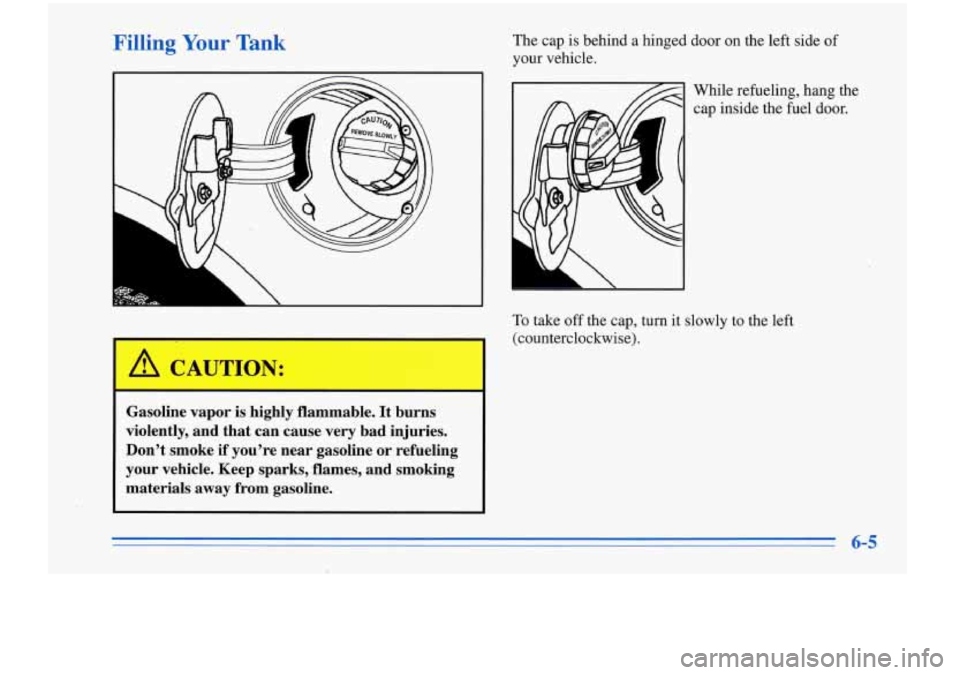
Filling Your Tank The cap. is behind a hinged door on the left side of
your vehicle.
I A CAUTION:
Gasoline vapor is highly flammable. It burns
violently, and that can cause very bad injuries.
Don’t smoke
if you’re near gasoline or refueling
your vehicle. Keep sparks, flames, and smoking
materials away from gasoline.
While refueling, hang the
cap inside the fuel door.
To take off the cap, turn it slowly to the left
(counterclockwise).
Page 226 of 356
I 1 CAUTIOT’
If you get gasoline on yourself and then
something ignites it, you could be badly burned.
Gasoline can spray out on you
if you open the
fuel filler cap too quickly. This spray can happen
if your tank
is nearly full, and is more likely in
hot weather. Open the fuel filler cap slowly and
wait for any “hiss” noise to stop. Then unscrew
the cap all the way.
Be careful not to spill gasoline. Clean gasoline from
painted surfaces as soon as possible. See “Cleaning the
Outside of Your Oldsmobile” in the Index. When you put the
cap back on,
turn it to the right until
you hear at least three clicks. Make sure you fully install
the cap. The diagnostic system can determine if the fuel
cap has been left off or improperly installed. This would
allow fuel to evaporate into the atmosphere. See
“Malfunction Indicator Lamp” in the Index.
NOTICE:
If you need a new cap, be sure to get the right
type. Your retailer can get one for you. If you get
the wrong type, it may not fit
or have proper
venting, and your fuel tank and emissions system
might be damaged.
Page 230 of 356
it Fiy.
Engine Oil
Before closing the hood, be sure all the filler caps are
on properly. Then just pull the hood down and close
LOW OIL
LEVEL
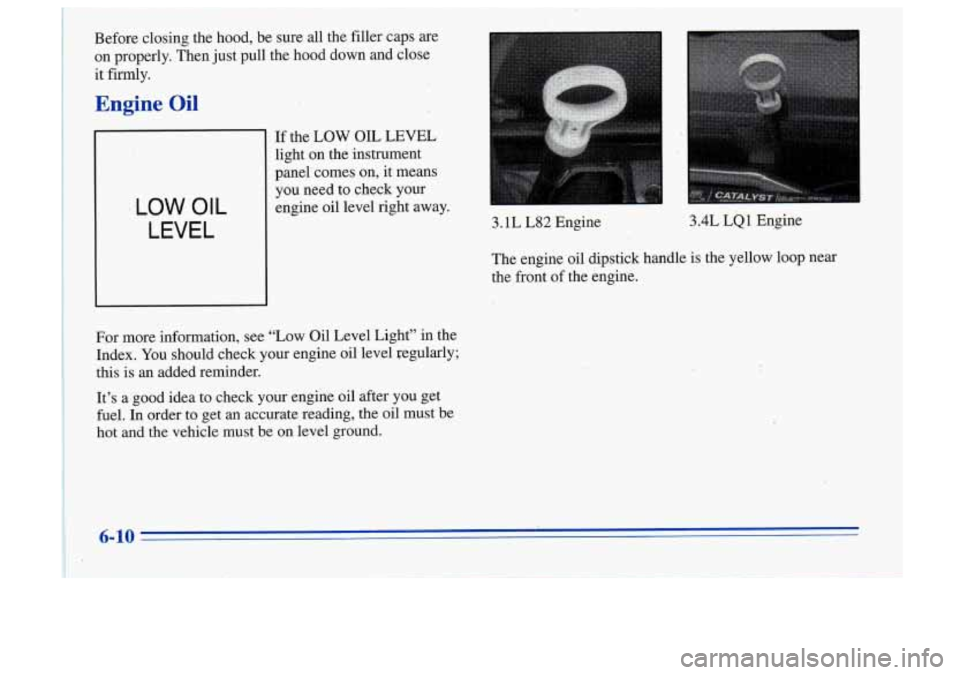
,If the LOW OIL LEVEL
light on the instrument
panel comes on, it means
you need to check your
engine oil level right away.
For more information, see
“Low Oil Level Light” in the
Index. You should check your engine oil level regularly;
this is an added reminder.
It’s a good idea to check your engine oil after you get
fuel. In order to get an accurate reading, the oil must be
hot and the vehicle must
be on level ground.
i
3.1L L82 Engine 3.4L LQ1 Engine
The engine oil dipstick handle is- the yellow loop near
the front
of the engine.
6-10
Page 263 of 356
Inflation -- Tire Pressure
The Tire-Loading Information label, located on
the inside of the trunk lid, shows the correct inflation
pressures for your tires when they’re cold. “Cold”
means your vehicle has been sitting for at least
three hours or driven no more than
1 mile (1.6 km).
NOTICE:
Don’t let anyone tell you that underinflation or
overinflation is all right.
It’s not. If your tires
don’t have enough
air (underinflation), you can
get the following:
Too much flexing
Too much heat
Tire overloading
Bad wear
Bad handling
Bad fuel economy.
NOTICE: (Continued) NOTICE: (Continued)
If your tires have too much
air (overinflation),
you can get the following:
Unusual wear
Bad handling
Rough ride
Needless damage from road hazards.
When to Check
Check your tires once a month or more.
Don’t ‘forget your compact spare tire. It should be at
60 psi (420 kPa).
How to Check
Use a good quality pocket-type gage to check tire
pressure. You can’t tell
if your tires are properly inflated
simply by looking at them. Radial tires may look
properly inflated even when they’re underinflated.
Be sure to put
the valve caps back on the valve stems.
They help prevent leaks by keeping out
dirt and moisture.
6-43