steering wheel Oldsmobile Intrigue 2000 s Owner's Guide
[x] Cancel search | Manufacturer: OLDSMOBILE, Model Year: 2000, Model line: Intrigue, Model: Oldsmobile Intrigue 2000Pages: 348, PDF Size: 2.6 MB
Page 185 of 348

4-16
Loss of Control
Let's review what driving experts say about what
happens when the three control systems (brakes, steering
and acceleration) don't have enough friction where the
tires meet the road to do what the driver has asked.
In any emergency, don't give up. Keep trying to
steer and constantly seek an escape route or area of
less danger.
Skidding
In a skid, a driver can lose control of the vehicle.
Defensive drivers avoid most skids by taking reasonable
care suited to existing conditions, and by not ªoverdrivingº
those conditions. But skids are always possible.
The three types of skids correspond to your vehicle's
three control systems. In the braking skid, your wheels
aren't rolling. In the steering or cornering skid, too
much speed or steering in a curve causes tires to slip and
lose cornering force. And in the acceleration skid, too
much throttle causes the driving wheels to spin.A cornering skid is best handled by easing your foot off
the accelerator pedal.
Remember: Any traction control system helps avoid
only the acceleration skid.
If your traction control system is off, then an
acceleration skid is also best handled by easing your
foot off the accelerator pedal.
If your vehicle starts to slide, ease your foot off the
accelerator pedal and quickly steer the way you want the
vehicle to go. If you start steering quickly enough, your
vehicle may straighten out. Always be ready for a
second skid if it occurs.
If your vehicle is equipped with the Precision Control
System, the LOW TRAC light may come on. See ªLow
Traction Active (LOW TRAC) Lightº in the Index.
Page 207 of 348

4-38 Following Distance
Stay at least twice as far behind the vehicle ahead as you
would when driving your vehicle without a trailer. This
can help you avoid situations that require heavy braking
and sudden turns.
Passing
You'll need more passing distance up ahead when
you're towing a trailer. And, because you're a good deal
longer, you'll need to go much farther beyond the
passed vehicle before you can return to your lane.
Backing Up
Hold the bottom of the steering wheel with one hand.
Then, to move the trailer to the left, just move that hand
to the left. To move the trailer to the right, move your
hand to the right. Always back up slowly and, if
possible, have someone guide you.
Making Turns
NOTICE:
Making very sharp turns while trailering could
cause the trailer to come in contact with the
vehicle. Your vehicle could be damaged. Avoid
making very sharp turns while trailering.
When you're turning with a trailer, make wider turns than
normal. Do this so your trailer won't strike soft shoulders,
curbs, road signs, trees or other objects. Avoid jerky or
sudden maneuvers. Signal well in advance.
Page 229 of 348
5-20
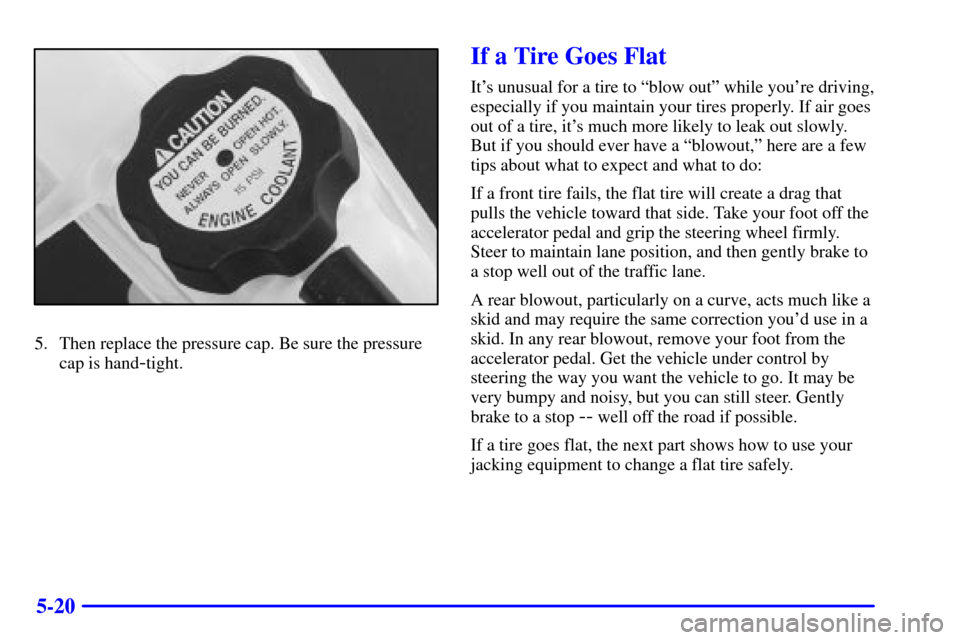
5. Then replace the pressure cap. Be sure the pressure
cap is hand
-tight.
If a Tire Goes Flat
It's unusual for a tire to ªblow outº while you're driving,
especially if you maintain your tires properly. If air goes
out of a tire, it's much more likely to leak out slowly.
But if you should ever have a ªblowout,º here are a few
tips about what to expect and what to do:
If a front tire fails, the flat tire will create a drag that
pulls the vehicle toward that side. Take your foot off the
accelerator pedal and grip the steering wheel firmly.
Steer to maintain lane position, and then gently brake to
a stop well out of the traffic lane.
A rear blowout, particularly on a curve, acts much like a
skid and may require the same correction you'd use in a
skid. In any rear blowout, remove your foot from the
accelerator pedal. Get the vehicle under control by
steering the way you want the vehicle to go. It may be
very bumpy and noisy, but you can still steer. Gently
brake to a stop
-- well off the road if possible.
If a tire goes flat, the next part shows how to use your
jacking equipment to change a flat tire safely.
Page 242 of 348
5-33
CAUTION:
If you let your tires spin at high speed, they can
explode, and you or others could be injured. And,
the transaxle or other parts of the vehicle can
overheat. That could cause an engine
compartment fire or other damage. When you're
stuck, spin the wheels as little as possible. Don't
spin the wheels above 35 mph (55 km/h) as shown
on the speedometer.
NOTICE:
Spinning your wheels can destroy parts of your
vehicle as well as the tires. If you spin the wheels
too fast while shifting your transaxle back and
forth, you can destroy your transaxle.
For information about using tire chains on your vehicle,
see ªTire Chainsº in the Index.
Rocking Your Vehicle To Get It Out
First, turn your steering wheel left and right. That will
clear the area around your front wheels. If your vehicle
has traction control, you should turn the system off.
(See ªTraction Control Systemº in the Index.) Then shift
back and forth between REVERSE (R) and a forward
gear, spinning the wheels as little as possible. Release
the accelerator pedal while you shift, and press lightly
on the accelerator pedal when the transaxle is in gear.
By slowly spinning your wheels in the forward and
reverse directions, you will cause a rocking motion that
may free your vehicle. If that doesn't get you out after a
few tries, you may need to be towed out. If you do need
to be towed out, see ªTowing Your Vehicleº in
the Index.
Page 243 of 348
6-
6-1
Section 6 Service and Appearance Care
Here you will find information about the care of your vehicle. This section begins with service and fuel information,
and then it shows how to check important fluid and lubricant levels. There is also technical information about your
vehicle, and a part devoted to its appearance care.
6
-2 Service
6
-3 Fuel
6
-5 Fuels in Foreign Countries
6
-6 Filling Your Tank
6
-9 Filling a Portable Fuel Container
6
-9 Checking Things Under the Hood
6
-12 Engine Oil
6
-17 Engine Air Cleaner/Filter
6
-19 Passenger Compartment Air Filter
(If Equipped)
6
-20 Automatic Transaxle Fluid
6
-23 Engine Coolant
6
-26 Cooling System Pressure Cap
6
-27 Power Steering Fluid
6
-28 Windshield Washer Fluid
6
-29 Brakes
6
-33 Battery6
-33 Bulb Replacement
6
-41 Windshield Wiper Blade Replacement
6
-42 Tires
6
-49 Appearance Care
6
-50 Cleaning the Inside of Your Vehicle
6
-52 Care of Safety Belts
6
-53 Cleaning the Outside of Your Vehicle
6
-55 Cleaning Aluminum or Chrome-Plated
Wheels (If Equipped)
6
-56 Finish Damage
6
-57 GM Vehicle Care/Appearance Materials
6
-58 Vehicle Identification Number (VIN)
6
-58 Service Parts Identification Label
6
-58 Electrical System
6
-66 Replacement Bulbs
6
-66 Capacities and Specifications
6
-67 Normal Maintenance Replacement Parts
Page 303 of 348

6-61
Fuse Description
NOT USED Not Used
PCM, BCM,
U/H RELAYPowertrain Control Module, Body
Control Module, Underhood
Ignition/Relay
RADIO, HVAC,
RFA
CLUSTER,
DATA LINKRadio, HVAC Control Assembly,
Instrument Panel Cluster, Remote
Keyless Entry Module, Data Link
Connector, Bose Amplifier
BCM Body Control Module
CIGAR LTR,
AUX POWERAuxiliary Power, Cigarette Lighter,
Power Drop
INADV
POWER BUSVanity Mirrors, Instrument Panel
Courtesy Lamps, Instrument Panel
Compartment Lamps, Trunk
Courtesy Lamp, Header Courtesy
and Reading Lamps, I/S Lighted
Rearview Mirror
CD CHANGER Cartridge Disk Changer
HIGH
BLOWERHigh Blower Relay
HAZARD Hazard Switch
STOP LAMPS Stoplamps SwitchFuse Description
DOOR LOCKS Door Lock Relays (Internal to Body
Control Module) and External
Driver Door Lock Relay
POWER
MIRRORSLeft
-hand and Right-hand
Power Mirrors
RH HEATED
SEATPassenger's Side Heated Seat
LH HEATED
SEATDriver's Side Heated Seat
NOT USED Not Used
NOT USED Not Used
NOT USED Not Used
NOT USED Not Used
RED STRG
WHL ILLUMSteering Wheel Radio
Switch Illumination
FRT PARK LPS Front Parking Lamps,
Sidemarker Lamps
TAIL LAMPS,
LIC LAMPSTaillamps, License Lamps, Rear
Sidemarker Lamps, Rear
Sidemarker Lamps
PANEL
DIMMINGDimmable Instrument Panel Lamps
Page 304 of 348
6-62
Fuse Description
NOT USED Not Used
WIPER Wiper Switch
POWER DROP Power Drop
RADIO,
CRUISERadio, Steering Wheel Radio
Controls, Cruise Control Switches
NOT USED Not Used
Circuit
BreakerDescription
NOT USED Not Used
PWR
WINDOWS,
PWR
SUNROOFPower Windows, Power Sunroof
REAR DEFOG Rear Defog
POWER
SEATSPower Seats, Fuel Door Relay
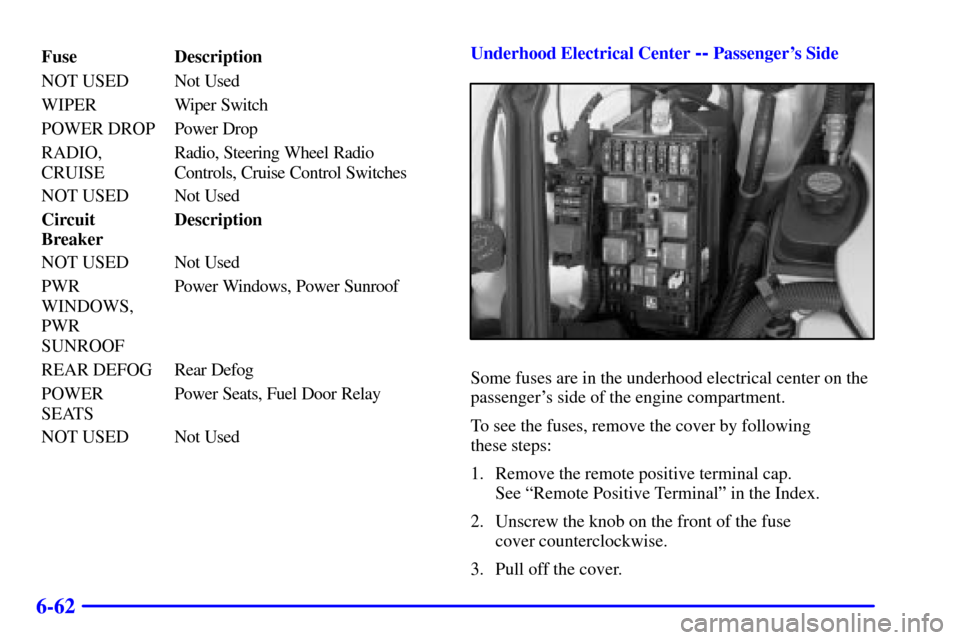
NOT USED Not UsedUnderhood Electrical Center -- Passenger's Side
Some fuses are in the underhood electrical center on the
passenger's side of the engine compartment.
To see the fuses, remove the cover by following
these steps:
1. Remove the remote positive terminal cap.
See ªRemote Positive Terminalº in the Index.
2. Unscrew the knob on the front of the fuse
cover counterclockwise.
3. Pull off the cover.