steering OLDSMOBILE SILHOUETTE 1993 Owner's Manual
[x] Cancel search | Manufacturer: OLDSMOBILE, Model Year: 1993, Model line: SILHOUETTE, Model: OLDSMOBILE SILHOUETTE 1993Pages: 323, PDF Size: 17.13 MB
Page 205 of 323
Ifa Tire Goes Hat
It’s unusual for a tire to “blow out”
while you’re driving, especially if
you
maintain your tires properly. If air goes
out of a tire, it’s much more likely to
leak out slowly. But if you should ever
have a “blowout:’ here are a few tips
about what
to expect and what to do:
If a front tire
fails, the flat tire will
create a drag that pulls
the vehicle
toward that side. Take your foot off the
accelerator pedal and grip the steering
wheel
firmly. Steer to maintain lane
position, then gently brake to a stop well
out of the traffic lane.
A rear blowout, particularly on a curve,
acts much like a skid and may require
the same correction you’d use in a skid.
In any rear blowout, remove your foot
from the accelerator pedal. Get
the
vehicle under control by steering the
way you want the vehicle to go.
It may
be very bumpy and noisy, but you can still steer. Gently brake to a stop, well
off the road if possible.
If your tire goes flat, the next section
shows how
to use your jacking
equipment to change a flat tire safely.
Air Inflator
Your vehicle may have an air inflator for
use
in bringing tires up to the proper
pressure.
To learn about it, see the Index
under Air Inflator System.
Inflating something too much
can make it explode, and
you
or others could be injured. Be sure
to read the inflator instructions and
inflate any object only to
its
recommended pressure.
I
203
ProCarManuals.com
Page 215 of 323
If You’re Stuck: In Sand, Mud,
Ice or Snow
What you don’t want to do when your
vehicle is stuck is to spin your wheels.
The method known as “rocking” can
help you get out when you’re stuck, but
you must use caution.
‘ If you let your tires spin at
high speed, they can explode
and
you or others could be injured.
And, the transaxle or other parts of
the vehicle can overheat. That could
cause an engine compartment fire
or other damage. When you’re
stuck, spin the wheels as little as
possible. Don’t spin
the wheels
above
35 mph (56 km/h) as shown
on the speedometer.
.~.. .. . .
$ back and forth, you can desi
F$ your transaxle.
Rocking Your Vehicle to Get it Out:
First, turn your steering wheel left and
right. That will clear the area around
your front wheels. Then shift back and
forth between
R (Reverse) and a
forward gear, spinning the wheels as
little as possible. Release the accelerator
pedal while
you shift, and press lightly
on
the accelerator pedal when the
transaxle is
in gear. If that doesn’t get
you out after a few tries, you may need
to be towed out. If you do need to be
towed out, see the
Index- under Towing
Your Oldsmobile.
213
ProCarManuals.com
Page 217 of 323
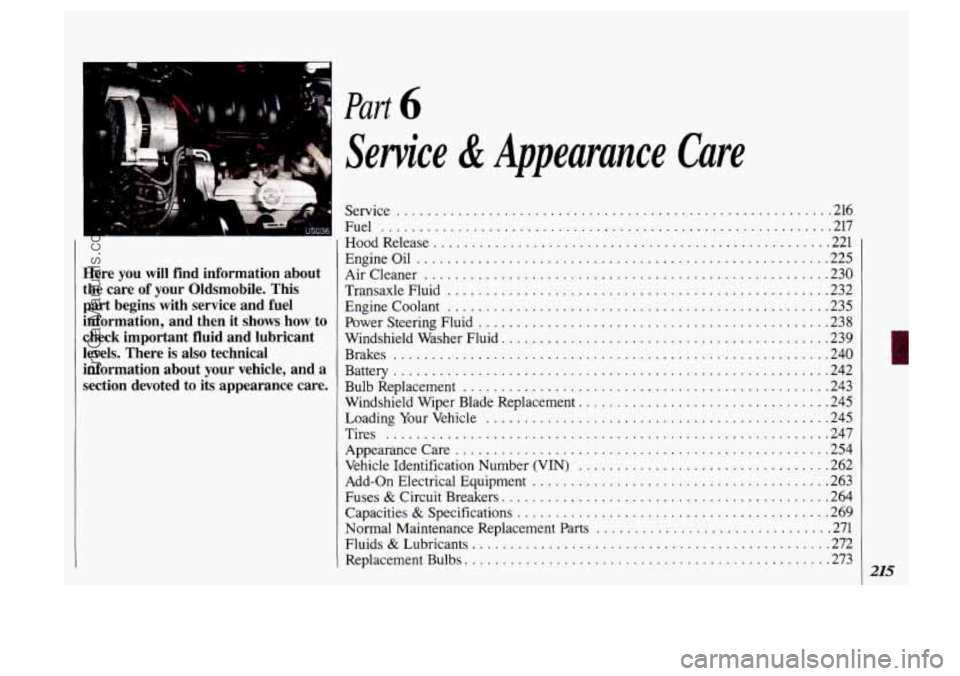
Here you will find information about
the care of your Oldsmobile
. This
part begins with service and fuel
information. and then it shows how to
check important fluid and lubricant levels
. There is also technical
information about your vehicle. and a section devoted to its appearance care
.
Part 6
Service di Appearance Care
Service ......................................................... 216
Fuel ........................................................... 217
HoodRelease
.................................................... 221
Engineoil
...................................................... 225
Aircleaner
..................................................... 230
TransaxleFluid
.................................................. 232
Enginecoolant
.................................................. 235
Power Steering Fluid
.............................................. 238
Windshield Washer Fluid
........................................... 239
Brakes
......................................................... 240
Battery
......................................................... 242
Bulb Replacement
................................................ 243
Windshield Wiper Blade Replacement
................................. 245
Loading Your Vehicle
............................................. 245
Tires
.......................................................... 247
Appearancecare ................................................. 254
Vehicle Identification Number (VIN)
................................. 262
Add-on Electrical Equipment
....................................... 263
Fuses
& Circuit Breakers ........................................... 264
Capacities
& Specifications ......................................... 269
Normal Maintenance Replacement Parts
............................... 271
Fluids
& Lubricants ............................................... 272
ReplacementBulbs
................................................ 273
215
ProCarManuals.com
Page 225 of 323
P P
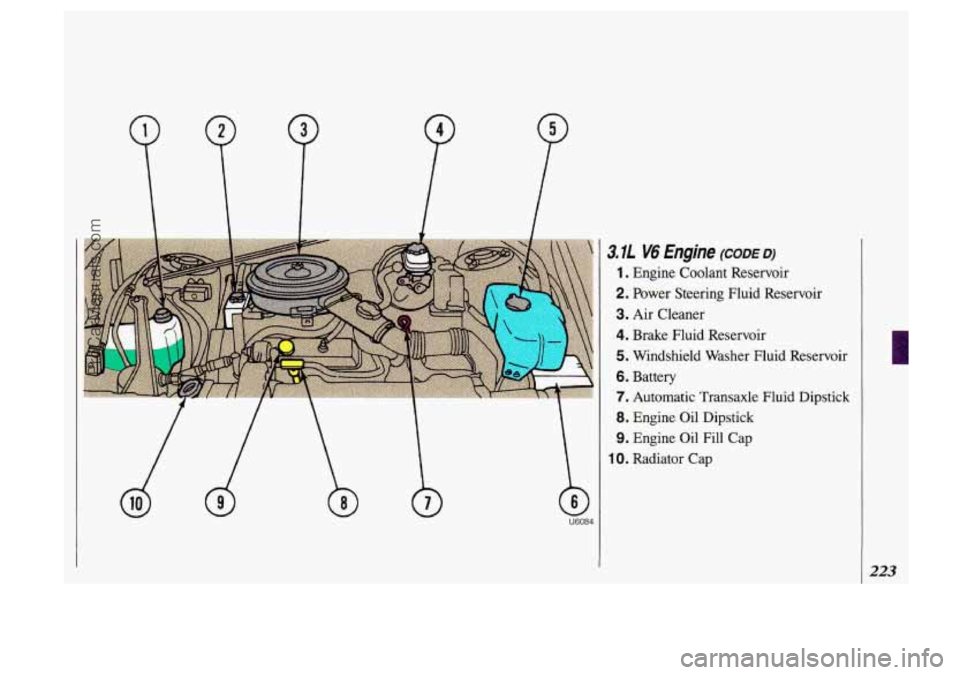
3,lL V6 Engine (CODE D)
1. Engine Coolant Reservoir
2. Power Steering Fluid Reservoir
3. Air Cleaner
4. Brake Fluid Reservoir
5. Windshield Washer Fluid Reservoir
6. Battery
7. Automatic Transaxle Fluid Dipstick
8. Engine Oil Dipstick
9. Engine Oil Fill Can
1 0. Radiator Cap
@ U6084
223
ProCarManuals.com
Page 226 of 323
Service & Appearance Cure
224
P P
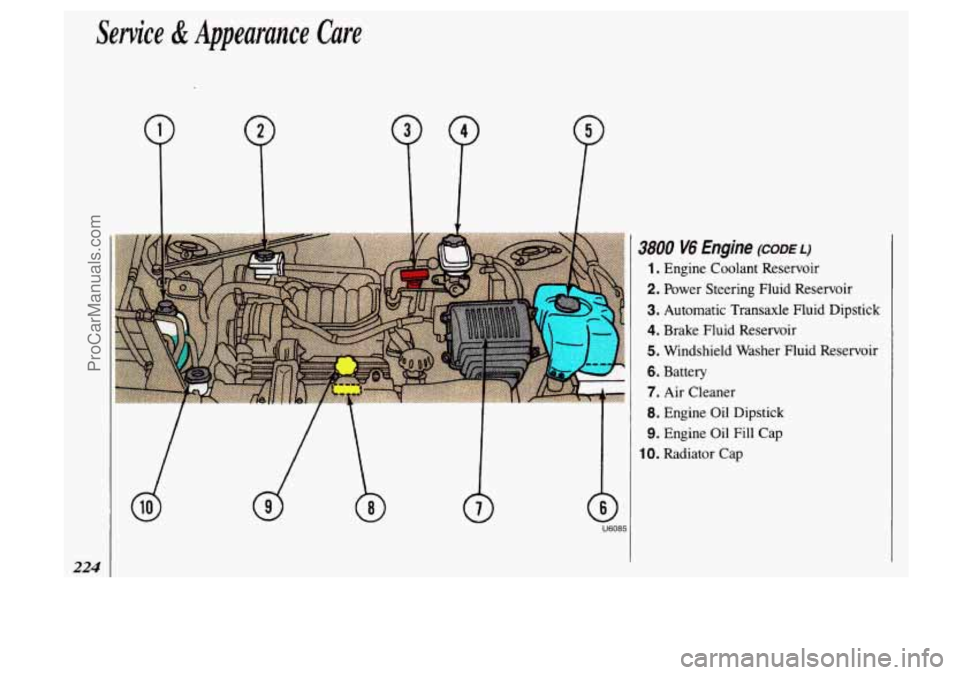
3800 V6 Engine (CODE L)
1 . Engine Coolant Reservoir
2. Power Steering Fluid Reservoir
3. Automatic Transaxle Fluid Dipstick
4. Brake Fluid Reservoir
5. Windshield Washer Fluid Reservoir
6. Battery
7. Air Cleaner
8. Engine Oil Dipstick
9. Engine Oil Fill Cap
10. Radiator Cap
(3 U6085
ProCarManuals.com
Page 240 of 323
Service & Appearance Care
238
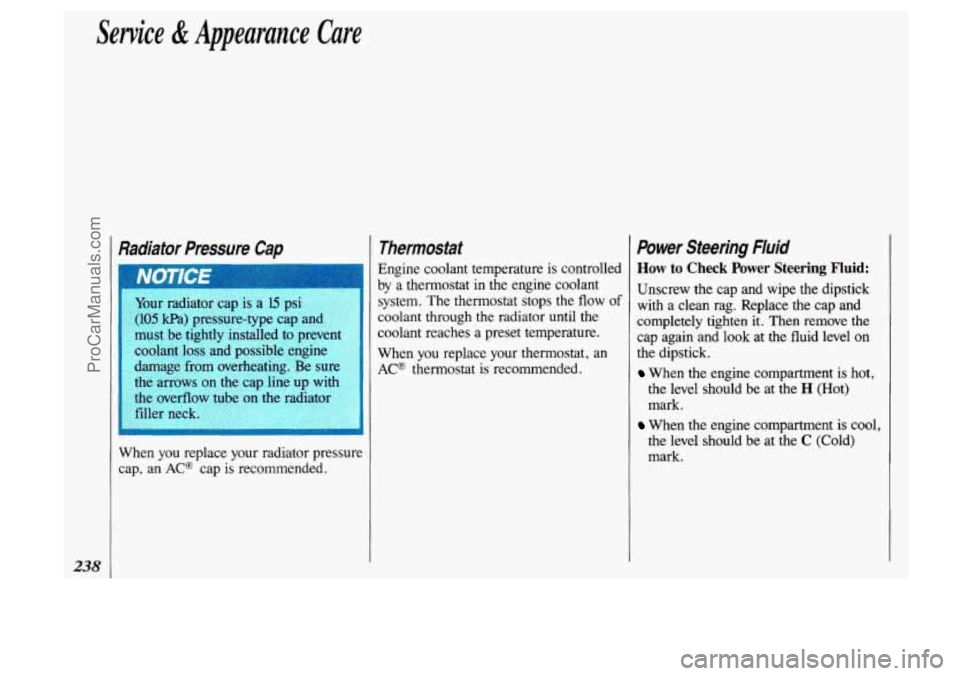
Radiator Pressure Cap
(105 kPa) pressure-type cap and
must be tightly installed to prevent
$3
coolant loss and possible engine +-
damage from overheating. Be sure
the arrows on the cap line up with
the overflow tube on
the radiator
filler neck.
When
you replace your radiator pressure
cap, an
AC@ cap is recommended.
Thermostat
Engine coolant temperature is controlled
by a thermostat
in the engine coolant
system. The thermostat stops the flow
of
coolant through the radiator until the
coolant reaches a preset temperature.
When
you replace your thermostat, an
AC@ thermostat is recommended.
Power Steering Fluid
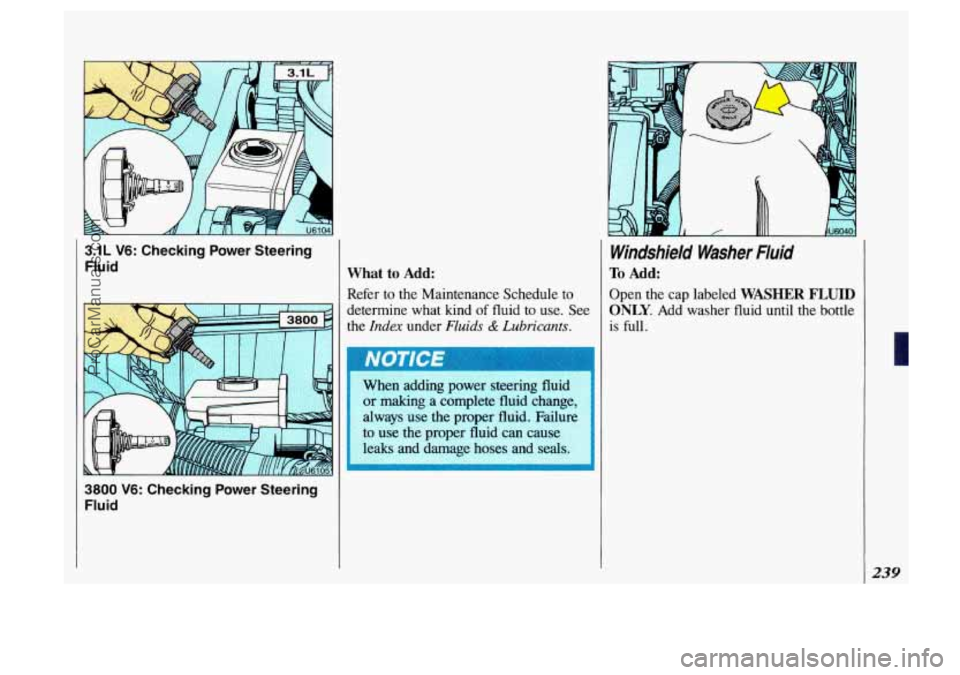
How to Check Power Steering Fluid:
Unscrew the cap and wipe the dipstick
with a clean rag. Replace the cap
and
completely tighten it. Then remove the
cap again and look at the fluid level on
the dipstick.
When the engine compartment is hot,
the level should be at the
H (Hot)
mark.
the level should be at the
C (Cold)
mark.
When the engine compartment is cool,
ProCarManuals.com
Page 241 of 323
3.1L V6: Checking Power Steering
Fluid
3800 V6: Checking Power Steering
Fluid
What to Add:
Refer to the Maintenance Schedule to
determine what kind of fluid to use. See
the
Index under Fluids & Lubricants.
When adding power steering fluid or making a complete fluid change,
always use the proper fluid. Failure
leaks and damage hoses and
to use the proper fluid can cause
Windshield Washer Fluid
To Add:
Open the cap labeled WASHER FLUID
ONLY. Add
washer fluid until the bottle
is full.
239
ProCarManuals.com
Page 272 of 323
Service & Appearance Care
Capacities & Specifications (CONT.)
Refrigerant, Air Conditioning .......................... See refrigerant charge label under hood.
Not all air conditioning refrigerants are the same. If the air
conditioning system in your vehicle needs refrigerant, be sure
the proper refrgerant
is used. If you’re not sure, ask your
Oldsmobile dealer.
FuelTank ........................................... 20gallons
Power Steering
3.n V6 Engine:
Pump Only ...................................... 1 pint
Complete System
.................................. 1 ?4 pints
76.00 L
0.50 L
0.60 L
3800 V6 Engine:
pump only ...................................... 1 pint
Complete System.
................................. 1 pints
0.50 L
.70 L
Tire Pressures, Sizes .................................. See Certification/Tire label on driver’s door.
Wheel Nut Torque ................................... 100 pound-feet (140 Nem)
NOTE: All capacities are approximate. When adding, be sure to fiil to the appropriate level, as recommended in this manual.
ProCarManuals.com
Page 274 of 323
Service & Appeurunce Cure
' 2z
!
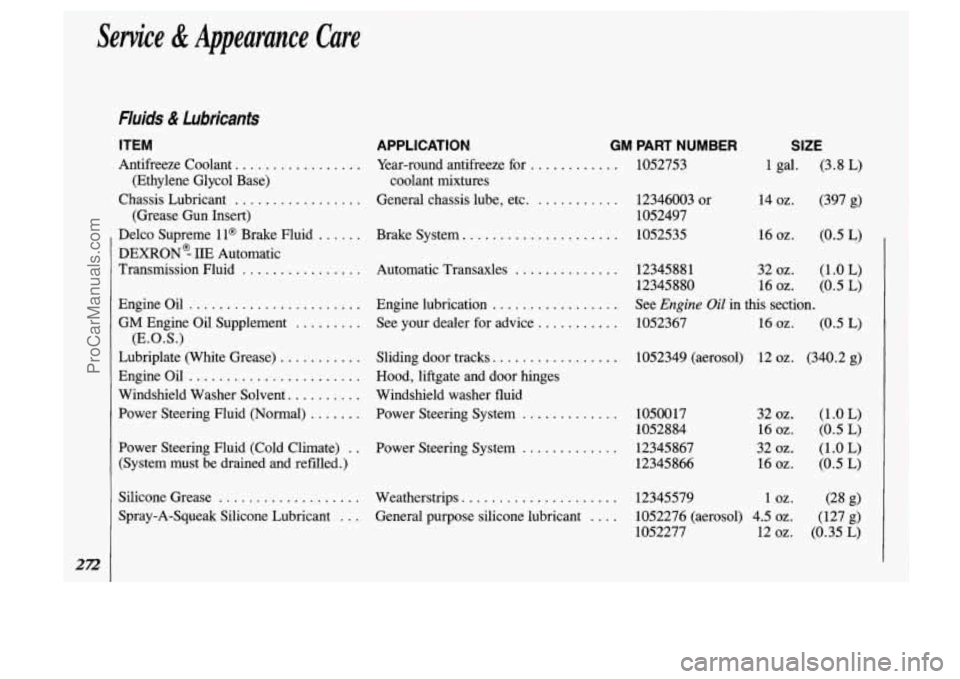
Fluids & Lubricants
ITEM
Antifreeze Coolant .............
Chassis Lubricant .............
(Ethylene Glycol Base)
(Grease Gun Insert)
Delco Supreme
1 l@ Brake Fluid ......
DEXRONE IIE Automatic
Transmission Fluid
................
Engine Oil .......................
GM Engine Oil Supplement .........
Lubriplate (White Grease) ...........
Windshield Washer Solvent. .........
Power Steering Fluid (Normal) .......
(E.O.S.)
Engine Oil
.......................
Power Steering Fluid (Cold Climate) . .
(System must be drained and refrlled.)
Silicone Grease
...................
Spray-A-Squeak Silicone Lubricant ...
....
....
APPLICATION
Year-round antifreeze for ....
General chassis lube, etc. ...
coolant mixtures
GM PART NUMBER
........ 1052753
SIZE
1 gal. (3.8 L)
........ 12346003 or
1052497
Brake System ..................... 1052535 14
oz. (397 g)
16 oz. (0.5 L)
Automatic Transaxles
.............. 12345881 32 oz. (1 .O L)
12345880 16 oz. (0.5 L)
Engine lubrication
................. See Engine Oil in this section.
See your dealer for advice
........... 1052367 16 oz. (0.5 L)
Sliding door tracks. ................ 1052349 (aerosol) 12 oz. (340.2 g)
Power Steering System
............. 1050017
Power Steering System ............. 12345867
Hood, liftgate and door hinges
Windshield washer fluid
1052884
12345866 32
oz. (1.0 L)
16 oz. (0.5 L)
32 oz. (1.0 L)
16 02. (0.5 L)
Weatherstrips.
.................... 12345579 1 oz. (28 g)
General purpose silicone lubricant .... 1052276 (aerosol) 4.5 oz. (127 g)
1052277 12 oz. (0.35 L)
ProCarManuals.com
Page 286 of 323
Maintenance Schedule
Section A: Scheduled Maintenance Services (Cont.)
284
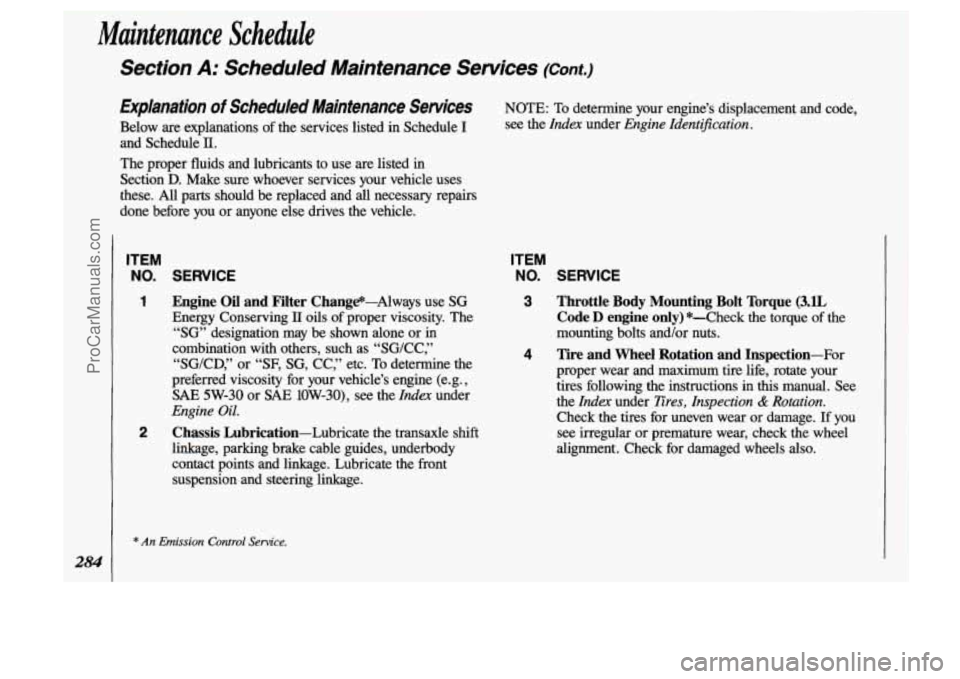
Explanation of Scheduled Maintenance Services
Below are explanations of the services listed in Schedule I
and Schedule II.
The proper fluids and lubricants to use are listed in
Section D. Make sure whoever services your vehicle uses
these. All parts should be replaced
and all necessary repairs
done before you or anyone else drives the vehicle.
ITEM
NO. SERVICE
1 Engine Oil and Filter Chang@-Always use SG
Energy Conserving
II oils of proper viscosity. The
“SG” designation may be shown alone or in
combination with others, such as “SG/CC,” “SG/CD,” or
“SF, SG, CC,” etc. To determine the
preferred viscosity for your vehicle’s engine (e.g.,
SAE 5W-30 or SAE 10W-30), see the
Index under
Engine Oil.
2 Chassis Lubrication-Lubricate the transaxle shift
linkage, parking brake cable guides, underbody
contact points and linkage. Lubricate the front
suspension and steering linkage. NOTE:
To determine your engine’s displacement and code,
see the
Index under Engine IdentiJication.
ITEM
NO. SERVICE
3 Throttle Body Mounting Bolt Torque (3.a
Code D engine only) *-Check the torque of the
mounting bolts and/or nuts.
4 Tire and Wheel Rotation and Inspection-For
proper wear and maximum tire life, rotate your
tires following the instructions
in this manual. See
the
Index under Eres, Inspection & Rotation.
Check the tires for uneven wear or damage. If you
see irregular or premature wear, check the wheel
alignment. Check for damaged wheels
also.
* An Emission Control Senice.
ProCarManuals.com