warning OLDSMOBILE SILHOUETTE 1993 Owner's Manual
[x] Cancel search | Manufacturer: OLDSMOBILE, Model Year: 1993, Model line: SILHOUETTE, Model: OLDSMOBILE SILHOUETTE 1993Pages: 323, PDF Size: 17.13 MB
Page 142 of 323
Your Driving and the Road
140
w Road Signs
The road signs you see everywhere are
coded by color, shape and symbols.
It's
a good idea to know these codes so that
you can quickly grasp the basic meaning
or intent of the sign even before you
have a chance to read it.
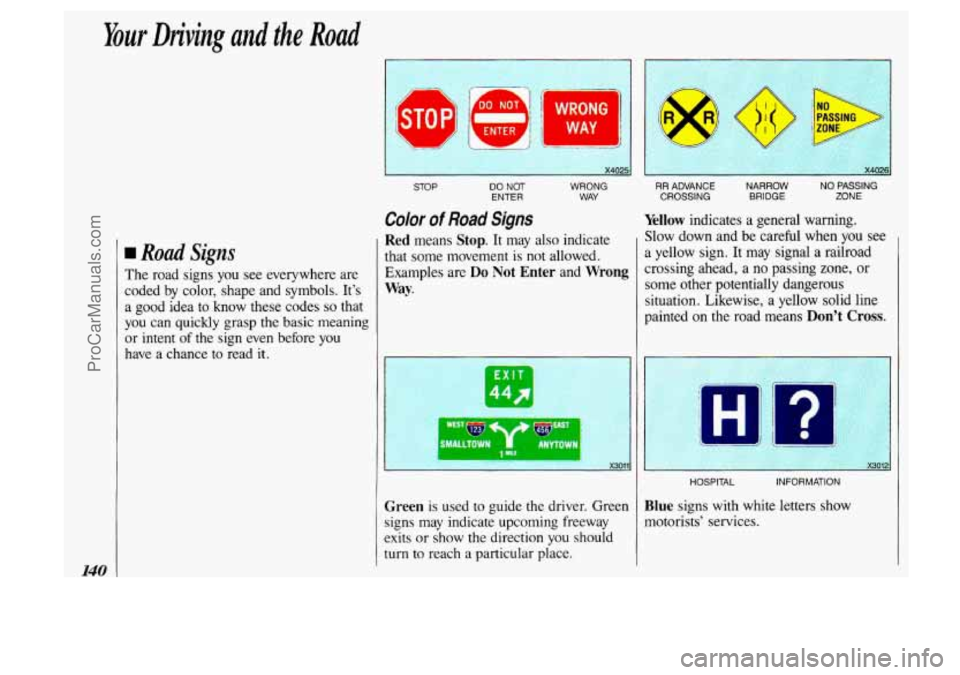
STOP DO NOT ENTER
Color of Road Signs
Red means Stop. It may also indicate
1
1
:hat some movement is not allowed.
Examples are
Do Not Enter and Wrong
Way.
X4025 I
WRONG
WAY
Green is used to guide the driver. Green
;igns may indicate upcoming freeway
:xits or show the direction you should
urn to reach
a particular place.
RR ADVANCE NARROW NO PASSING
CROSSING BRIDGE ZONE
Yellow indicates a general warning.
Slow down and be careful when
you see
a yellow sign. It may signal a railroad
crossing ahead, a no passing zone, or
some other potentially dangerous
situation. Likewise, a yellow solid line
painted on the road means
Don't Cross.
HOSPITAL
11
Blue signs with white letters show
motorists' services.
ProCarManuals.com
Page 143 of 323
r
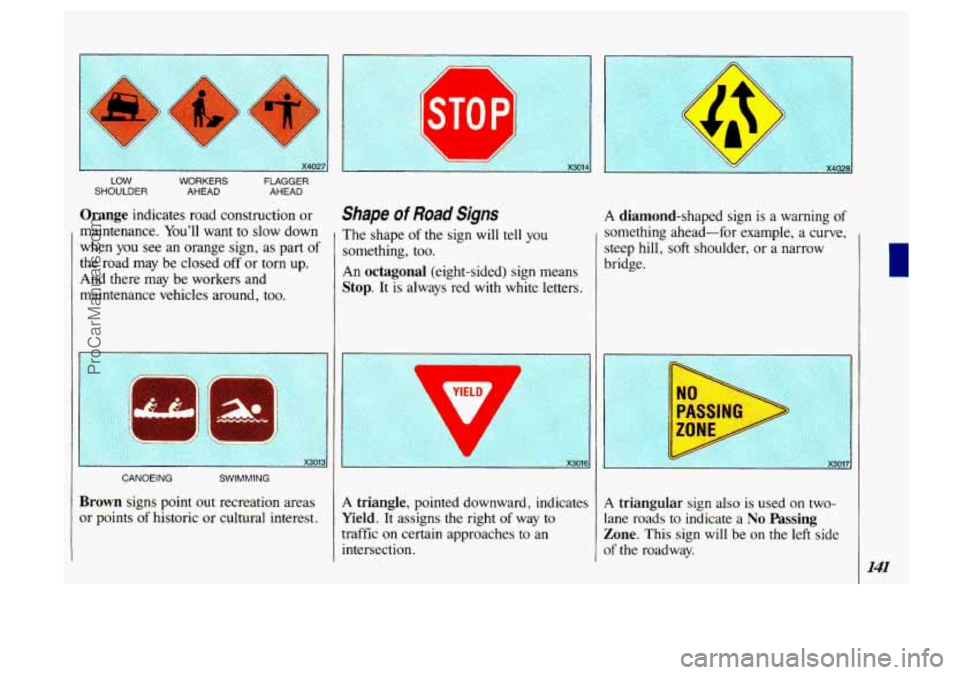
Orange indicates road construction or
maintenance. You'll want
to slow down
when
you see an orange sign, as part of
the road may be closed off or torn up.
And there may be workers and
maintenance vehicles around, too.
CANOEING SWIMMING
Brown signs point out recreation areas
or points
of historic or cultural interest.
Shape of Road Signs
The shape of the sign will tell you
something, too.
An octagonal (eight-sided) sign means
Stop. It is always red with white letters.
A triangle, pointed downward, indicates
Yield. It assigns the right of way to
traffic on certain approaches to an
intersection. A
diamond-shaped sign
is a warning of
something ahead-for example, a curve,
steep hill,
soft shoulder, or a narrow
bridge.
A triangular sign also is used on two-
lane roads to indicate a
No Passing
Zone. This sign will be on the left side
of the roadway.
ProCarManuals.com
Page 145 of 323
m%p&:*g%
REVERSIBLE LANE ON MULTILANE ROADWAY
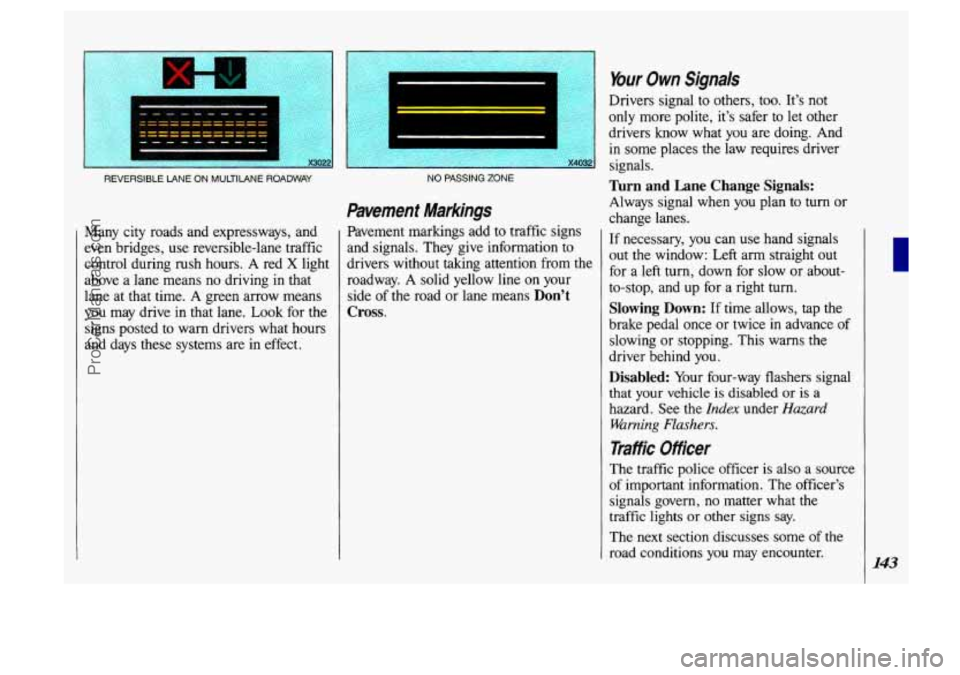
Many city roads and expressways, and
even bridges, use reversible-lane traffic
control during rush hours.
A red X light
above a lane means no driving in that
lane at that time. A green arrow means
you may drive in that lane.
Look for the
signs posted to warn drivers what hours
and days these systems are in effect.
~ ~~~
NO PASSING ZONE
Pavement Markings
Pavement markings add to traffic signs
and signals. They give information to
drivers without taking attention from the
roadway.
A solid yellow line on your
side of the road or lane means
Don’t
Cross.
Your Own Signals
Drivers signal to others, too. It’s not
only more polite, it’s safer
to let other
drivers know what
you are doing. And
in some places the law requires driver
signals.
Turn and Lane Change Signals:
Always signal when you plan to turn or
change lanes.
If necessary, you can use hand signals
out the window: Left arm straight out
for a left turn, down for slow or about-
to-stop, and up for a right turn.
Slowing Down: If time allows, tap the
brake pedal once or twice in advance of
slowing or stopping. This warns the
driver behind you.
Disabled: Your four-way flashers signal
that your vehicle is disabled or
is a
hazard. See the
Index under Hazard
Warning Flashers.
Traffic Officer
The traffic police officer is also a source
of important information. The officer’s
signals govern, no matter what the
traffic lights
or other signs say.
The next section discusses some
of the
road conditions you may encounter.
143
ProCarManuals.com
Page 152 of 323
Your
i
Anti-Lock Brakes (CONE)
This light on the instrument panel will
go on when you start your vehicle.
Your anti-lock brake system has
a two-
part system check:
When you start your vehicle and begin
to drive away you may hear a
momentary motor or clicking noise
and you may even notice that your
brake pedal moves a little while this is
going on. This is the
ABS system
testing itself. (You may
also hear this
noise if you leave the ignition in the
Run position for about four seconds
before starting the vehicle.)
If you have your foot on the brake
pedal, this check won’t happen until
the vehicle goes about
4 mph (6 Wh)
or until you take your foot off the
brake pedal.
You’ll also hear a clicking noise the
next time the vehicle goes about
4
mph (6 Wh).
If there’s a problem with the anti-lock
brake system, the anti-lock brake system
warning light will stay on
or flash. See
the
Inda under Anti-Lock Brake System
Warning Light.
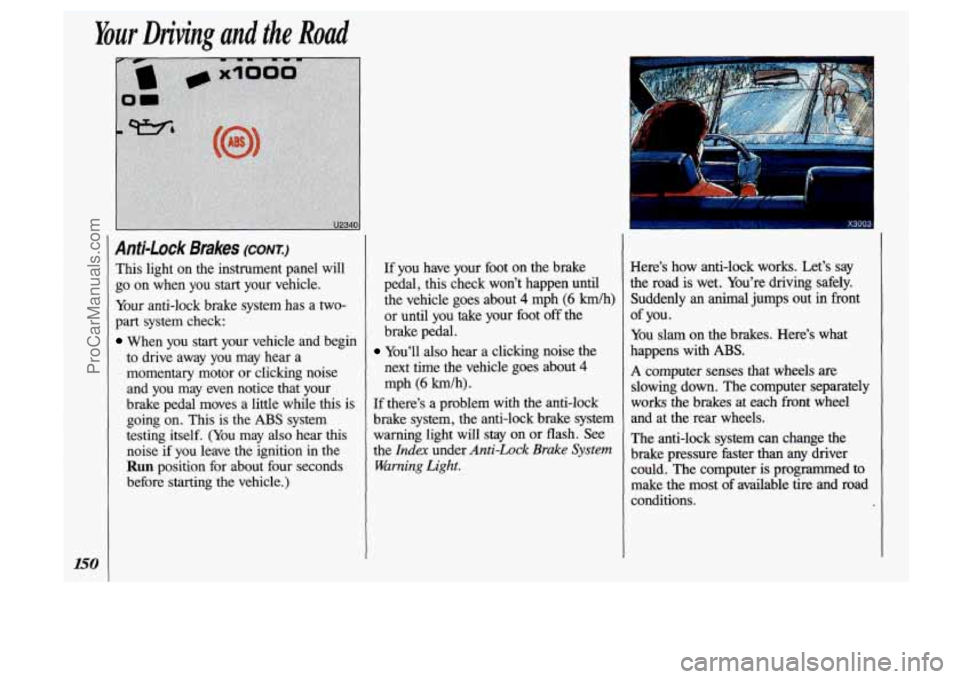
Here’s how anti-lock works. Let’s say
the road is wet. YOU’E driving safely.
Suddenly
an animal jumps out in front
You
slam on the brakes. Here’s what
happens with
ABS.
A computer senses that wheels are
slowing down. The computer separately
works the brakes at each front wheel
and at the rear wheels.
The anti-lock system can change the
brake pressure faster than any driver
could. The computer is programmed to
make the most of available tire and road
conditions.
of you.
ProCarManuals.com
Page 153 of 323
X3006 I
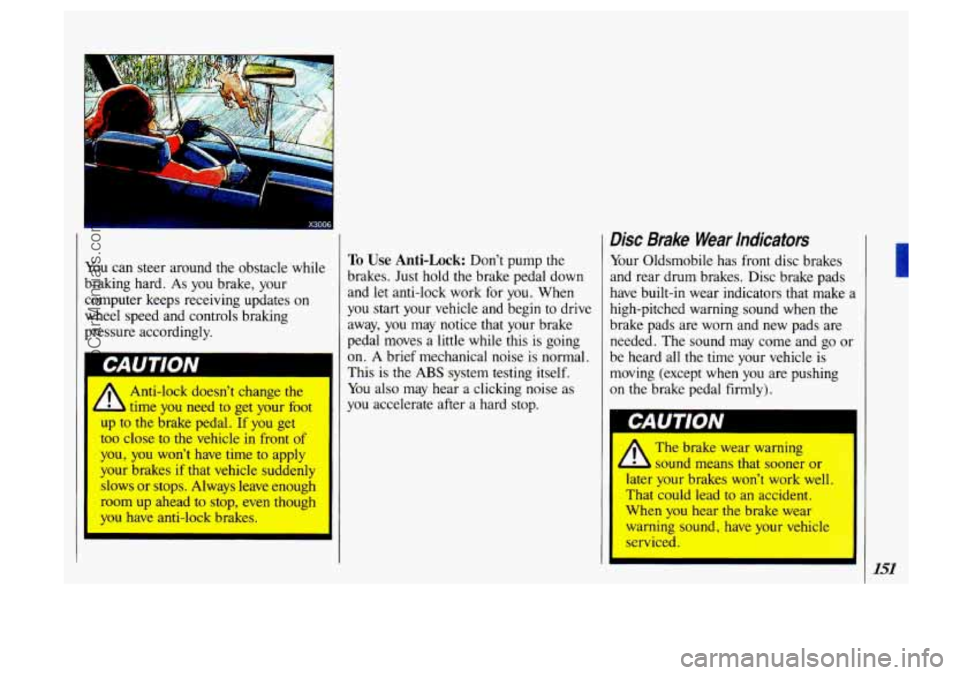
You can steer around the obstacle while
braking hard.
As you brake, your
computer keeps receiving updates on
wheel speed and controls braking
pressure accordingly.
1
‘t
Anti-lock doesn’t change the
time you need to get your foot
up
to the brake pedal. If you get
too close to the vehicle in front of
you, you won’t have time to apply
your brakes if that vehicle suddenly slows
or stops. Always leave enough
room up ahead to stop, even though
you have anti-lock brakes.
To Use Anti-Lock: Don’t pump the
brakes. Just hold the brake pedal down
and let anti-lock work for you. When
you start your vehicle and begin to drive
away, you may notice that your brake
pedal moves a little
while this is going
on.
A brief mechanical noise is normal.
This is
the ABS system testing itself.
You also may hear a clicking noise as
you accelerate after a hard stop.
Disc Brake Wear Indicators
Your Oldsmobile has front disc brakes
and rear drum brakes. Disc brake pads
have built-in wear indicators that make a
high-pitched warning sound when the
brake pads are worn and
new pads are
needed. The sound may come and
go or
be heard all
the time your vehicle is
moving (except when you are pushing
on the brake pedal firmly).
The brake wear warning
sound means that sooner or
later your brakes won’t work well
That could lead to an accident.
when you hear the brake wear
serviced. arning
sound, have your vehicle
151
ProCarManuals.com
Page 161 of 323
a lower gear). Any sudden changes
could cause the tires to slide. You may
not realize the surface is slippery until
your vehicle is skidding. Learn
to
recognize warning clues-such as
enough water, ice or packed snow on
the road to make a “mirrored
surface”-and slow down when
you
have any doubt.
Remember: Any anti-lock braking
system
(ABS) helps avoid only the
braking skid. Steer the way you want to
go.
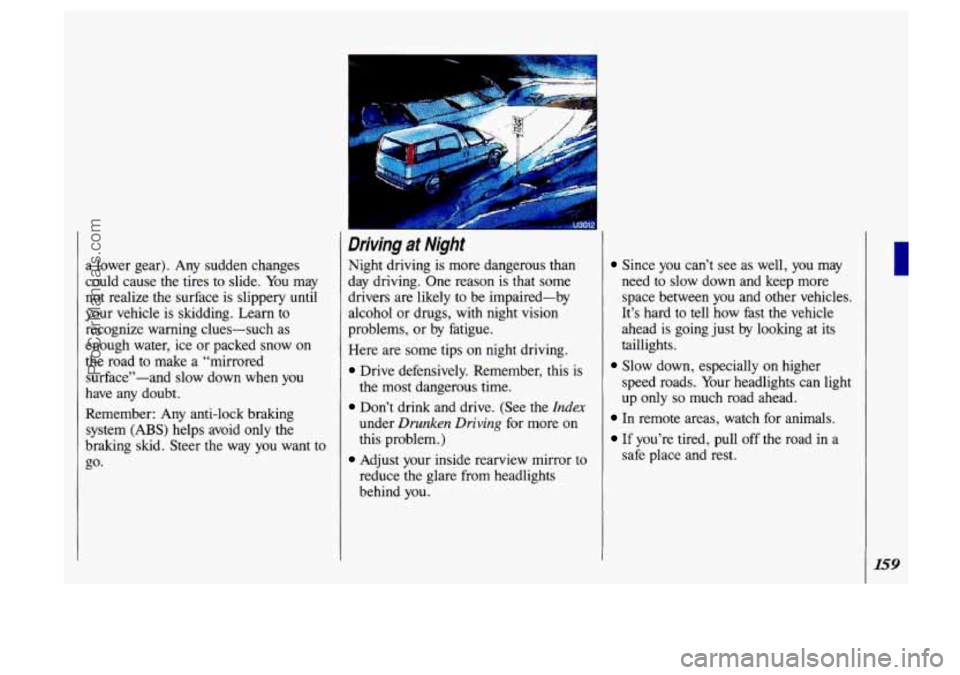
Driving at Night
Night driving is more dangerous than
day driving. One reason
is that some
drivers are likely to be impaired-by
alcohol or drugs, with night vision
problems, or by fatigue.
Here are some tips on night driving.
Drive defensively. Remember, this is
the most dangerous time.
Don’t drink and drive. (See the Index
under Drunken Driving for more on
this problem.)
Adjust your inside rearview mirror to
reduce the glare from headlights
behind you.
Since you can’t see as well, you may
need to slow down and keep more
space between
you and other vehicles.
It’s hard to tell how fast the vehicle
ahead is going just by looking at its
taillights.
speed roads. Your headlights can light
up only
so much road ahead.
Slow down, especially on higher
In remote areas, watch for animals.
If you’re tired, pull off the road in a
safe place and rest.
159
ProCarManuals.com
Page 167 of 323
something between you and moving
vehicles-space, trees, telephone poles,
a private driveway, anything that
removes you from other traffic.
If visibility is near zero and you must
stop but are unsure whether you are
away from the road, turn your lights on,
start your hazard warning flashers, and
sound your horn at intervals or when
you hear approaching traffic.
Pass other vehicles in fog only if you
can
see far enough ahead to pass safely.
Even then, be prepared to delay your
pass if you suspect the fog is worse up
ahead. If other vehicles
try to pass you,
make it easy for them.
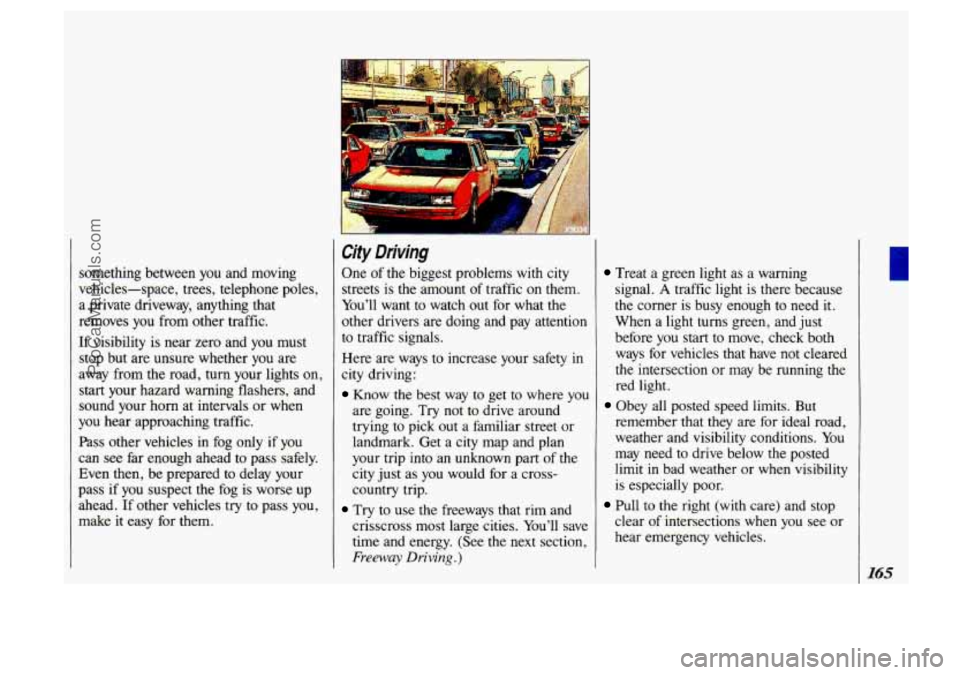
City Driving
One of the biggest problems with city
streets is the amount of traffic on them.
You’ll want to watch out for what the
other drivers are doing and pay attention
to traffic signals.
Here are ways to increase your safety
in
city driving:
Know the best way to get to where you
are going. Try not to drive around
trying
to pick out a familiar street or
landmark. Get a city map and plan
your trip into an unknown part of
the
city just as you would for a cross-
country trip.
Try to use the freeways that rim and
crisscross most large cities. You’ll save
time and energy. (See the next section,
Freeway Driving.)
Treat a green light as a warning
signal.
A traffic light is there because
the corner is busy enough to need it.
When a light turns green, and just
before you
start to move, check both
ways for vehicles that have not cleared
the intersection or may be running the
red light.
remember that
they are for ideal road,
weather and visibility conditions. You
may need
to drive below the posted
limit in bad weather or when visibility
is especially poor.
clear of intersections when you see
or
hear emergency vehicles.
Obey all posted speed limits. But
Pull to the right (with care) and stop
165
ProCarManuals.com
Page 169 of 323
If you are moving from an outside to a
center lane on a freeway having more
than two lanes, make sure another
vehicle isn’t about to move into the same spot. Look at the vehicles two lanes
over and watch for telltale signs:
turn
signals flashing, an increase in speed, or
moving toward the edge of the lane. Be
prepared
to delay your move.
Once you are moving on the freeway,
make certain you allow a reasonable
following distance. Expect
to move
slightly slower at night.
Leaving the Fkeeway
When you want to leave the freeway,
move to the proper lane well
in advance.
Dashing across lanes at the last minute
is dangerous.
If you miss your exit do
not, under any circumstances, stop and
back up. Drive on
to the next exit.
At each exit point is a deceleration lane.
Ideally it should be long enough for
you
to enter it at freeway speed (after
signaling, of course) and then do your
braking before moving onto the exit
ramp. Unfortunately, not
all deceleration
lanes are long enough-some are too
short for all the braking. Decide when
to start braking.
If you must brake on
the through lane, and if there is traffic
close behind you, you can allow a little extra time and flash your brake lights (in
addition to your
turn signal) as extra
warning that you are about
to slow
down and exit.
The exit ramp can be curved, sometimes
quite sharply. The exit speed is usually
posted. Reduce your speed according to your speedometer, not
to your sense of
motion. After driving for any distance at
higher speeds, you may tend to
think
you are going slower than you actually
are. For example,
40 mph (65 km/h)
might seem like only 20 mph (30 km/h).
Obviously, this could lead to serious
trouble on a ramp designed for
20 mph
(30 Mh)!
I67
ProCarManuals.com
Page 175 of 323
Torque Lock
If you are parking on a hill and you
don’t shift your transaxle into
P (Park)
properly, the weight of the vehicle may
put too much force on the parking pawl
in the transaxle. You may find it difficult
to pull the shift lever out of
P (Park).
This is called “torque lock.” To prevent
torque lock, always be sure
to shift into
P (Park) properly before you leave the
driver’s seat. To find out how, see the
Index under Shifting Into P (Park).
When you are ready to drive, move the
shift lever out of P (Park) before you
release the parking brake.
If torque lock does occur, you may need
to have another vehicle push yours a
little uphill to take some of the pressure
from the transaxle,
so you can pull the
shift lever out of
P (Park).
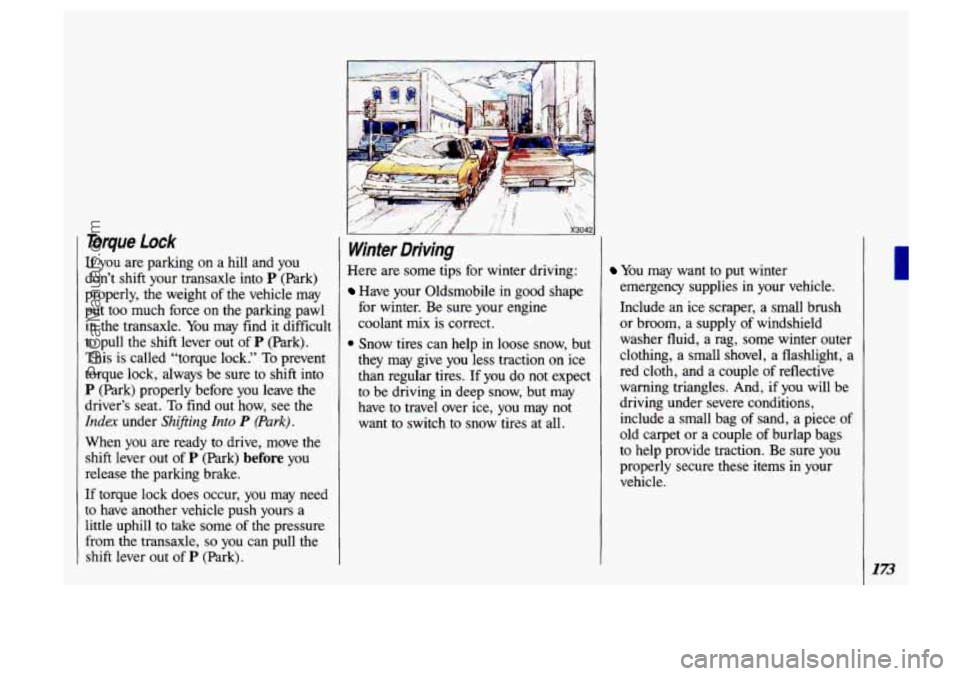
Winter Driving
Here are some tips for winter driving:
Have your Oldsmobile in good shape
for winter. Be sure your engine
coolant
mix is correct.
* Snow tires can help in loose snow, but
they may give you less traction on ice
than regular tires.
If you do not expect
to be driving in deep snow, but may
have to travel over ice, you may not
want
to switch to snow tires at all.
You may want to put winter
emergency supplies in your vehicle.
Include
an ice scraper, a small brush
or broom,
a supply of windshield
washer fluid, a rag,
some winter outer
clothing, a small shovel, a flashlight,
a
red cloth, and a couple of reflective
warning triangles. And,
if you will be
driving under severe conditions,
include a small bag
of sand, a piece of
old carpet or a couple of burlap bags
to help provide traction. Be sure you
properly secure these items
in your
vehicle.
173
ProCarManuals.com
Page 187 of 323
.....
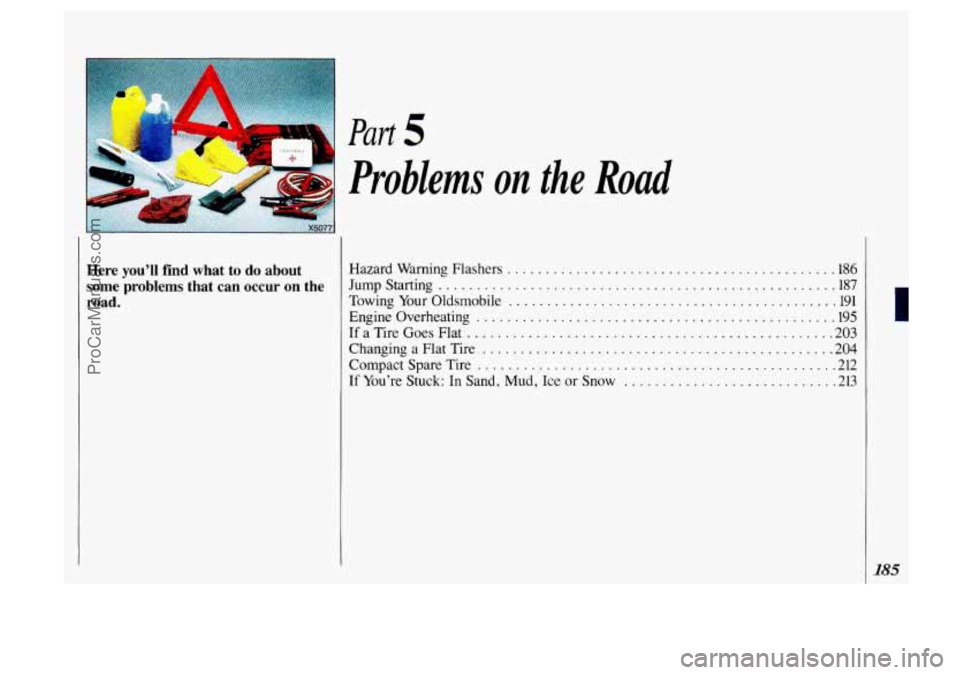
Here you'll find what to do about
some problems that
can occur on the
road .
Part 5
Problems on the Road
Hazard Warning Flashers .... ............................... 186
Jumpstarting .................................................... 187
Towing Your Oldsmobile ........................................... 191
Engine Overheating ............................................... 195
If a Tire Goes Flat ................................................ 203
ChangingaFlatTire
.............................................. 204
Compact Spare Tire
............................................... 212
If You're Stuck: In Sand, Mud. Ice or Snow ............................ 213
ProCarManuals.com