brake light OLDSMOBILE SILHOUETTE 1995 User Guide
[x] Cancel search | Manufacturer: OLDSMOBILE, Model Year: 1995, Model line: SILHOUETTE, Model: OLDSMOBILE SILHOUETTE 1995Pages: 390, PDF Size: 20.27 MB
Page 190 of 390
A computer senses that wheels are slowing down. If one
of the wheels is about to stop rolling, the computer will
separately work the brakes at each front wheel and at the
rear wheels.
The anti-lock system can change
the brake pressure
faster than any driver could. The computer
is
programmed to make the most of available tire and road
conditions.
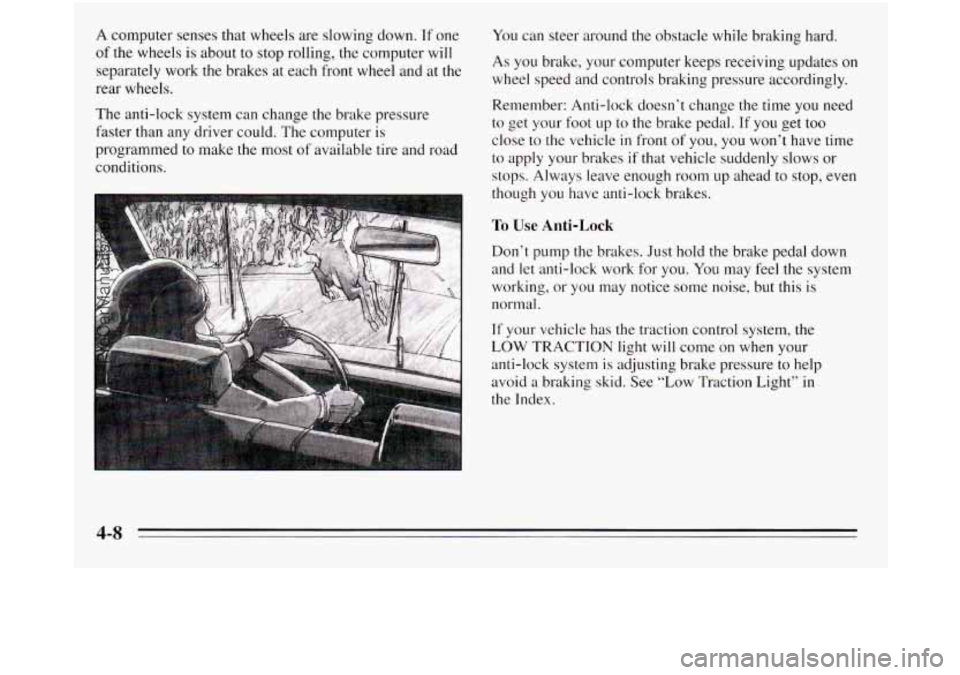
You can steer around the obstacle while braking hard.
As you brake, your computer keeps receiving updates on
wheel speed and controls braking pressure accordingly.
Remember: Anti-lock doesn’t change the time you need
to get your foot up to the brake pedal. If you get too
close
to the vehicle in front of you, you won’t have time
to apply your brakes if that vehicle suddenly slows or
stops. Always leave enough room up ahead
to stop, even
though you have anti-lock brakes.
To Use Anti-Lock
Don’t pump the brakes. Just hold the brake pedal down
and let anti-lock work for you.
You may feel the system
working, or you may notice some noise, but this
is
normal.
If your vehicle has the traction control system, the
LOW TRACTION light will come on when your
anti-lock system
is adjusting brake pressure to help
avoid a braking skid. See “Low Traction Light” in
the Index.
4-8
ProCarManuals.com
Page 191 of 390
Traction Control System
(Option:
3800 V6 Engine)
Your vehicle may have a traction control system that
limits wheel spin. This is especially useful in slippery
road conditions. The system operates only if it senses
that one or both of the front wheels are spinning or
beginning to lose traction.
When this happens, the system works the front brakes
and reduces engine power to limit wheel spin.
The LOW TRACTION light will come on when your
traction control system is limiting wheel spin. See
“Low Traction Light” in the Index. You may feel the
system working, or you may notice some noise, but this
is normal.
If your vehicle is in cruise control when the traction
control system begins to limit wheel spin, the cruise
control will automatically disengage. When road
conditions allow you
to safely use it again, you may
re-engage the cruise control. (See “Cruise Control” in
the Index.)
TCS
The TCS warning light will come on to let you know if
there’s a problem with your traction control system.
See “Traction Control System Warning Light’’ in the
Index. When this warning light is on, the system will not
limit wheel spin. Adjust your driving accordingly.
4-9
ProCarManuals.com
Page 192 of 390
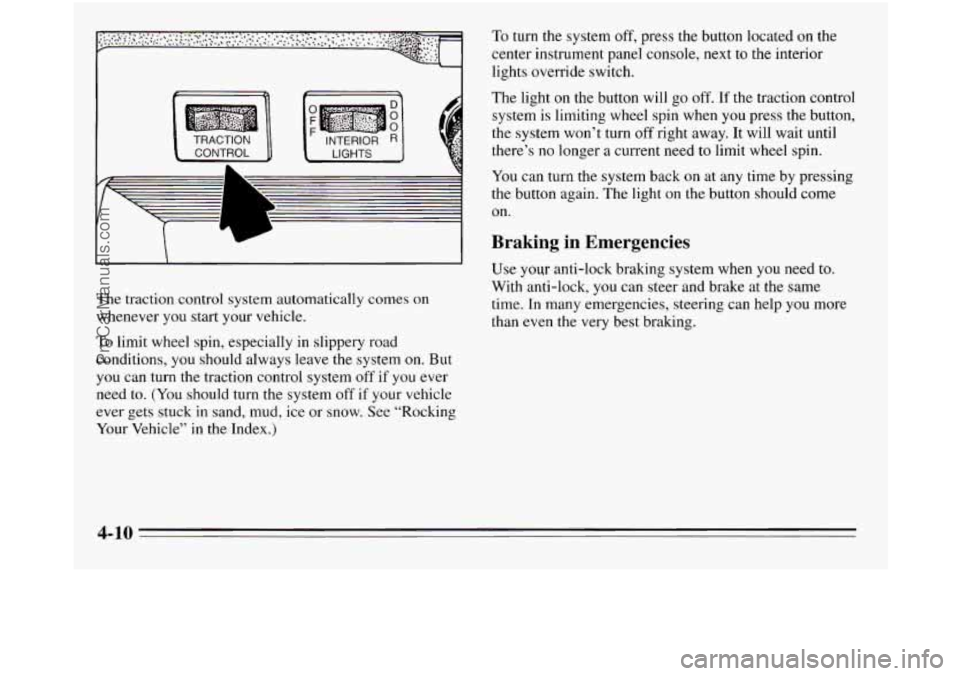
The light on the button will go off. If the traction control
system is limiting wheel spin when you press the button,
the system won’t turn
off right away. It will wait until
there’s no longer a current need to limit wheel spin.
You can turn the system back on at any time by pressing
the button again. The light on the button should come
on.
Braking in Emergencies
I I I Use your anti-lock braking system when you need to.
With anti-lock,
you can steer and brake at the same
time. In many emergencies, steering can help you more
than even the very best braking.
The
traction control system automatically comes
on
whenever you start your vehicle.
To limit wheel spin, especially in slippery road
conditions,
you should always leave the system on. But
you can turn the traction control system off if you ever
need to.
(You should turn the system off if your vehicle
ever gets stuck
in sand, mud, ice or snow. See “Rocking
Your Vehicle” in the Index.)
4-10
ProCarManuals.com
Page 194 of 390
Steering in Emergencies
There are times when steering can be more effective than
braking. For example, you come over
a hill and find a
truck stopped in your lane, or a car suddenly pulls out
from nowhere, or a child darts
out from between parked
cars and stops right in front of
you. You can avoid these
problems by braking
-- if you can stop in time. But
sometimes you can’t; there isn’t room. That’s the time
for evasive action
-- steering around the problem.
Your Oldsmobile can perform very well in emergencies
like these. First apply your brakes. (See “Braking in
Emergencies” earlier
in this section.) It is better to
remove as much speed as you can from a possible
collision. Then steer around the problem, to the left or
right depending on the space available.
An emergency like this requires close attention and a
quick decision. If you are holding the steering wheel at
the recommended
9 and 3 o’clock positions, you can
turn it a full
180 degrees very quickly without removing
either hand. But you have to act fast, steer quickly, and
just as quickly straighten the wheel once you have
avoided the object.
The fact that such emergency situations are always
possible is a good reason
to practice defensive driving at
all times and wear safety belts properly.
Off-Road Recovery
You may find sometime that your right wheels have
dropped off the edge of a road onto the shoulder while
you’re driving.
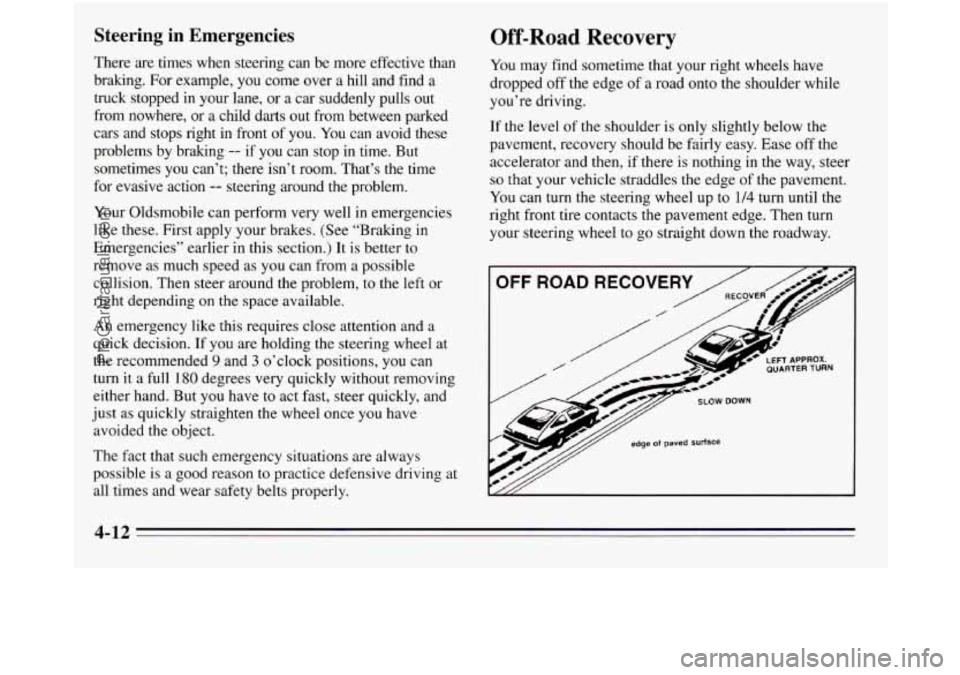
If the level of the shoulder is only slightly below the
pavement, recovery should be fairly easy. Ease off the
accelerator and then, if there is nothing in the way, steer
so that your vehicle straddles the edge of the pavement.
You can turn the steering wheel up to
1/4 turn until the
right front tire contacts the pavement edge. Then turn
your steering wheel to go straight down the roadway.
LeT/ SLOW DOWN
p,/y edge of paved surface
4-12
ProCarManuals.com
Page 288 of 390
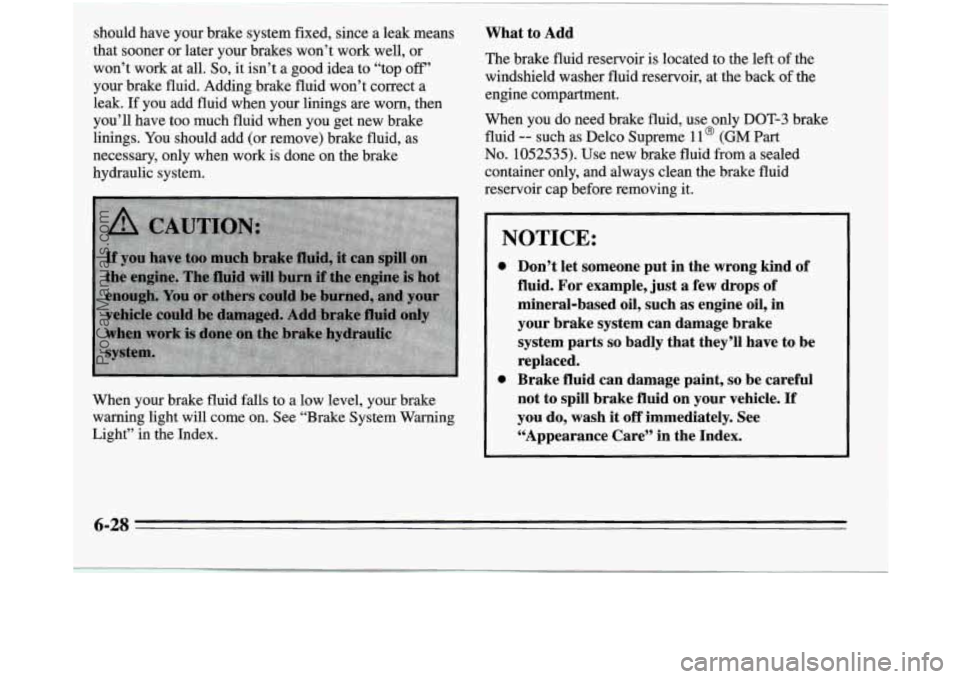
should have your brake system fixed, since a leak means
that sooner or later your brakes won’t work well, or
won’t work at all.
So, it isn’t a good idea to “top off’
your brake fluid. Adding brake fluid won’t correct a
leak. If you add fluid when your linings are worn, then
you’ll have too much fluid when you get new brake
linings. You should add (or remove) brake fluid, as
necessary, only when work is done on the brake
hydraulic system.
When your brake fluid falls to a low level, your brake
warning light will come on. See “Brake System Warning
Light” in the Index.
~~
~~~ ~~~ ~
What to Add
The brake fluid reservoir is located to the left of the
windshield washer fluid reservoir, at the back of the
engine compartment.
When you
do need brake fluid, use only DOT-3 brake
fluid
-- such as Delco Supreme 11 @ (GM Part
No. 1052535). Use new brake fluid from a sealed
container only, and always clean the brake fluid
reservoir cap before removin,g it.
-
NOTICE:
0 Don’t let someone put in the wrong kind of
fluid. For example, just a few drops of
mineral-based oil, such
as engine oil, in
your brake system can damage brake
system parts
so badly that they’ll have to be
replaced.
0 Brake fluid can damage paint, so be careful
not to spill brake fluid on your vehicle.
If
you do, wash it off immediately. See
“Appearance Care” in the Index.
6-28
ProCarManuals.com
Page 289 of 390
Brake Wear
Your Oldsmobile has front disc brakes and rear drum
brakes.
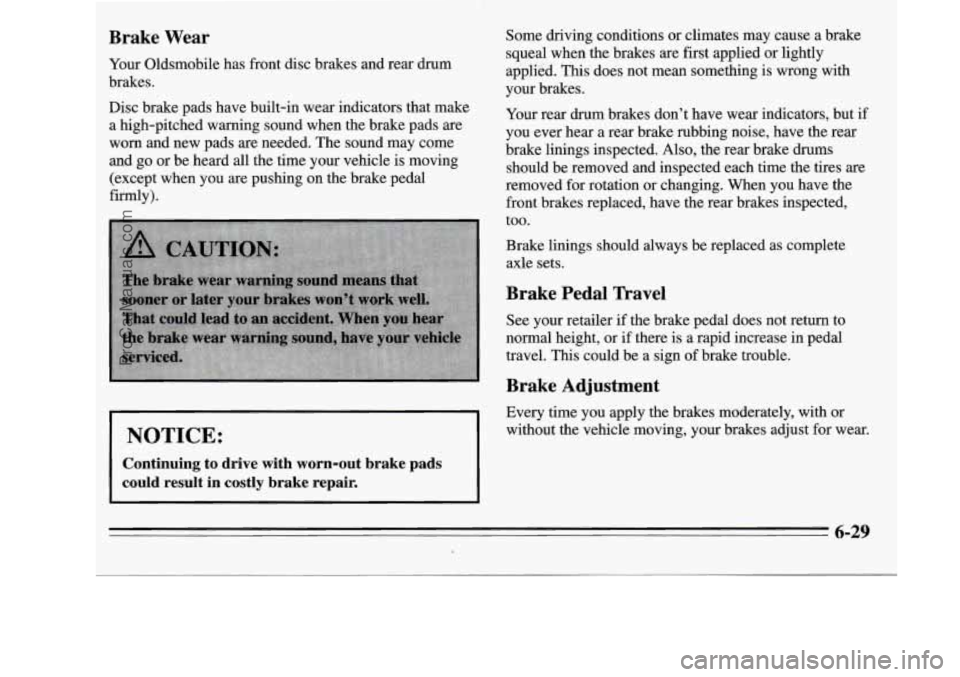
Disc brake pads have built-in wear indicators that make
a high-pitched warning sound when the brake pads are
worn and new pads are needed. The sound may come
and go or be heard
all the time your vehicle is moving
(except when you are pushing on the brake pedal
firmly).
NOTICE:
Continuing to drive with worn-out brake pads
could result in costly brake repair.
Some driving conditions or climates may cause a brake
squeal when the brakes are first applied or lightly
applied.
This does not mean something is wrong with
your brakes.
Your rear drum brakes don’t have wear indicators, but
if
you ever hear a rear brake rubbing noise, have the rear
brake linings inspected. Also, the rear brake drums
should be removed and inspected each time the tires are
removed for rotation or changing. When you have the
front brakes replaced, have the rear brakes inspected,
too.
Brake linings should always be replaced as complete
axle sets.
Brake Pedal Travel
See your retailer if the brake pedal does not return to
normal height, or if there is a rapid increase in pedal
travel.
This could be a sign of brake trouble.
Brake Adjustment
Every time you apply the brakes moderately, with or
without the vehicle moving, your brakes adjust for wear.
6-29
ProCarManuals.com
Page 313 of 390

e
E5
c3
€3
ELC
HORN
E3 RDOllAUX
TAIL
El
c3
n
c3
ECM
TURN B/U
GAUGES LPS
ABS
E3 R WIPER
€5 HTRA/C
F WIPER
p-4 R BLW
Fuse Panel (3.1L V6 Engine)
Position Circuitry
CTSY Dome Lamps, Courtesy Lamps, Power Door
Lock Switches, Glove Box Lamp, Power
Mirrors, Power Sliding Delay Lock Module
ELC
HORN
STOP
HAZ Auto
Level Control, Underhood Lamp
Horns, Horn Relay, Safety Belt Buzzer
Front/Rear Turn Lamps, Front Sidemarker
Lamps, Rear Stop Lamps, Instrument Cluster
Turn Indicator Lamps, Cruise Brake Switch
F PUMP Fuel Pump,
Oil Pressure SenderIFuel Pump Switch
Position
RDO 1/
AUX
TAIL
ECM
TURN
B/U
GAUGES
LPS
ABS
RD02
R WIPER
F WIPER
IGN
HTR-A/C
R BLW
Circuitry
Radio, Front Cigar Lighter, Accessory Power
Outlet
Front Park Lamps, Rear Taillamps, Front
Sidemarker Lamps, License Plate Lamp, Radio,
HeatNentlAC Control Head, Power Sliding Door
Throttle Body Fuel Injection, Fuel Pump Relay,
Elec. Vac. Reg. Valve, Elec. Control Module,
Elec. Spark Control Module
Front/Rear Turn Lamps, Front Sidemarker Lamps, Cluster Turn Telltale, Back-up Lamps,
Fog Lamps
Cluster, Anti-Lock Brake System Lamp
Module, Elec. Level Control Sensor
Cluster, Radio, Wiper Switch, Headlamp
Switch, Rear Blower Switch, Heat/Vent/AC
Control Head, Door Switch Illumination,
FrontIRear Ashtray Illumination Bulbs
Anti-Lock Brake System
Radio
Rear Wiperwasher Motors; Overhead Console
Compass
Front Wipermasher Motor
A/C Compressor, A/C Solenoid Box, Compressor
Relay, Temp. Door Motor,
Low Blower Relay;
HeatNentlAC Control Head; Cruise Module; Cooling Fan Relay; Rear Defogger Relay;
Key
Chime; Vehicle Speed Sensor Buffer and Generator
Charge Discrete, Transaxle Converter Clutch Switch
FrondRear Blower Motors, High Blower Relay
Rear Blower, Rear Heat/Vent/AC
6-53
ProCarManuals.com
Page 314 of 390

Fuse Panel (3800 V6 Engine)
cCTSYI, ,fD023
eeC3
R WIPER
HORN TURN BIU F WIPER
r"4
STOP HA2
E5 TAIL
Position
CTSY
ELC
HORN
STOP
HAZ
Circuitry
Dome Lamps, Courtesy Lamps, Power Door
Lock Switches, Glove Box Lamp, Power
Mirrors, Power Sliding Delay Lock Module
Auto Level Control, Underhood Lamp
Horns,
Horn Relay, Safety Belt Buzzer
Front/Rear Turn Lamps, Front Sidemarker
Lamps, Rear Stop Lamps, Instrument Cluster
Turn Indicator Lamps
Position Circuitry
RDOl/ Radio, Front Cigar Lighter, Accessory Power
AUX Outlet
TAIL Front Park Lamps, Rear Taillamps, Front Sidemarker Lamps, License Plate Lamp, Radio,
HeatNentlAC Control Head, Power Sliding Door
ABS
ECM Anti-Lock
Brakemraction Control System
Mass Air How Sensor, Electronic Control Module
TURN Front/Rear Turn Lamps, Front Sidemarker
B/U Lamps, Cluster Turn Telltale, Back-up Lamps,
Fog Lamps
Module, Elec. Level Control Sensor
GAUGES Cluster, Anti-Lock
Brake System Lamp
INJ 3365D Remote Location (see page
6-56)
LPS Cluster, Radio, Wiper Switch, Headlamp
Switch, Rear Blower Switch, HeatNentlAC
Control Head, Door Switch Illumination,
Front/Rear Ashtray Illumination Bulbs
RD02 Radio
R WIPER Rear Wipermasher Motors; Overhead Console
F WIPER Front WiperNasher Motor
Compass
IGN A/C
Solenoid Box, Temp. Door Motor, Low
Blower Relay; HeatNentlAC Control Head;
Cooling Fan Relay; Rear Defogger Relay; Key
Chime; Transaxle Converter Clutch Solenoid
and Generator Charge Discrete
HTR-A/C Front/Rear Blower Motors, High Blower Relay
R BLW Rear Blower,
Rear HeatNentlAC
6-54
ProCarManuals.com
Page 377 of 390
Section 9 Index
Accessory Power Outlet ......................... 2-57
Adding Automatic Transaxle Fluid
..................... 6-2 1
BrakeFluid ................................. 6-28
Electrical Equipment
............... 2.25.3.21. 6.51
Engine Coolant
.............................. 6-23
Engineoil
.................................. 6-12
Power Steering Fluid
......................... 6-26
SoundEquipment
............................ 3-21
Windshield Washer Fluid
................. 2.43. 6-26
AirBag
....................................... 1-26
How Does
it Restrain ......................... 1-29
How
it Works ............................... 1-28
Location
................................... 1-28
Readiness Light
........................ 1.27. 2.76
What Makes it Inflate
......................... 1-29
What Will You See After it Inflates
.............. 1-30
When Should
it Inflate ........................ 1-29
AirClealler
.................................... 6-17
Airconditioner
................................. 3-2
AirInflator
.................................... 2-63
Alignment and Balance. Tires
..................... 6-40
Aluminum Wheels. Cleaning
...................... 6-48
Servicing
................................... 1-31 Antenna.
Integrated Roof
......................... 3-23
Anti-Lock
..................................... 4-6
Anti-Lock Brake (ABS) Junction Block Fuse ......... 6-56
Anti-Lock Brake System Warning Light
......... 2.78. 4.7
Anti-Lock Brakes
............................... 4-6
Anti-Theft Feature. CD Player
.................... 3-17
Antifreeze
..................................... 6-22
Adding
.................................... 6-23
Checking
................................... 6-23
Appearance Care
............................... 6-42
Appearance Care and Materials
.................... 6-50
Ashtrays
................................... 2.65. 66
Audio Systems
.................................. 3-8
Auto Down Window Feature
...................... 2-39
Automatic Door Locks
............................ 2-5
Automatic Overdrive Position
..................... 2-30
Automatic Transaxle
............................ 2-28
Automatic Overdrive Position
.................. 2-30
First Gear (1) Position
........................ 2-32
Neutral
(N) Position .......................... 2-30
Park (P) Position
............................. 2-29
Reverse (R) Position
.......................... 2-29
Second Gear
(2) Position ...................... 2-31
Audio
System. Steering Wheel Touch Controls
....... 3-20
9-1
ProCarManuals.com
Page 378 of 390
Battery ...................................... 6-30
Battery Replacement. Remote Lock Control .......... 2-10
BBB Auto Line ................................. 8-3
Adjustment ................................. 6-29
Fluid, Adding ............................... 6-28
Master Cylinder ............................. 6-27
Pedal Travel ................................ 6-29
System Parts. Replacing ....................... 6-30
System Warning Light ........................ 2-77
BatteryWarnings ..............................5-2. 4
Blizzard ...................................... 4-27
Brake Trailer
..................................... 4-35
Transaxle Shift Interlock (BTSI) ........ 2-29.36. 7-37
Wear ...................................... 6-29
Brake. Parking ................................. 2-32
Brakes. Trailer .................................. 4-35
Brakes. Anti-Lock ............................... 4-6
Braking ........................................ 4-5
Braking In Emergencies .......................... 4-10
Break-In. New Vehicle .......................... 2-22
BTSI (Brake Transaxle Shift Interlock) ...... 2-29.36. 7-37
Bucketseats .................................... 1-5
Adjusting Rear Seats .......................... 1- 10
Capacities and Specifications ..................... 6-58
CarbonMonoxide ................... 2.20.4.27.34. 37
Cassette Tape Player ............................ 3-11
Cassette Tape Player Care ........................ 3-22
CD Player Anti-Theft Feature ..................... 3-17
Center Dome Lamp ............................. 2-55
Center Passenger Position ........................ 1-36
Certificatioflire Label .......................... 4-29
Chains, Safety ................................. 4-35
Changing a Flat Tire ............................. 5-24
CDPlayer ..................................... 3-16
Chains, Tire ................................... 6-41
9-2
ProCarManuals.com