tires OLDSMOBILE SILHOUETTE 1995 Owner's Manual
[x] Cancel search | Manufacturer: OLDSMOBILE, Model Year: 1995, Model line: SILHOUETTE, Model: OLDSMOBILE SILHOUETTE 1995Pages: 390, PDF Size: 20.27 MB
Page 294 of 390
Windshield Wiper Blade Replacement Tires
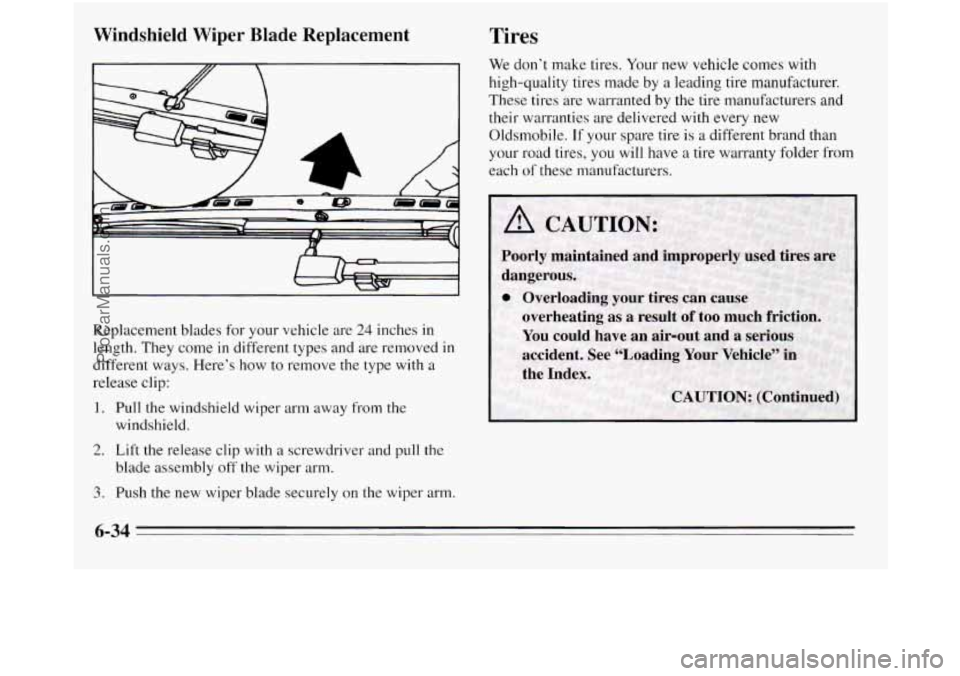
Replacement blades for your vehicle are 24 inches in
length. They come in different types and are removed in
different ways. Here’s how to remove the type
with a
release clip:
1. Pull the windshield wiper arm away from the
windshield.
2. Lift the release clip with a screwdriver and pull the
blade assembly
off the wiper arm.
3. Push the new wiper blade securely on the wiper arm.
6-34
ProCarManuals.com
Page 295 of 390
Inflation - Tire Pressure
The Certificatioflire label which is on the rear edge of
the driver’s door shows the correct inflation pressures
for your tires, when they’re cold. “Cold” means your
vehicle
has been sitting for at least three hours or driven
no more than a mile.
NOTICE:
Don’t let anyone tell you that underinflation or
overinflation is all right. It’s not. If your tires
don’t have enough
air (underinflation) you can
get:
Too much flexing
Too much heat
Tire overloading
Bad wear
Bad handling
Bad fuel economy.
If your tires have too much air (overinflation),
you can get:
Unusual wear
Bad handling
Rough ride
Needless damage from road hazards.
When
to Check
Check your tires once a month
or more.
Don’t forget your compact spare tire. It should be at
60 psi (420 Pa).
6-35
ProCarManuals.com
Page 296 of 390
How to Check
Use a good quality pocket-type gage to check tire
pressure. Simply looking at the tires will not tell you the
pressure, especially if you have radial tires
-- which
may look properly inflated even if they’re underinflated.
If your tires have valve caps, be sure to put them back
on. They help prevent leaks by keeping out dirt and
moisture.
Tire Inspection and Rotation
Tires should be inspected every 6,000 to 8,000 miles
(1 0 000 to 13 000 km) for any signs of unusual wear. If
unusual wear is present, rotate your tires as soon as
possible and check wheel alignment. Also check for
damaged tires or wheels. See “When it’s Time for New
Tires” and “Wheel Replacement” later in this section for
more information.
The purpose
of regular rotation is to achieve more
uniform wear for all tires on the vehicle. The first
rotation is the most important. See “Scheduled
Maintenance Services” in the Index for scheduled
rotation intervals. When
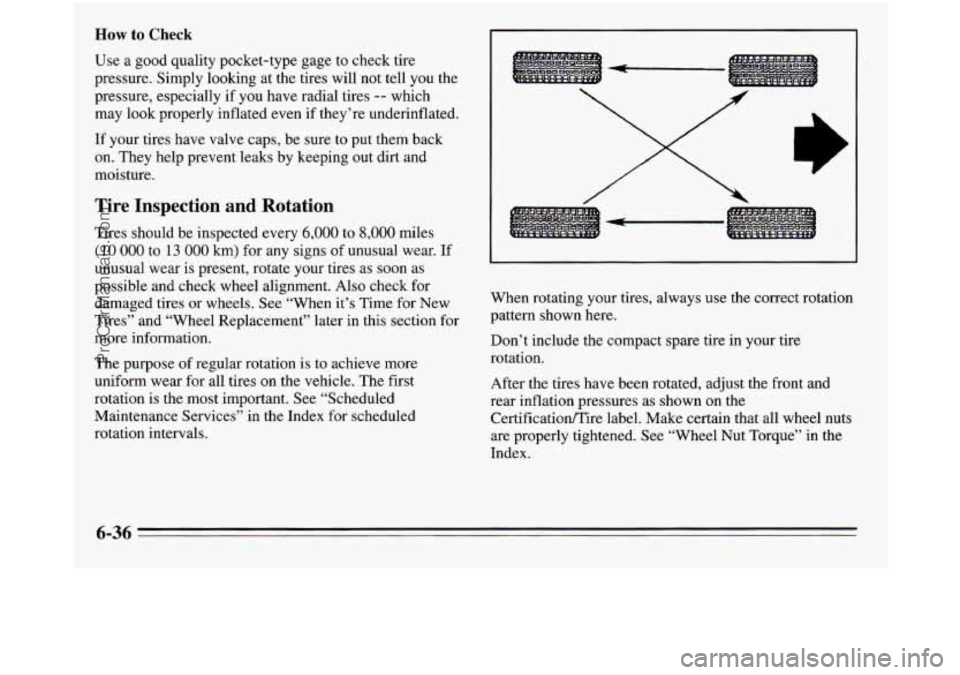
rotating your tires, always use the correct rotation
pattern shown here.
Don’t include the compact spare tire in your tire
rotation.
After the tires have been rotated, adjust the front and
rear inflation pressures as shown on
the
Certificatioflire label. Make certain that all wheel nuts
are properly tightened. See “Wheel Nut Torque” in the
Index.
6-36
ProCarManuals.com
Page 297 of 390
When it’s Time for New Tires
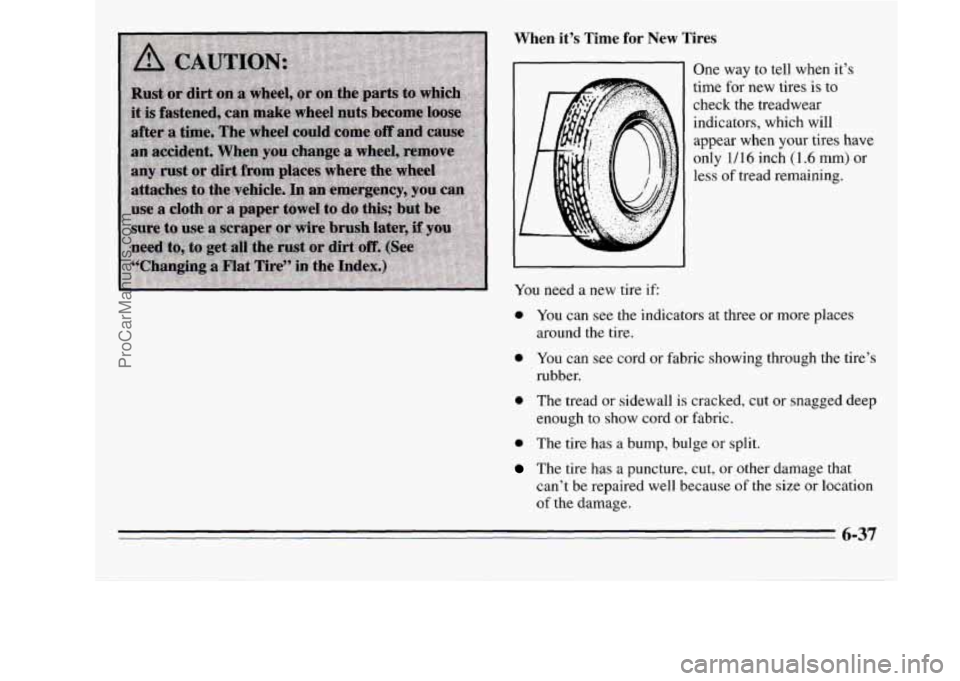
One way to tell when it’s
time for new tires
is to
check the treadwear
indicators, which will
appear when your tires have
only
1/16 inch (1.6 mm) or
less of tread remaining.
You need a new tire if:
0 You can see the indicators at three or more places
around the tire.
0 You can see cord or fabric showing through the tire’s
rubber.
0 The tread or sidewall is cracked, cut or snagged deep
enough to show cord
or fabric.
0 The tire has a bump, bulge or split.
The tire has a puncture, cut, or other damage that
can’t be repaired well because
of the size or location
of the damage.
6-37
ProCarManuals.com
Page 298 of 390
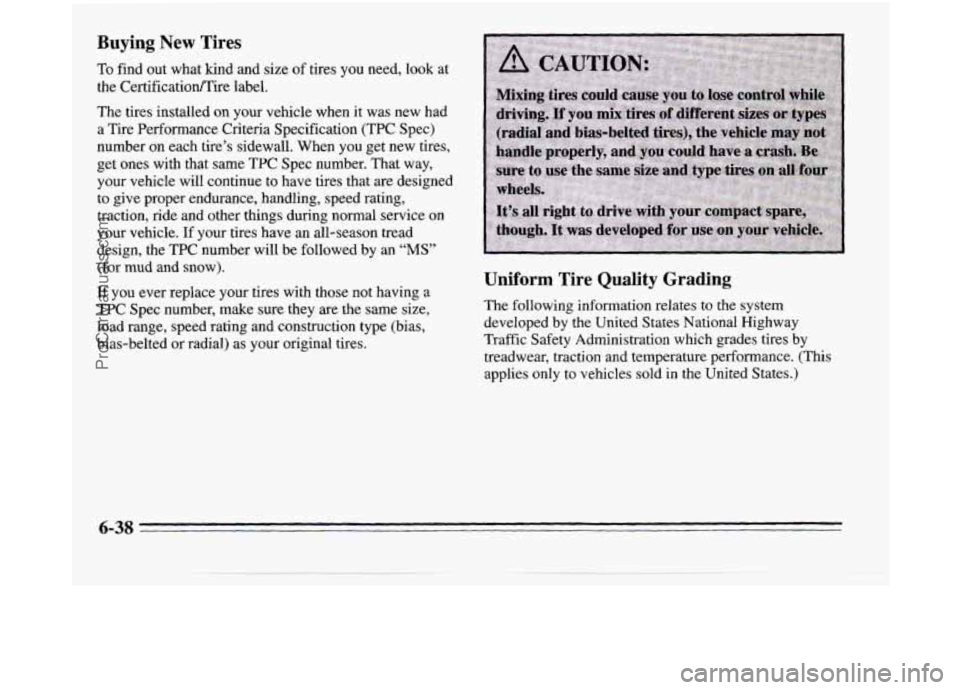
Buying New Tires
To find out what kind and size of tires you need, look at
the CertificatiordTire label.
The tires installed
on your vehicle when it was new had
a Tire Performance Criteria Specification
(TPC Spec)
number on each tire’s sidewall. When
you get new tires,
get ones with that same
TPC Spec number. That way,
your vehicle will continue to have tires that are designed
to give proper endurance, handling, speed rating,
traction, ride and other things during normal service on
your vehicle.
If your tires have an all-season tread
design, the TPC number will be followed by an
“MS”
(for mud and snow).
If you ever replace your tires with those not having a
TPC Spec number, make sure they are the same size,
load range, speed rating and construction type (bias,
bias-belted or radial) as your original tires.
Uniform Tire Quality Grading
The following information relates to the system
developed by the United States National Highway
Traffic Safety Administration which grades tires by
treadwear, traction and temperature performance.
(This
applies only to vehicles sold in the United States.)
6-38
ProCarManuals.com
Page 299 of 390
Treadwear Temperature - A, B, C
The temperature grades are A (the
highest), B, and C,
representing the tire’s resistance to the generation of
heat and its ability to dissipate heat when tested under
controlled conditions on a specified indoor laboratory
test wheel. Sustained high temperature can cause the
material of the tire to degenerate and reduce tire life, and
excessive temperature can lead to sudden tire failure.
The grade
C corresponds to a level of performance
which all passenger car tires must meet under the
Federal Motor Vehicle Safety Standard
No. 109. Grades
B and A represent higher levels of performance on the
laboratory test wheel than the minimum required by law.
The treadwear grade
is a comparative rating based on
the wear rate of the tire when tested under controlled
conditions on a specified government test course. For
example, a tire graded
150 would wear one and a half
(1 1/2) times as well on the government course as a tire
graded
100. The relative performance of tires depends
upon the actual conditions
of their use, however, and
may depart significantly from the norm due to variations
in driving habits, service practices and differences
in
road characteristics and climate.
Traction - A, B, C
The traction grades, from highest to lowest are: A, B,
and C. They represent the tire’s ability to stop on wet
pavement as measured under controlled conditions on
specified government test surfaces
of asphalt and
concrete.
A tire marked C may have poor traction
performance.
Warning: The traction grade assigned
to this tire is based
on braking (straight-ahead) traction tests and does not
include cornering (turning) traction. Warning:
The temperature grade for this tire is
established for a tire that
is properly inflated and not
overloaded. Excessive speed, underinflation, or
excessive loading, either separately or in combination,
can cause heat buildup and possible tire failure.
These grades are molded on the sidewalls
of passenger
car tires.
6-39
ProCarManuals.com
Page 300 of 390
While the tires available as standard or optional
equipment
on General Motors vehicles may vary with
respect to these grades, all such tires meet General
Motors performance standards and have been approved
for use on General Motors vehicles. All passenger type
(P Metric) tires must conform to Federal safety
requirements in addition to these grades.
Wheel Alignment and Tire Balance
The wheels on your vehicle were aligned and balanced
carefully at the factory to give you the longest tire life
and best overall performance.
In most cases, you will not need to have your wheels
aligned again. However, if you notice unusual tire wear
or your vehicle pulling one way or the other, the
alignment may need to be reset.
If you notice your
vehicle vibrating when driving on
a smooth road, your
wheels may need to be rebalanced.
Wheel Replacement
Replace any wheel that is bent, cracked, or badly rusted
or corroded.
If wheel nuts keep coming loose, the wheel,
wheel bolts, and wheel nuts should be replaced. If the
wheel leaks air, replace it (except some aluminum wheels,
which can sometimes be repaired). See your
Oldsmobile retailer
if any of these conditions exist.
Your retailer will know the kind of wheel you need.
Each new wheel should have the same load carrying
capacity, diameter, width, offset, and be mounted the
same way as the one it replaces.
If you need to replace any of your wheels, wheel bolts,
or wheel nuts, replace them only with new GM original
equipment parts. This way, you will be sure
to have the
right wheel, wheel bolts, and wheel nuts for your
Oldsmobile model.
6-40
ProCarManuals.com
Page 301 of 390

1 NOTICE:
The wrong wheel can also cause problems with
bearing life, brake cooling,
speedometer/odometer calibration, headlamp
aim, bumper height, vehicle ground clearance,
and tire or tire chain clearance to the body and
chassis.
Used Replacement Wheels
Tire Chains
NOTICE:
Use tire chains only where legal and only when
you must. Use only
SAE Class “S” type chains
that are the proper size for your tires. Install
them on the front tires and tighten them
as
tightly as possible with the ends securely
fastened. Drive slowly and follow the chain
manufacturer’s instructions.
If you can hear the
chains contacting your vehicle, stop and retighten
them.
If the contact continues, slow down until it
stops. Driving too fast or spinning the wheels
with chains on will damage your vehicle.
6-41
ProCarManuals.com
Page 308 of 390
Exterior painted surfaces are subject to aging, weather
and chemical fallout, that can take their toll over
a
period of years. You can help to keep the paint finish
looking new by keeping your Oldsmobile garaged or
covered whenever possible.
Aluminum Wheels
Tires
To clean your tires, use a stiff brush with a tire cleaner.
When applying
a tire dressing always take care to wipe
off any overspray or splash from painted surfaces.
Petroleum-based products may damage the paint finish.
Your aluminum wheels have
a protective coating similar Finish Damage
to the painted surface of your vehicle. Don’t use strong Any stone chips, fractures or deep scratches in the finish
soaps, chemicals, chrome polish, abrasive cleaners or should be repaired right away.
abrasive cleaning brushes on them because yo~l could
damage this coating. After rinsing thoroughly,
a wax
may be applied. Minor
chips and scratches can be repaired with touch-up
materials available from your retailer or other service
outlets. Larger areas of finish damage can be corrected
in your retailer’s body and paint shop.
NOTICE: Underbody Maintenance
Don’t use an automatic car wash that has hard
silicon carbide cleaning brushes. These brushes
can take the protective coating
off your
underbody parts such as fuel lines, frame, floor pan, and aluminum wheels.
removed, accelerated corrosion (rust) can occur on the
Chemicals used
for ice and snow removal and dust
control can collect on the underbody. If these are not
exhaust system even though they have corrosion
protection.
6-48
ProCarManuals.com
Page 329 of 390
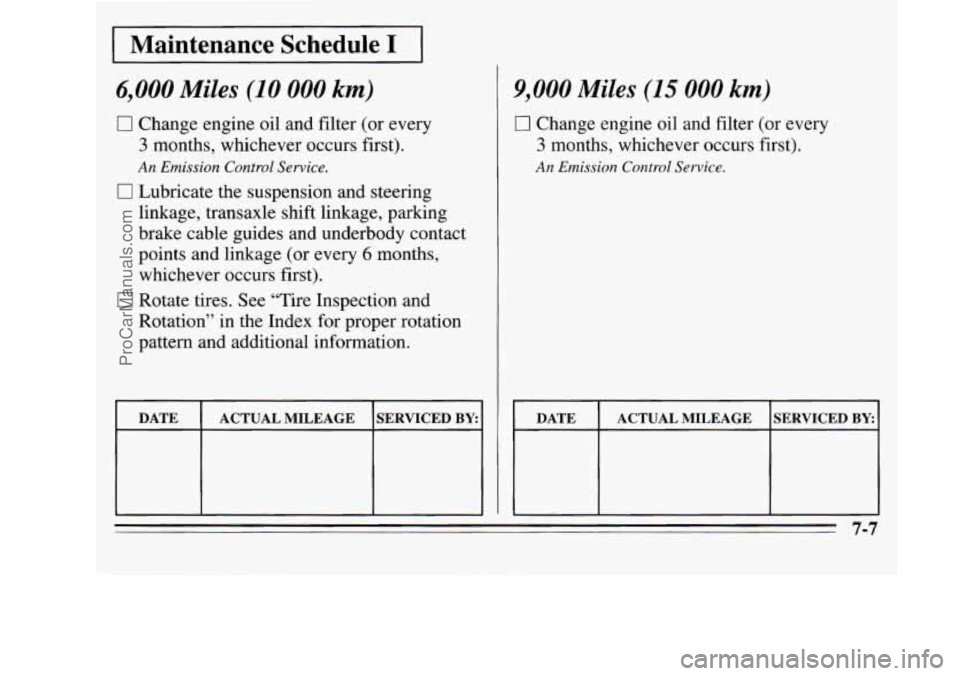
I Maintenance Schedule I I
6,000 Miles (10 000 km)
0 Change engine oil and filter (or every
3 months, whichever occurs first).
An Emission Control Service.
0 Lubricate the suspension and steering
linkage, transaxle shift linkage, parking
brake cable guides and underbody contact
points and linkage (or every
6 months,
whichever occurs first).
0 Rotate tires. See “Tire Inspection and
Rotation” in the Index for proper rotation
pattern and additional information.
DATE
SERVICED BY: ACTUAL MILEAGE
9,000 Miles (15 000 km)
0 Change engine oil and filter (or every
3 months, whichever occurs first).
An Emission Control Service.
I DATE I ACTUAL MILEAGE SERVICED BY I
7-7
ProCarManuals.com