check engine OLDSMOBILE SILHOUETTE 1998 Owner's Manual
[x] Cancel search | Manufacturer: OLDSMOBILE, Model Year: 1998, Model line: SILHOUETTE, Model: OLDSMOBILE SILHOUETTE 1998Pages: 444, PDF Size: 23.2 MB
Page 318 of 444

Checking Things Under the Hood
I
A CAUTION: I
An electric fan under the hood can start up and
injure you even when the engine is not running.
Keep hands, clothing and tools away from any
underhood electric fan.
I
L
A CAUTION:
I
Things that burn can get on hot engine parts and
start a fire. These include liquids like gasoline,
oil, coolant, brake fluid, windshield washer and
other fluids, and plastic or rubber. You or others
could be burned. Be careful not to drop or spill
things that will burn onto a hot engine.
Hood Release
To open the hood, first pull the hood release handle
inside the vehicle.
6-8
ProCarManuals.com
Page 321 of 444
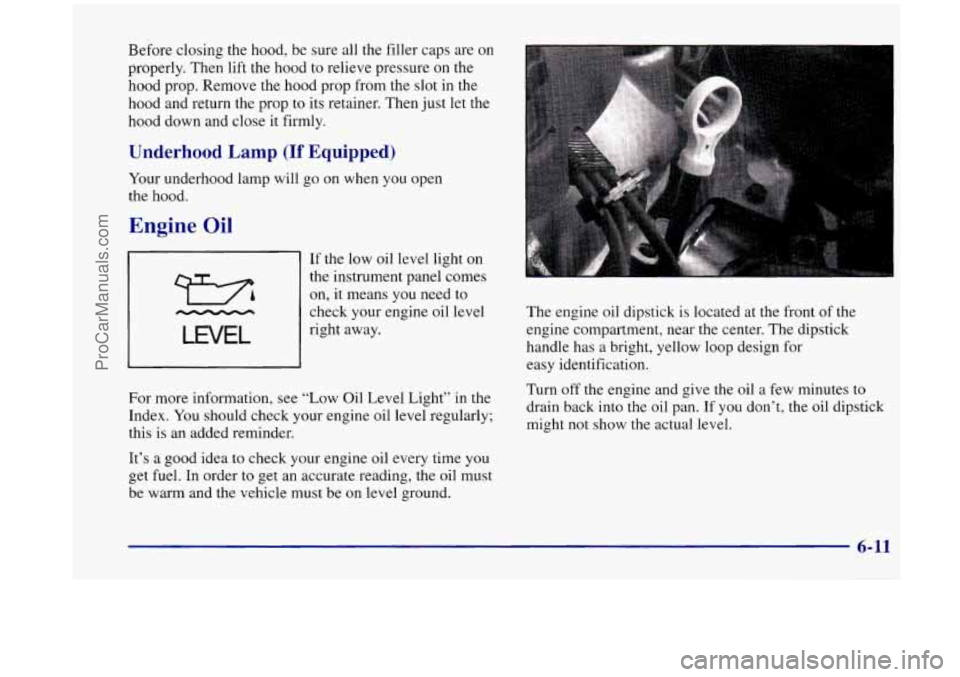
Before closing the hood, be sure all the filler caps are on
properly. Then lift the hood
to relieve pressure on the
hood prop. Remove the hood prop from the slot in the
hood and return the prop to its retainer. Then just let the
hood down and close it firmly.
Underhood Lamp (If Equipped)
Your underhood lamp will go on when you open
the hood.
Engine Oil
LEVEL
If the low oil level light on
the instrument panel comes
on, it means you need to
check your engine oil level
right away.
For more information, see
“Low Oil Level Light” in the
Index. You should check your engine oil level regularly;
this is an added reminder.
It’s a good idea to check your engine oil every time you
get fuel. In order to get an accurate reading, the oil must
be warm and
the vehicle must be on level ground. The
engine
oil dipstick is located at the front of the
engine compartment, near the center. The dipstick
handle has
a bright, yellow loop design for
easy identification.
Turn off the engine and give the oil a few minutes to
drain back into the oil pan. If you don’t, the oil dipstick
might not show the actual level.
6-11
ProCarManuals.com
Page 322 of 444

Checking Engine Oil
Pull out the dipstick and clean it with a paper towel or
cloth, then push it back
in all the way. Remove it again,
keeping the tip down, and check the level.
When to Add Engine Oil
If the oil is at or below the ADD mark, then you’ll need
to add at least one
quart of oil. But you must use the
right kind. This
part explains what kind of oil to use. For
crankcase capacity, see “Capacities and Specifications”
in the Index.
NOTICE:
Don’t add too much oil. If your engine has so
much oil that the oil level gets above the
cross-hatched area that shows the proper
operating range, your engine could be damaged.
The engine oil fill cap is
located just behind the
engine oil dipstick.
Be sure to fill it enough to put the level somewhere in
the proper operating range. Push the dipstick
all the way
back in when you’re through.
6-12
ProCarManuals.com
Page 326 of 444

Checking or Replacing the Air Cleaner
1. Unlatch the two hooks on top of the air
cleaner housing.
2. Turn back the air inlet panel and rest it on top of the
housing. The air intake tube is designed to flex back;
you do not need to disconnect it.
3. After replacing the air cleaner filter, seat the tabs on
the bottom of the panel into the slots at the bottom.
4. Latch the hooks to secure the panel in place. If the
panel moves easily, check that the tabs
are seated
correctly in the slots.
NOTICE:
If the air cleaner is off, a backfire can cause a
damaging engine fire. And, dirt can easily get
into your engine, which will damage it. Always
have the air cleaner in place when you’re driving.
Passenger Cornparti .t Air
Filter Replacemem
Passenger compartment air, both outside and
I recirculated air, is routed through a passenger
compartment filter, which is part of
a two-piece filter
system. The filter removes certain contaminants from
the air, including pollen and dust particles. Reductions
Operating the engine with the air cleaner off can in airflow, which may occur more quickly in dusty
cause you or others to be burned. The air cleaner areas, indicate that the filter needs to be replaced early.
not only cleans the air, it stops flame if the engine For how often to change the passenger compartment air
backfires. If it isn’t there, and the engine
backfires, you could be burned. Don’t drive with
The access panel for the passenger compartment air
it off, and be careful working on the engine with filter is in the back of the glove box.
the air cleaner off.
filter, see “Maintenance Schedule” in the Index.
6-16
ProCarManuals.com
Page 328 of 444

5. Close the inner access door, while squeezing the tab,
6. Snap the outer access panel into the back of the
to be sure it is
tightly closed.
glove box.
Automatic Transaxle Fluid
r--- In to Check and Change
A good time to check your automatic transaxle fluid
level is when the engine oil is changed.
Change both
the fluid and filter every 50,000 miles
(83 000 km) if the vehicle is mainly driven under one
or more of these conditions:
0 In heavy city traffic where the outside temperature
regularly reaches
90°F (32°C) or higher.
In hilly or mountainous terrain.
0 When doing frequent trailer towing.
0 Uses such as found in taxi, police or delivery service.
If you do not use your vehicle under any
of these
conditions, the fluid and filter do not require changing.
See “Scheduled Maintenance Services” in the Index.
How to Check
Because this operation can be a little difficult, you may
choose to have this done at your Oldsmobile retail
facility Service Department.
If you do it yourself, be sure to follow all the
instructions here, or
you could get a false reading
on the dipstick.
NOTICE:
Too much or too little fluid can damage your
transaxle.
Too much can mean that some of the
fluid could come out and fall on hot engine parts
or exhaust system parts, starting a fire. Be sure to
get an accurate reading if you check your
transaxle fluid.
6-18
ProCarManuals.com
Page 329 of 444

Wait at least 30 minutes before checking the transaxle
fluid level if
you have been driving:
When outside temperatures are above 90°F (32°C).
At high speed for quite a while.
In heavy traffic -- especially in hot weather.
While pulling a trailer.
To get the right reading, the fluid should be at normal
operating temperature, which is
180°F to 200°F
(82°C to 93°C).
Get the vehicle warmed up by driving about 15 miles
(24 km) when outside temperatures are above
50°F (10°C). If it's colder than 50°F (lO°C), you
may have to drive longer.
Checking the Fluid Level
Park your vehicle on a level place. Keep the
engine running.
With the parking brake applied, place the shift lever
in PARK (P).
With your foot on the brake pedal, move the shift
lever through each gear range, pausing for about
three seconds in each range. Then, position the shift
lever in
PARK (P).
Let the engine run at idle for three to five minutes.
Then, without shutting off the engine, follow
these steps:
1. The dipstick is located toward the back
of the engine
compartment, next to the brake master cylinder. The
dipstick handle has
a bright red loop design for easy
identification. Pull
out the dipstick and wipe it with a
clean rag or paper towel.
2. Push it back in all the way, wait three seconds and
then pull
it back out again.
6-19
ProCarManuals.com
Page 332 of 444

What to Use
Use a mixture of one-half clean water (preferably
distilled) and one-half
DEX-COOL@ coolant which
won’t damage aluminum parts. If you use this mixture,
you don’t need to add anything else.
Adding only plain water to your cooling system
can be dangerous. Plain water, or some other
liquid like alcohol, can boil before the proper coolant mixture will. Your vehicle’s coolant
warning system is set for the proper coolant
mixture. With plain water or the wrong mixture,
your engine could get too hot but you wouldn’t
get the overheat warning. Your engine could
catch fire and you or others could be burned.
Use
a 50/50 mixture of clean water and
DEX-COOL@ coolant.
J
NOTICE:
If you use an improper coolant mixture, your
engine could overheat and be badly damaged.
The repair cost wouldn’t be covered by your
warranty. Too much water in the mixture can
freeze and crack the engine, radiator, heater core
and other parts.
If you have to add coolant more than four times a year,
have your retailer check your cooling system.
NOTICE:
If you use the proper coolant, you don’t have to
add extra inhibitors or additives which claim to
improve the system. These can be harmful.
6-22
ProCarManuals.com
Page 333 of 444

Checking Coolant
The engine coolant reservoir is located on the driver’s
side
of the vehicle, above the air cleaner.
When your engine
is cold, the coolant level should be
at
FULL COLD, or a little higher. When your engine
is warm, the level should be above the
FULL COLD
mark, or a little higher.
Adding Coolant
If this light comes on, it
means you’re low on
engine coolant.
If you need more coolant, add the proper DEX-COOL@
coolant mixture at the coolant recovery tank.
-
Turning the radiator pressure cap when the
engine and radiator are hot can allow steam and
scalding liquids to blow out and burn you badly.
With the coolant recovery tank, you will almost
never have
to add coolant at the radiator. Never
turn the radiator pressure cap
-- even a little --
when the engine and radiator are hot.
6-23
ProCarManuals.com
Page 335 of 444

Power Steering Fluid
The power steering fluid reservoir is located to the right
of the windshield washer fluid reservoir, at the back of
the engine compartment.
When to Check Power Steering Fluid
It is not necessary to regularly check power steering
fluid unless
you suspect there is a leak in the system or
you hear an unusual noise.
A fluid loss in this system
could indicate a problem. Have the system inspected
and repaired.
How To Check Power Steering Fluid
When the engine compartment is cool, wipe the cap and
the top
of the reservoir clean, then unscrew the cap and
wipe the dipstick with a clean rag. Replace the cap and
completely tighten
it. Then remove the cap again and
look at the fluid level on the dipstick.
When the engine compartment is hot,
the level should
be at the
“H” mark. When it’s cold, the level should be
at the
“C” mark. If the fluid is at the ADD mark, you
should add fluid.
What to Use
To determine what lund of fluid to use, see
“Recommended Fluids and Lubricants” in the Index.
Always use the proper fluid. Failure to use the proper
fluid can cause leaks and damage hoses and seals.
6-25
ProCarManuals.com
Page 405 of 444

Part B: Owner Checks and Services
Listed below are owner checks and services which
should be performed at the intervals specified to help
ensure the safety, dependability and emission control
performance
of your vehicle.
Be sure any necessary repairs are completed at once.
Whenever any fluids or lubricants are added
to your
vehicle, make sure they are the proper ones, as shown in
Part
D.
At Each Fuel Fill
It is important for you or a service station attendant to
pe~orm these underhood checks
at each fueljill.
Engine Oil Level Check
Check the engine oil level and add the proper oil if
necessary. See “Engine Oil” in
the Index for
further details.
Engine Coolant Level Check
Check the engine coolant level and add DEX-COOL@
coolant mixture if necessary. See “Engine Coolant”
in
the Index for further details.
Windshield Washer Fluid Level Check
Check the windshield washer fluid level in the
windshield washer tank and add the proper fluid if
necessary. See “Windshield Washer Fluid” in the Index
for further details.
At Least Once a Month
Tire Inflation Check
Make sure tires are inflated to the correct pressures. See
“Tires” in the Index for further details.
Cassette Deck Service
Clean cassette deck. Cleaning should be done every
50 hours of tape play. See “Audio Systems” in the Index
for further details.
7-29
ProCarManuals.com