oil OLDSMOBILE SILHOUETTE 1998 Owner's Manual
[x] Cancel search | Manufacturer: OLDSMOBILE, Model Year: 1998, Model line: SILHOUETTE, Model: OLDSMOBILE SILHOUETTE 1998Pages: 444, PDF Size: 23.2 MB
Page 331 of 444
Engine Coolant
The cooling s stem in your vehicle is filled with
DEX-COOL engine coolant. This coolant is designed
to remain in your vehicle for
5 years or 150,000 miles
(240 000 lunb whichever occurs first, if you add only
DEX-COOL extended life coolant.
J
The following explains your cooling system and how
to add coolant when it is low. If you have a problem
with engine overheating, see “Engine Overheating” in
the Index.
A 50/50 mixture of water and DEX-COOL@
coolant will:
Give freezing protection down to -34°F (-37°C).
0 Give boiling protection up to 265 OF (1 29 O C).
Protect against rust and corrosion.
Help keep the proper engine temperature.
Let the warning lights and gages work as
they should.
NOTICE:
When adding coolant, it is important that you
use only
DEX-COOL@ (silicate-free) coolant.
If coolant other than DEX-COOL is added to
the system, premature engine, heater core or
radiator corrosion may result. In addition, the
engine coolant will require change sooner
-- at
30,000 miles (50 000 km) or 24 months,
whichever occurs
first. Damage caused by the
use of coolant other than DEX-COOL@ is not
covered by your new vehicle warranty.
6-21
ProCarManuals.com
Page 332 of 444

What to Use
Use a mixture of one-half clean water (preferably
distilled) and one-half
DEX-COOL@ coolant which
won’t damage aluminum parts. If you use this mixture,
you don’t need to add anything else.
Adding only plain water to your cooling system
can be dangerous. Plain water, or some other
liquid like alcohol, can boil before the proper coolant mixture will. Your vehicle’s coolant
warning system is set for the proper coolant
mixture. With plain water or the wrong mixture,
your engine could get too hot but you wouldn’t
get the overheat warning. Your engine could
catch fire and you or others could be burned.
Use
a 50/50 mixture of clean water and
DEX-COOL@ coolant.
J
NOTICE:
If you use an improper coolant mixture, your
engine could overheat and be badly damaged.
The repair cost wouldn’t be covered by your
warranty. Too much water in the mixture can
freeze and crack the engine, radiator, heater core
and other parts.
If you have to add coolant more than four times a year,
have your retailer check your cooling system.
NOTICE:
If you use the proper coolant, you don’t have to
add extra inhibitors or additives which claim to
improve the system. These can be harmful.
6-22
ProCarManuals.com
Page 338 of 444
BRAKE
United States Canadian
When your brake fluid falls to a low level, your brake
warning light will come on. See “Brake System Warning
Light” in the Index.
What to Add
When
you do need brake fluid, use only DOT-3
brake fluid -- such as Delco Supreme 1 1 @ (GM Part
No. 12377967). Use new brake fluid from a sealed
container only.
Always clean the brake fluid reservoir cap and the area
around the cap before removing it. This will help keep
dirt from entering the reservoir. With the wrong kind
of fluid in your brake
system, your brakes may not work well, or they
may not even work at all. This could cause
a
crash. “1 Always use the proper brake fluid.
NOTICE:
0
0
Using the wrong fluid can badly damage
brake system parts. For example, just
a few
drops of mineral-based oil, such as engine
oil, in your brake system can damage brake
system parts
so badly that they’ll have to be
replaced. Don’t let someone put in the
wrong kind of fluid.
If you spill brake fluid on your vehicle’s
painted surfaces, the paint finish can be
damaged. Be careful not to spill brake fluid
on your vehicle.
If you do, wash it off
immediately. See “Appearance Care” in
the Index.
6-28
ProCarManuals.com
Page 357 of 444
Appearance Care
Remember, cleaning products can be hazardous. Some
are toxic. Others can burst into flame
if you strike a
match or get them on a hot part of the vehicle. Some are
dangerous if you breathe their fumes in a closed space.
When you use anything from a container to clean your
vehicle, be sure to follow the manufacturer’s warnings
and instructions. And always open your doors or
windows when you’re cleaning the inside.
Never use these to clean your vehicle:
Gasoline
0 Benzene
0 Naphtha
0 Carbon Tetrachloride
Acetone
0 Paint Thinner
Turpentine
0 Lacquer Thinner
0 Nail Polish Remover
They can all
be hazardous -- some more than
others
-- and they can all damage your vehicle, too. Don’t use any
of these unless this manual says you can.
In many uses, these will damage your vehicle:
Alcohol
Laundry Soap
Bleach
Reducing Agents
Cleaning the Inside of Your Vehicle
Use a vacuum cleaner often to get rid of dust and loose
dirt. Wipe vinyl, leather, plastic and painted surfaces
with a clean, damp cloth.
Your retailer has two cleaners, Multi-Purpose Interior
Cleaner and Capture Non-Solvent Dry Spot and Soil
Remover.
They will clean normal spots and stains very
well.
You can get GM-approved cleaning products from
your retailer. (See “Appearance Care and Materials” in
the Index.)
Here are
some cleaning tips:
0 Always read the instructions on the cleaner label.
Clean up stains as soon as you can -- before they set.
Carefully scrape off any excess stain.
Use a clean cloth or sponge, and change to a clean area
often.
A soft brush may be used if stains are stubborn.
If a ring forms after spot cleaning, clean the entire
area immediately or
it will set.
6-47
ProCarManuals.com
Page 358 of 444
Using Multi-Purpose Interior Cleaner on Fabric
1.
2.
3.
4.
5.
6.
7.
Vacuum and brush the area to remove any loose dirt.
Always clean a whole trim panel or section. Mask
surrounding trim along stitch or welt lines.
Mix powdered cleaner following the directions
on
the container label to form thick suds.
Use suds only and apply with
a clean sponge. Don’t
saturate the material and don’t rub it roughly.
As soon as you’ve cleaned the section, use a sponge
to remove the suds.
Wipe cleaned area with a clean, damp towel or cloth.
Wipe with a clean cloth and let dry.
Special Fabric Cleaning Problems
Stains caused by such things as catsup, coffee (black),
egg, fruit, fruit juice, milk, soft drinks, vomit, urine and
blood can be removed as follows:
1. Carefully scrape off excess stain, then sponge the
2. If a stain remains, follow the multi-purpose interior
soiled area
with cool water.
cleaner instructions described earlier.
3. If an odor lingers after cleaning vomit or urine,
treat the area with
a waterhaking soda solution:
1 teaspoon (5 ml) of baking soda to 1 cup (250 ml)
of lukewarm water.
4. Let dry.
Stains caused by candy, ice cream, mayonnaise, chili
sauce and unknown stains can be removed as follows:
1. Carefully scrape off excess stain.
2. First, clean with cool water and allow to dry
completely.
3. If a stain remains, follow instructions for
Multi-Purpose Interior Cleaner.
Cleaning Vinyl
Use warm water and a clean cloth.
Rub with a clean, damp cloth to remove dirt. You
may have to do it more than once.
Things like tar, asphalt and shoe polish will stain
if you don’t get them off quickly. Use a clean cloth
and a vinyl/leather cleaner. See your retailer for
this product.
6-48
ProCarManuals.com
Page 359 of 444
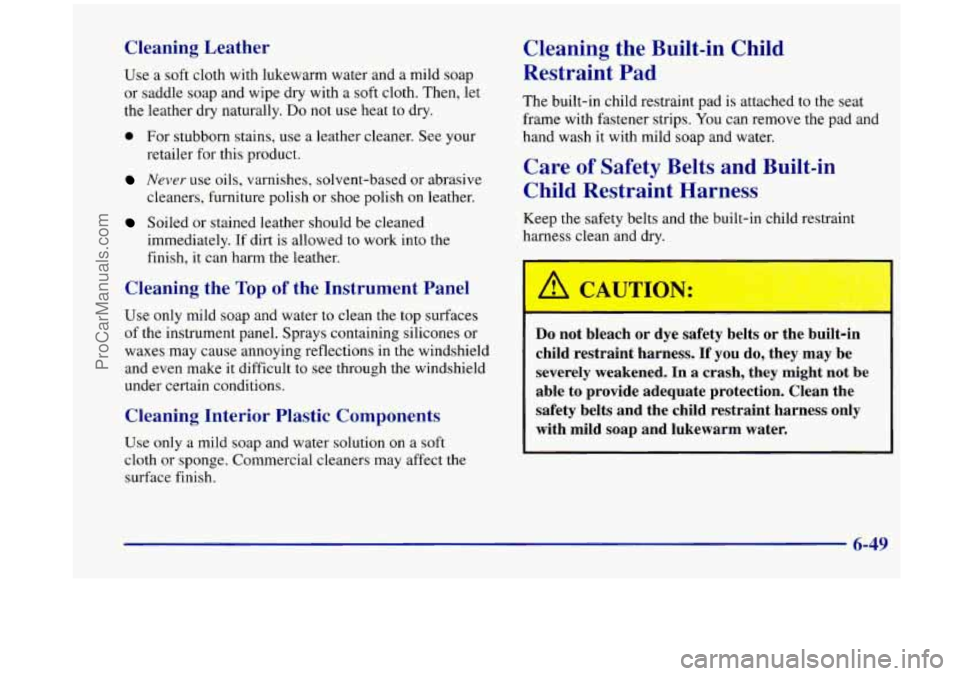
Cleaning Leather
Use a soft cloth with lukewarm water and a mild soap
or saddle soap and wipe dry with a soft cloth. Then, let
the leather dry naturally.
Do not use heat to dry.
0 For stubborn stains, use a leather cleaner. See your
Never use oils, varnishes, solvent-based or abrasive
retailer
for this product.
cleaners, furniture polish or shoe polish on leather.
immediately.
If dirt is allowed to work into the
finish, it can harm the leather.
Soiled or stained leather should be cleaned
Cleaning the Top of the Instrument Panel
Use only mild soap and water to clean the top surfaces
of the instrument panel. Sprays containing silicones or
waxes may cause annoying reflections in the windshield
and even make it difficult
to see through the windshield
under certain conditions.
Cleaning Interior Plastic Components
Use only a mild soap and water solution on a soft
cloth
or sponge. Commercial cleaners may affect the
surface finish.
Cleaning the Built-in Child
Restraint Pad
The built-in child restraint pad is attached to the seat
frame with fastener strips. You can remove the pad and
hand wash
it with mild soap and water.
Care of Safety Belts and Built-in
Child Restraint Harness
Keep the safety belts and the built-in child restraint
harness clean and dry.
Do not bleach or dye safety belts or the built-in
child restraint harness. If you
do, they may be
severely weakened. In
a crash, they might not be
able to provide adequate protection. Clean the
safety belts and the child restraint harness only
with mild soap and lukewarm water.
6-49
ProCarManuals.com
Page 362 of 444
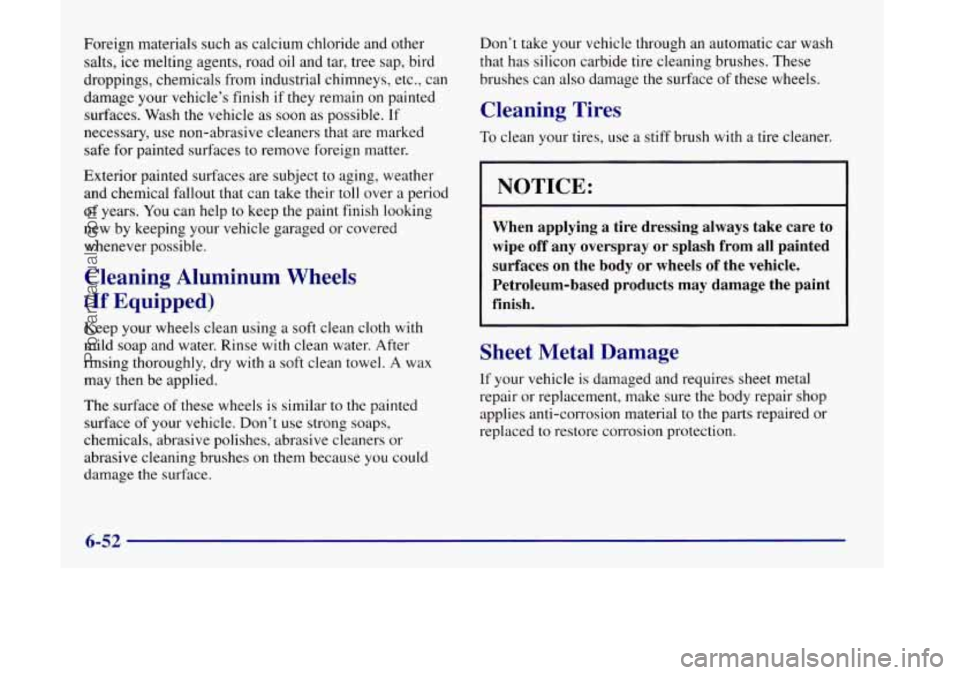
Foreign materials such as calcium chloride and other
salts, ice melting agents, road oil and tar, tree sap, bird
droppings, chemicals from industrial chimneys, etc., can
damage your vehicle’s finish if they remain
on painted
surfaces. Wash the vehicle
as soon as possible. If
necessary, use non-abrasive cleaners that are marked
safe for painted surfaces to remove foreign matter. Don’t take your vehicle through an automatic
car wash
that has silicon carbide tire cleaning brushes. These
brushes can also damage the surface of these wheels. Cleaning Tires
To clean your tires, use a stiff brush with a tire cleaner.
Exterior painted surfaces are subject to aging, weather
and chemical fallout that can take their toll over a period
of years.
You can help to keep the paint finish looking
new by keeping your vehicle garaged or covered
whenever possible.
Cleaning Aluminum Wheels
(If Equipped)
Keep your wheels clean using a soft clean cloth with
mild soap and water. Rinse with clean water. After
rinsing thoroughly, dry with a soft clean towel.
A wax
may then be applied.
The surface of these wheels is similar to the painted
surface of your vehicle. Don’t use strong soaps,
chemicals, abrasive polishes, abrasive cleaners or
abrasive cleaning brushes on them because
you could
damage the surface.
I NOTICE:
When applying a tire dressing always take care to
wipe off any overspray or splash from all painted
surfaces
on the body or wheels of the vehicle.
Petroleum-based products may damage the paint
finish.
Sheet Metal Damage
If your vehicle is damaged and requires sheet metal
repair or replacement, make sure the body repair shop
applies anti-corrosion material to the parts repaired or
replaced to restore corrosion protection.
6-52
ProCarManuals.com
Page 364 of 444
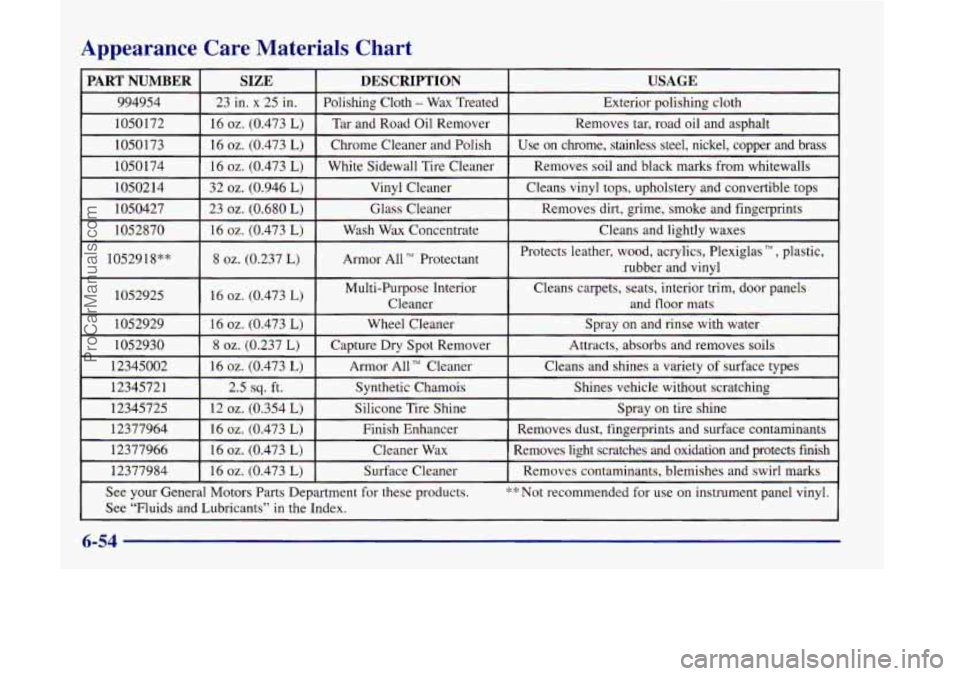
Appearance Care Materials Chart
PART NUMBER USAGE DESCRIPTION
SIZE
994954
Exterior polishing cloth
Polishing Cloth - Wax Treated 23 in. x 25 in.
1050 172
Cleans and lightly waxes
Wash Wax Concentrate
16
oz. (0.473 L) 1052870 Removes dirt, grime, smoke and fingerprints
Glass Cleaner
23 oz. (0.680 L) 1050427 Cleans vinyl tops, upholstery and convertible tops
Vinyl Cleaner 32
02. (0.946 L) 1050214 Removes soil and black marks from whitewalls White Sidewall Tir\
e Cleaner
16
oz. (0.473 L) 1050174 Use on chrome, stainless steel, nickel, copper and brass
Chrome Cleaner and Polish 16
oz. (0.473 L) 1050173 Removes tar, road oil and asphalt
Tar and Road Oil Remover 16
oz. (0.473 L)
1 ~ 1052918** I 8 oz. (0.237 L) I Armor All TM Protectant Protects leather, wood, acrylics, Plexiglas T’, plastic,
rubber and vinyl
6-54
ProCarManuals.com
Page 373 of 444

Mini Fuse
2 1 -1GN 1 -UH
22-SPARE
23-SPARE
24-SPARE
25-ELEK
IGN
26-SPARE
27-B/U LAMP
28-NC CLU
29-RADIO Evaporative Emissions
(EVAP)
Canister Purge Valve, Heated
Oxygen Sensors
1 and 2, Mass
Air Flow (MAF) Sensor
Not Used
Not Used
Not Used
Ignition Control Module (ICM)
Not Used
Transaxle Range Switch to
Back-up Lamps
A/C CLU Relay to A/C
Compressor Clutch Oil
Driver Information Display,
Heater A/C Control, Radio,
Rear Side Door Actuator
Control Motor, Remote Control
Door Lock Receiver (RCDLR),
Security Indicator Lamp and
Theft Deterrent Shock Sensor
Mini Fuse
30-ALT SENSE
3
1 -TCC Generator
Automatic Transaxle
(Torque
Converter Clutch Solenoids)
Stoplamp Switch to PCM
32-FUEL PUMP Fuel Pump Relay
33-ECM SENSE
34
35-FOG LP
36-HORN
37-PARK LP
38
39
40 Powertrain Control
Module (PCM)
Not Used
Fog Lamp Relay
Horn Relay
Daytime Running Lamps (DRL) Control Module,
Headlamps and
I/P Dimmer
Switch Theft-Deterrent Relay
to Headlamps
Not Used
Not Used
Mini Fuse Puller
6-63
ProCarManuals.com
Page 374 of 444
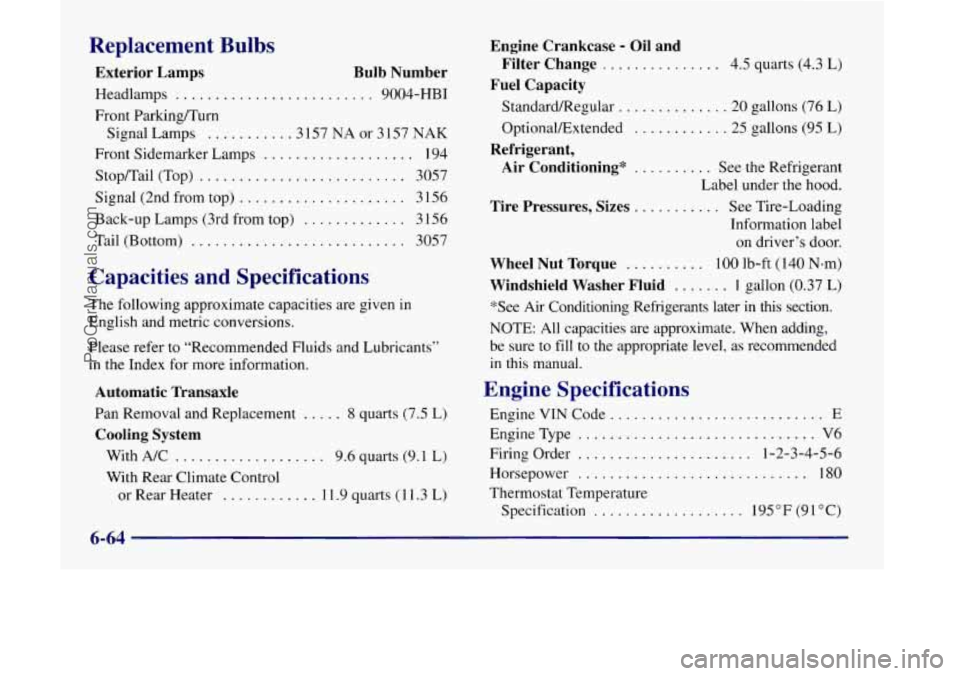
Replacement Bulbs
Exterior Lamps Bulb Number
Headlamps ......................... 9004-HBI
Signal Lamps
.......... .3 157 NA or 3 157 NAK
Front Sidemarker Lamps ................... 194
Stop/Tail (Top)
.......................... 3057
Signal (2nd from top)
..................... 3 156
Tail (Bottom) ........................... 3057
Front Parking/Turn
Back-up Lamps (3rd from top)
............. 3156
Capacities and Specifications
The following approximate
capacities are given in
English and metric conversions.
Please refer to “Recommended Fluids and Lubricants’’
in the Index for more information.
Automatic Transaxle
Pan Removal and Replacement ..... 8 quarts (7.5 L)
With A/C
................... 9.6 quarts (9.1 L)
Cooling System
With Rear Climate Control
or Rear Heater
............ 1 1.9 quarts (1 1.3 L)
Engine Crankcase - Oil and
Fuel Capacity Filter Change
............... 4.5 quarts (4.3 L)
Standard/Regular .............. 20 gallons (76 L)
OptionalExtended
............ 25 gallons (95 L)
Refrigerant,
Air Conditioning*
.......... See the Refrigerant
Label under the hood.
Tire Pressures, Sizes ........... See Tire-Loading
Information label
on driver’s door.
Wheel Nut Torque .......... 100 lb-ft (140 N-m)
Windshield Washer Fluid ....... 1 gallon (0.37 L)
*See Air Conditioning Refrigerants later in this section.
NOTE: All capacities are approximate. When adding,
be sure to fill to the appropriate level, as recommended
in this manual.
Engine Specifications
Engine VIN Code ........................... E
Firing Order
...................... 1-2-3-4-5-6
EngineType
.............................. V6
Horsepower
............................. 180
Thermostat Temperature Specification
................... 195°F (91°C)
6-64
ProCarManuals.com