child seat OLDSMOBILE SILHOUETTE 2003 User Guide
[x] Cancel search | Manufacturer: OLDSMOBILE, Model Year: 2003, Model line: SILHOUETTE, Model: OLDSMOBILE SILHOUETTE 2003Pages: 466, PDF Size: 21.55 MB
Page 60 of 466
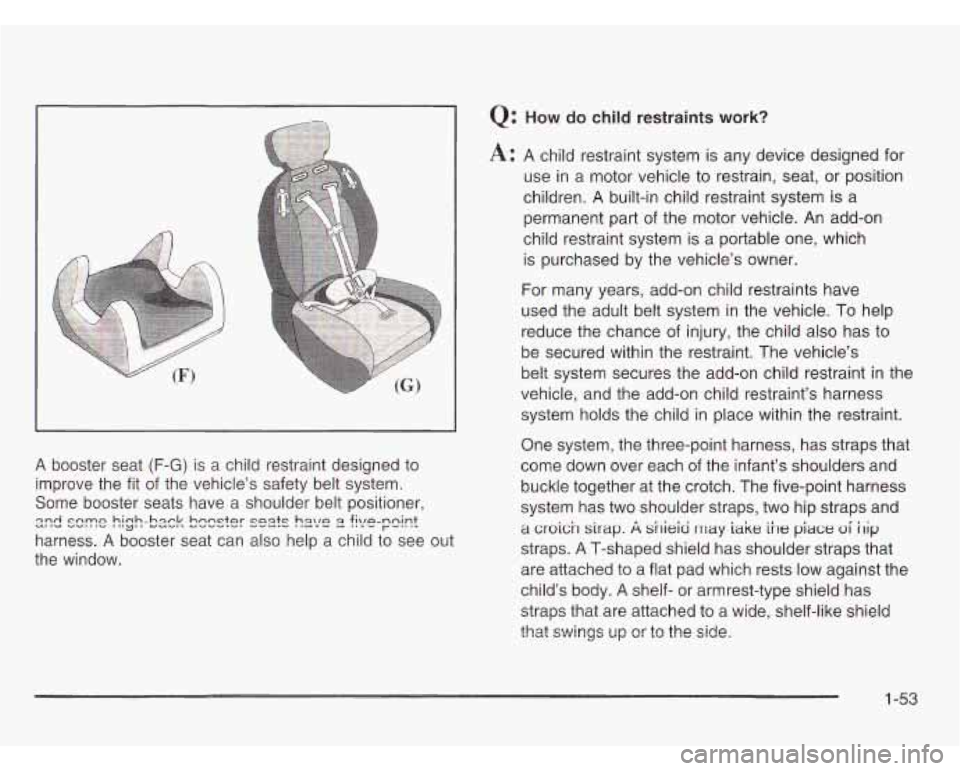
A booster seat (F-G) is a child restraint designed to
improve the fit of the vehicle's safety belt system.
Some booster seats have a shoulder belt positioner,
harness.
A booster seat can also help a child to see out
the window.
QnrJ cnrnn hirvh-hgok hnnctnr cndc ha
n 2 filie-nnint ut IU V.J.,IV I "y' I VUVI. UVVV.... ---I.. ..U" - I""""
Q: How do child restraints work?
A: A child restraint system is any device designed for
use in a motor vehicle to restrain, seat, or position
children. A built-in child restraint system is a
permanent part of the motor vehicle. An add-on
child restraint system is a portable one, which
is purchased by the vehicle's owner.
For many years, add-on child restraints have
used the adult belt system in the vehicle.
To help
reduce the chance of injury, the child also has to
be secured within the restraint. The vehicle's
belt system secures the add-on child restraint in the
vehicle, and the add-on child restraint's harness
system holds the child in place within the restraint.
One system, the three-point harness, has straps that
come down over each of the infant's shoulders and
buckle together at the crotch. The five-point harness
system has two shoulder straps, two hip straps and
a crotch strap. A sirieici rnay iake ihe piace oi hip
straps. A T-shaped shield has shoulder straps that
are attached to a flat pad which rests low against the
child's body.
A shelf- or armrest-type shield has
straps that are attached to a wide, shelf-like shield
that
S?..,l!?cJS up or io the side.
1-53
Page 61 of 466
When choosing a child restraint, be sure the child
restraint is designed to be used in a vehicle.
If it is,
it will have a label saying that it meets federal motor
vehicle safety standards.
Then follow the instructions for the restraint.
You may
find these instructions on the restraint itself or in a
booklet, or both. These restraints use the belt system
in your vehicle, but the child also has to be secured
within the restraint to help reduce the chance of personal
injury. When securing an add-on child restraint, refer
to the instructions that come with the restraint which may
be on the restraint itself or in a booklet, or both, and
to this manual. The child restraint instructions are
important,
so if they are not available, obtain a
replacement copy from the manufacturer.
Where to Put the Restraint
Accident statistics show that children are safer if they
are restrained in the rear rather than the front seat.
General Motors, therefore, recommends that child
restraints be secured in a rear seat, including an
infant riding in
a rear-facing infant seat, a child riding
in a forward-facing child seat and an older child
riding in a booster seat.
Never put a rear-facing child restraint in the front
passenger seat. Here’s why:
A child
in a rear-facing child restraint can be
seriously injured or killed if the right front
passenger’s air bag inflates. This is because the
back of the rear-facing child restraint would be
very close to the inflating air bag. Always secure
a rear-facing child restraint in a rear seat.
You may secure a forward-facing child restraint
in the right front seat, but before you do, always
move the front passenger seat as far back as
it
will go. It’s better to secure the child restraint
in a rear seat.
Wherever you install it, be sure to secure the child
restraint properly.
Keep in mind that an unsecured child restraint can move
around in a collision or sudden stop and injure people in
the vehicle. Be sure to properly secure any child restraint
in your vehicle
- even when no child is in it.
1-54
Page 63 of 466
Don’t use a child restraint that requires a top strap in
the right front passenger’s position because there’s
no place to anchor the top strap.
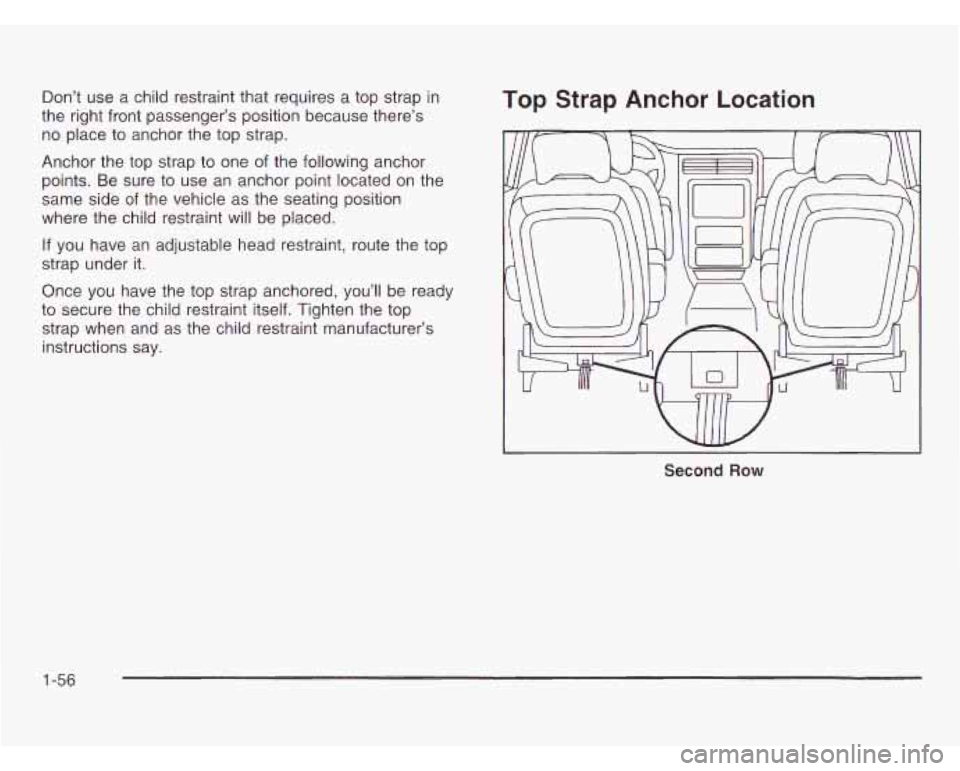
Anchor the top strap to one
of the following anchor
points. Be sure to use an anchor point located on the
same side
of the vehicle as the seating position
where the child restraint will be placed.
If you have an adjustable head restraint, route the top
strap under it.
Once you have the top strap anchored, you’ll be ready
to secure the child restraint itself. Tighten the top
strap when and as the child restraint manufacturer’s
instructions say.
Top Strap Anchor Location
Second Row
1-56
Page 65 of 466
Lower Anchorages and Top Tethers
for Children
(LATCH System)
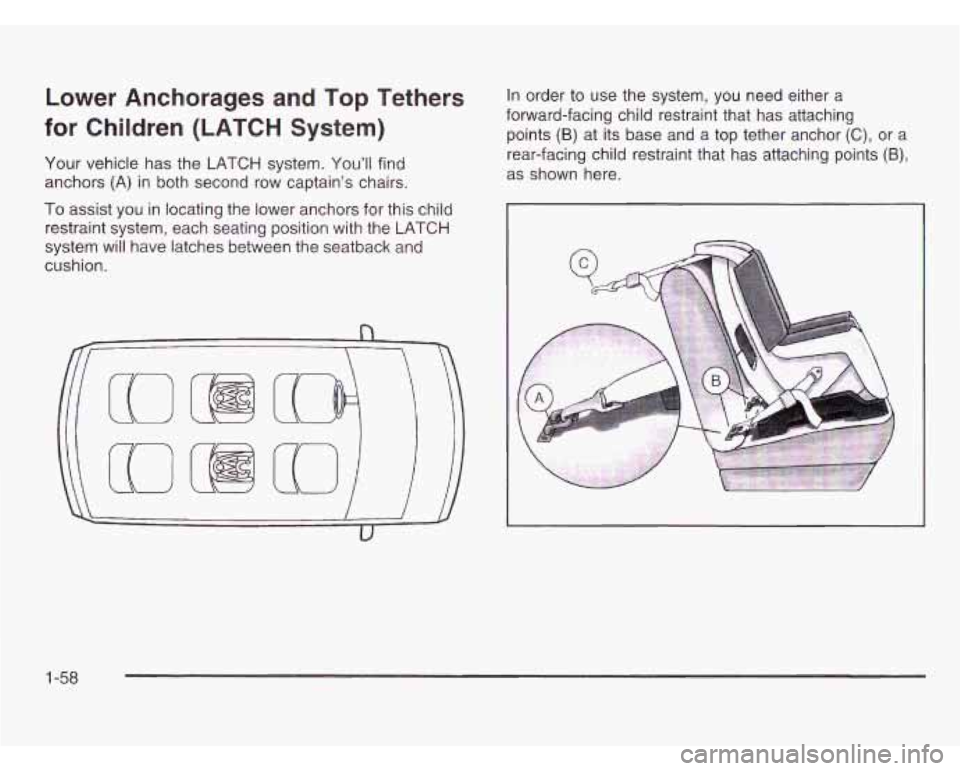
Your vehicle has the LATCH system. You'll find
anchors (A) in both second row captain's chairs.
To assist you
in locating the lower anchors for this child
restraint system, each seating position with the LATCH
system will have latches between the seatback and
cushion. In order
to use the system, you need either a
forward-facing child restraint that has attaching
points
(B) at its base and a top tether anchor (C), or a
rear-facing child restraint that has attaching points
(B),
as shown here.
1-58
Page 66 of 466
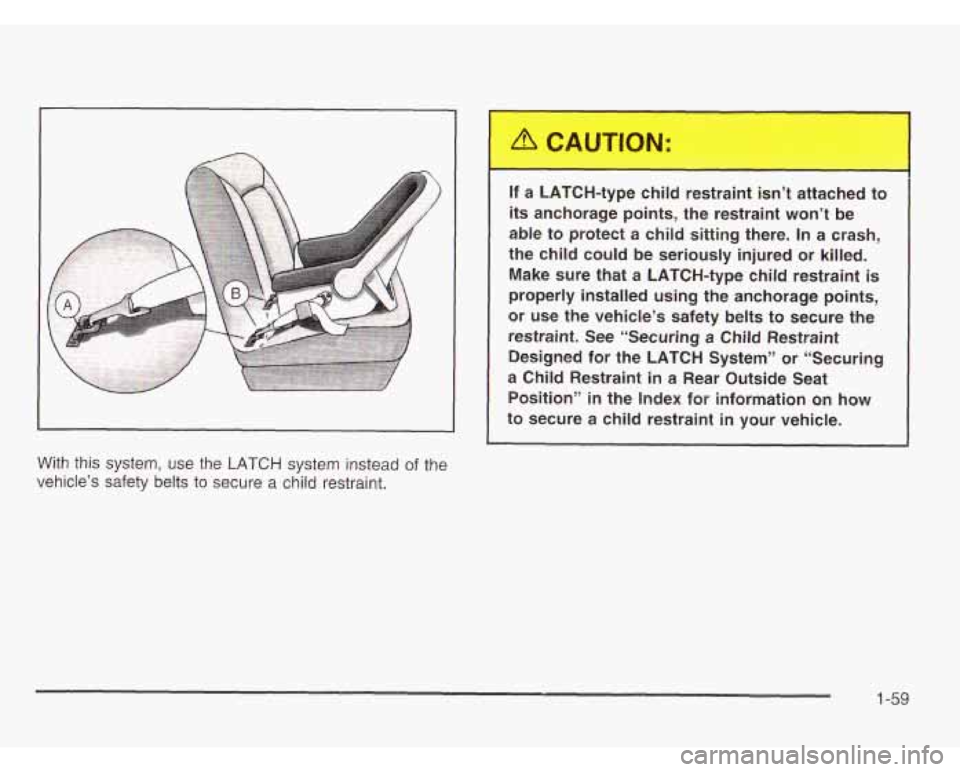
With this system, use the LATCH system instead of the
vehicle’s safety belts
to secure a child restraint. If a
LAT4-type child restraint isn’t attached to
its anchorage points, the restraint won’t be
able to protect
a child sitting there. In a crash,
the child could be seriously injured or killed. Make sure that a LATCH-type child restraint
is
properly installed using the anchorage points,
or use the vehicle’s safety belts to secure the
restraint. See “Securing a Child Restraint
Designed for the LATCH System’’ or “Securing
a Child Restraint
in a Rear Outside Seat
Position”
in the Index for information on how
to secure a child restraint
in your vehicle.
1 -59
Page 67 of 466
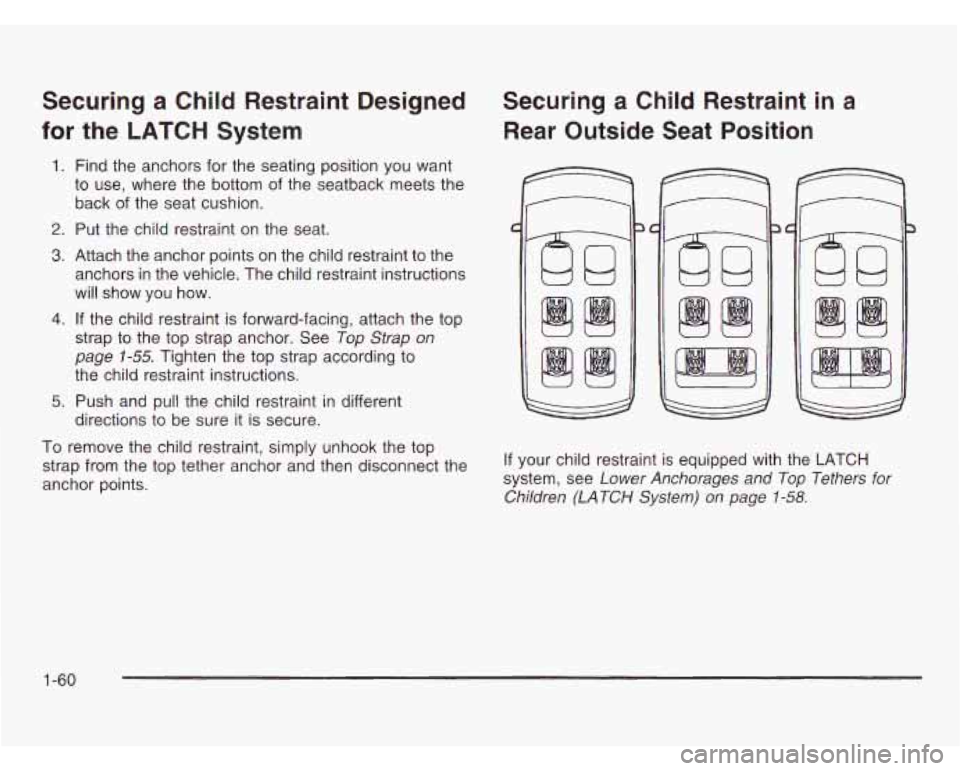
Securing a Child Restraint Designed
for the LATCH System
1. Find the anchors for the seating position you want
to use, where the bottom of the seatback meets the
back of the seat cushion.
2. Put the child restraint on the seat.
3. Attach the anchor points on the child restraint to the
anchors in the vehicle. The child restraint instructions
will show you how.
4. If the child restraint is forward-facing, attach the top
strap to the top strap anchor. See
Top Strap on
page 1-55. Tighten the top strap according to
the child restraint instructions.
5. Push and pull the child restraint in different
directions to be sure it is secure.
To remove the child restraint, simply unhook the top
strap from the top tether anchor and then disconnect the
anchor points.
Securing a Child Restraint in a
Rear Outside Seat Position
1
I
If your child restraint is equipped with the LATCH
system, see
Lower Anchorages and Top Tethers for
Children
(LATCH System) on page 1-58.
3
1 -60
Page 68 of 466
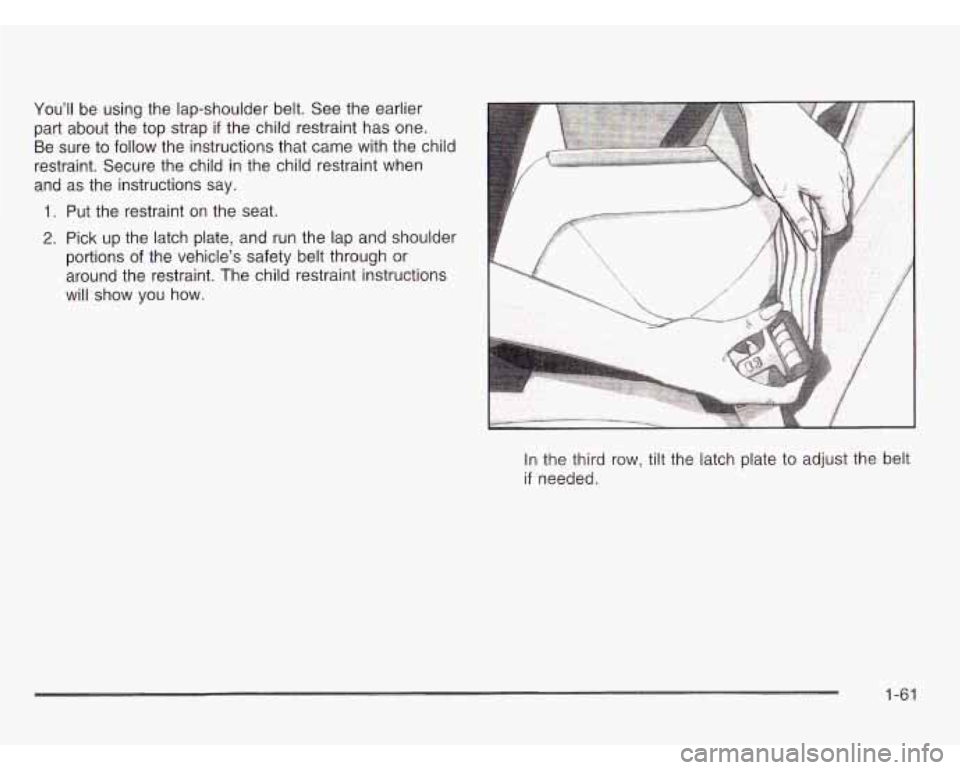
You’ll be using the lap-shoulder belt. See the earlier
part about the top strap
if the child restraint has one.
Be sure to follow the instructions that came with the child
restraint. Secure the child in the child restraint when
and as the instructions say.
1.
2.
Put the restraint on the seat.
Pick up the latch plate, and run the lap and shoulder
portions
of the vehicle’s safety belt through or
around the restraint. The child restraint instructions
will show you how.
In the third row, tilt the latch plate to adjust the belt
if needed.
1-61
Page 71 of 466
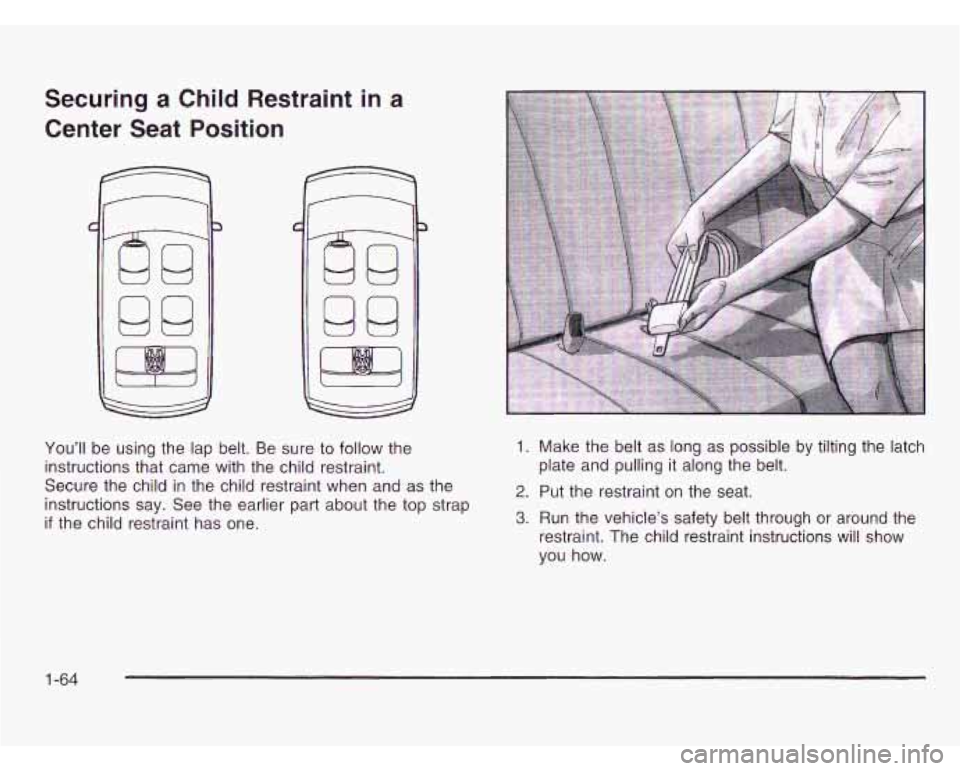
Securing a Child Restraint in a
Center Seat Position
3
You’ll be using the lap belt. Be sure to follow the
instructions that came with the child restraint.
Secure the child in the child restraint when and as the
instructions say. See the earlier part about the top strap
if the child restraint has one.
1.
2.
3.
Make the belt as long as possible by tilting the latch
plate and pulling it along the belt.
Put the restraint on the seat.
Run the vehicle’s safety belt through or around the
restraint. The child restraint instructions will show
you how.
1-64
Page 73 of 466
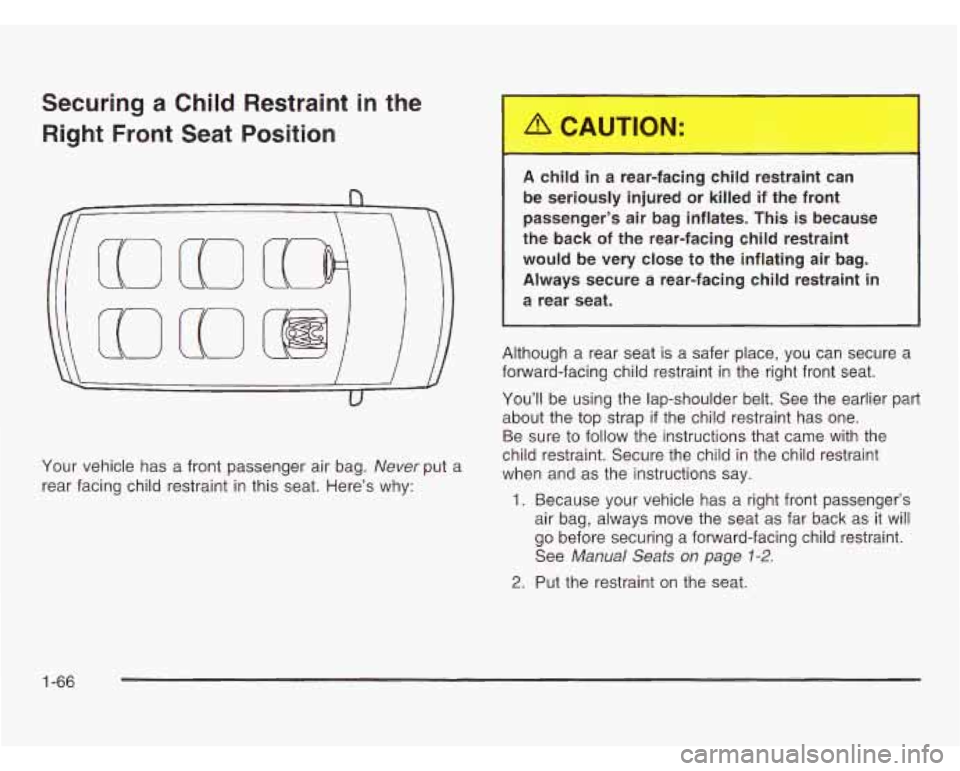
Securing a Child Restraint in the
Right Front Seat Position
n
Your vehicle has a front passenger air bag. Never put a
rear facing child restraint in this seat. Here’s why:
A cl ...- .. t a rear-facing child restraint can
be seriously injured or killed if the front
passenger’s air bag inflates. This
is because
the back
of the rear-facing child restraint
would be very close
to the inflating air bag.
Always secure a rear-facing child restraint in
a rear seat.
Although a rear seat is a safer place, you can secure a
forward-facing child restraint in the right front seat.
You’ll be using the lap-shoulder belt. See the earlier part
about the
top strap if the child restraint has one.
Be sure to follow the instructions that came with the
child restraint. Secure the child in the child restraint
when and as the instructions say.
1. Because your vehicle has a right front passenger’s
air bag, always move the seat as far back as it will
go before securing a forward-facing child restraint.
See
Manual Seats on page 1-2.
2. Put the restraint on the seat.
1-66
Page 298 of 466
If you put things inside your vehicle - like suitcases,
tools, packages, or anything else
- they will go as fast
as the vehicle goes.
If you have to stop or turn
quickly, or
if there is a crash, they'll keep going.
Things you put inside your vehicle can strike
and injure people in a sudden stop or turn,
or
in a crash.
Put things in the cargo area of your
vehicle.
Try to spread the weight evenly.
Never stack heavier things, like suitcases,
inside the vehicle
so that some of them
are above the tops
of the seats.
Don't leave an unsecured child restraint
in your vehicle.
0 When you carry something inside the
vehicle, secure
it whenever you can.
i3on.i ieave a seai ioiciea ciown uniess
you need to.
Automatic Level Control
On vehicles equipped with the automatic level control,
the rear of the vehicle is automatically kept level as you
load or unload your vehicle. However, you should still
not exceed the GVWR or the GAWR.
If the engine is running or the ignition key is in
ACCESSORY or when Retained Accessory Power (RAP)
is active, you may hear the compressor operating when
you load or unload your vehicle, and periodically as the
system self-adjusts. This is normal. See "Retained
Accessory Power" under
Ignition Positions on page 2-32.
The compressor should operate for brief periods of time.
If the sound continues for an extended period of
time, your vehicle needs service.
Using heavier suspension components to get added
durability might not change your weight ratings. Ask your
dealer to help you load your vehicle the right away.
4-35