fuel OLDSMOBILE SILHOUETTE 2003 Owner's Guide
[x] Cancel search | Manufacturer: OLDSMOBILE, Model Year: 2003, Model line: SILHOUETTE, Model: OLDSMOBILE SILHOUETTE 2003Pages: 466, PDF Size: 21.55 MB
Page 321 of 466
Engine Oil
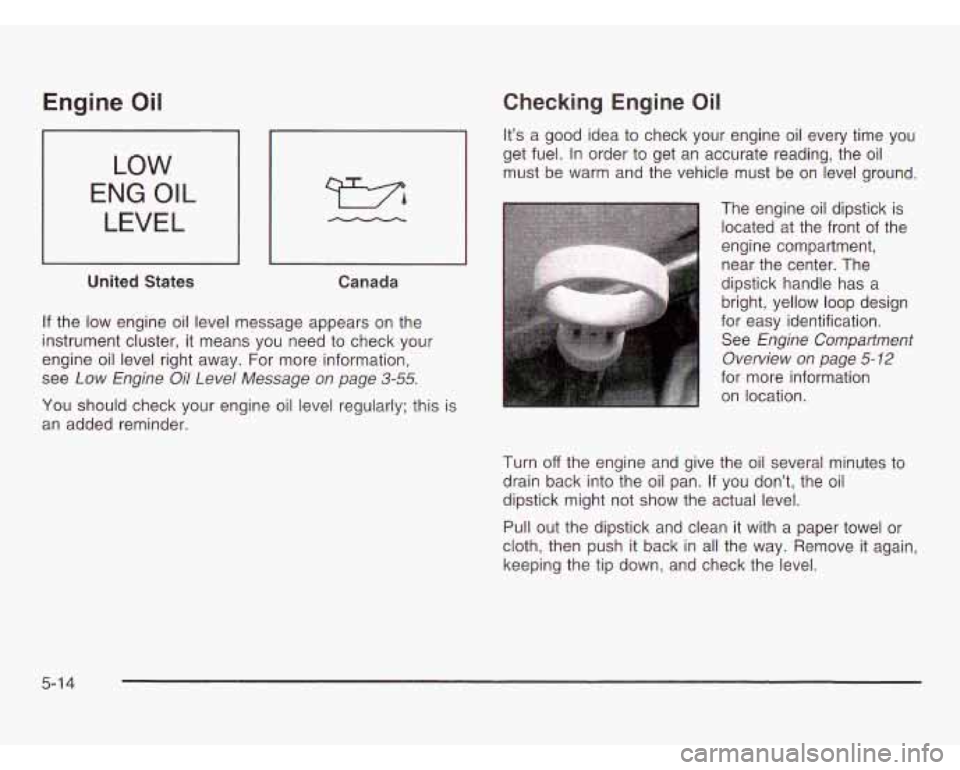
LOW
ENG OIL
LEVEL
United States
Canada
If the low engine oil level message appears on the
instrument cluster, it means you need to check your
engine oil level right away. For more information,
see
Low Engine Oil Level Message on page 3-55.
You should check your engine oil level regularly; this is
an added reminder.
Checking Engine Oil
It’s a good idea to check your engine oil every time you
get fuel. In order to get an accurate reading, the oil
must be warm and the vehicle must be on level ground.
The engine oil dipstick is
located at the front of the
engine compartment,
near the center. The
dipstick handle has a
bright, yellow loop design
for easy identification. See
Engine Compartment
Overview on page
5- 12
for more information on location.
Turn
off the engine and give the oil several minutes to
drain back into the oil pan. If you don’t, the oil
dipstick might not
show the actual level.
Pull out the dipstick and clean it with a paper towel or
cloth, then push
it back in all the way. Remove it again,
keeping the tip down, and check the level.
5-1 4
Page 324 of 466
As in the chart shown previously, SAE 5W-30 is the
only viscosity grade recommended for your vehicle.
You should look for and use only oils which have the
API Starburst symbol and which are also identified
as SAE 5W-30. If you cannot find such SAE 5W-30 oils,
you can use an SAE
1OW-30 oil which has the
API Starburst symbol,
if it's going to be 0°F (-18°C)
or above. Do not use other viscosity grade oils, such as
SAE 1OW-40 or SAE 20W-50 under any conditions.
Notice: Use only engine oil with the American
Petroleum Institute Certified For Gasoline Engines
starburst symbol. Failure to use the recommended
oil can result in engine damage not covered by
your warranty.
GM Goodwrench@ oil meets all the requirements for
your vehicle.
If you are in an area of extreme cold, where the
temperature falls below -20°F (-29"C), it is
recommended that you use either an SAE 5W-30
synthetic oil or an SAE OW-30 oil. Both will provide
easier cold starting and better protection for your engine
at extremely low temperatures.
Engine Oil Additives
Don't add anything to your oil. The recommended oils
with the starburst symbol are all you will need for
good pe;formance and engifie prs:ection.
When to Change Engine Oil
(GM Oil Life System)
Your vehicle has a computer system that lets you know
when to change the engine oil and filter. This is based
on engine revolutions and engine temperature, and
not on mileage. Based on driving conditions, the mileage
at which an oil change will be indicated can vary
considerably. For the oil life system to work properly,
you must reset the system every time the oil
is changed.
When the system has calculated that oil life has
been diminished,
it will indicate that an oil change is
necessary. A change engine oil message will come on.
Change your oil as soon as possible within the next
two times you stop for fuel. It is possible that,
if you are
driving under the best conditions, the oil life system
may not indicate that an oil change is necessary for
over a year. However, your engine oil and filter must
be changed at least once a year and at this time
the system must be reset. It is also important to check
. .- . ..- -:I .I - ..I. . - - -1 I-- - - :r -I rl- - .- .- - ._ I -. ,-I yuul UII I cyular IY a1 IU ncep 11 a1 11 le IJI upcl eve^.
If the system is ever reset accidentally, you must change
your oil at 3,000 miles
(5 000 km) since your last oil
change. Remember to reset the oil life system
whenever the oil is changed.
5-1 7
Page 368 of 466
Inflation - Tire Pressure
The Certificationflire label, which is on the rear edge ot
the driver’s door, shows the correct inflation pressures
for your tires when they’re cold. “Cold” means your
vehicle has been sitting for at least three hours or driven
no more than
1 mile (1.6 km).
Notice: Don’t let anyone tell you that underinflation
or overinflation is all right. It’s not. If your tires
don’t have enough air (underinflation), you can get
the following:
Too much flexing
Too much heat
Tire overloading
Bad wear
Bad handling
Bad fuel economy If your tires have too much air (overinflation),
you can get the following:
Unusual wear
e Bad handling
Rough ride
Needless damage from road hazards
When to Check
Check your tires once a month or more.
Don’t forget your compact spare tire.
It should be at
60 psi (420 kPa).
How to Check
Use a good quality pocket-type gage to check tire
pressure.
You can’t tell if your tires are properly inflated
simply by looking at them. Radial tires may look
properly inflated even when they’re underinflated.
Be sure to put the valve caps back on the valve stems.
moisture.
TL-. L-1.- .-Y^..^Y L l--l,- L.. I<--.-:.-- ^..I A:.A ...-A I I ICY I ICI~ PI GVCI 11 IcaRa uy nt;cpI ~y uut UII c ar IU
5-6 1
Page 400 of 466
Underbody Maintenance
Chemicals used for ice and snow removal and dust
control can collect on the underbody. If these are not
removed, accelerated corrosion (rust) can occur on
the underbody parts such as fuel lines, frame, floor pan
and exhaust system even though they have corrosion
protection.
At least every spring, flush these materials from the
underbody with plain water. Clean any areas where mud
and debris can collect. Dirt packed in close areas of
the frame should be loosened before being flushed.
Your dealer or an underbody car washing system can
do this for you.
Chemical Paint Spotting
Some weather and atmospheric conditions can create a
chemical fallout. Airborne pollutants can fall upon and
attack painted surfaces on your vehicle. This damage can
take two forms; blotchy, ringlet-shaped discolorations,
surface.
Although no defect in the paint job causes this, GM will
repair, at no charge to the owner, the surfaces of
new vehicles damaged by this fallout condition within
12 months or 12,000 miles (20 000 km] of purchase,
whichever occurs first.
UI IU .m I IUII II s uyu~ua ucll r D~WL~ GLU IGU II ILW LI IC pall IL qncl orn-11 ivrnmm3I-v rlnrl, ,-nn+r. n+-h-A :-+- ih- --:-+
GM Vehicle Care/Appearance
Materials
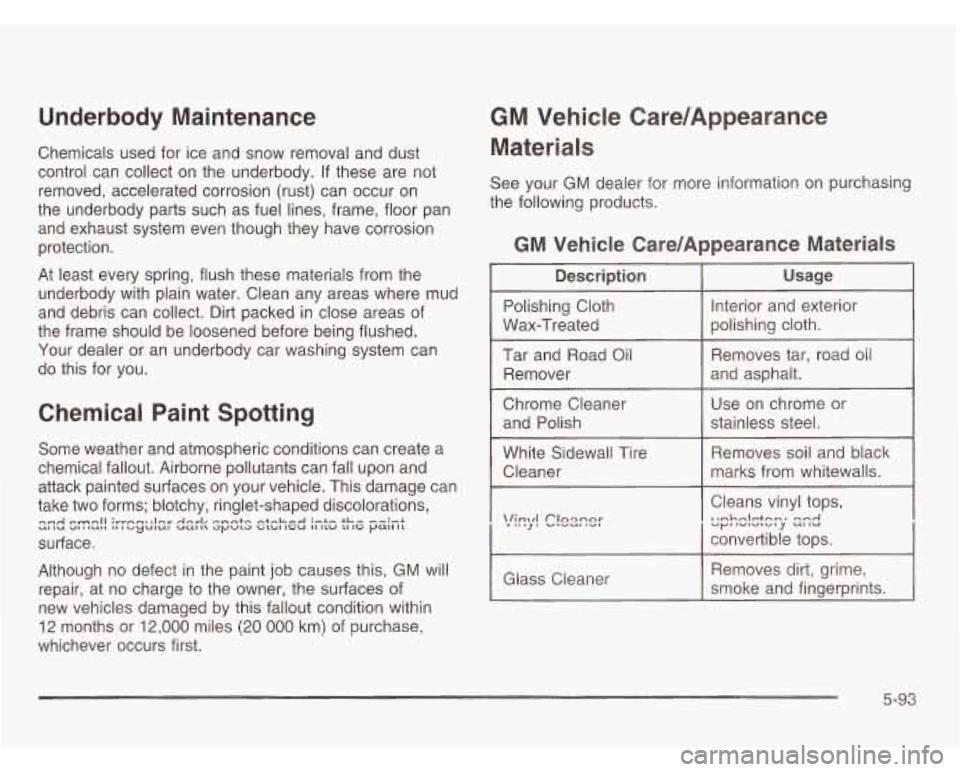
See your GM dealer for more information on purchasing
the following products.
GM Vehicle Care/Appearance Materials
hite Sidewall Tire
I Cleans vinyl tops,
Glass Cleaner Removes dirt,
grime,
smoke and finaertxints.
5-93
Page 408 of 466
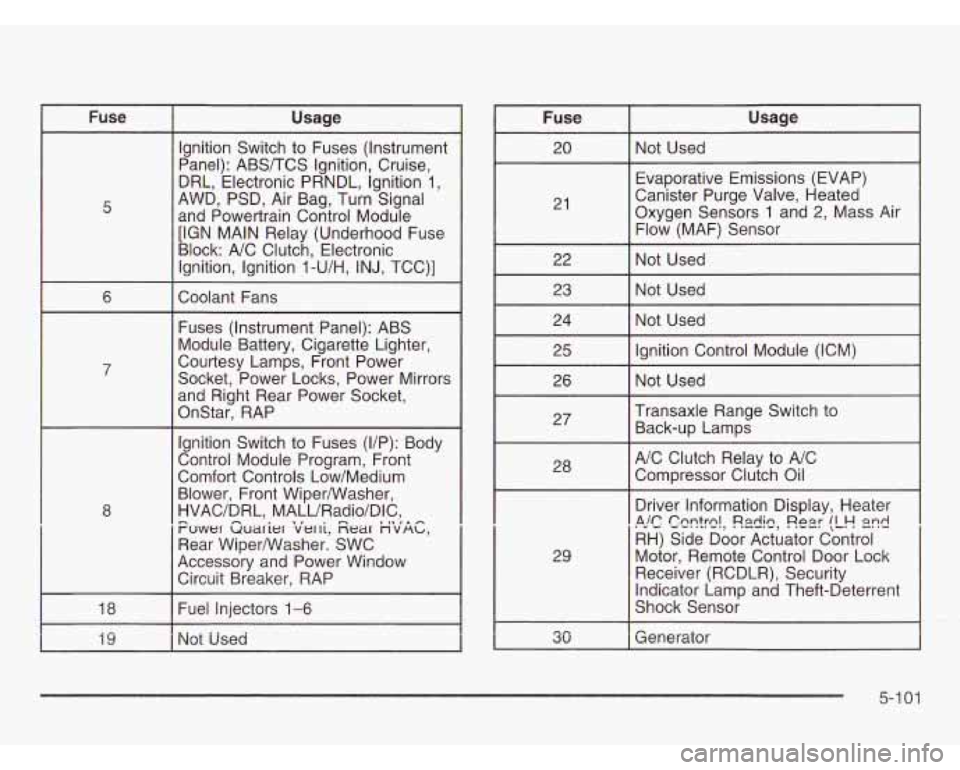
Fuse Usage
5 Ignition
Switch to Fuses (Instrument
Panel): ABS/TCS Ignition, Cruise,
DRL, Electronic PRNDL, Ignition 1,
AWD, PSD, Air Bag, Turn Signal
and Powertrain Control Module
[IGN MAIN Relay (Underhood Fuse
Block: A/C Clutch, Electronic
Ignition, Ignition
l-U/H, INJ, TCC)]
I 6 I Coolant Fans I
Fuses (Instrument Panel): ABS
Module Battery, Cigarette Lighter,
Courtesy Lamps, Front Power
Socket, Power Locks, Power Mirrors
and Right Rear Power Socket,
OnStar, RAP
Ignition Switch to Fuses (VP): Body
Control Module Program, Front
Comfort Controls Low/Medium
Blower, Front WiperANasher,
HVAC/DRL, MALURadio/DIC,
Puwer Guarier iierri, Zear nvnb,
Rear Wiper/Washer. SWC
Accessory and Power Window Circuit Breaker, RAP
I I. ,n -
I 18 I Fuel Injectors 1-6 I
Fuse Usage
21 Evaporative Emissions (EVAP)
Canister Purge Valve, Heated
Oxygen Sensors 1 and 2, Mass Air
Flow (MAF) Sensor
I 22 I Not Used I
23 I Not Used
I 24 I Not Used I
I 25 I Ignition Control Module (ICM) I
I
26 I Not Used I
I 27 I
Transaxle Range Switch to
Back-up Lamps
I 28 I
A/C Clutch Relay to A/C
Compressor Clutch Oil
29
I I’ *ulc CQr?!!3!, !?.ldiQ, Re2r !L!-! 2nd , I
Driver Information Display, Heater
RH) Side Door Actuator Control
Motor, Remote Control Door Lock
Receiver (RCDLR), Security
Indicator Lamp and Theft-Deterrent
Shock Sensor
5-1
01
Page 409 of 466

I Fuse I Usage I
31 Automatic Transaxle (Torque
Converter Clutch Solenoids)
Stoplamp Switch to Powertrain
Control Module
I 32 I Fuel Pump Relay I
Powertrain Control Module
Not Used
Fog Lamp Relay
I 36 I Horn Relay I
37 Daytime Running Lamps (DRL)
Control Module, Headlamps and
Instrument Panel Dimmer Switch
Theft-Deterrent Relay to Headlamps
Not Used
40 Mini Fuse Puller
I [TI I Air Conditioning Clutch Diode
I 9 I Right Fan 1, Left Fan 2 I
10
11
Left Fan 2
Fuses: A/C Clutch, Ignition l-U/H,
Electronic Ignition, TCC, Injectors
I 12 I Right Fan 1, Left Fan 2 I
I 13 I A/C Clutch I
Fuel Pump
Not Used
Horn
17 Left Fog Lamp, Right Fog Lamp,
Fog Lamp Indicator
5-1
02
Page 414 of 466
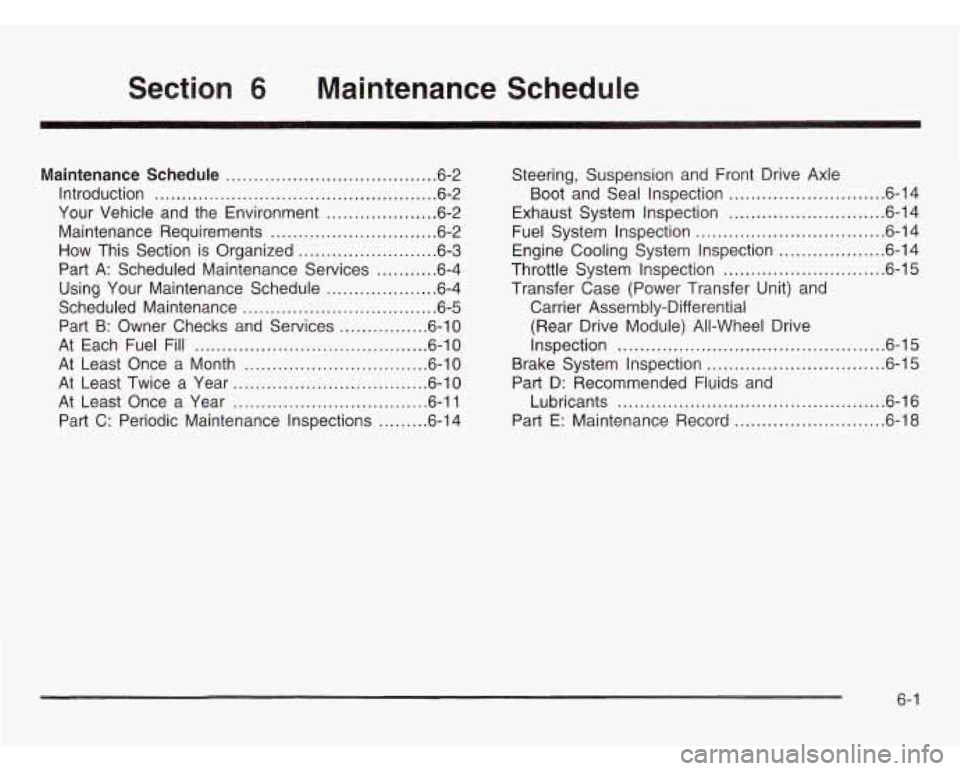
Section 6 Maintenance Schedule
Maintenance Schedule ...................................... 6.2
Introduction
................................................... 6.2
Your Vehicle and the Environment
.................... 6-2
Maintenance Requirements
.............................. 6.2
How This Section is Organized
......................... 6.3
Part
A: Scheduled Maintenance Services ........... 6.4
Scheduled Maintenance
................................... 6-5
Part
B: Owner Checks and Services ................ 6-10
At Each Fuel Fill .......................................... 6-10
At Least Once a Month ................................. 6-10
At Least Twice a Year ................................... 6-10
At Least Once a Year ................................... 6-11
Using Your Maintenance
Schedule
.................... 6.4
Part C: Periodic Maintenance Inspections
......... 6-14 Steering.
Suspension and Front Drive Axle
Boot and Seal Inspection
............................ 6.14
Exhaust System Inspection
............................ 6.14
Fuel System Inspection
.................................. 6.14
Engine Cooling System Inspection
................... 6.14
Throttle System Inspection
............................. 6.15
Transfer Case (Power Transfer Unit) and
Carrier Assembly-Differential
(Rear Drive Module) All-Wheel Drive
Inspection
................................................ 6.15
Brake System Inspection
................................ 6.15
Part D: Recommended Fluids and
Lubricants
................................................ 6.16
Part
E: Maintenance Record ........................... 6.18
6-
1
Page 417 of 466

Part A: Scheduled Maintenance
Services
This part contains engine oil and chassis lubrication
scheduled maintenance which explains the engine oil
life system and how
it indicates when to change
the engine oil and filter. Lubricate chassis components
with each
oil change. Also, listed are scheduled
maintenance services which are to be performed at the
mileage intervals specified.
Using Your Maintenance Schedule
We at General Motors want to help you to keep your
vehicle in good working condition. But we don’t know
exactly how you’ll drive it. You may drive short distances
only a few times a week. Or you may drive long distances
all the time in very hot, dusty weather. You may use your
vehicle in making deliveries. Or you may drive it to work,
to do errands or in many other ways.
Because of all the different ways people use their
vehicles, maintenance needs vary. You may need more
frequent checks and replacements.
So please read
the following and note how you drive. If you have any
questions on how to keep your vehicle in good condition,
see your dealer. This part tells
you the maintenance services you
should have done and when you should schedule them.
When you go to your dealer for your service needs,
you’ll know that GM-trained and supported service
people will perform the work using GM parts.
The proper fluids and lubricants to use are listed in
Part
D. Make sure whoever services your vehicle uses
them.
All parts should be replaced and all necessary
repairs done before you or anyone else drives the
vehicle.
This schedule is for vehicles that:
carry passengers and cargo within recommended
limits. You will find these limits on your vehicle’s
Certificationflire label. See
Loading Your Vehicle
on page 4-34.
driving limits.
are driven on reasonable road surfaces within
use the recommended fuel. See Gasoline Octane
on page
5-5.
6-4
Page 418 of 466
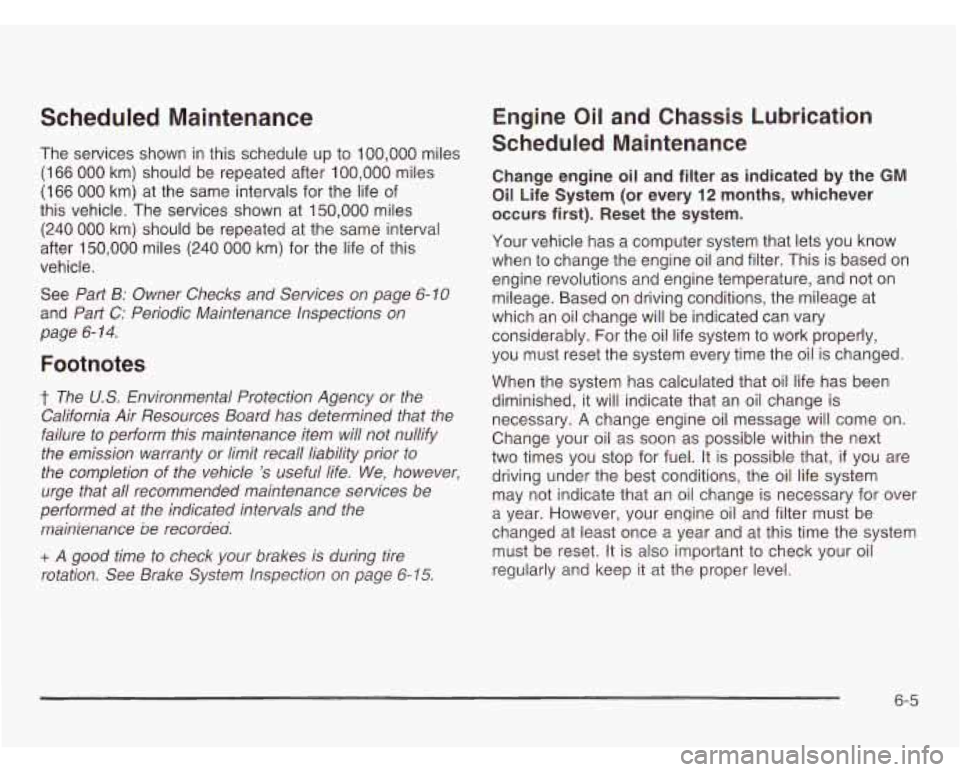
Scheduled Maintenance
The services shown in this schedule up to 100,000 miles
(1 66 000 km) should be repeated after 100,000 miles
(1 66 000 km) at the same intervals for the life of
this vehicle. The services shown at
150,000 miles
(240 000 km) should be repeated at the same interval
after
150,000 miles (240 000 km) for the life of this
vehicle.
See
Part 5: Owner Checks and Services on page 6-10
and Part C: Periodic Maintenance Inspections on
page
6- 14.
Footnotes
t The U.S. Environmental Protection Agency or the
California Air Resources Board has determined that the
failure to perform this maintenance item will not nullify
the emission warranty or limit recall liability prior to
the completion of the vehicle
's useful life. We, however,
urge that all recommended maintenance services be
performed at the indicated intervals and the
mainienance
be recoraea.
+ A good time to check your brakes is during tire
rotation. See Brake System Inspection
on page 6-15.
Engine Oil and Chassis Lubrication
Scheduled Maintenance
Change engine oil and filter as indicated by the GM
Oil Life System (or every 12 months, whichever
occurs first). Reset the system.
Your vehicle has a computer system that lets you know
when to change the engine oil and filter. This is based on
engine revolutions and engine temperature, and not on
mileage. Based on driving conditions, the mileage at
which an oil change will be indicated can vary
considerably. For the oil life system to work properly,
you must reset the system every time the
oil is changed.
When the system has calculated that oil life has been
diminished, it will indicate that an oil change is
necessary.
A change engine oil message will come on.
Change your oil as soon
as possible within the next
two times you stop for fuel. It
is possible that, if you are
driving under the best conditions, the oil life system may not indicate that an oil change is necessary for over
a year. However, your engine oil and filter must be
changed at least once a year and at this time the system
must be reset. It is also important to check your oil
regularly and keep it at the proper level.
6-5
Page 423 of 466
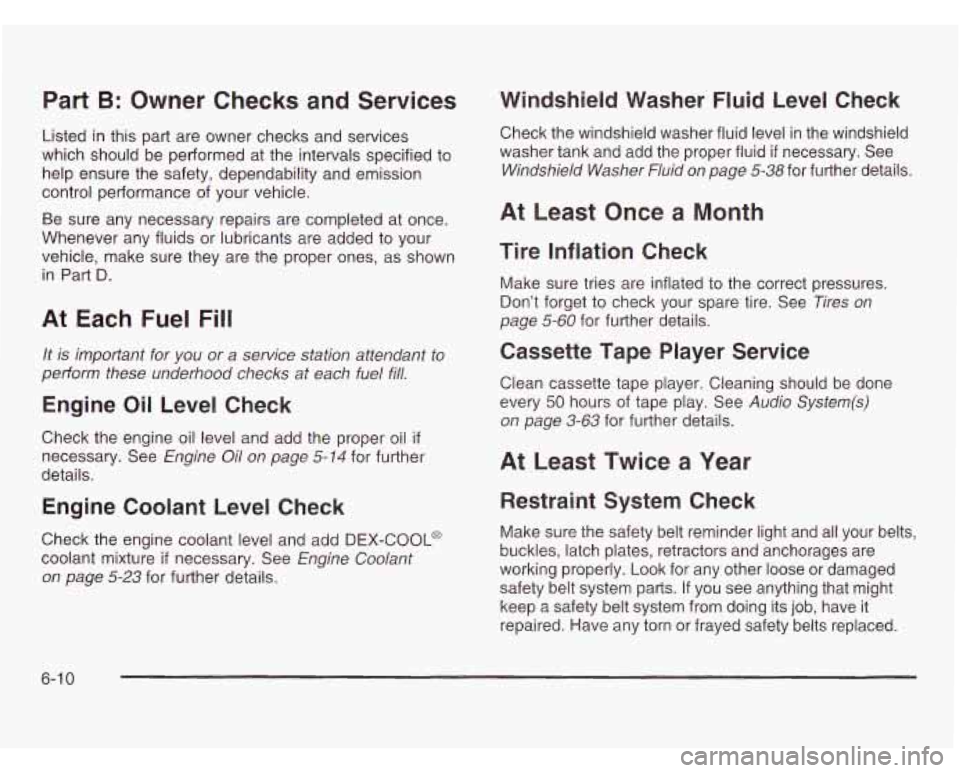
Part B: Owner Checks and Services
Listed in this part are owner checks and services
which should be performed at the intervals specified to
help ensure the safety, dependability and emission
control performance of your vehicle.
Be sure any necessary repairs are completed at once.
Whenever any fluids or lubricants are added to your
vehicle, make sure they are the proper ones, as shown
in Part D.
At Each Fuel Fill
It is important for you or a service station attendant to
perform these underhood checks at each fuel fill.
Engine Oil Level Check
Check the engine oil level and add the proper oil if
necessary. See Engine Oil on page 5-14 for further
details.
Engine Coolant Level Check
Check the engine coolant level and add DEX-COOL@
coolant mixture
if necessary. See Engine Coolant
on page 5-23
for further details.
Windshield Washer Fluid Level Check
Check the windshield washer fluid level in the windshield
washer tank and add the proper fluid
if necessary. See
Windshield Washer Fluid on page 5-38 for further details.
At Least Once a Month
Tire Inflation Check
Make sure tries are inflated to the correct pressures.
Don’t forget to check your spare tire. See
Tires on
page 5-60
for further details.
Cassette Tape Player Service
Clean cassette tape player. Cleaning should be done
every
50 hours of tape play. See Audio Systern(s)
on page 3-63 for further details.
At Least Twice a Year
Restraint System Check
:s , Make sure the safety belt reminder light and all your bell
buckles, latch plates, retractors and anchorages are
working properly. Look for any other loose or damaged
safety belt system parts.
If you see anything that might
keep a safety belt system from doing its
job, have it
repaired. Have any torn or frayed safety belts replaced.
6-1 0