light OLDSMOBILE SILHOUETTE 2003 Manual Online
[x] Cancel search | Manufacturer: OLDSMOBILE, Model Year: 2003, Model line: SILHOUETTE, Model: OLDSMOBILE SILHOUETTE 2003Pages: 466, PDF Size: 21.55 MB
Page 348 of 466
h the wrong kind of fluid in ur brake
system, your brakes may not work well, or they
may not even work at all. This could cause a
crash. Always use the proper brake fluid.
Notice:
Using the wrong fluid can badly damage brake
system parts. For example, just a few drops of
mineral-based oil, such as engine oil,
in your
brake system can damage brake system
parts
so badly that they’ll have to be replaced.
Don’t let someone
put in the wrong kind of fluid.
0 If you spill brake fluid on your vehicle’s painted
surfaces, the paint finish can be damaged.
Be careful not to spill brake fluid on your
vehicle. If you do, wash
it off immediately.
See “Appearance Care” in the Index.
Brake Wear
Your vehicle has front disc brakes and rear drum brakes.
Disc brake pads have built-in wear indicators that make
a high-pitched warning sound when the brake pads are
worn and new pads are needed. The sound may come
and
go or be heard all the time your vehicle is moving
(except when you are pushing on the brake pedal firmly).
The brake wear warning sound means that soon
your brakes won’t work well. That could lead
to
an accident. When you hear the brake wear
warning sound, have your vehicle serviced.
Notice: Continuing to drive with worn-out brake
pads could result
in costly brake repair.
Some driving conditions or climates may cause a brake
squeal when the brakes are first applied or lightly
applied. This does not mean something is wrong with
your brakes.
5-41
Page 352 of 466
Notice: If you leave your radio on, it could be badly
damaged. The repairs wouldn’t be covered by
your warranty.
3.
4.
Turn off the ignition on both vehicles. Unplug
unnecessary accessories plugged into the cigarette
lighter or in the accessory power outlet. Turn
off
the radio and all lamps that aren’t needed. This will
avoid sparks and help save both batteries. And it
could save your radio!
Open the hoods and locate the batteries. Find the
positive
(+) and negative (-) terminal locations on
each vehicle.
You will not need to access your battery for jump
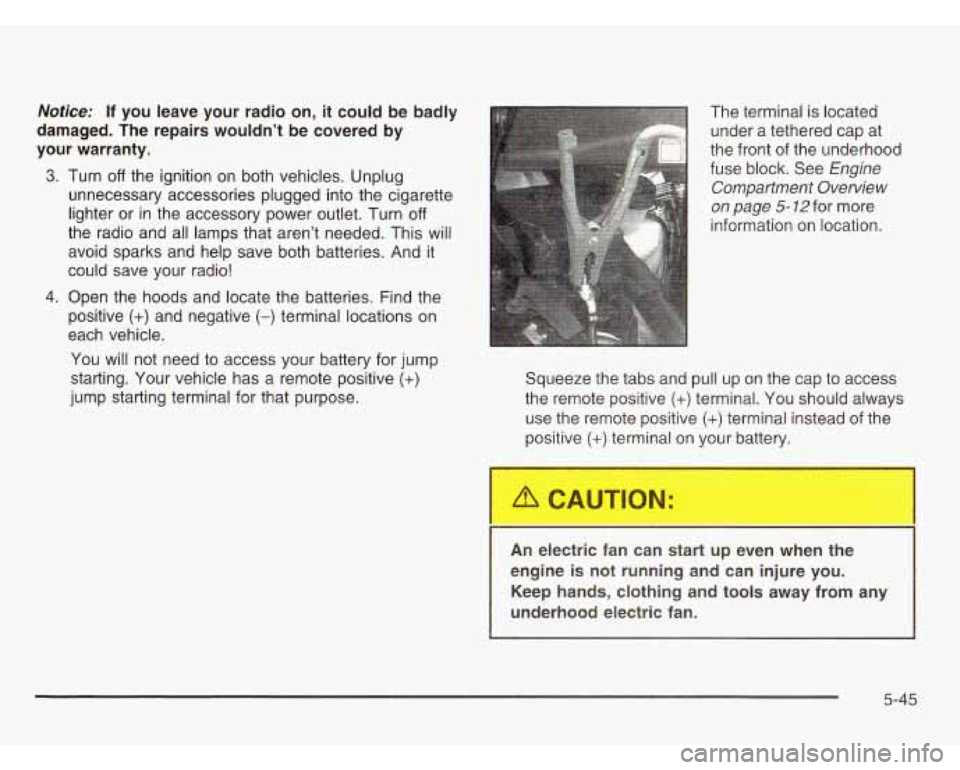
starting. Your vehicle has a remote positive
(+)
jump starting terminal for that purpose. The terminal is located
under a tethered cap at
the front of the underhood
fuse block. See
Engine
Compartment Overview
on page
5- 12 for more
information on location.
Squeeze the tabs and pull up
on the cap to access
the remote positive
(+) terminal. You should always
use the remote positive
(+) terminal instead of the
positive (+) terminal on your battery.
An electric fan can start up ever !hen the
engine is not running and can injure you.
Keep hands, clothing and tools away from any
underhood electric fan.
5-45
Page 353 of 466
--
1
Using a match near a battery can cause battery
gas to explode. People have been hurt doing
this, and some have been blinded. Use a
flashlight if you need more light.
Be sure the battery has enough water. You
don’t need to add water to the ACDelco@ battery
installed
in your new vehicle. But if a battery
has filler caps, be sure the right amount
of fluid
is there. If it is low, add water to take care of
that first. If you don’t, explosive gas could be
present.
Battery fluid contains acid that can burn you.
Don’t get
it on you. If you accidentally get it in
your eyes or on your skin,
flush the place with
water and get medical help immediately. Fans or other moving engine parts can injure
you badly. Keep your hands away from moving
parts once the engine is running.
5. Check that the jumper cables don’t have loose or
missing insulation.
If they do, you could get a
shock. The vehicles could be damaged, too.
Before you connect the cables, here are some
basic things you should know. Positive
(+) will go to
positive
(+) or to a remote positive (+) terminal if
the vehicle has one. Negative (-) will go to a
heavy, unpainted metal engine part or to a remote
negative
(-) terminal if the vehicle has one.
Don’t connect positive
(+) to negative (-) or you
will get a short that would damage the battery and
maybe other parts, too. And don’t connect the
negative
(-) cable to the negative (-) terminal on
the dead battery because this can cause sparks.
5-46
Page 372 of 466
Uniform Tire Quality Grading
Quality grades can be found where applicable on the
tire sidewall between tread shoulder and maximum
section width. For example:
Treadwear 200 Traction AA Temperature A
The following information relates to the system
developed by the United States National Highway
Traffic Safety Administration, which grades tires by
treadwear, traction and temperature performance.
(This applies only to vehicles sold in the United States.)
The grades are molded on the sidewalls of most
passenger car tires. The Uniform Tire Quality Grading
system does not apply to deep tread, winter-type
snow tires, space-saver or temporary use spare tires,
tires with nominal rim diameters of 10 to
12 inches
(25 to 30 cm), or to some limited-production tires.
While the tires available on General Motors passenger
cars and light trucks may vary with respect to these
grades, they must also conform to federal safety
Performance Criteria (TPC) standards.
-.-A -A-l:*:---l fi,,,,,I ill^+-”, T:”- It=~Ullt=lllelltb allu ~UUI~IUIIQI UCIICI~~ lvlulula I IIG
Treadwear
The treadwear grade is a comparative rating based on
the wear rate of the tire when tested under controlled
conditions on a specified government test course.
For example, a tire graded 150 would wear one and
a half (1
5) times as well on the government course as
a tire graded 100. The relative performance of tires
depends upon the actual conditions of their use,
however, and may depart significantly from the norm
due to variations in driving habits, service practices and differences in road characteristics and climate.
Traction - AA, A, 9, C
The traction grades, from highest to lowest, are AA, A,
B, and C. Those grades represent the tire’s ability
to stop on wet pavement as measured under controlled
conditions on specified government test surfaces of
asphalt and concrete. A tire marked C may have poor
traction performance. Warning: The traction grade
assigned to this tire is based on straight-ahead braking
traction tests, and does not include acceleration,
wrrlerir~ly, ilydlupih1Gl^ly, wr pea“ tIdwuI I cII la1 c~wz;I 1aL1t-a. ._ - - 1. A..- -A: - .- -L. -+--:-+:--
5-65
Page 375 of 466
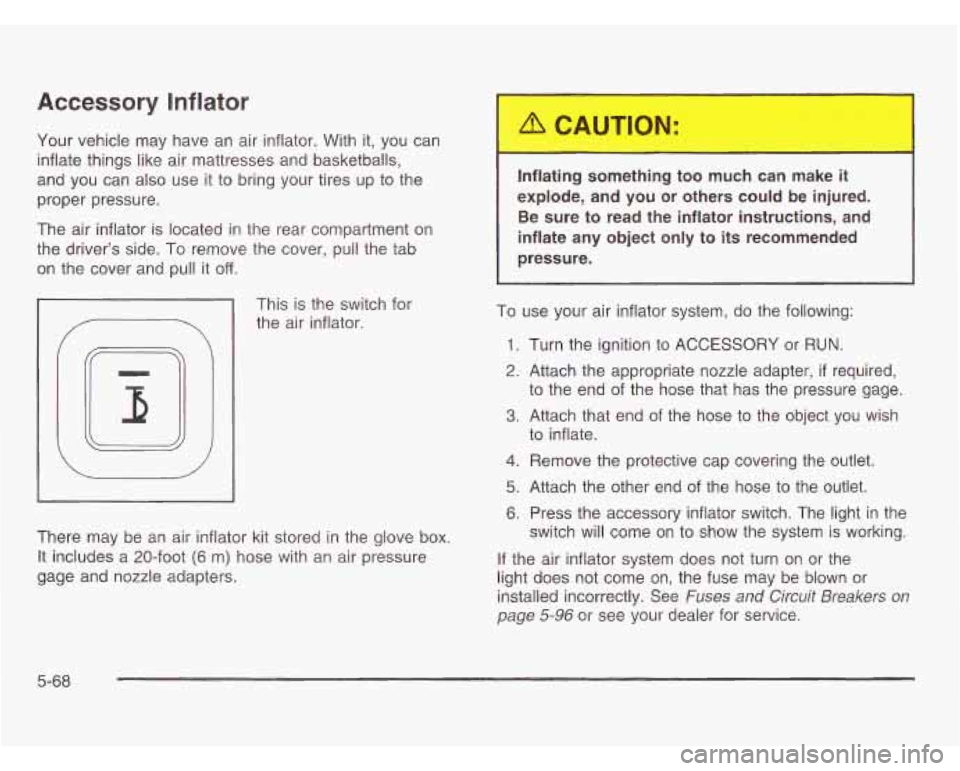
Accessory Inflator
Your vehicle may have an air inflator. With it, you can
inflate things like air mattresses and basketballs,
and you can also use it to bring your tires up to the
proper pressure.
The air inflator is located in the rear compartment on
the driver’s side. To remove the cover, pull the tab
on the cover and pull it
off.
This is the switch for
the air inflator.
There may be an air inflator kit stored in the glove box.
It includes a 20-foot
(6 m) hose with an air pressure
gage and nozzle adapters.
....___ ting something too much can make it
explode, and you or others could be injured.
Be sure to read the inflator instructions, and
inflate any object only
to its recommended
pressure.
To use your air inflator system, do the following:
1. Turn the ignition to ACCESSORY or RUN.
2. Attach the appropriate nozzle adapter, if required,
to the end
of the hose that has the pressure gage.
3. Attach that end of the hose to the object you wish
to inflate.
4. Remove the protective cap covering the outlet.
5. Attach the other end of the hose to the outlet.
6. Press the accessory inflator switch. The light in the
switch will come on to show the system is working.
If the air inflator system does not turn on or the
light does not come on, the fuse may be blown or
installed incorrectly. See
Fuses and Circuit Breakers on
page 5-96 or see your dealer for service.
5-68
Page 376 of 466
Your air inflator will automatically shut off after about
10 minutes. The light in the switch will blink. After about
one minute you can use the system again. Press the
inflator switch and the indicator light will come on.
Notice: Don’t run your air inflator for longer than
30 minutes at one time. If you do, you may damage
the system.
After running the air inflator for
30 minutes, wait at least
10 minutes before restarting the air inflator.
To turn off the inflator, do the following:
1. Press the switch and detach the hose, first from the
2. Put the protective cap back on.
3. Place the inflator kit tools in the pouch, and store in
inflated
object, then from the outlet.
the glove box.
To put the cover back on, line up the tabs at the back
of the cover and put it in place. Push down the tab
to secure the cover.
If a Tire Goes Flat
It’s unusual for a tire to “blow out” while you’re driving,
especially
if you maintain your tires properly. If air
goes out of a tire, it’s much more likely to leak out
slowly. But if you should ever have a “blowout”, here are
a few tips about what to expect and what to do:
If a front tire fails, the flat tire will create a drag that
pulls the vehicle toward that side. Take your foot
off the
accelerator pedal and grip the steering wheel firmly.
Steer to maintain lane position, and then gently brake
to a stop well out of the traffic lane.
A rear blowout, particularly on a curve, acts much like
a skid and may require the same correction you’d use
in a skid. In any rear blowout, remove your foot from
the accelerator pedal. Get the vehicle under control by
steering the way you want the vehicle to go. It may
be very bumpy and noisy, but you can still steer.
Gently brake to a stop
- well off the road if possible.
If a tire goes flat, the next part shows how to use
your jacking equipment to change a flat tire safely.
5-69
Page 393 of 466
Compact Spare Tire
Although the compact spare tire was fully inflated
when your vehicle was new,
it can lose air after a time.
Check the inflation pressure regularly. It should be
60 psi (420 kPa).
After installing the compact spare on your vehicle,
you should stop as soon as possible and make sure
your spare tire is correctly inflated. The compact spare
is made to perform well at speeds up to 65 mph
(105 km/h) for distances up to 3,000 miles (5 000 km),
so you can finish your trip and have your full-size
tire repaired or replaced where you want. Of course,
it’s best to replace your spare with a full-size tire as soon
as you can. Your spare will last longer and be in good
shape in case you need it again.
Notice: When the compact spare is installed, don’t
take your vehicle through an automatic car wash
with guide rails. The compact spare can get caught
on the rails. That can damage the tire and wheel,
and maybe other parts of your vehicle.
Don’t use your compact spare on other vehicles. And
don’t mix your compact spare tire or wheel with
other wheels or tires. They won’t
fit. Keep your spare tire
and its wheel together.
Notice: Tire chains won’t fit your compact spare.
Using them can damage your vehicle and can
damage the chains too. Don’t use tire chains on
your compact spare.
All-Wheel Drive
After installing a compact spare tire on a vehicle with
all-wheel drive you will need to drive with light to
moderate acceleration, for
10 seconds, in a straight line.
This action will allow the vehicle to detect the compact
spare tire and disable the all-wheel drive system.
The AWD DISABLE message will come on indicating
that the all-wheel drive system is
off. You may detect
a slight pull during this time, but this is normal.
Notice: You may damage your vehicle’s all-wheel
drive system if your vehicle
is driven for an extended
period with a compact spare tire installed and
the all-wheel drive system in operation. See “All-Wheel Drive System’’ and “AWD Disable
Warning Message’’
in the Index for more information.
5-86
Page 401 of 466
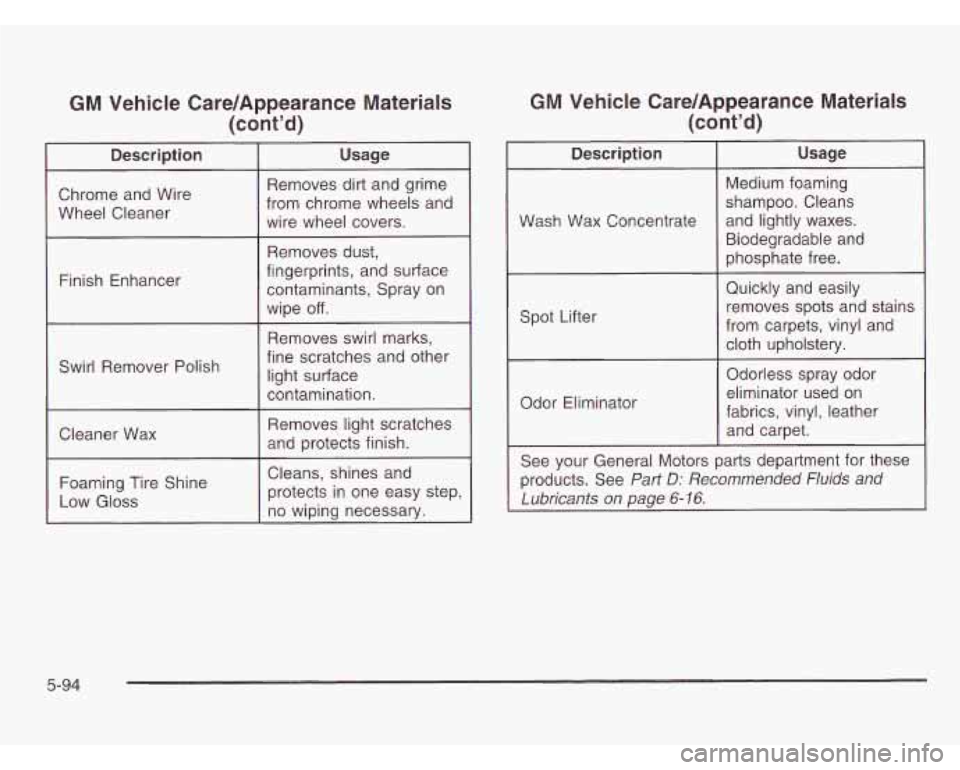
GM Vehicle Care/Appearance Materials
(cont’d) GM Vehicle Care/A
(C(
Description I Usage
Chrome and Wire
Wheel Cleaner Removes
dirt and grime
from chrome wheels and
wire wheel covers.
I
I Removes dust,
Finish Enhancer fingerprints, and surface
contaminants, Spray on
wipe
off.
Removes swirl marks,
Swirl Remover Polish fine scratches
and other
light surface
contamination.
Cleaner Wax Removes
light scratches
and protects finish.
Foaming Tire Shine
Low
Gloss
Cleans, shines and
protects in one easy step,
no wiping necessary. Description
Wash Wax Concentrate
Spot Lifter
Odor Eliminator
ppearance Materials
lnt’d)
Usage
Medium foaming
shampoo. Cleans and lightly waxes.
Biodegradable and
phosphate free.
Quickly and easily
removes spots and stains
from carpets, vinyl and
cloth upholstery.
Odorless spray odor
eliminator used on
fabrics, vinyl, leather
and carpet.
See your General Motors parts department for these
products. See
Part D: Recommended Fluids and
Lubricants on Daae
6-16.
5-94
Page 403 of 466
Electrical System
Add-on Electrical Equipment
Notice: Don’t add anything electrical to your
vehicle unless you check with your dealer first.
Some electrical equipment can damage your vehicle
and the damage wouldn’t be covered by your
warranty. Some add-on electrical equipment can
keep other components from working as they should.
Your vehicle has an air bag system. Before attempting to
add anything electrical to your vehicle, see
Servicing
Your Air Bag-Equipped Vehicle
on page 1-76.
Headlamp Wiring
The headlamp wiring is protected by an internal circuit
breaker in the instrument panel fuse panel. An electrical
overload will cause the lamps to go on and
off, or in
some cases to remain
off. If this happens, have
your headlamp wiring checked right away.
Windshield Wiper Fuses
The windshield wiper motor is protected by an internal
circuit breaker and a fuse. If the motor overheats due to
heavy snow, etc., the wiper will stop until the motor
cools. If the overload is caused by some electrical
problem, be sure to get it fixed.
Power Windows and Other
Power Options
Circuit breakers in the instrument panel fuse panel
protect the power windows and other power accessories.
When the current load is too heavy, the circuit breaker
opens and closes, protecting the circuit until the
problem is fixed.
Fuses and Circuit Breakers
The wiring circuits in your vehicle are protected from
short circuits by a combination of fuses, circuit breakers
and fusible thermal links.
Look at the silver-colored band inside the fuse. If the
band is broken or melted, replace the fuse. Be sure you
replace a bad fuse with a new one
of the identical
size and rating.
If you ever have a problem on the road and don’t have
a spare fuse, you can borrow one that has the same
amperage or use one of the spare fuses in the
underhood fuse block. Just pick some feature of your
vehicle that you can get along without
- like the radio
or cigarette lighter
- and use its fuse, if it is the
right amperage. Replace it as soon as you can.
There are two fuse blocks in your vehicle, the instrument
panel fuse block and the underhood fuse block.
5-96
Page 404 of 466
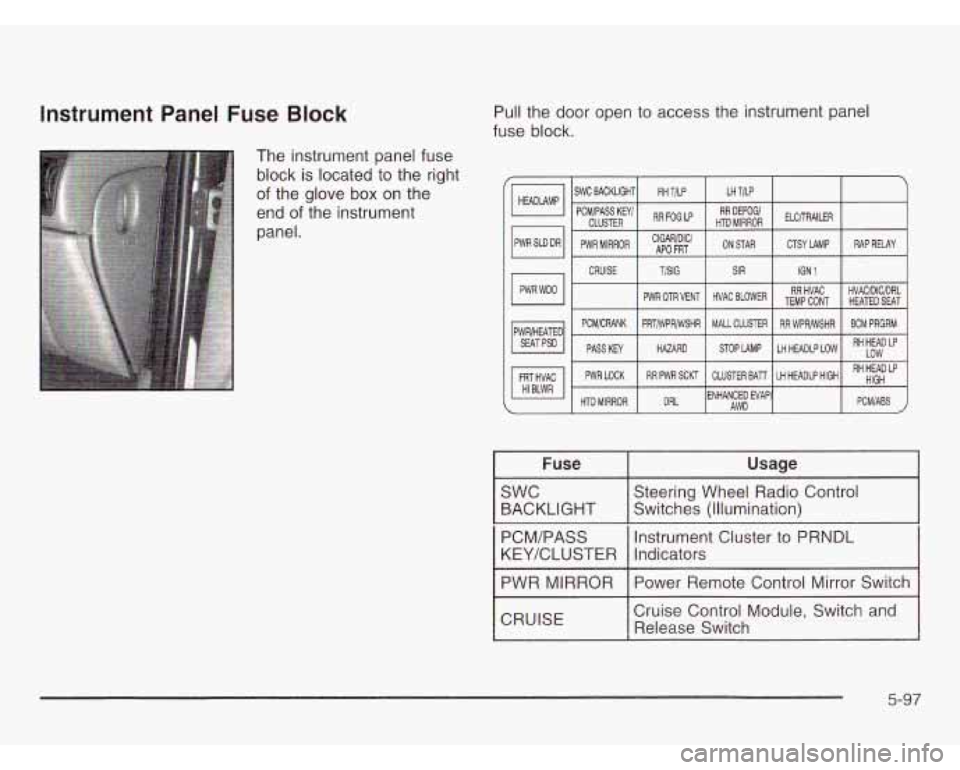
Instrument Panel Fuse Block
The instrument panel fuse
block is located to the right
of the glove box on the
end
of the instrument
panel. Pull the
door open
to access the instrument panel
fuse block.
PCWCRANK FRTMPWSHR MALL CLUSTER RR WPWSHR BCM PRGRM
Low RH HEAD LP
PASSKEY HAZARD STOPLAMP LHHEADLPLOW
I Fuse I Usage I
Steering Wheel Radio Control
I :!ZKLIGHT Switches (Illumination)
PCM/PASS Indicators
KEYKLUSTER Instrument Cluster to PRNDL
I PWR MIRROR I Power Remote
Control Mirror Switch I
I CRUISE I
Cruise Control Module, Switch and
Release Switch
5-97