coolant temperature Oldsmobile Silhouette 2004 Owner's Manuals
[x] Cancel search | Manufacturer: OLDSMOBILE, Model Year: 2004, Model line: Silhouette, Model: Oldsmobile Silhouette 2004Pages: 462, PDF Size: 3.1 MB
Page 119 of 462
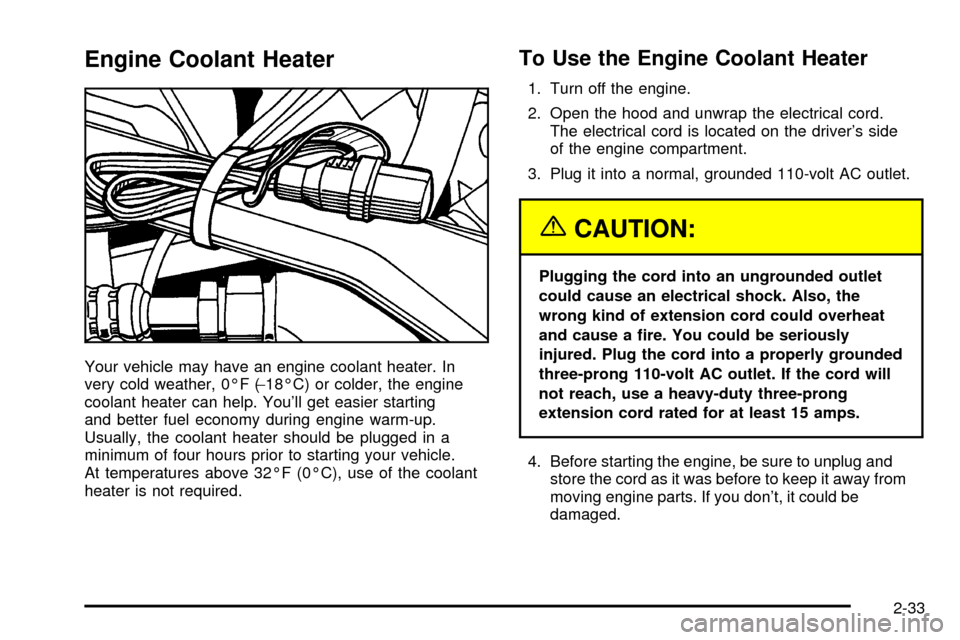
Engine Coolant Heater
Your vehicle may have an engine coolant heater. In
very cold weather, 0ÉF (-18ÉC) or colder, the engine
coolant heater can help. You'll get easier starting
and better fuel economy during engine warm-up.
Usually, the coolant heater should be plugged in a
minimum of four hours prior to starting your vehicle.
At temperatures above 32ÉF (0ÉC), use of the coolant
heater is not required.
To Use the Engine Coolant Heater
1. Turn off the engine.
2. Open the hood and unwrap the electrical cord.
The electrical cord is located on the driver's side
of the engine compartment.
3. Plug it into a normal, grounded 110-volt AC outlet.
{CAUTION:
Plugging the cord into an ungrounded outlet
could cause an electrical shock. Also, the
wrong kind of extension cord could overheat
and cause a ®re. You could be seriously
injured. Plug the cord into a properly grounded
three-prong 110-volt AC outlet. If the cord will
not reach, use a heavy-duty three-prong
extension cord rated for at least 15 amps.
4. Before starting the engine, be sure to unplug and
store the cord as it was before to keep it away from
moving engine parts. If you don't, it could be
damaged.
2-33
Page 120 of 462

How long should you keep the coolant heater plugged
in? The answer depends on the outside temperature, the
kind of oil you have, and some other things. Instead
of trying to list everything here, we ask that you contact
your dealer in the area where you'll be parking your
vehicle. The dealer can give you the best advice for that
particular area.
Automatic Transaxle Operation
Maximum engine speed is limited when you are in
PARK (P) or NEUTRAL (N), to protect driveline
components from improper operation.There are several different positions for your shift lever.
PARK (P):This gear position locks your front wheels.
It is the best position to use when you start your engine
because your vehicle cannot move easily.
Ensure the shift lever is fully in PARK (P) before starting
the engine. Your vehicle has an automatic transaxle
shift lock control system. You have to fully apply
your regular brakes before you can shift from PARK (P)
when the ignition key is in RUN. As you step on the
brake pedal while in PARK (P), you may hear a
click from the solenoid of the system. This ensures that
the system is operating properly.
If you cannot shift out of PARK (P), ease pressure on
the shift lever ± push the shift lever all the way into
PARK (P) as you maintain brake application. Then move
the shift lever into the gear you wish. See
Shifting Out
of Park (P) on page 2-41.
2-34
Page 157 of 462

Instrument Panel Overview...............................3-4
Hazard Warning Flashers................................3-6
Other Warning Devices...................................3-7
Horn.............................................................3-7
Tilt Wheel.....................................................3-7
Turn Signal/Multifunction Lever.........................3-8
Exterior Lamps.............................................3-16
Interior Lamps..............................................3-18
Switchbanks.................................................3-23
Instrument Panel Switchbank..........................3-23
Overhead Console Switchbank.......................3-24
Ultrasonic Rear Parking Assist (URPA)............3-24
Accessory Power Outlets...............................3-27
Climate Controls............................................3-28
Climate Control System.................................3-28
Dual Climate Control System..........................3-31
Outlet Adjustment.........................................3-34
Rear Climate Control System
(Without Entertainment System)...................3-34
Rear Climate Control System
(With Entertainment System).......................3-36
Passenger Compartment Air Filter...................3-39
Warning Lights, Gages and Indicators.............3-41
Instrument Panel Cluster................................3-42
Speedometer and Odometer...........................3-43Safety Belt Reminder Light.............................3-44
Air Bag Readiness Light................................3-45
Brake System Warning Light..........................3-46
Anti-Lock Brake System Warning Light.............3-47
Traction Control System (TCS)
Warning Light...........................................3-47
Engine Coolant Temperature Gage..................3-48
Malfunction Indicator Lamp.............................3-49
Fuel Gage...................................................3-52
Message Center.............................................3-53
Service Traction System
Warning Message......................................3-53
Traction Active Message................................3-54
Engine Coolant Temperature
Warning Message......................................3-54
Charging System Indicator Message................3-55
Low Oil Pressure Message............................3-55
Change Engine Oil Message..........................3-56
Power Sliding Door Warning Message.............3-57
Door Ajar Warning Message...........................3-57
Rear Hatch Ajar Warning Message..................3-58
PASS-Key
žIII Security Message....................3-58
All-Wheel Drive Disable
Warning Message......................................3-59
Low Fuel Warning Message...........................3-59
Section 3 Instrument Panel
3-1
Page 204 of 462

·If there's a brake system problem that is speci®cally
related to traction control, the traction control
system will turn off and the warning light will come
on. If your brakes begin to overheat, the traction
control system will turn off and the warning light will
come on until your brakes cool down.
·If the traction control system is affected by an
engine-related problem, the system will turn off and
the warning light will come on.
If the traction control system warning light comes on
and stays on for an extended period of time when the
system is turned on, your vehicle needs service.
Engine Coolant Temperature Gage
This gage shows the engine coolant temperature.
If the gage pointer moves into the red area, your engine
is too hot!
It means that your engine coolant has overheated.
If you have been operating your vehicle under normal
driving conditions, you should pull off the road, stop your
vehicle and turn off the engine as soon as possible.
See
Engine Overheating on page 5-25. United States
Canada
3-48
Page 210 of 462

Traction Active Message
If your vehicle has the traction control system, the
TRACTION ACTIVE message will appear when the
traction control system is limiting wheel spin. You may
feel or hear the system working, but this is normal.
Slippery road conditions may exist if this message
appears, so adjust your driving accordingly.
The message will stay on for a few seconds after
the traction control system stops limiting wheel spin.
Engine Coolant Temperature
Warning Message
This message will come on when your engine gets
too hot.
If this message comes on, it means that your engine
coolant has overheated. If you have been operating your
vehicle under normal driving conditions, you should
pull off the road, stop your vehicle and turn off the
engine as soon as possible.
See
Engine Overheating on page 5-25. United States
Canada
United StatesCanada
3-54
Page 324 of 462

How to Add Fluid Automatic Transaxle
Fluid
Refer to the Maintenance Schedule to determine what
kind of transaxle ¯uid to use. SeeRecommended Fluids
and Lubricants on page 6-12.
If the ¯uid level is low, add only enough of the proper
¯uid to bring the level into the cross-hatched area on
the dipstick.
1. Pull out the dipstick.
2. Using a long-neck funnel, add enough ¯uid at the
dipstick hole to bring it to the proper level.
It does not take much ¯uid, generally less than
one pint (0.5 L). Do not over®ll.
Notice:Use of automatic transaxle ¯uid labeled
other than DEXRONž-III may damage your vehicle,
and the damages may not be covered by your
warranty. Always use DEXRON
ž-III labeled automatic
transaxle ¯uid.
3. After adding ¯uid, recheck the ¯uid level as
described under ªHow to Check Automatic
Transaxle Fluidº.
4. When the correct ¯uid level is obtained, push the
dipstick back in all the way.
Engine Coolant
The cooling system in your vehicle is ®lled with
DEX-COOLžengine coolant. This coolant is designed
to remain in your vehicle for 5 years or 150,000 miles
(240 000 km), whichever occurs ®rst, if you add
only DEX-COOL
žextended life coolant.
The following explains your cooling system and how
to add coolant when it is low. If you have a problem
with engine overheating, see
Engine Overheating
on page 5-25.
A 50/50 mixture of clean, drinkable water and
DEX-COOL
žcoolant will:
·Give freezing protection down to-34ÉF (-37ÉC)
·Give boiling protection up to 265ÉF (129ÉC)
·Protect against rust and corrosion
·Help keep the proper engine temperature
·Let the warning messages and gages work
as they should
Notice:Using coolant other than DEX-COOLžmay
cause premature engine, heater core or radiator
corrosion. In addition, the engine coolant may
require changing sooner, at 30,000 miles (50 000 km)
or 24 months, whichever occurs ®rst. Any repairs
would not be covered by your warranty. Always use
DEX-COOL
ž(silicate-free) coolant in your vehicle.
5-22
Page 327 of 462
{CAUTION:
You can be burned if you spill coolant on hot
engine parts. Coolant contains ethylene glycol,
and it will burn if the engine parts are hot
enough. Do not spill coolant on a hot engine.
Occasionally check the coolant level in the radiator.
For information on how to add coolant to the radiator,
see
Cooling System on page 5-28.
Radiator Pressure Cap
Notice:The radiator cap on your vehicle is a
pressure-type cap and must be tightly installed to
prevent coolant loss and possible engine damage
from overheating. Be sure the arrows on the cap line
up with the over¯ow tube on the radiator ®ller neck.
The radiator pressure cap is located at the front of the
engine compartment on the passenger's side of the
vehicle. See
Engine Compartment Overview on
page 5-12for more information on location.
Engine Overheating
You will ®nd an engine coolant temperature gage on
your vehicle's instrument panel cluster. SeeEngine
Coolant Temperature Gage on page 3-48. You
also have an engine coolant temperature warning
message on your instrument panel. See
Engine Coolant
Temperature Warning Message on page 3-54.
Overheated Engine Protection
Operating Mode
This emergency operating mode allows your vehicle to
be driven to a safe place in an emergency situation.
If an overheated engine condition exists, an overheat
protection mode which alternates ®ring groups of
cylinders helps prevent engine damage. In this mode,
you will notice a signi®cant loss in power and engine
performance. The temperature gage will indicate
an overheat condition exists. Driving extended
miles (km) and/or towing a trailer in the overheat
protection mode should be avoided.
Notice:After driving in the overheated engine
protection operating mode, to avoid engine damage,
allow the engine to cool before attempting any repair.
The engine oil will be severely degraded. Repair the
cause of coolant loss, change the oil and reset the oil
life system. See
Engine Oil on page 5-13.
5-25
Page 339 of 462

Windshield Washer Fluid
What Washer Fluid to Use
When you need windshield washer ¯uid, be sure to read
the manufacturer's instructions before use. If you will be
operating your vehicle in an area where the temperature
may fall below freezing, use a ¯uid that has sufficient
protection against freezing. See
Engine Compartment
Overview on page 5-12for reservoir location.
Adding Washer Fluid
Open the cap with the
washer symbol on it.
Add washer ¯uid until
the tank is full.
Notice:
·When using concentrated washer ¯uid,
follow the manufacturer's instructions for
adding water.
·Do not mix water with ready-to-use washer ¯uid.
Water can cause the solution to freeze and
damage your washer ¯uid tank and other parts
of the washer system. Also, water does not
clean as well as washer ¯uid.
·Fill your washer ¯uid tank only three-quarters
full when it is very cold. This allows for
expansion if freezing occurs, which could
damage the tank if it is completely full.
·Do not use engine coolant (antifreeze) in your
windshield washer. It can damage your washer
system and paint.
5-37
Page 420 of 462

(c)Visually inspect hoses and have them replaced if they
are cracked, swollen or deteriorated. Inspect all pipes,
®ttings and clamps; replace with genuine GM parts as
needed. To help ensure proper operation, a pressure test
of the cooling system and pressure cap and cleaning the
outside of the radiator and air conditioning condenser is
recommended at least once a year.
(d)Visually inspect wiper blades for wear or cracking.
Replace blade inserts that appear worn or damaged
or that streak or miss areas of the windshield.
(e)Make sure the safety belt reminder light and all your
belts, buckles, latch plates, retractors and anchorages
are working properly. Look for any other loose or
damaged safety belt system parts. If you see anything
that might keep a safety belt system from doing its
job, have it repaired. Have any torn or frayed safety belts
replaced. Also look for any opened or broken air bag
coverings, and have them repaired or replaced. (The air
bag system does not need regular maintenance.)
(f)Lubricate all key lock cylinders, hood latch
assemblies, secondary latches, pivots, spring anchor
and release pawl, hood and door hinges, rear folding
seats, liftgate hinges, fuel door hinge, power sliding door
cable and sliding door track(s). More frequent lubrication
may be required when exposed to a corrosive
environment. Applying silicone grease on weatherstrips
with a clean cloth will make them last longer, seal
better and not stick or squeak.
(g)If you drive regularly under dusty conditions, the
®lter may require replacement more often.
(h)Change automatic transaxle ¯uid and ®lter if the
vehicle is mainly driven under one or more of these
conditions:
þIn heavy city traffic where the outside temperature
regularly reaches 90ÉF (32ÉC) or higher.
þIn hilly or mountainous terrain.
þWhen doing frequent trailer towing.
þUses such as found in taxi, police or delivery
service.
(i)Drain, ¯ush and re®ll cooling system. See Engine
Coolant on page 5-22for what to use. Inspect hoses.
Clean radiator, condenser, pressure cap and ®ller neck.
Pressure test the cooling system and pressure cap.
(j)
Check system for interference or binding and
for damaged or missing parts. Replace parts as needed.
Replace any components that have high effort or
excessive wear. Do not lubricate accelerator or cruise
control cables.
(k)A ¯uid loss in any vehicle system could indicate a
problem. Have the system inspected and repaired
and the ¯uid level checked. Add ¯uid if needed.
6-8
Page 448 of 462

Content Theft-Deterrent System,
Arming and Disarming..................................2-67
Control of a Vehicle.......................................... 4-5
Convenience Center........................................2-58
Convenience Net............................................2-56
Coolant
Engine Temperature Gage............................3-48
Engine Temperature Warning Message...........3-54
Heater, Engine............................................2-33
Cooling System..............................................5-28
Cruise Control................................................3-12
Cupholder(s)..................................................2-52
Current and Past Model Order Forms................7-13
Customer Assistance Information
Courtesy Transportation.................................. 7-8
Customer Assistance for Text
Telephone (TTY) Users............................... 7-4
Customer Assistance Offices........................... 7-4
Customer Satisfaction Procedure..................... 7-2
GM Mobility Program for Persons with
Disabilities................................................ 7-6
Reporting Safety Defects to
General Motors........................................7-12
Reporting Safety Defects to the
Canadian Government..............................7-12
Reporting Safety Defects to the
United States Government.........................7-11Customer Assistance Information (cont.)
Roadside Assistance Program......................... 7-6
Service Publications Ordering Information........7-12
D
Daytime Running Lamps/Automatic
Headlamp System.......................................3-17
Defensive Driving............................................. 4-2
Defogging and Defrosting.........................3-29, 3-33
Delayed Illumination and
Exit Lighting................................................2-61
Delayed Lighting.............................................3-20
Dinghy Towing................................................4-32
Directing the Air¯ow................................3-35, 3-37
Disarming with the Remote Keyless
Entry Transmitter.........................................2-27
Disarming with Your Key..................................2-27
Doing Your Own Service Work........................... 5-3
Dolly Towing..................................................4-32
Dome Lamp...................................................3-19
Door
Ajar Warning Message.................................3-57
Dual Sliding Doors.......................................2-13
Last Door Closed Locking.............................2-12
Locks.......................................................... 2-9
Power Door Locks.......................................2-11
4