Transmission OPEL 1900 1973 Owners Manual
[x] Cancel search | Manufacturer: OPEL, Model Year: 1973, Model line: 1900, Model: OPEL 1900 1973Pages: 625, PDF Size: 17.22 MB
Page 444 of 625

AUTOMATIC TRANSMISSION 7C- 83
ConditionCause
Starting
1. No starting in any driverange.a) Low oil level.
b) Clogged suction screen.
c) Manual valve linkage or inner trans-
mission selector lever disconnected.
d) Input shaft broken.e) Pressure regulator valve stuck in open
position. -0 Failed oil pump.
2. No starting in any drive range
for a time. Driving possible only
after repeatedly moving selector
lever to and fro.Manual valve position does not coincide
with valve body channels:
a) Selector lever shaft retaining
pin dropped out.
b) Connecting rod to manual valve
shifting.
c) Selector lever shaft nut loose.
3. No starting after shifting
lever from “P” to “D”, “S”, or “L”
(inadequate engine acceleration).a) Parking
paw1 does not disengage.
4. Sudden starting only after
increase of engine RPM.a) Band servo piston jamming.
b) Low oil level.
c) Oil pump defective.
d) Oil screen missing.
e) Sealing ball in valve body dropped out
5. Heavy jerking when starting.a) Low oil pressure.
b) Wrong modulator valve.
c) Pressure regulator valve stuck.
d) Sealing ball in valve body dropped out.
6. No starting in “D” or “S”
range, but in “L” and “R” range.a) Input sprag installed backwards.
b) Input sprag failure.
7. No starting in “D” or “S” and
“L” (proper driving in “R”; see
also point 9).a) Band worn, does not grip.
b) Band servo piston jamming.
c) Excessive leak in band servo.
d) Parking
paw1 does not disengage.
Page 445 of 625

7C. 841973 OPEL SERVICE MANUALConditionCause8. No starting in “R” range
(proper driving in all other
ranges).a) Reverse clutch failure.
9. Drive in selector lever
position “N”.a) Inadequate selector lever linkage.
b) Planetary gear set broken.
c) Improper adjustment of band.
Gear Change1. No l-2 upshift in “D” and “S”
(transmission remains in 1st gear
at all speeds).a) Governor valves stuck.
b) 1-2 shift valve stuck in 1st gear
position.
c) Seal rings (oil pump hub) leaky.
d) Large leak in governor pressure circuit.
e) Governor screen clogged.
2. No 2-3 upshift in “D” (trans-
mission remains in 2nd gear at all
speeds).a) 2-3 shift valve stuck.
b) Large leak in governor pressure circuit.
3. Upshifts in “D” and “S” only
at full throttle.a) Failed vacuum modulator.
b) Modulator vacuum line leaky or
interrupted.
c) Leak in any part of engine or
accessory vacuum system.
d) Detent valve or cable stuck.
4. Upshifts in “D” and “S” only
at part throttle (no detent
upshift).a) Detent pressure regulator valve stuck.
b) Detent cable broken or misadjusted.
5. Driving only in 1st gear of
“D” and “S” range (transmission
blocks in 2nd gear and “R”).a) “L” and “R” control valve stuck in
“L” or “R” position.
6. No part throttle 3-2 downshift
at low vehicle speeds.a) 3-2 downshift control valve stuck.
7. No forced downshift.a) Detent cable broken or improperly
adjusted.
b) Detent pressure regulator valve stuck.
Page 446 of 625
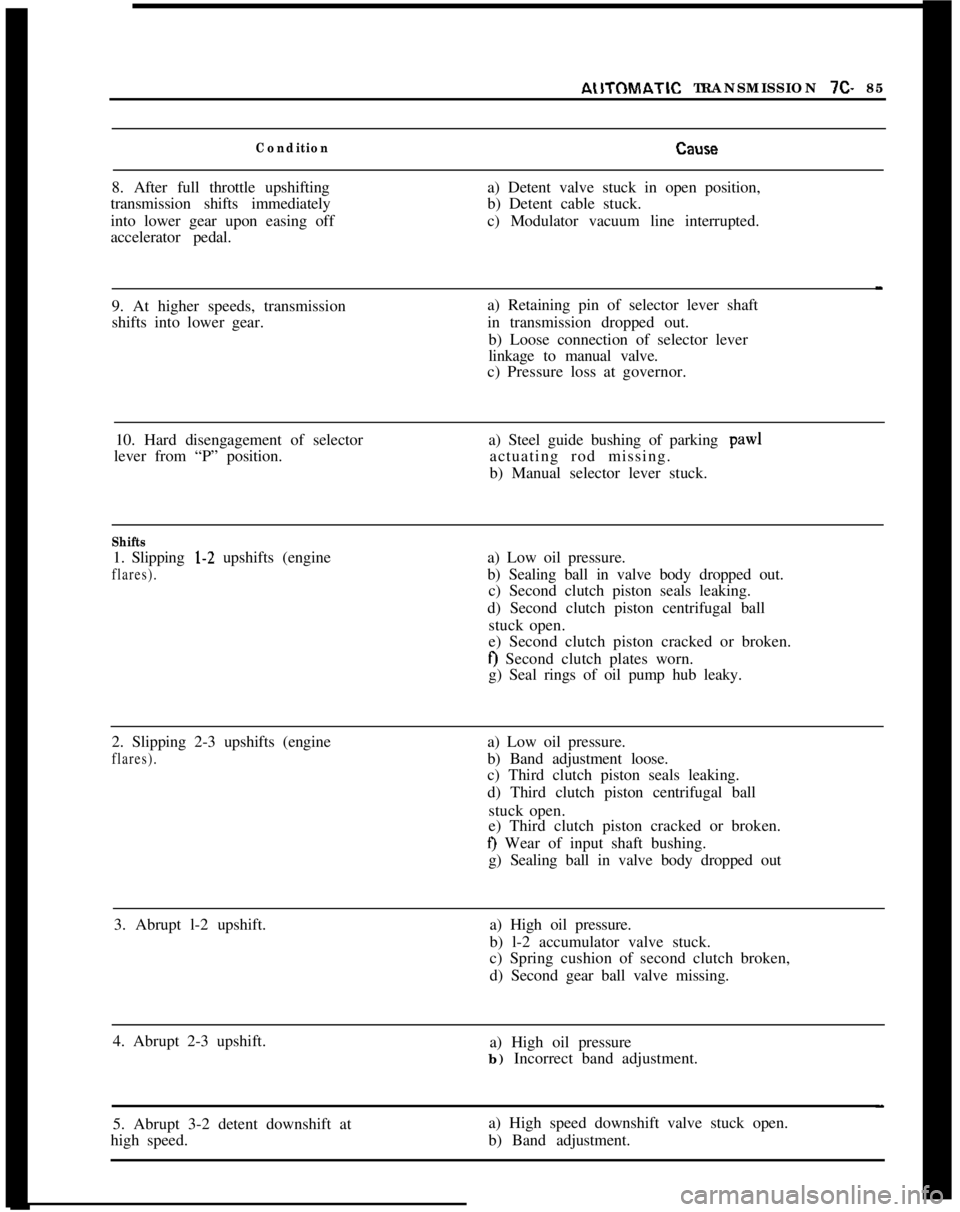
AlITOMATIC TRANSMISSION 7C- 85
ConditionCtSlSl?8. After full throttle upshifting
transmission shifts immediately
into lower gear upon easing off
accelerator pedal.a) Detent valve stuck in open position,
b) Detent cable stuck.
c) Modulator vacuum line interrupted.
9. At higher speeds, transmission
shifts into lower gear.a) Retaining pin of selector lever shaft
in transmission dropped out.
b) Loose connection of selector lever
linkage to manual valve.
c) Pressure loss at governor.
10. Hard disengagement of selector
lever from “P” position.a) Steel guide bushing of parking
paw1actuating rod missing.
b) Manual selector lever stuck.
Shifts1. Slipping l-2 upshifts (engine
flares).a) Low oil pressure.
b) Sealing ball in valve body dropped out.
c) Second clutch piston seals leaking.
d) Second clutch piston centrifugal ball
stuck open.
e) Second clutch piston cracked or broken.
f) Second clutch plates worn.
g) Seal rings of oil pump hub leaky.
2. Slipping 2-3 upshifts (engine
flares).a) Low oil pressure.
b) Band adjustment loose.
c) Third clutch piston seals leaking.
d) Third clutch piston centrifugal ball
stuck open.
e) Third clutch piston cracked or broken.
f) Wear of input shaft bushing.
g) Sealing ball in valve body dropped out
3. Abrupt l-2 upshift.a) High oil pressure.
b) l-2 accumulator valve stuck.
c) Spring cushion of second clutch broken,
d) Second gear ball valve missing.
4. Abrupt 2-3 upshift.
a) High oil pressure
b) Incorrect band adjustment.
5. Abrupt 3-2 detent downshift at
high speed.a) High speed downshift valve stuck open.
b) Band adjustment.
Page 447 of 625
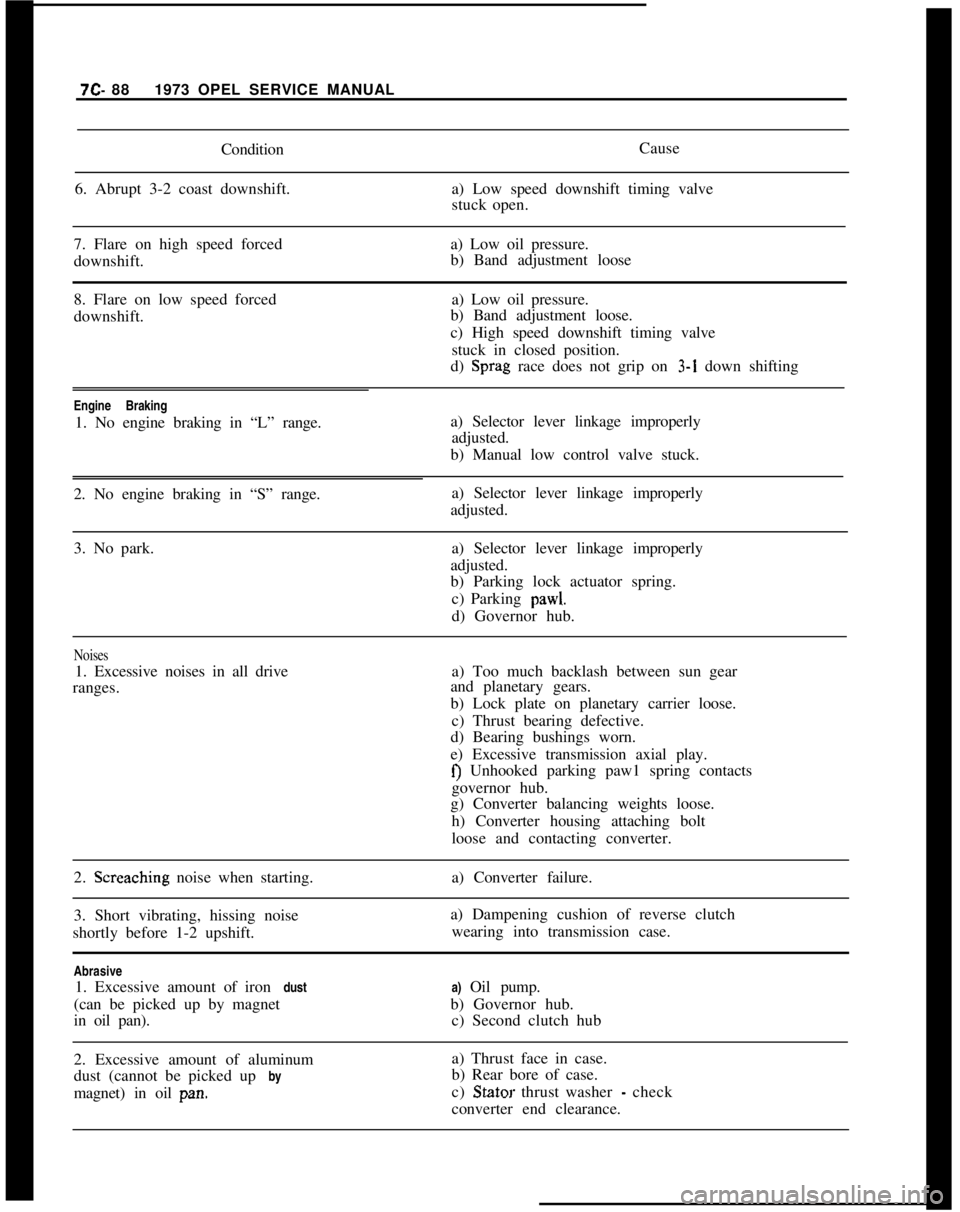
7C- 881973 OPEL SERVICE MANUAL
Condition
6. Abrupt 3-2 coast downshift.Cause
a) Low speed downshift timing valve
stuck open.
7. Flare on high speed forceda) Low oil pressure.
downshift.b) Band adjustment loose
8. Flare on low speed forced
downshift.a) Low oil pressure.
b) Band adjustment loose.
c) High speed downshift timing valve
stuck in closed position.
d) Sprag race does not grip on 3-1 down shifting
Engine Braking
1. No engine braking in “L” range.a) Selector lever linkage improperly
adjusted.
b) Manual low control valve stuck.
2. No engine braking in “S” range.a) Selector lever linkage improperly
adjusted.
3. No park.a) Selector lever linkage improperly
adjusted.
b) Parking lock actuator spring.
c) Parking pawl.
d) Governor hub.
Noises1. Excessive noises in all drive
ranges.a) Too much backlash between sun gear
and planetary gears.
b) Lock plate on planetary carrier loose.
c) Thrust bearing defective.
d) Bearing bushings worn.
e) Excessive transmission axial play.
f) Unhooked parking paw1 spring contacts
governor hub.
g) Converter balancing weights loose.
h) Converter housing attaching bolt
loose and contacting converter.
2. Screaching noise when starting.
3. Short vibrating, hissing noise
shortly before 1-2 upshift.a) Converter failure.
a) Dampening cushion of reverse clutch
wearing into transmission case.
Abrasive
1. Excessive amount of iron dust
(can be picked up by magnet
in oil pan).a) Oil pump.
b) Governor hub.
c) Second clutch hub
2. Excessive amount of aluminum
dust (cannot be picked up by
magnet) in oil pan.a) Thrust face in case.
b) Rear bore of case.
c) Stator thrust washer
- check
converter end clearance.
Page 448 of 625
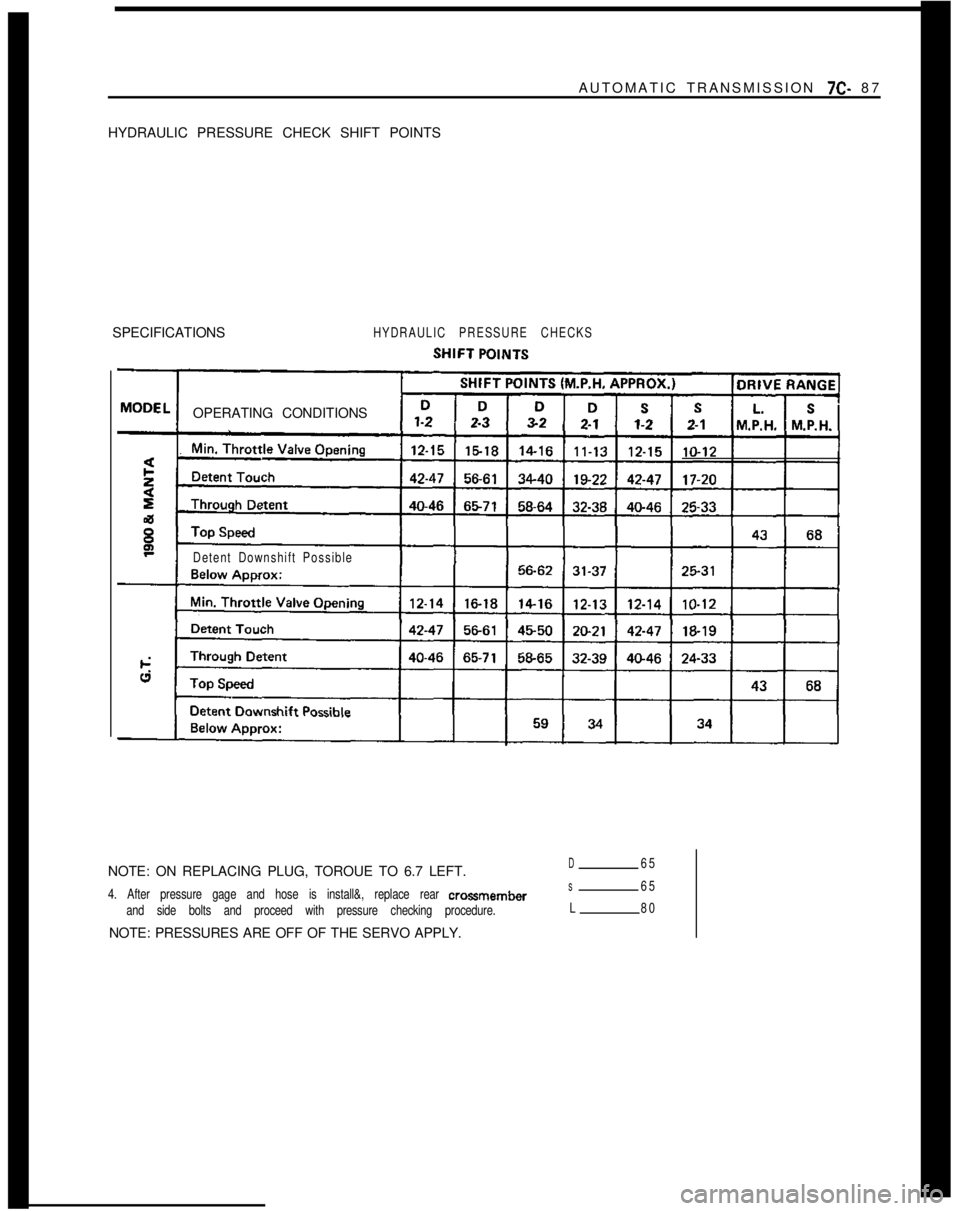
AUTOMATIC TRANSMISSION 7C- 87
HYDRAULIC PRESSURE CHECK SHIFT POINTS
SPECIFICATIONSHYDRAULIC PRESSURE CHECKSNOTE: ON REPLACING PLUG, TOROUE TO 6.7 LEFT.
D65
4. After pressure gage and hose is install&, replace rear
crossmembers65
and side bolts and proceed with pressure checking procedure.L80NOTE: PRESSURES ARE OFF OF THE SERVO APPLY.OPERATING CONDITIONS
Detent Downshift Possible
Page 450 of 625
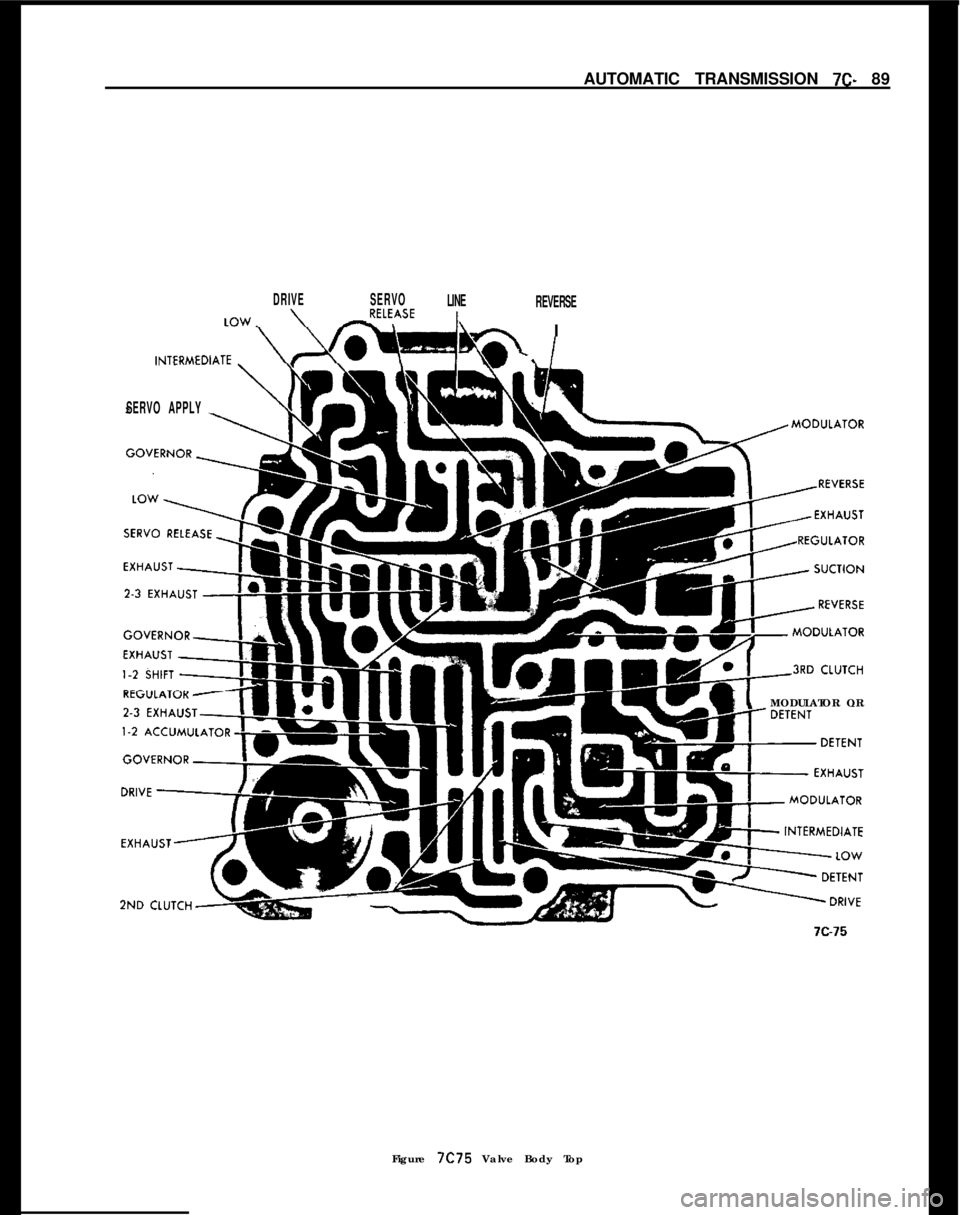
AUTOMATIC TRANSMISSION 7C- 89
DRIVESERVO
LINE
REVERSEI
,NTERMEDlATE\T
SERVO APPLYMODULATOR OR
Figure 7C75 Valve Body Top
Page 452 of 625
AUTOMATIC TRANSMISSION 7C- 91
MAINTENANCE AND ADJUSTMENTS
DETENT CABLE REPLACEMENT AND
ADJUSTMENT
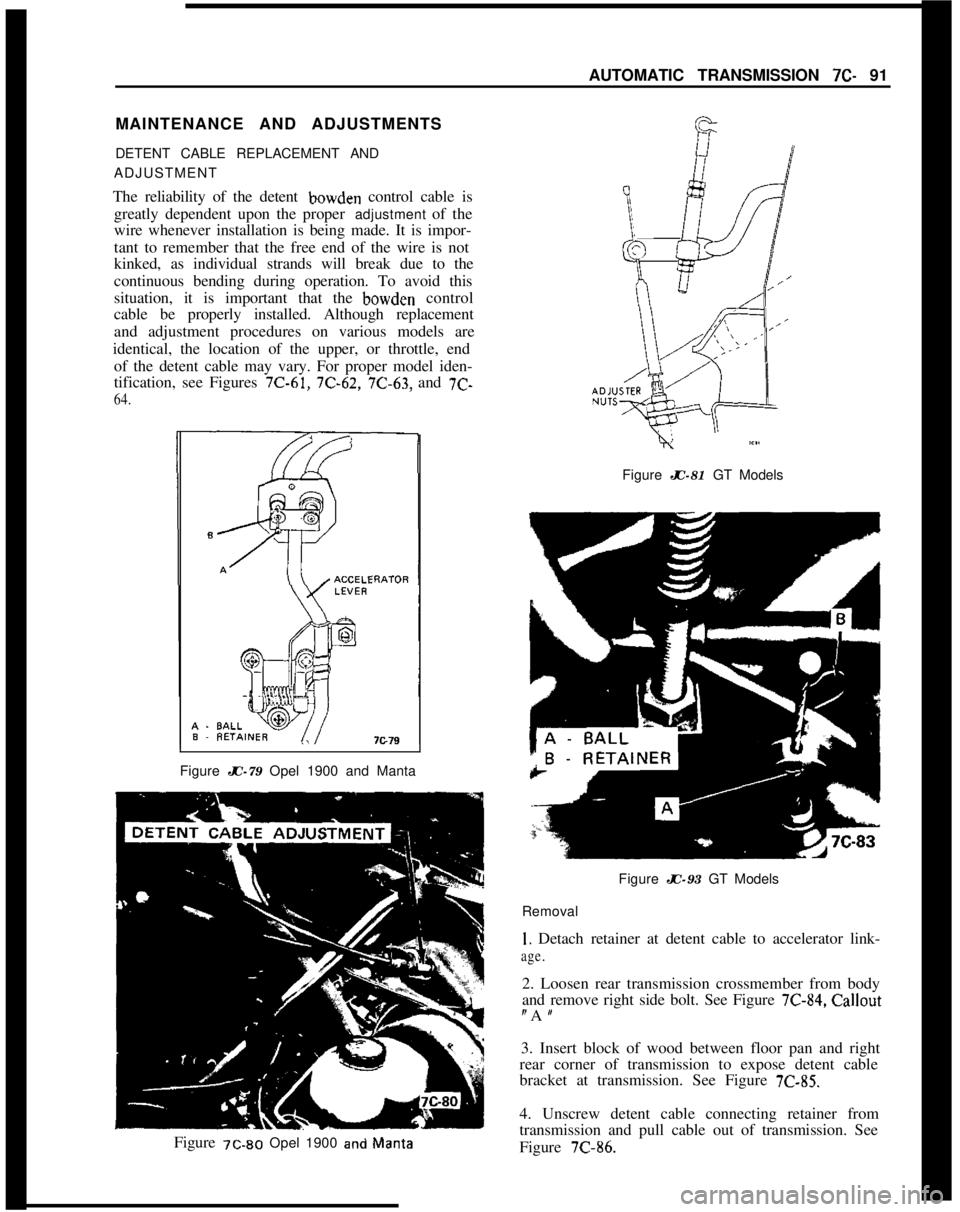
The reliability of the detent bowden control cable is
greatly dependent upon the proper adjustment of the
wire whenever installation is being made. It is impor-
tant to remember that the free end of the wire is not
kinked, as individual strands will break due to the
continuous bending during operation. To avoid this
situation, it is important that the bowden control
cable be properly installed. Although replacement
and adjustment procedures on various models are
identical, the location of the upper, or throttle, end
of the detent cable may vary. For proper model iden-
tification, see Figures
7C-61, 7C-62, 7C-63, and 7C-
64.Figure JC-79 Opel 1900 and Manta
Figure
7~80 Opel 1900 and MantaFigure JC-81 GT Models
Figure JC-93 GT Models
Removal
I. Detach retainer at detent cable to accelerator link-
age.2. Loosen rear transmission crossmember from body
and remove right side bolt. See Figure
7C-84, Callout
” A ”3. Insert block of wood between floor pan and right
rear corner of transmission to expose detent cable
bracket at transmission. See Figure
7C-85.4. Unscrew detent cable connecting retainer from
transmission and pull cable out of transmission. See
Figure
7C-86.
Page 454 of 625
AUTOMATIC TRANSMISSION 7C- 93
(on Manta models, turn adjuster) until ball end of
cable rests firmly against lever.
2. At this point, measure length of exposed detent
inner cable. Depress accelerator pedal fu/fy, and
again measure inner cable. If correctly adjusted, de-
tent cable should move approximately 3/S inch.
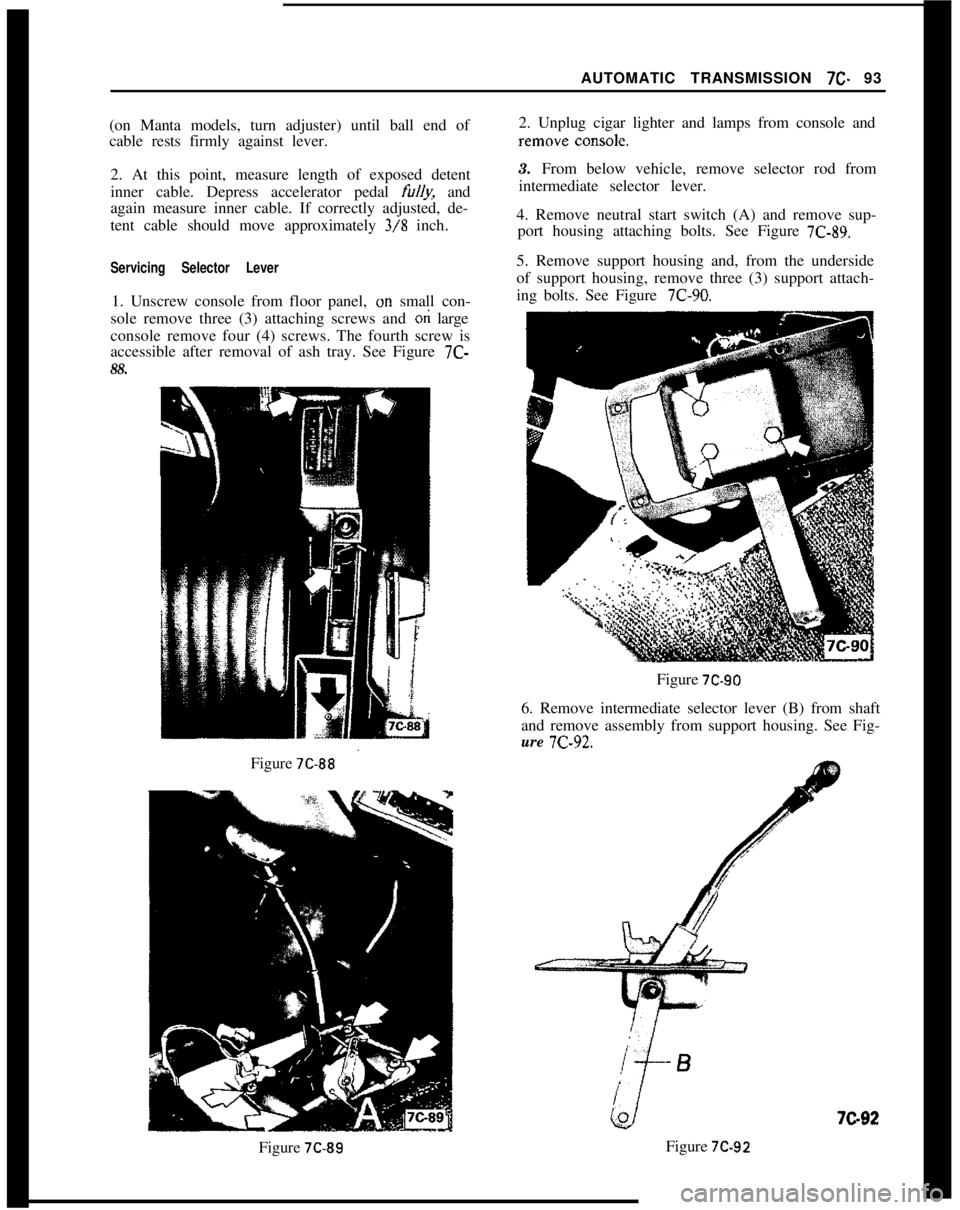
Servicing Selector Lever1. Unscrew console from floor panel, on small con-
sole remove three (3) attaching screws and
on large
console remove four (4) screws. The fourth screw is
accessible after removal of ash tray. See Figure 7C-
88.Figure
7C-88Figure
7C-892. Unplug cigar lighter and lamps from console and
remO”e co”sole.
3. From below vehicle, remove selector rod from
intermediate selector lever.
4. Remove neutral start switch (A) and remove sup-
port housing attaching bolts. See Figure
7C-89.5. Remove support housing and, from the underside
of support housing, remove three (3) support attach-
ing bolts. See Figure
7C-90.Figure
7C-906. Remove intermediate selector lever (B) from shaft
and remove assembly from support housing. See Fig-
ure 7C-92.7GB2
Figure
7C.92
Page 455 of 625
7C. 941973 OPEL SERVICE MANUAL
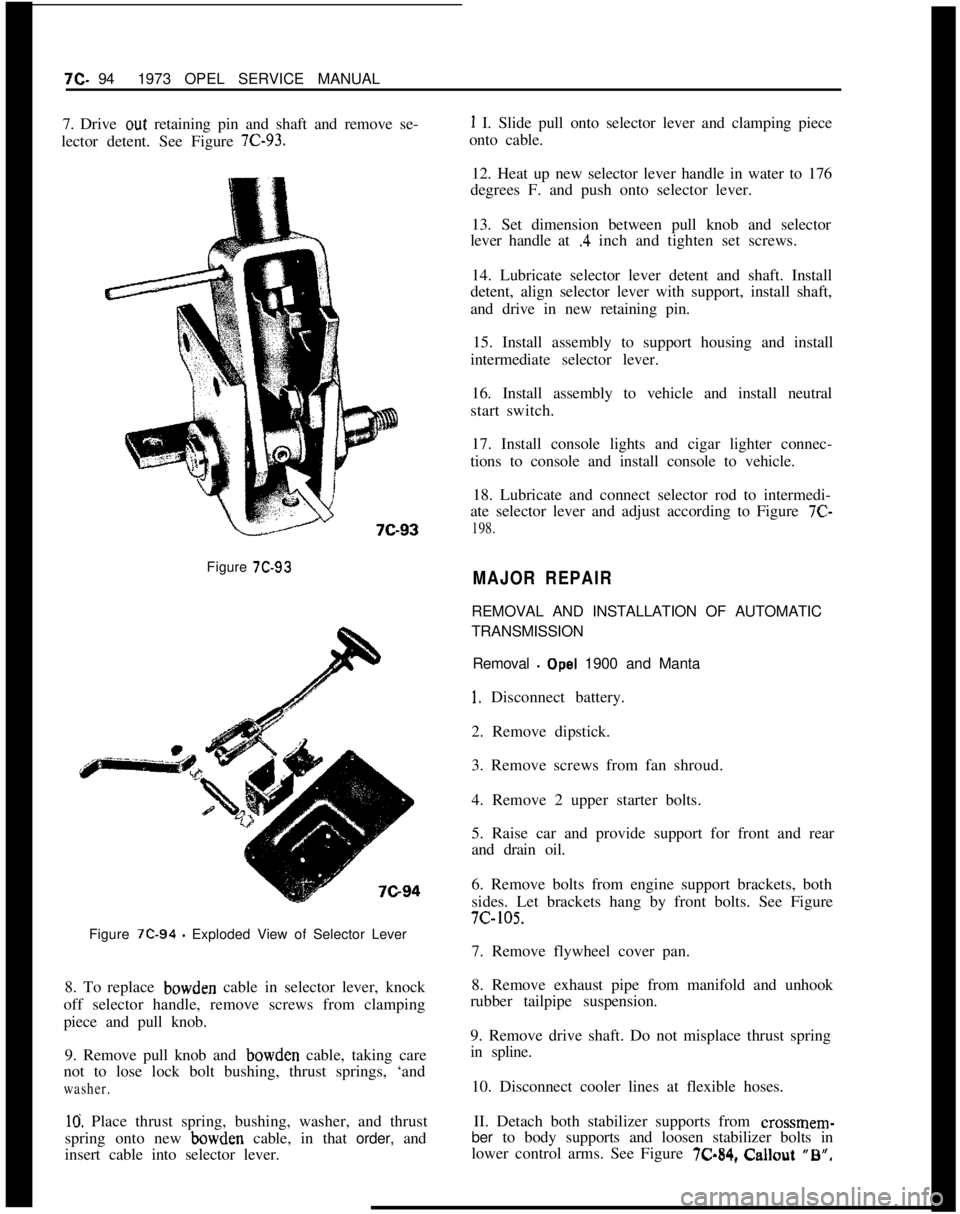
7. Drive out retaining pin and shaft and remove se-
lector detent. See Figure 7C-93.Figure
7C-93Figure
7C-94 - Exploded View of Selector Lever
8. To replace bowden cable in selector lever, knock
off selector handle, remove screws from clamping
piece and pull knob.
9. Remove pull knob and bowden cable, taking care
not to lose lock bolt bushing, thrust springs, ‘and
washer.
10. Place thrust spring, bushing, washer, and thrust
spring onto new bowden cable, in that order, and
insert cable into selector lever.
1 I. Slide pull onto selector lever and clamping piece
onto cable.
12. Heat up new selector lever handle in water to 176
degrees F. and push onto selector lever.
13. Set dimension between pull knob and selector
lever handle at
.4 inch and tighten set screws.
14. Lubricate selector lever detent and shaft. Install
detent, align selector lever with support, install shaft,
and drive in new retaining pin.
15. Install assembly to support housing and install
intermediate selector lever.
16. Install assembly to vehicle and install neutral
start switch.
17. Install console lights and cigar lighter connec-
tions to console and install console to vehicle.
18. Lubricate and connect selector rod to intermedi-
ate selector lever and adjust according to Figure 7C-
198.
MAJOR REPAIRREMOVAL AND INSTALLATION OF AUTOMATIC
TRANSMISSION
Removal
- Opel 1900 and Manta
I. Disconnect battery.
2. Remove dipstick.
3. Remove screws from fan shroud.
4. Remove 2 upper starter bolts.
5. Raise car and provide support for front and rear
and drain oil.
6. Remove bolts from engine support brackets, both
sides. Let brackets hang by front bolts. See Figure7c-105.
7. Remove flywheel cover pan.
8. Remove exhaust pipe from manifold and unhook
rubber tailpipe suspension.
9. Remove drive shaft. Do not misplace thrust spring
in spline.
10. Disconnect cooler lines at flexible hoses.
II. Detach both stabilizer supports from
crossmem-ber to body supports and loosen stabilizer bolts in
lower control arms. See Figure X-84, Callout “B”,
Page 456 of 625
AUTOMATIC TRANSMISSION 7C- 95
12. Place suitable jack under transmission and
remove transmission support bolts.
13. Lower transmission enough to remove detent
cable and modulator vacuum line.
14. Remove speedometer cable.
15. Remove selector lever.
16. Mark flywheel and converter for reassembly in
same position, and remove converter to flywheel
bolts. See Figure 7C-106.17. Remove converter housing to engine bolts and
tiller tube.
18. Pry transmission loose from engine.
19. Keep rear of transmission lower than front to
prevent converter from falling and install converter
holding fixture J-21366. Lower transmission and
move to bench.
Installation. Opel 1900 and Manta1. Assemble transmission to suitable jack and raise
transmission into position. Rotate converter to per-
mit coupling of fly wheel and converter with original
relationship. Remove J-21366.
2. Install tiller tube and converter housing to engine
block bolts. Torque to 35 lb. ft. DO NOT over
torque.
3. Install flywheel to converter bolts. Torque to 30 lb.
ft.4. Install detent cable to transmission.
5. Connect oil cooler lines.
6. Install lower bolt on starter. Torque to 40 lb. ft.
7. Connect shift linkage to transmission.
8. Connect modulator line.
9. Connect speedometer cable.
10. Install transmission support.
11. Install drive shaft. Torque U-Bolts to 18 lb. ft.
12. Install flywheel cover pan. Torque to 15 lb. ft.
13. Install engine support brackets.
14. Reconnect exhaust system.15. Attach stabilizer supports and tighten stabilizer
bolts in lower control arms.
16. Lower car.
17. Install starter bolts. Torque to 40 lb. ft.
18. Reconnect battery.
19. Fill transmission with fluid as described in
Specifications. Check selector lever and detent cable
adjustment.
Removal GT1. Disconnect battery.
2. Remove dipstick.
3. Pull throttle control rod off ball pin.
4. Remove screws from fan shroud.
5. Raise car and provide support for front and rear.
6. Remove heat protection shield from right side to
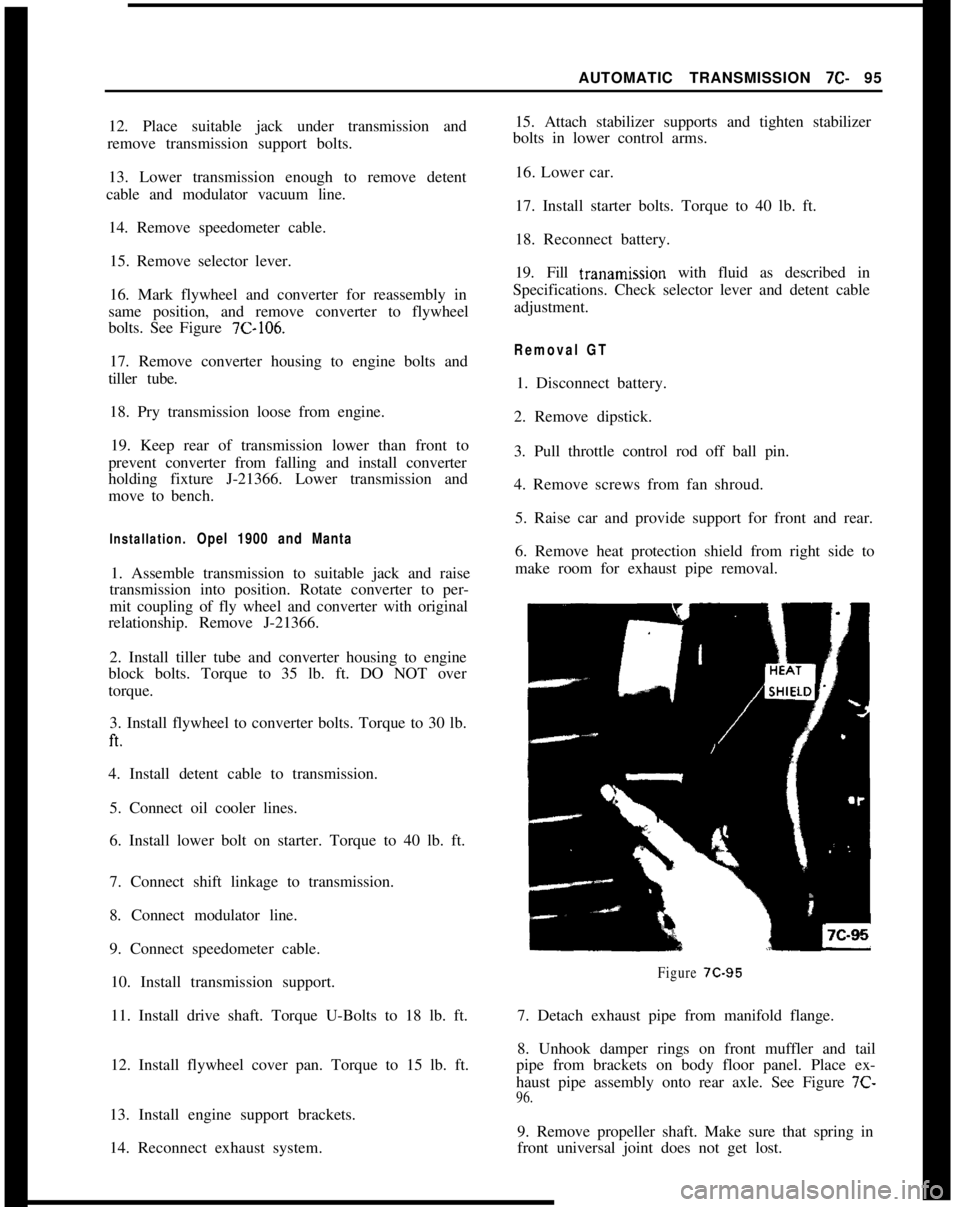
make room for exhaust pipe removal.
Figure 7C-957. Detach exhaust pipe from manifold flange.
8. Unhook damper rings on front muffler and tail
pipe from brackets on body floor panel. Place ex-
haust pipe assembly onto rear axle. See Figure 7C-
96.9. Remove propeller shaft. Make sure that spring in
front universal joint does not get lost.