height OPEL 1900 1973 User Guide
[x] Cancel search | Manufacturer: OPEL, Model Year: 1973, Model line: 1900, Model: OPEL 1900 1973Pages: 625, PDF Size: 17.22 MB
Page 291 of 625
5C- 321973 OPEL SERVICE MANUAL
Never use copper tubing because copper is subject to
fatigue cracking which would result in brake failure.2. Cut tubing to length. The correct length may be
determined by measuring the old pipe using a cord
and adding l/8” for each double lap flare.
To make up a brake pipe assembly, proceed as fol-
lows:3. Double lap flare tubing ends, using a suitable flar-
ing tool such as J-8051. Follow the instructions in-
cluded in the tool set. Make sure fittings are installed
1. Procure the recommended tubing and fittings of
the correct size. (Outside diameter of tubing is used
to specify size.)before starting second flare.
4. Bend pipe assembly to match old pipe.
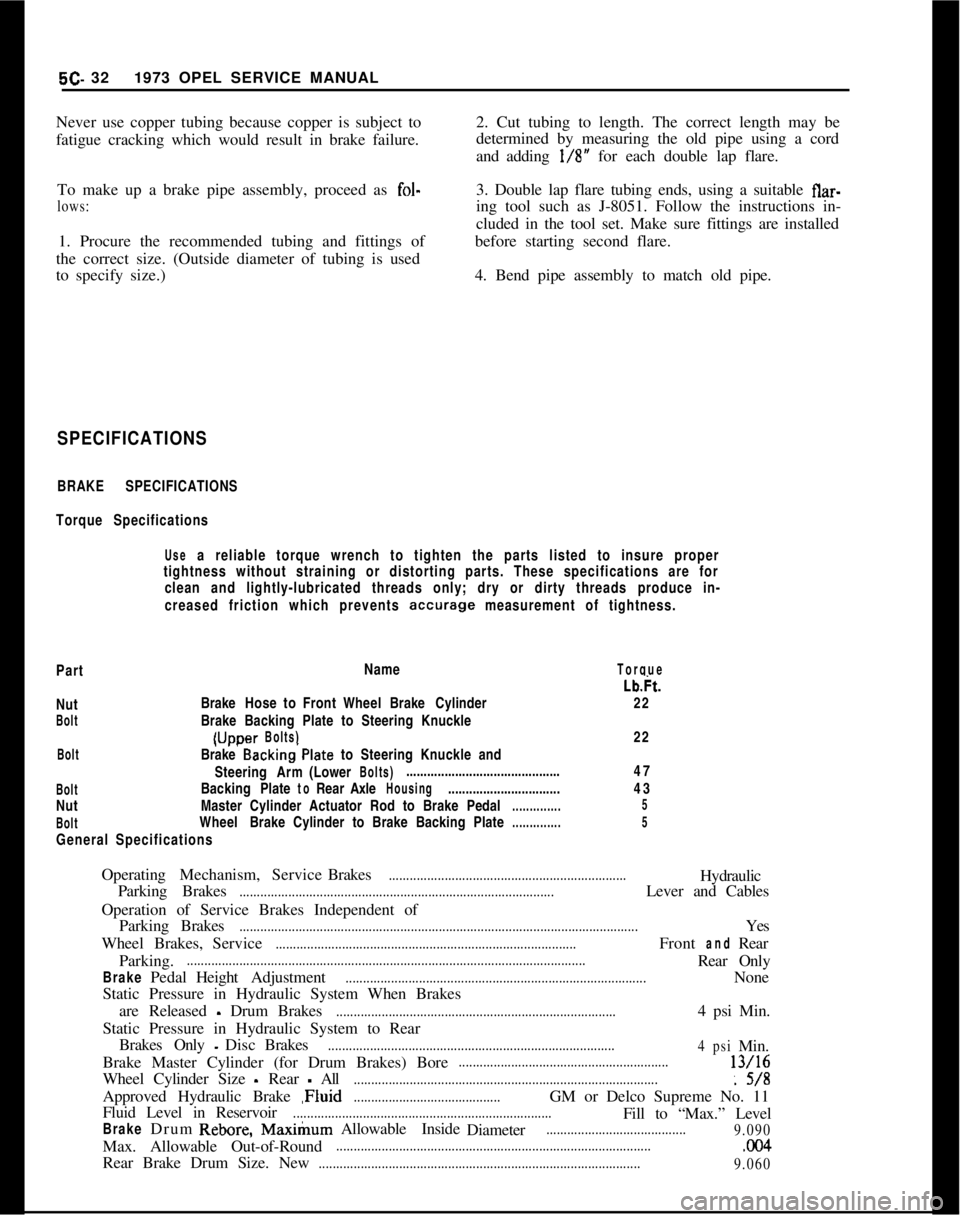
SPECIFICATIONS
BRAKE SPECIFICATIONS
Torque Specifications
Use a reliable torque wrench to tighten the parts listed to insure proper
tightness without straining or distorting parts. These specifications are for
clean and lightly-lubricated threads only; dry or dirty threads produce in-
creased friction which prevents
accurage measurement of tightness.
PartName
TorqueNut
BoltBrakeHose to Front WheelBrake Cylinder
Brake Backing Plate to Steering Knuckle(Uccer
Bolts)Lb&.
22
22...BoltBrake Backing’Plate to Steering Knuckle and
SteeringArm(Lower
Bolts)............................................
BoltBackingPlatetoRearAxleHousing................................
NutMaster Cylinder Actuator Rod to BrakePedal
..............
BoltWheelBrake Cylinder to Brake Backing Plate
..............
General Specifications47
43
5
5OperatingMechanism,ServiceBrakes
....................................................................Hydraulic
Parking Brakes
..........................................................................................Lever and Cables
Operation of Service Brakes Independent of
ParkingBrakes
..................................................................................................................Yes
WheelBrakes,Service
......................................................................................FrontandRear
Parking.
..................................................................................................................Rear Only
BrakePedalHeightAdjustment......................................................................................None
Static Pressure in Hydraulic System When Brakes
are Released
- Drum Brakes................................................................................4 psi Min.
Static Pressure in Hydraulic System to Rear
BrakesOnly
-DiscBrakes..................................................................................
4psiMin.
Brake Master Cylinder (for Drum Brakes) Bore
............................................................13/16
Wheel Cylinder Size
- Rear - All.......................................................................................: 5/8
Approved Hydraulic Brake ,Fluid
..........................................GM or Delco Supreme No. 11
Fluid Level in Reservoir
..........................................................................Fill to “Max.” Level
BrakeDrumRebore,Max&urnAllowable Inside
Diameter........................................
9.090Max. Allowable Out-of-Round
...........................................................................................CKl4Rear Brake Drum Size. New
............................................................................................
9.060
Page 358 of 625
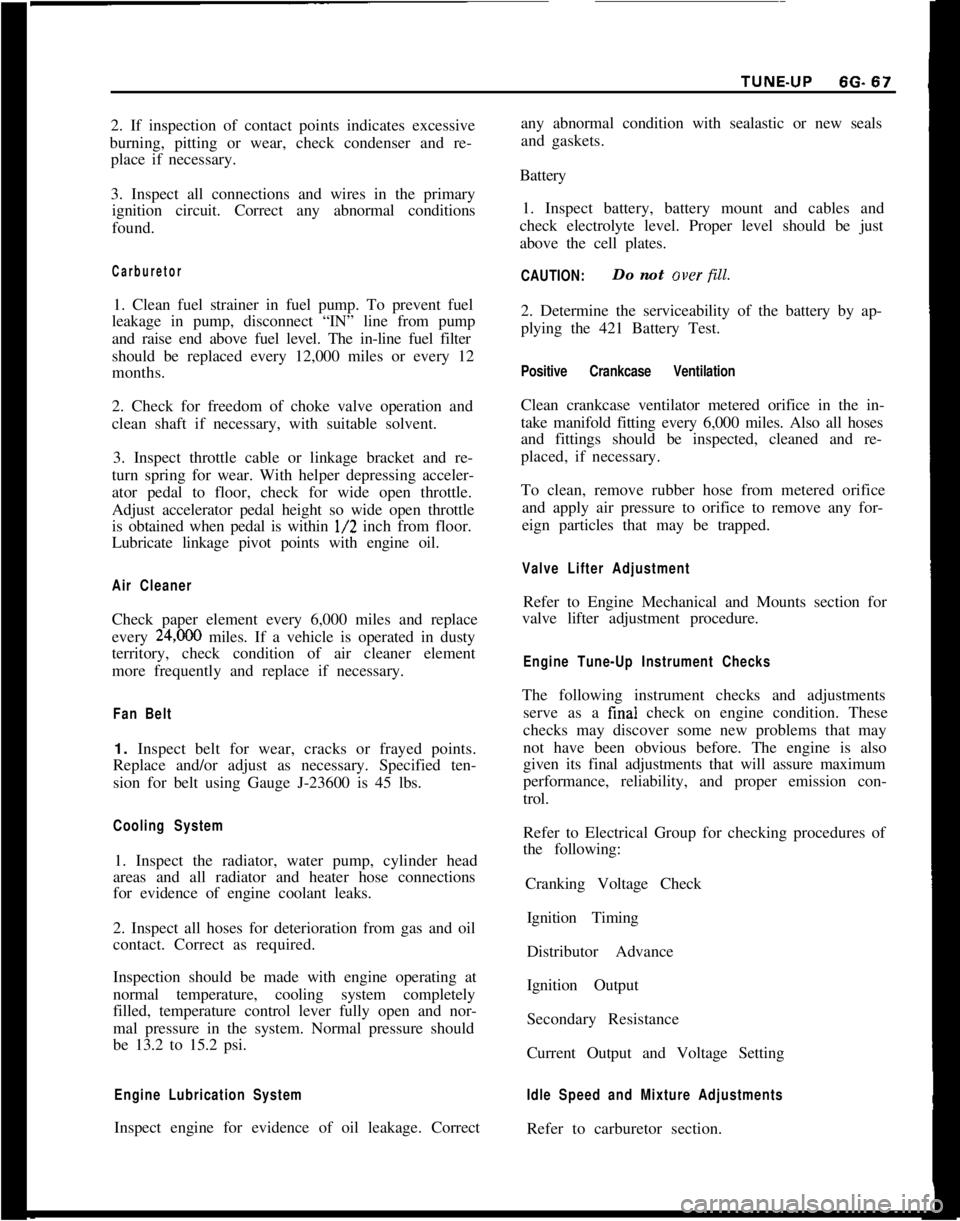
2. If inspection of contact points indicates excessive
burning, pitting or wear, check condenser and re-
place if necessary.
3. Inspect all connections and wires in the primary
ignition circuit. Correct any abnormal conditions
found.Carburetor1. Clean fuel strainer in fuel pump. To prevent fuel
leakage in pump, disconnect “IN” line from pump
and raise end above fuel level. The in-line fuel filter
should be replaced every 12,000 miles or every 12
months.
2. Check for freedom of choke valve operation and
clean shaft if necessary, with suitable solvent.
3. Inspect throttle cable or linkage bracket and re-
turn spring for wear. With helper depressing acceler-
ator pedal to floor, check for wide open throttle.
Adjust accelerator pedal height so wide open throttle
is obtained when pedal is within
l/2 inch from floor.
Lubricate linkage pivot points with engine oil.
Air CleanerCheck paper element every 6,000 miles and replace
every
24,ooO miles. If a vehicle is operated in dusty
territory, check condition of air cleaner element
more frequently and replace if necessary.
Fan Belt1. Inspect belt for wear, cracks or frayed points.
Replace and/or adjust as necessary. Specified ten-
sion for belt using Gauge J-23600 is 45 lbs.
Cooling System1. Inspect the radiator, water pump, cylinder head
areas and all radiator and heater hose connections
for evidence of engine coolant leaks.
2. Inspect all hoses for deterioration from gas and oil
contact. Correct as required.
Inspection should be made with engine operating at
normal temperature, cooling system completely
filled, temperature control lever fully open and nor-
mal pressure in the system. Normal pressure should
be 13.2 to 15.2 psi.
Engine Lubrication SystemInspect engine for evidence of oil leakage. Correctany abnormal condition with sealastic or new seals
and gaskets.
Battery
1. Inspect battery, battery mount and cables and
check electrolyte level. Proper level should be just
above the cell plates.
CAUTION:Do not over fill.
2. Determine the serviceability of the battery by ap-
plying the 421 Battery Test.
Positive Crankcase VentilationClean crankcase ventilator metered orifice in the in-
take manifold fitting every 6,000 miles. Also all hoses
and fittings should be inspected, cleaned and re-
placed, if necessary.
To clean, remove rubber hose from metered orifice
and apply air pressure to orifice to remove any for-
eign particles that may be trapped.
Valve Lifter AdjustmentRefer to Engine Mechanical and Mounts section for
valve lifter adjustment procedure.
Engine Tune-Up Instrument ChecksThe following instrument checks and adjustments
serve as a final check on engine condition. These
checks may discover some new problems that may
not have been obvious before. The engine is also
given its final adjustments that will assure maximum
performance, reliability, and proper emission con-
trol.
Refer to Electrical Group for checking procedures of
the following:
Cranking Voltage Check
Ignition Timing
Distributor Advance
Ignition Output
Secondary Resistance
Current Output and Voltage Setting
Idle Speed and Mixture AdjustmentsRefer to carburetor section.
Page 485 of 625
7C.1241973 OPEL SERVICE MANUAL
14. Remove the downshift timing valve plug retain-
ing pin and remove downshift timing valve plug.
Remove the low speed downshift timing valve and
spring.
15. Remove the manual low and r&erse control
valve retaining pin. Remove the spring and the
manual low control valve and the reverse control
valve.
16. Remove the l-2 accumulator valve retaining pin
and remove the l-2 accumulator valve plug, l-2 ac-
cumulator valve and spring.
17. A clean work area which is free of dirt and dust
should be used to inspect, clean and install the valves
in the valve body. Handle valve components with
clean hands and tools. Since most valve failures are
caused initially by dirt or other foreign matter pre-
venting a valve from functioning properly, a
thorough cleaning of all the components with a
cleaning solvent is essential. Do not use paraffin toclean out the valve body passages and valve bore.
Compressed air may be used to blow out the pas-
sages.18. Inspect each valve for free movement in its re-
spective bore in
t.he valve body. If necessary, use
crocus cloth to remove small burrs on a valve. Do
not remove the sharp edges of the valves as these
edges perform a cleaning action within the bore.
19. Inspect the valve springs for distortion or col-
lapsed coils. Replace the entire valve body assembly
if any parts are damaged.
20. Inspect the transfer plate for dents or distortion.
Replace transfer plate if necessary.
21. Reassemble the valves, springs, plugs and retain-
ing pins in their proper location and order into the
valve body using a liberal amount of transmission
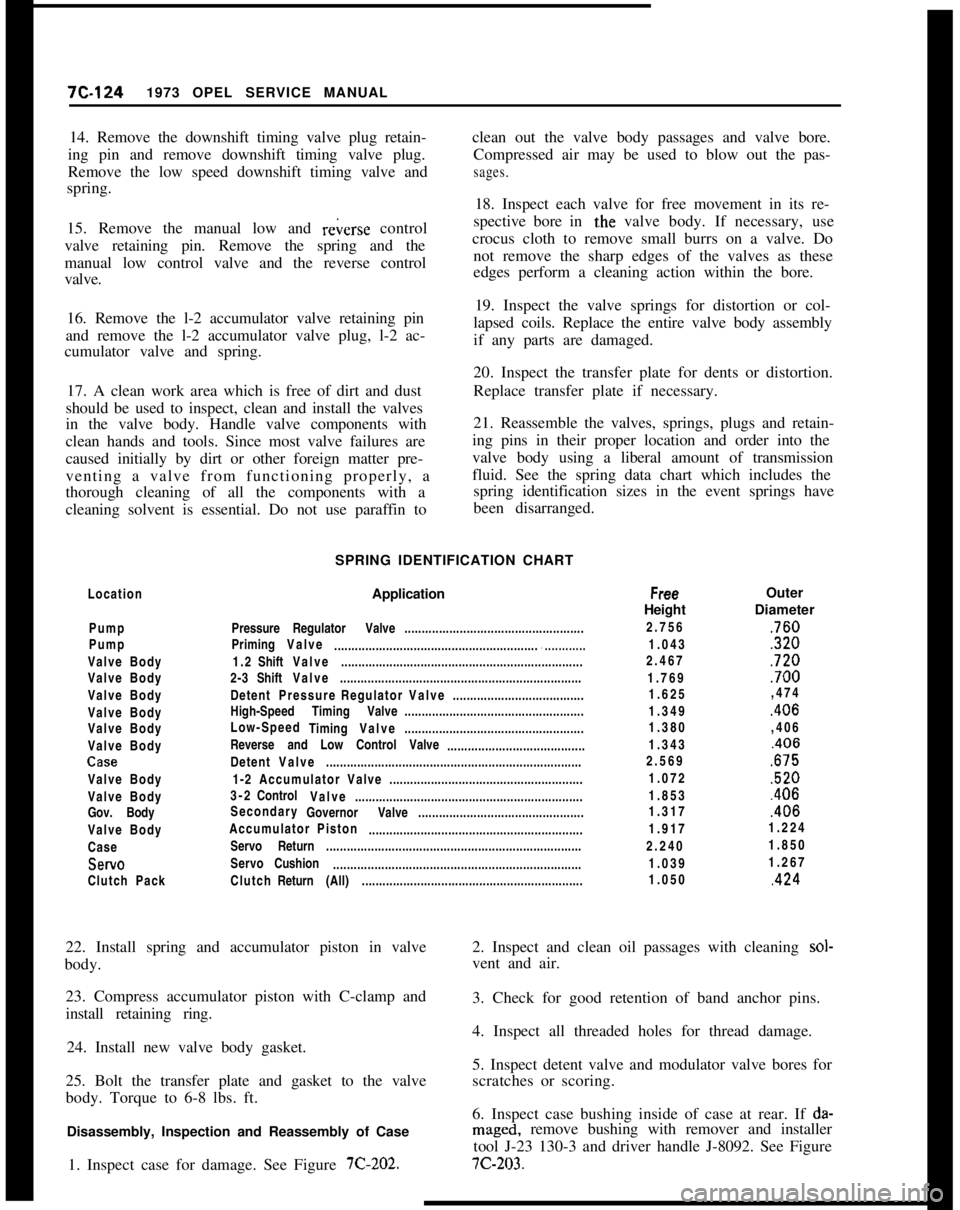
fluid. See the spring data chart which includes the
spring identification sizes in the event springs have
been disarranged.
LocationApplication
PumpPressureRegulator Valve....................................................
PumpPrimingValve
...........................................................
.............Valve Body1.2ShiftValve......................................................................
Valve Body2-3ShiftValve......................................................................
Valve BodyDetentPressureRegulatorValve......................................
Valve BodyHigh-Speed Timing Valve....................................................
Valve BodyLow-Speed
TimingValve....................................................
Valve BodyReverse and Low Control Valve
........................................
CSSDetentValve..........................................................................
Valve Body1-2 Accumulator Valve........................................................
Valve Body3-2Control
Valve..................................................................
Gov. BodySecondary
Governor Valve................................................
Valve BodyAccumulator Piston
..............................................................
CaseServo Return..........................................................................SHVOServoCushion
........................................................................
Clutch PackClutchReturn(All)................................................................ SPRING IDENTIFICATION CHART
FreeOuter
HeightDiameter
2.756
,7601.043
,3202.467
,7201.769
,7001.625,474
1.349
,4061.380,406
1.343
,4062.569
,6751.072
,5201.853
.4061.317
,4061.9171.224
2.2401.850
1.0391.267
1.050
,42422. Install spring and accumulator piston in valve
body.
23. Compress accumulator piston with C-clamp and
install retaining ring.
24. Install new valve body gasket.2. Inspect and clean oil passages with cleaning sol-
vent and air.
3. Check for good retention of band anchor pins.
25. Bolt the transfer plate and gasket to the valve
body. Torque to 6-8 lbs. ft.
Disassembly, Inspection and Reassembly of Case
1. Inspect case for damage. See Figure
7C-202.4. Inspect all threaded holes for thread damage.
5. Inspect detent valve and modulator valve bores for
scratches or scoring.
6. Inspect case bushing inside of case at rear. If
da-maged, remove bushing with remover and installer
tool J-23 130-3 and driver handle J-8092. See Figure
7C-203.
Page 507 of 625
8A-61973 OPEL SERVICE MANUAL
9. On installation make sure that the gaps between
headlamp housing in closed position and headlamp
opening is equal all round and housing is flush in its
height with the body.
REMOVAL AND INSTALLATION OF HEADLAMP
CABLE ASSEMBLY
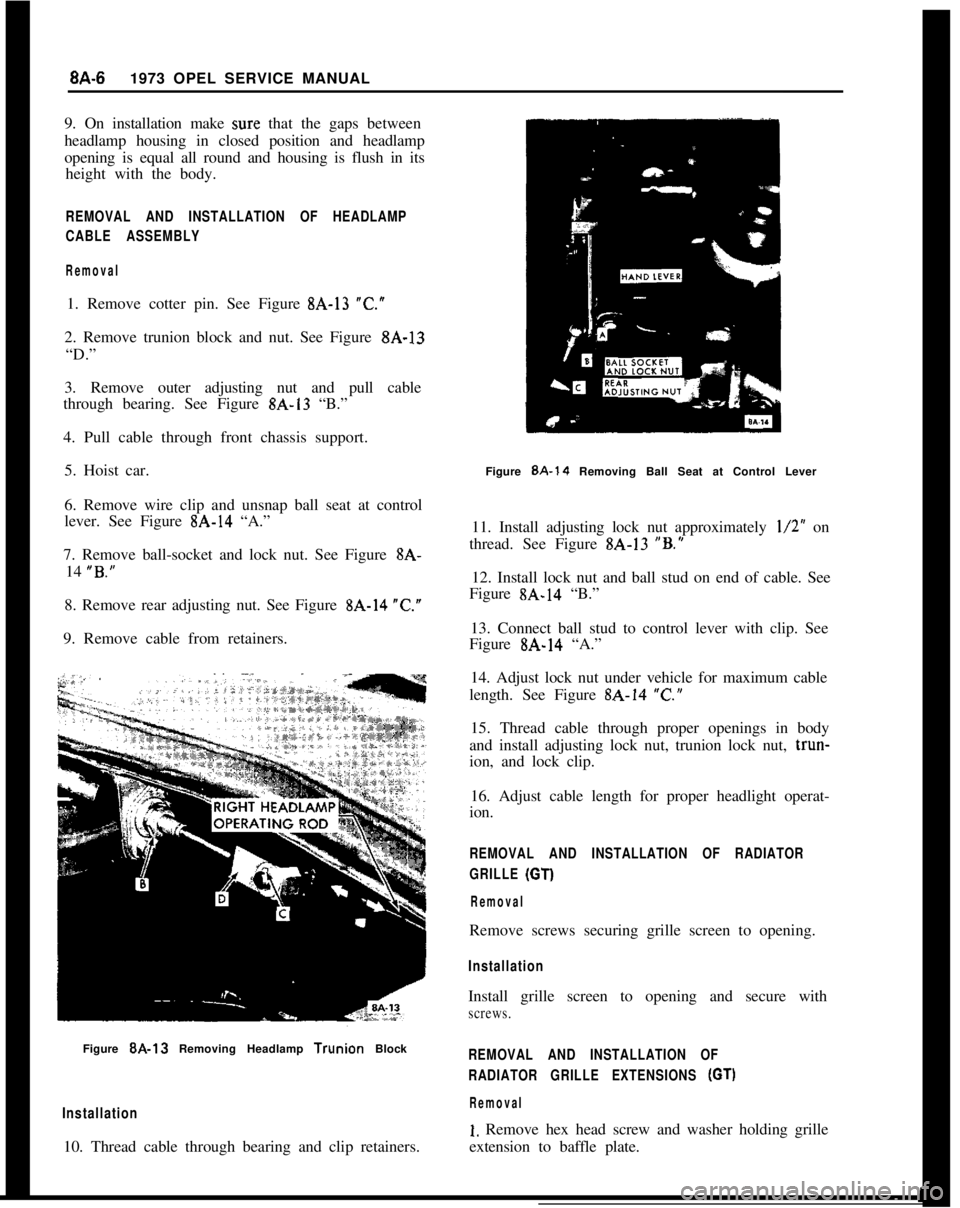
Removal1. Remove cotter pin. See Figure
EA-13 “CL”2. Remove trunion block and nut. See Figure SA-13
“D.”
3. Remove outer adjusting nut and pull cable
through bearing. See Figure 8A-13 “B.”
4. Pull cable through front chassis support.
5. Hoist car.
6. Remove wire clip and unsnap ball seat at control
lever. See Figure 8A-14 “A.”
7. Remove ball-socket and lock nut. See Figure SA-
14
“B.”8. Remove rear adjusting nut. See Figure 8A-14
“CL”9. Remove cable from retainers.
Figure SA-13 Removing Headlamp Trunion Block
Installation10. Thread cable through bearing and clip retainers.Figure 8A-14 Removing Ball Seat at Control Lever
11. Install adjusting lock nut approximately
l/2” on
thread. See Figure 8A-13 “B.’
12. Install lock nut and ball stud on end of cable. See
Figure 8A-14 “B.”
13. Connect ball stud to control lever with clip. See
Figure 8A-14 “A.”
14. Adjust lock nut under vehicle for maximum cable
length. See Figure 8A-14
“CL”15. Thread cable through proper openings in body
and install adjusting lock nut, trunion lock nut, trun-
ion, and lock clip.
16. Adjust cable length for proper headlight operat-
ion.
REMOVAL AND INSTALLATION OF RADIATOR
GRILLE
(GT)
RemovalRemove screws securing grille screen to opening.
InstallationInstall grille screen to opening and secure with
screws.
REMOVAL AND INSTALLATION OF
RADIATOR GRILLE EXTENSIONS
(GTI
Removal
1. Remove hex head screw and washer holding grille
extension to baffle plate.
Page 533 of 625
9B-24 1973 OPEL SERVICE MANUAL
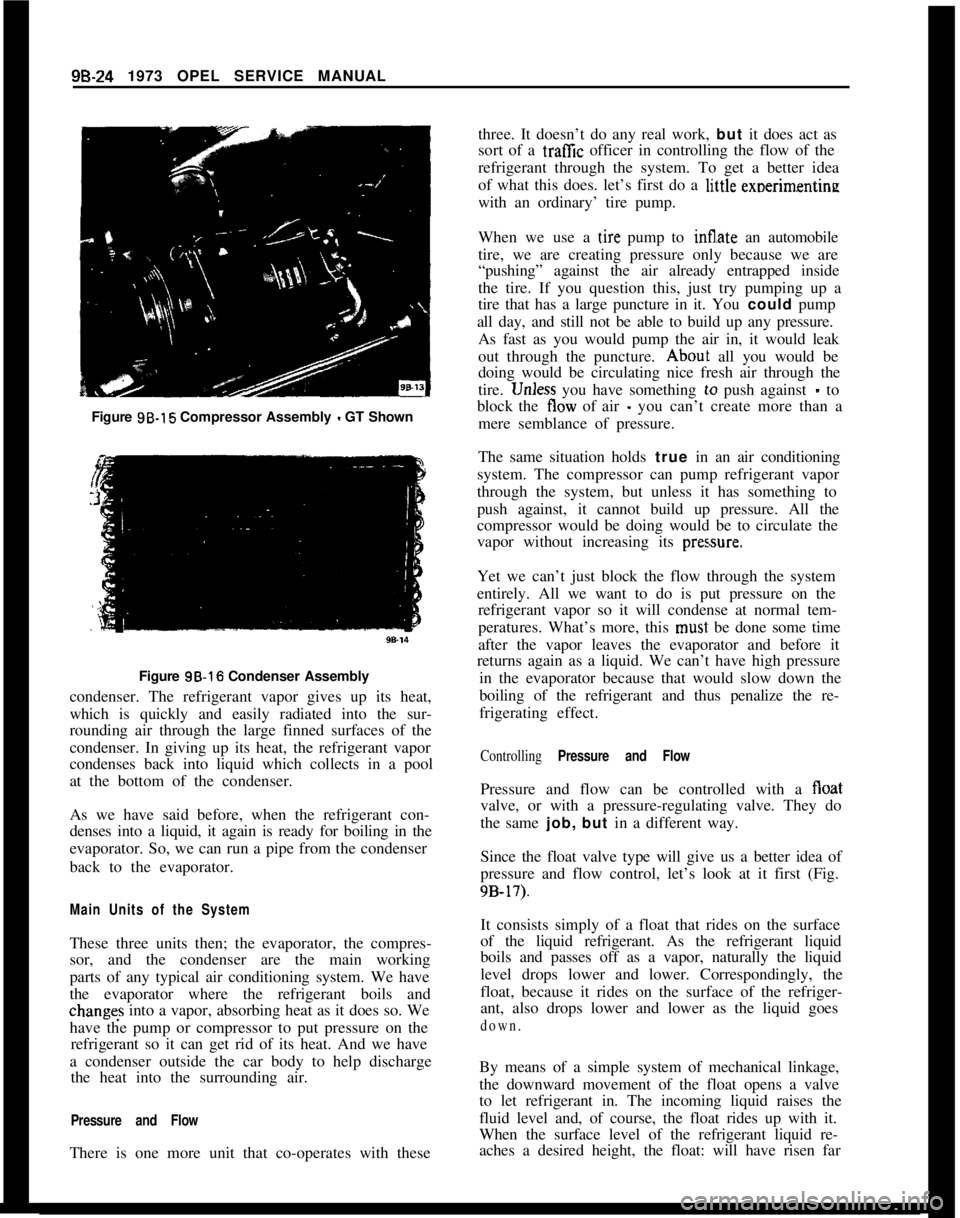
Figure 9B-15 Compressor Assembly - GT Shown
Figure 3B-16 Condenser Assembly
condenser. The refrigerant vapor gives up its heat,
which is quickly and easily radiated into the sur-
rounding air through the large finned surfaces of the
condenser. In giving up its heat, the refrigerant vapor
condenses back into liquid which collects in a pool
at the bottom of the condenser.
As we have said before, when the refrigerant con-
denses into a liquid, it again is ready for boiling in the
evaporator. So, we can run a pipe from the condenser
back to the evaporator.
Main Units of the SystemThese three units then; the evaporator, the compres-
sor, and the condenser are the main working
parts of any typical air conditioning system. We have
the evaporator where the refrigerant boils andchanges into a vapor, absorbing heat as it does so. We
have the pump or compressor to put pressure on the
refrigerant so it can get rid of its heat. And we have
a condenser outside the car body to help discharge
the heat into the surrounding air.
Pressure and FlowThere is one more unit that co-operates with thesethree. It doesn’t do any real work, but it does act as
sort of a traffic officer in controlling the flow of the
refrigerant through the system. To get a better idea
of what this does. let’s first do a li,ttle exoerimentine
with an ordinary’ tire pump.
When we use a
t,ire pump to Sate an automobile
tire, we are creating pressure only because we are
“pushing” against the air already entrapped inside
the tire. If you question this, just try pumping up a
tire that has a large puncture in it. You could pump
all day, and still not be able to build up any pressure.
As fast as you would pump the air in, it would leak
out through the puncture.
Abou~t all you would be
doing would be circulating nice fresh air through the
tire.
1Jnless you have something lo push against - to
block the tlow of air
- you can’t create more than a
mere semblance of pressure.
The same situation holds true in an air conditioning
system. The compressor can pump refrigerant vapor
through the system, but unless it has something to
push against, it cannot build up pressure. All the
compressor would be doing would be to circulate the
vapor without increasing its
pres,sure.Yet we can’t just block the flow through the system
entirely. All we want to do is put pressure on the
refrigerant vapor so it will condense at normal tem-
peratures. What’s more, this
musi: be done some time
after the vapor leaves the evaporator and before it
returns again as a liquid. We can’t have high pressure
in the evaporator because that would slow down the
boiling of the refrigerant and thus penalize the re-
frigerating effect.
Controlling Pressure and FlowPressure and flow can be controlled with a float
valve, or with a pressure-regulating valve. They do
the same job, but in a different way.
Since the float valve type will give us a better idea of
pressure and flow control, let’s look at it first (Fig.
9B-17).It consists simply of a float that rides on the surface
of the liquid refrigerant. As the refrigerant liquid
boils and passes off as a vapor, naturally the liquid
level drops lower and lower. Correspondingly, the
float, because it rides on the surface of the refriger-
ant, also drops lower and lower as the liquid goes
down.By means of a simple system of mechanical linkage,
the downward movement of the float opens a valve
to let refrigerant in. The incoming liquid raises the
fluid level and, of course, the float rides up with it.
When the surface level of the refrigerant liquid re-
aches a desired height, the float: will have risen far
Page 548 of 625
REFRIGERANT COMPONENTS ALL MODELS96-39
In all instances where the indications of refrigerant
shortage continues, additional refrigerant should be
added in
l/4 lb. increments until the sight glass is
clear.
An additional charge of l/4 lb. should be ad-
ded as a reserve. In no case should the system be
overcharged.
LEAK TESTING SYSTEM
The following two methods are recommended when attempting to locate refrigerant leaks in the system.
Loss of
regrigerant is always indicative of a leak since
refrigerant is not consumed and does not wear out.
1. Open Flame Method
- This method utilizes a gas
operated torch type leak detector (J-6084). Use of
this method is recommended when checking for
leaks in confined areas. To perform test, light torch
and adjust to obtain a pale blue flame, approximately
3/8 inch in height, in burner.
Explore for leaks by moving end of search tube
around suspected area. Check bottom of connections
since Refrigerant-12 is heavier than air and will be more apparent at underside of fittings. The flame
color will turn yellow-green when a small leak is
detected. Large leaks will turn the flame blue or
purple.
WARNING:
Do not breathe fumes resdting from
burning of
refrigerant gas. These fumes az ex-
tremeiy poisonous.
2. Liquid Leak Detectors - This method utilizes a
solution which will bubble (soap solution) to signify
a gas leak. Use of this method of checking is recom-
mended for locating small leaks.
FUNCTIONAL TESTING SYSTEM
Functional testing is a measurement of the air condi-
tioner system performance to determine if discharge
air temperature, pressure in suction line, and pres-
sure in discharge line are within specific limitations.
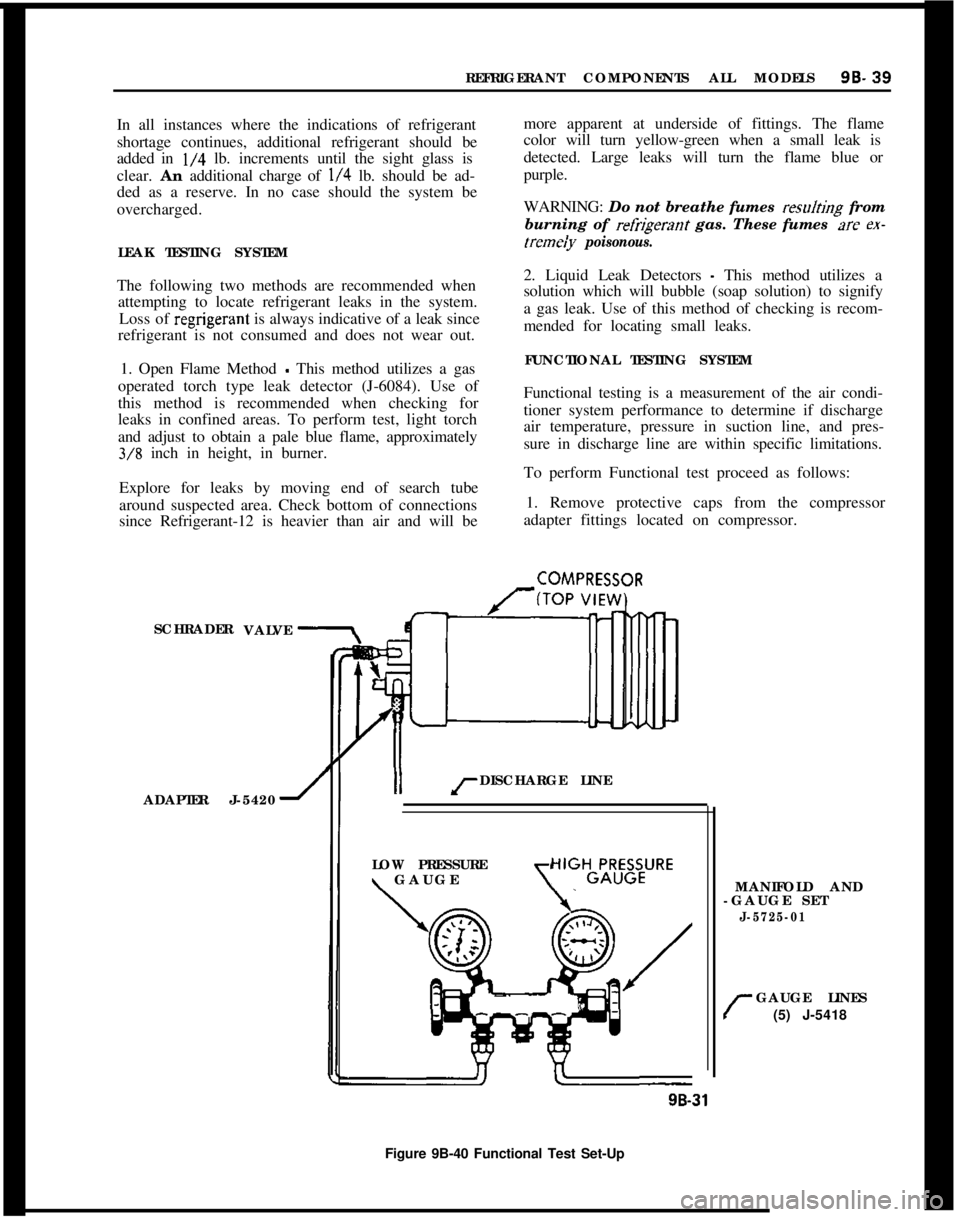
To perform Functional test proceed as follows:
1. Remove protective caps from the compressor
adapter fittings located on compressor.
SCHRADER
ADAPTER J-5420
1II rDISCHARGE LINE
COMPRESSOR
VALVE
LOW PRESSURE
\ GAUGE\
HIGHGLR;B;URE
MANIFOLD AND
-GAUGE SET
J-5725-01
r
GAUGE LINES
(5) J-5418
9B-31
Figure 9B-40 Functional Test Set-Up
Page 613 of 625

RADIO. GT9c- 105
RADIO
GTCONTENTS
Subject
DESCRIPTION AND OPERATION: (Not Applicable)
DIAGNOSIS:
RadioTroubleDiagnosis. . . . . . . . . . . . . . . . . . . . . . . . . . . . . . . . . . . . . . . . . . . . . . . . . .MAINTENANCE AND ADJUSTMENTS:
Antenna Trimmer Adjustment
. . . . . . . . . . . . . . . . . . . . . . . . . . . . . . . . . . .MAJOR REPAIR:
RemovingandInstallingRadio. . . . . . . . . . . . . . . . . . . . . . . . . . . . . . . . . . . . . .SPECIFICATIONS: (Not Applicable)
Page No.
9c-105
9C-106
9c-107
DIAGNOSIS
RADIO TROUBLE DIAGNOSISBecause radio problems are most often repaired at
United Delco authorized warranty repair stations,
the tendency for many dealer servicemen is to
remove the set when a problem is reported, without
any preliminary diagnosis. This results in a large
number of radios showing up as “NO TROUBLE
FOUND” units when received by the warranty re-
pair stations. This indicates that the trouble can
often be corrected without removal of the radio.
The inconvenience to an owner of driving without a
radio while his set is being serviced at a warranty
station can frequently be avoided if the following
quick checks are used to eliminate external radio
system :problems before removing the radio for re-
pair.
Always determine from the owner the exact nature
of the radio problem as an aid to diagnosis. Knowing
whether the condition is intermittent or constant,
whether it occurs with engine off or running, with
car stationary or moving, will help to pinpoint the
problem. Never turn on radio with speaker discon-
nected.
Radio Ii
Inoperative.1. Turn on the radio. The dial should light and a
thump should be heard from the speaker.a. If a thump is heard, go to Step No. 2 for antenna
check.b. If no thump is heard,
check the fuse.
(1) If fuse is bad, replace and try radio again. Race
engine and, if fuse blows again,‘remove the radio and
speaker assembly for repair by
4 trained radio techni-
cian.
(2) If fuse is good, check to
s&e that the speaker-to-
receiver interconnecting cable is connected securely.
If there is still no thump when the radio is turned on,
remove the receiver and speaker for repair.
2. Check the antenna by substituting with one held
out the car window.
a. If radio is still dead with substitute antenna,
remove the receiver and spea!er for repair.
b. If radio operates near normal with substitute an-
tenna, some part of the car antenna or lead-in is at
fault.
Radio Reception Is Weak1. Check to see if antenna trimmer is peaked.
a. Position antenna at a height of 31 inches.
b. Tune radio to weak station at or near 1400 KHz
on the dial, and turn volume control to maximum.
Page 614 of 625

9C-106 1973 OPEL SERVICE MANUAL
c. Adjust trimmer screw for maximum volume.
d. If antenna trimmer does not have a definite peak, check for defective antenna by substitution.
2. Check that the speaker connection is plugged in
SXUdY.
3. If the radio is still weak, remove the receiver and
speaker assembly for repair.
Radio Is Noisy
1. Radio is noisy all the time:
a. Check for defective antenna by striking antenna
with hand. If static is heard while tapping, replace
antenna.
b. If antenna is not defective, remove receiver and
speaker for repair.
2. Radio is noisy only when jarred:
a. Check antenna as in Step No. 1 above.
b. Check speaker connection. If speaker connection is not at fault, remove receiver and speaker for re-
pair.
3. Radio is noisy when engine is running:
a. Check noise suppressor by substituting on genera-
tor with known good one.
b. Check to see that antenna is mounted securely,
grounding the antenna base to the fender. The an-
tenna lead-in wire is shielded and the shield should
have good ground connection at the receiver and the
antenna base.
c. Check for other car wiring, passing too close to
radio receiver case.
d. If engine noise is still present, remove receiver and
speaker for repair.
4. Radio is noisy when car equipment is operated,
such as directional lights or brake lights:
Check for defective antenna lead-in wire or, loose
antenna mounting, as in Step No. 3b above.
MAINTENANCE AND ADJUSTMENTS
ANTENNA TRIMMER ADJUSTMENT
An antenna trimmer adjusment screw is provided for
matching of the antenna coil in the receiver to the car antenna. This adjustment must always be made after
installation of a receiver or an antenna, or after re-
pair to these units. This adjustment should also be
performed whenever radio reception is unsatisfac-
tory.
1. Position antenna to a height of 31 inches.
2. Tune receiver
tb a weak station at or near 1400
KHz that can barely be heard
with volume turned
fully up.
3. Insert a small-bladed screwdriver in antenna trim-
Figure 9C-1 Location of Access Trim Plug
Figure
9C-2 Removing Hex Head Screw
Page 617 of 625

RADIO - OPEL 1900 - MANTA9c- 109
RADIO
OPEL 1900
- MANTA
CONTENTS
Subject
DESCRIPTION AND OPERATION: (Not Applicable)
DIAGNOSIS:
RadioTroubleDiagnosis. . . . . . . . . . . . . . . . . . . . . . . . . . . . . . . . . . . . . . . . . . . . . . . . . .MAINTENANCE AND ADJUSTMENTS:
Antenna Trimmer Adjustment
. . . . . . . . . . . . . . . . . . . . . . . . . . . . . . . . . . .MAJOR REPAIR:
Removal&InstallationRadio. . . . . . . . . . . . . . . . . . . . . . . . . . . . . . . . . . . . . . . .
Removal81InstallationAntenna. . . . . . . . . . . . . . . . . . . . . . . . . . . . . . . . . .SPECIFICATIONS:Page No.
9c-109
9c-110
9c-111
9c-111
DIAGNOSIS
RADIO TROUBLE DIAGNOSISBecause radio problems are most often repaired at
United Delco authorized warranty repair stations,
the tendency for many dealer servicemen is to
remove the set when a problem is reported, without
any preliminary diagnosis. This results in a large
number of radios showing up as “NO TROUBLE
FOUND” units when received by the warranty re-
pair stations. This indicates that the trouble can
often time be corrected without removal of the radio.
The inconvenience to an owner of driving without a
radio while his set is being serviced at a warranty
station can frequently be avoided if the following
quick checks are used to eliminate external radio
system Problems before removing the radio for re-
pair.
Always determine from the owner the exact nature
of the radio problem as an aid to diagnosis. Knowing
whether! the condition is intermittent or constant,whether::it occurs with engine off or running, with
car stationary or moving, will help to pinpoint theproblem: Never turn on radio with speaker discon-
nected.
Radio Is Inoperative
1. Turn on the radio. The dial should light and a
thump should be heard from the speaker.a. If a thump is heard, go to
Step No. 2 for antenna
check.b. If no thump is heard, check the fuse.
(1) If fuse is bad, replace and try radio again. Race
engine and, if fuse blows again, remove the radio and
speaker assembly for repair by a trained radio techni-
cian.
(2) If fuse is good, check to see that the speaker to
receiver interconnecting cable is connected securely.
If there is still no thump when the radio is turned on,
remove the receiver and speak+ for repair.
2. Check the antenna by substituting with one held
out the car window.
a. If radio is still dead with’substitute antenna,
remove the receiver and speaker for repair.
b. If radio operates near normal with substitute an-
tenna, some part of the car antenna or lead-in is at
fault.
Radio Reception Is Weak1. Check to see if antenna
tri$mer is peaked.
a. Position antenna at a height,of 31 inches.
b. Tune radio to weak station at or near 1400 KHz
on the dial, and turn volume control to maximum.
Page 618 of 625

9C-110 197j 6PEi SERVICE MANUAL
c. Adjust trimmei screw for maximum volume,
d. If antenna trir&ner does not have a definite peak,
check for defective ant&ma by substitution.
2. Check that the speaker connection is plugged in
securely.3. If the radio is still weak, remove the receiver and
speaker assembly for repair.
Radio Is Noisy1. Radio is noisy all the time:
a. Check for defective antenna by striking antenna
with hand. If static is heard while tapping, replace
antenna.
b. If antenna is not defective, remove receiver and
speaker for ripair.
2. Radio is noisy only when jarred:
a. Check antenna as in Step No. 1 above.
b. Check speaker connection. If speaker connection
is not at fault, remove receiver and speaker for re-
pair.
3. Radio is noisy when engine is running:
a. Check noise suppressor by substituting on genera-
tor with known good one.
b. Check to see that antenna is mounted securely,
grounding the antenna base to the fender. The an-
tenna lead-in wire is shielded and the shield should
have good ground corinection at the receiver and the
antenna base.
c. Check for other car wiring passing too close to
radio receiver case.
d. If engine noise is still present, remove receiver and
speaker for repair.
4. Radio is noisy when car equipment is operated,
such as directional lights or brake lights:
Check for defective antenna lead-in wire or loose
antenna mounting, as in Step No. 3b above.
5. Radio is noisy only on dry days when car is mov-
ing:
Wheel and tire static will occur only during dry
weather. To check to see if noise is wheel static or tire
static, drive car until noise is noticed. Touch the
brake. If noise disappears, it is wheel static. If noise
persists, it is tire static. Static may be eliminated in
two ways:a. Wheel static may be eliminated by installation of
static collectors in the front wheels. It is important
to make sure the button on the end of the spiral
collector rides evenly in the spindle. Grease and dirt
can cause poor contact between static collector and
the cap, which would result in wheel static, even with
the collectors installed.
b. Tire static is eliminated by injecting graphite tire
static powder in all
five (5) tires. Either a special gun
or a plastic squeeze bottle can be used to insert pow-
der.MAINTENANCE AND ADJUSTMENTS
ANTENNA TRIMMER ADJUSTMENTAn antenna trimmer adjustment screw is provided
for matching of the antenna coil in the receiver to the
car antenna. This adjustment must always be made
after installation of a receiver or an antenna, or after
repair to these units. This adjustment should also be
performed whenever radio reception is unsatisfac-
tory.1. Position antenna to a height of 31 inches.
2. Tune receiver to a weak station at or near 1400
KHz that can barely be heard with volume turned
fully up.
3. Insert a small-bladed screwdriver in antenna trim-
mer screw and rotate screw until maximum volume
is achieved.
Figure 9C-15 Radio Control Knobs